Textile Documents › Topic: Flax and linen
550 documents found
Sort: 
[Flax Cultivation]
Article · 1 page
A short passage on the state of flax cultivation in the United States around 1906. It reports that flax growing had nearly ceased in the Eastern States, and gives national figures for farms, acreage and yield. It also breaks down acreage by region, with the North Central States, especially Minnesota and the Dakotas, dominating production.
Flax Swingling in Canada
Illustration · 1 page
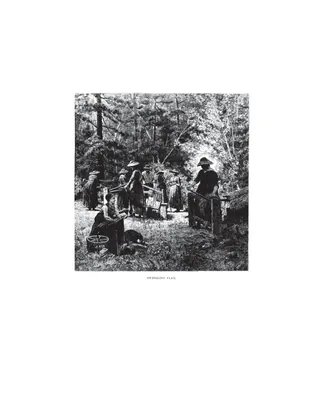
A single-page wood engraving from Harper's New Monthly showing flax swingling in Canada. Several workers, mostly women in long skirts and wide-brimmed hats, stand and kneel at wooden swingling benches in a forest clearing, beating flax to separate the fibre. The only printed text is the caption "Swingling Flax."
Roofing Linen
Article · 1 page
A short note in The Manufacturer and Builder, citing the Deutsche Bauzeitung, on a new roofing material called "roofing linen." It consists of a layer of coarse linen between two layers of thin roll paper, bonded with an asphalt composition called "roofing paint." The note gives application advice and approximate costs, and says the material's value cannot yet be judged without years of use.
Experiment in Flax Raising
Article · 10 pages
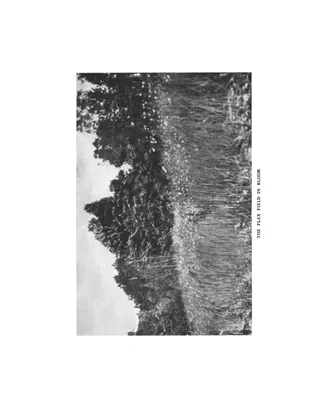
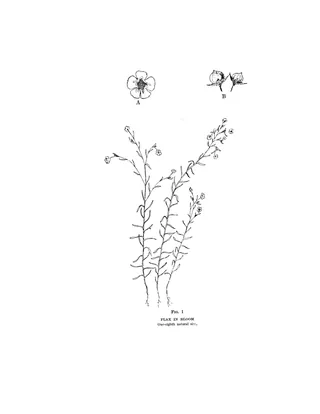
First-person account by Mabel H. Kerrison of growing flax on a small plot in northern New Hampshire and preparing the fiber by hand, written after postwar flax shortages. It covers sowing, pulling, rippling, dew-retting (with comparison to retting in Belgium, Russia and Ireland), breaking, scutching or swingling, and hackling, and notes the use of tow. Illustrated with a flax field, a botanical drawing and photographs of the ripple, hand-brake, swingling block and knife, and hackle. It ends with a plea for community flax growing, spinning and weaving, and mentions a towel she wove from her own flax.
Flax
Chambers's Encyclopedia, 1881
Article · 2 pages
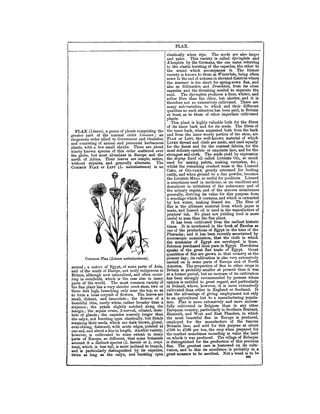
An encyclopedia article on flax (genus Linum) from Chambers's Encyclopedia, covering the botany of the common flax plant (Linum usitatissimum) and its varieties. It describes the uses of the fibre for linen and lace and of the seed for linseed oil and cake. It also covers the history of cultivation from ancient Egypt, the main growing regions (Belgium, the Baltic, Britain, Ireland, India), sowing and pulling practices, and purging flax (Linum catharticum). A botanical illustration of the plant is included.
Flax Culture and Preparation
Book · 187 pages
A technical textbook on growing flax and preparing it for market, from the Pitman's Textile Industries Series. It follows the crop from the plant, fibre and seed through soil, manures, sowing, weeding, pulling and harvesting, then deseeding, retting (pond, dew, tank and warm-water methods) and scutching by hand and machine, and ends with marketing of flax. It is illustrated with line drawings of machines, graphs and photographs, and includes an index. The focus is Irish and Belgian practice.
Flax Culture in Russia
Science, 1891
Article · 2 pages
A short 1891 article in Science summarizing a U.S. consul's report from Odessa on flax growing in European Russia. It covers the northern fibre region and southern seed region, acreage by government, yields, seed sowing and harvest practice, soil needs, and the poor quality of Russian fibre compared with Irish and western European flax. It closes by urging American farmers, especially in the Northwest, to grow flax for fibre and set up linen, twine and textile industries.
Genetics of Flax
Article · 1 page
A one-page review from the Botanical Gazette's Current Literature section summarizing Tine Tammes's genetic study of flower characters in six varieties of common flax (Linum usitatissimum). It explains how complementary factors B and C produce blue flowers, with factor A intensifying the color, and how these factors affect anther color, seed color, petal shape, vein pigmentation, and seed number and viability. It is plant genetics rather than textile technique, relevant to flax as a fiber crop.
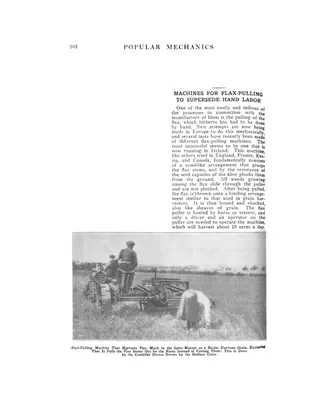
Machines for Flax-Pulling to Supersede Hand Labor
Popular Mechanics, 1923
Article · 1 page
A short Popular Mechanics article describing new European attempts to pull flax mechanically instead of by hand. It explains how a comblike device grips the flax stems and plucks them from the ground, with weeds sliding through, and how the flax is then bound and shocked like grain. The machine, hauled by horse or tractor with a driver and an operator, is said to harvest about 10 acres a day. A photograph shows the machine working in a field.
Microbiology of Flax Retting
Article · 12 pages
A 1922 scientific article from the Botanical Gazette on the bacteriology of flax retting, the process that frees bast fibers from the flax stalk. It describes flax cultivation, dew and water retting, and scutching. It then reviews earlier work on retting organisms (van Tieghem, Winogradsky, Haumann, Beijerinck, Rossi and others). It also reports the author's experiments with pure cultures and vat liquors from a Michigan rettery, concluding that an anaerobic spore-former, identified as Clostridium amylobacter, is the specific retting agent.
Treatise on Flax Culture
Monograph · 38 pages
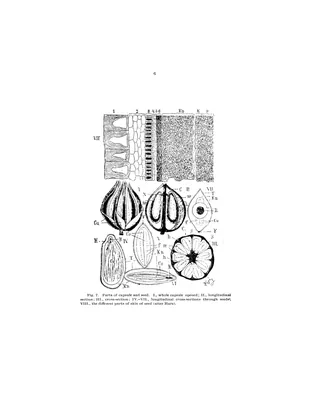
University of Minnesota Agricultural Experiment Station Bulletin No. 13 (December 1890), a treatise on growing flax for fibre and seed, based largely on European practice in Belgium, Germany, Ireland and elsewhere. It covers climate, soil, preparation, manuring, seed selection and sowing, weeding, crop rotation, the "Ländern" scaffolding method, pulling and harvesting, and producing good seed. It includes Lugger's report to the Governor on field experiments into a flax-sickness disease on exhausted land, plus a chapter by H. Leslie Osborn on the microscopic structure of the flax stem, with botanical plates and sections.
The American System of Flax and Other Fiber Culture
A. W. Thornton · 1917
Monograph · 60 pages
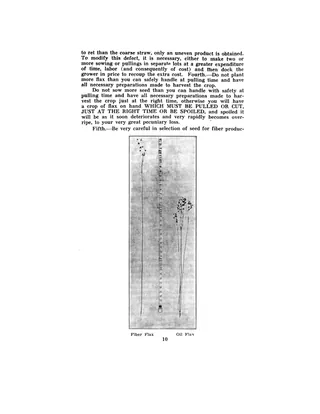
A 1917 agricultural monograph by Dr. A. W. Thornton, formerly a U.S. Department of Agriculture fiber agent in Washington State, proposing an 'Americanized' system of flax culture for Puget Sound and the Pacific Northwest. It surveys European flax practice (Belgium, Holland, Ireland, Germany, Austria) and then covers soil and crop rotation, seed selection, sowing, pulling or machine cutting, rippling, retting, drying, braking and scutching, with costs and yields per acre. Shorter sections treat hemp, roselle, Indian mallow, milkweed and nettle as other fiber plants. Illustrations include a flax ripple, seed grader, retting ponds, hand brake and scutching board.
Business letter
Ephemera · 1 page
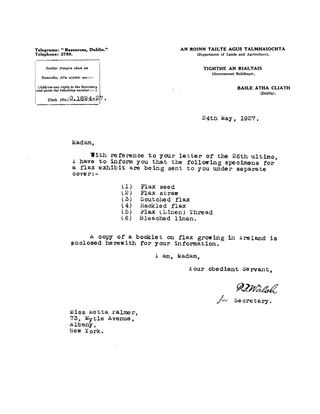
A typed business letter dated 24 May 1927 from the Irish Department of Lands and Agriculture in Dublin to Miss Metta Palmer of Albany, New York. It answers her earlier request by confirming that specimens for a flax exhibit are being sent: flax seed, straw, scutched flax, hackled flax, linen thread and bleached linen. A booklet on flax growing in Ireland is enclosed.
Demonstration of Flax-Pulling Machines
Article · 3 pages
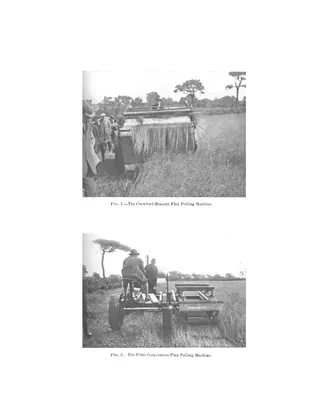
Report on public trials of two flax-pulling machines held by the Irish Department of Agriculture and Technical Instruction at Ballyveasey, Carnmoney, near Belfast, on 26 July 1921. It describes the self-propelled Crawford-Bennett drum machine and the tractor-drawn Fibre Corporation machine with endless chains of combs, and compares how each delivers the pulled flax. The author notes that the stems were undamaged but the heads were tangled, which would make rippling difficult, and concludes that machine pulling looks commercially achievable. Two photographs of the machines are included.
Flax
Domestic Encyclopedia, 1821
Article · 3 pages
An encyclopedia article on flax (Linum usitatissimum) from the Domestic Encyclopedia. It describes the plant, its use for linen, and the steps from sowing and pulling through water retting, grass retting, drying, rippling off the seed and scutching. It also covers linseed oil and oil-cake, and quotes Mr. Deane's New England Farmer on soil, manure, seed quantity, weeding and timing of harvest.
Flax
Zell's Encyclopedia, 1876
Article · 1 page
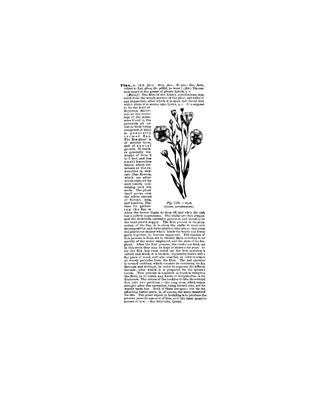
A one-page encyclopedia entry defining flax as both the plant genus Linum and the fibre of Linum usitatissimum used for linen. It describes the plant's appearance and range, harvesting, retting, drying, breaking, scutching and heckling, and the division of the dressed flax into line and tow for spinning. A botanical illustration of the flax plant accompanies the text.
Flax Experiments in India
Article · 9 pages
Article by Bernard Coventry, Director of the Agricultural Research Institute at Pusa, reviewing a century of attempts to grow and process flax for fibre in India, from Roxburgh's early trials near Calcutta through the 1839-41 company experiments and the 1856-60 trials in the Punjab and North-Western Provinces. It quotes a planter's account of a heated-tank retting installation at Beerghem, Belgium, and gives figures from recent trials at Dooriah in Behar on seed rates, yields, costs and profit per acre. Coventry concludes that flax can be grown and manufactured in India, but that skilled instruction in retting, breaking and scutching is essential for commercial success.
Flax Manufacture in the United States
Manufacturer and Builder, 1881
Article · 1 page
A short magazine article arguing that the United States should develop a domestic linen manufacturing industry. It gives import figures for flax manufactures, including a breakdown by product category for 1883. It notes that the US makes cordage, carpet yarns, threads and coarse cloth from flax but no fine linens, and that American-grown flax is said to be of good enough quality for fine linen.
Flax-Dressing
Chambers's Encyclopedia, 1881
Article · 2 pages
An encyclopedia article describing the stages of preparing flax fibre after harvest: pulling, rippling, retting (water, dew, and mixed methods), the Schenk and Watt artificial retting processes, breaking, and scutching by hand, machine, and revolving brushes. It ends by referring readers to the article on linen manufacture for later processes.
Flax-Puller
Article · 1 page
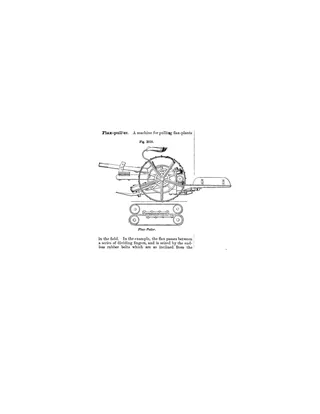
A short dictionary entry on the flax-puller, a machine for pulling flax plants in the field. It describes an example in which the flax passes between dividing fingers and is seized by inclined endless rubber belts. The page includes a line drawing (Fig. 2018) showing the machine's large geared wheel, dividing fingers, feed chute, and a plan view of the belts.
Flax: The Fiber and Seed. A Study in Agricultural Contrasts
Article · 30 pages
A 1919 economics article comparing flax grown for spinning fiber with flax grown for seed (linseed oil). It describes European handicraft fiber culture, including hand pulling, rippling, water and dew retting, and scutching, against mechanized frontier flaxseed farming in the United States, Canada and Argentina. It also covers failed attempts to mechanize fiber production, the westward migration of the U.S. flaxseed crop, and the principle of comparative advantage. Appendix tables give U.S. flaxseed production by state, 1849-1916 acreage and bushels, and world fiber and seed output for 1911-13.
Instructions for the Cultivating and Raising of Flax and Hemp
Monograph · 28 pages
A practical treatise on growing and preparing flax and hemp, first printed at Dublin in 1724 and reprinted at Boston in 1735 for New England readers. Lionel Slator, a flax and hemp dresser in County Cavan, covers soil choice, plowing, seed, sowing and rolling, weeding, rippling, stacking, rating (retting) in water, grassing, breaking, swingling and hackling, and hemp culture. A prefatory letter signed T. Coote, addressed to the Trustees of the Flaxen and Hempen Manufactures of Ireland, introduces the work.
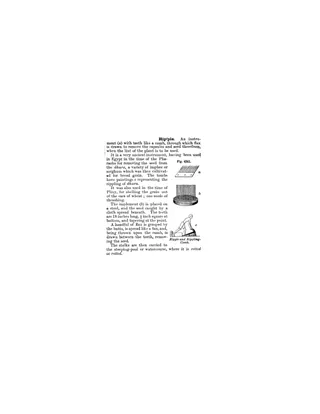
Ripple
Article · 1 page
A short dictionary entry on the ripple, a toothed comb through which flax stalks are drawn to strip off seed capsules before retting. It notes the tool's ancient use in Egypt for removing seed from dhura and in Pliny's time for grain, and describes how a handful of flax is fanned out and pulled through the teeth. Three illustrations show a flat ripple, a cylindrical rippling comb, and a person using the comb.
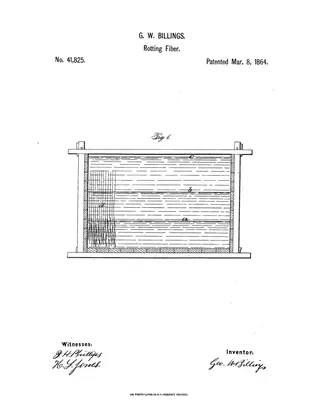
Rotting Fiber, US Patent No. 41825
Patent · 3 pages
US Patent No. 41,825, granted March 8, 1864 to George W. Billings of New York, for an improved method of retting flax and hemp straw. The specification describes a steam-heated vat in which upright stalks are immersed in stages, in thirds, at 85-90°F. This is meant to give uniform loosening of the fiber from the woody stem. The patent includes a drawing of the vat in cross-section and a single claim.
Swatch Page - Working with Linen
Article · 2 pages
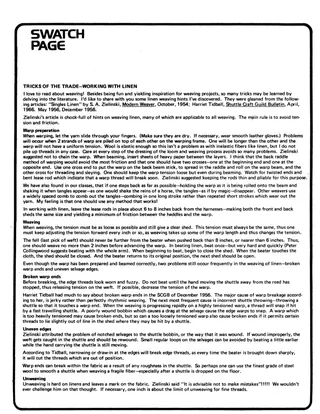
A short column from the Minnesota Weaver's Swatch Page in which Joy Rosner summarizes tips for weaving linen drawn from articles by S. A. Zielinski (Modern Weaver, 1954-55) and Harriet Tidball (Shuttle Craft Guild Bulletin, 1956). Topics include warp preparation and beaming, loom tension, beating, broken warp ends, uneven selvages, unweaving, sizing with paraffin wax or starch, and finishing and ironing linen. No drafts are included.
Advertisement. Boston. For the encouragement of the raising and well-curing and dressing of flax
January 15, 1752
Ephemera · 1 page
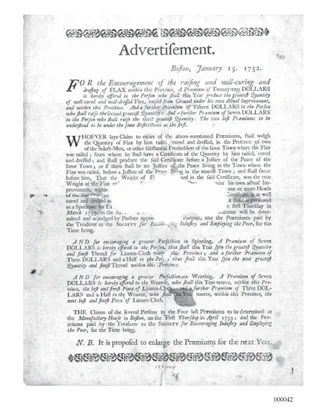
A one-page broadside dated Boston, January 15, 1752, offering cash premiums to encourage flax production in Massachusetts. Prizes go to the three people who raise the greatest quantities of well-cured and dressed flax, to the best spinners of fine linen thread, and to the weavers of the best linen cloth. It sets out how claims are to be certified and sworn before local officials, and says the Society for Encouraging Industry and Employing the Poor pays the premiums.
Flax
Article · 8 pages
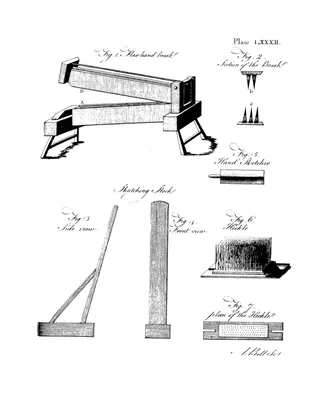
Eighteenth-century encyclopedia article on flax from the first edition of the Encyclopedia Britannica. It gives the Scottish Trustees' recommended practice for growing flax: soil choice, linseed selection, sowing, weeding, pulling, rippling, watering (retting) in canals, grassing and storage. It includes a cost and profit estimate for a Scots acre and a separate method for growing fine flax for cambric and lawn. The closing FLAX-DRESSING section describes breaking, scutching and heckling by hand tools, water-mills and foot machines, illustrated by an engraved plate of the tools.
Flax
London Encyclopaedia, 1829
Article · 8 pages
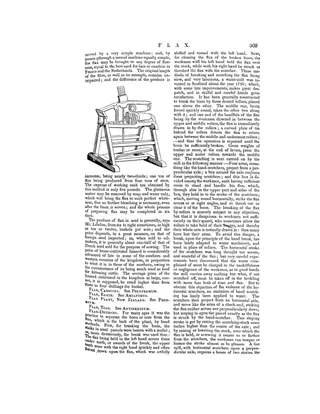
An 1829 encyclopedia article on flax (Linum usitatissimum) covering the word's etymology, literary quotations, and the plant's cultivation. It discusses soils, sowing times, weeding, and pulling, then the watering (retting) of flax in canals, grassing, and lifting. Later pages describe breaking and scutching by hand, foot and water-mill machines, and the start of heckling. One engraving shows a flax-breaking machine.
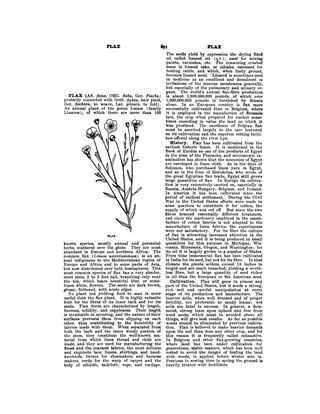
Flax
Article · 3 pages
Encyclopedia article on flax (Linum usitatissimum) from the New International Encyclopedia, pp. 671-673. It covers the botany of the plant, its uses for linen fibre and linseed oil, history of cultivation, and world production statistics. It describes soil and growing requirements, then the dressing steps of rippling, retting (dew, pool, running water, and chemical or heated-tank methods), breaking, scutching, and heckling, up to the point of spinning.
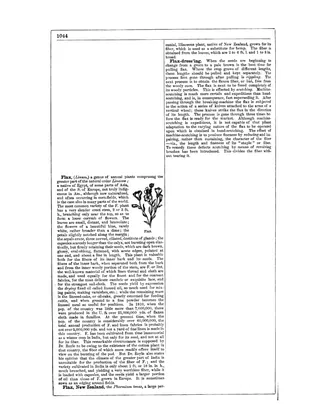
Flax
Article · 1 page
A one-page encyclopedia entry on flax (Linum) from the People's Cyclopedia of Universal Knowledge. It describes the plant, its origins and uses for linen fiber and linseed oil, and the steps of flax dressing (pulling, rippling, scutching by hand and machine). It also compares U.S. flax cloth production in 1810 with the 1890s, mentions flax in India, and begins a short entry on New Zealand flax (Phormium tenax).
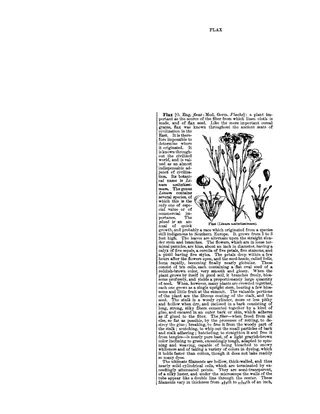
Flax
Article · 3 pages
An encyclopedia article on flax (Linum usitatissimum) from the Universal Cyclopaedia and Atlas. It describes the plant's botany, the structure of the fiber and seed, and the uses of linseed and oil-cake. It then covers cultivation (soil, sowing, weeding, pulling, threshing) and fiber preparation by retting, breaking, scutching and hatcheling. It closes with 1899 production statistics for the U.S., Europe and the world. Includes a botanical illustration of the plant.
Flax Culture
Article · 6 pages
A practical essay on growing and preparing flax, written from the author's 27 years of experience in Ireland and addressed to American farmers during the Civil War cotton shortage. It covers soil, ploughing, seed sowing, pulling, rippling, steeping (retting), and spreading, with cost and return tables for an acre of unrotted and of rotted flax. It also covers raising two crops in one season, tests of late-pulled samples at Pusey's mill in Wilmington, flax-cotton as a cotton substitute, the flax flea, and a proposal for local scutch mills.
Flax Machines
Article · 3 pages
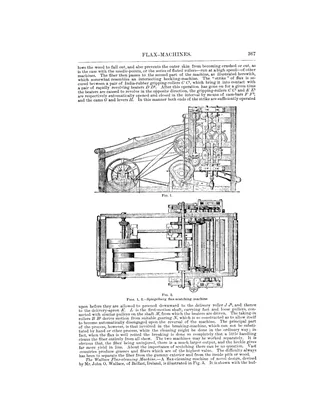
A three-page encyclopedia article on machinery for processing flax, from Appletons' Cyclopaedia of Applied Mechanics. It briefly explains retting and scutching, then describes two machines: the Spiegelberg flax-scutching machine, with a side elevation and plan view, and the Wallace flax-cleaning machine from Belfast, with an engraving. Details given include operating principles, parts, capacity, attendants and power requirements.
Flax Thrasher
Article · 1 page
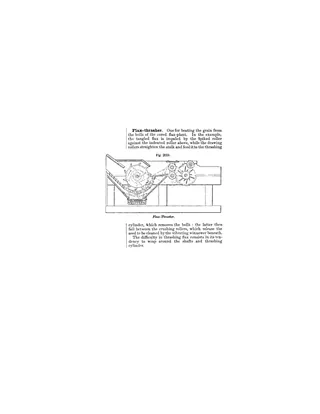
A short dictionary entry describing a flax-thrasher, a machine for beating seed from the bolls of cured flax plants. It explains how a spiked roller, indented roller, drawing rollers, thrashing cylinder, crushing rollers and vibrating winnower work in sequence, and notes the problem of flax wrapping around shafts and the cylinder. A side-elevation figure of the machine accompanies the text.
Flax-Brake
Article · 1 page
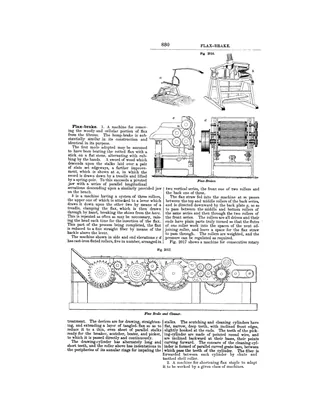
A dictionary entry on the flax-brake, a machine for breaking away the woody portion of retted flax stalks from the fiber. It traces the development from beating flax with a stick, through the sword-and-slat brake with treadle and spring-pole, the toothed-jaw brake, and the three-roller brake, to a five-roller fluted iron machine. It also describes a continuous machine (Fig. 2017) with drawing, scutching, cleaning and picking cylinders, and notes a second sense of the term as a machine for shortening flax staple.
From the Classics - Weaving of Linnen Cloth 1705
Article · 1 page
A short excerpt from Louis Crommelin's 1705 Dublin treatise on linen weaving, reprinted in the Master Weaver's "From the Classics" column. It gives a recipe for the warp dressing (sizing) used in France and Flanders, made from boiled wheat flour paste and fermented with old sour dressing. It also advises that weavers of fine linen work in an underground cellar or similarly damp, close place so the yarn does not break.
Hackling Machine
Article · 1 page
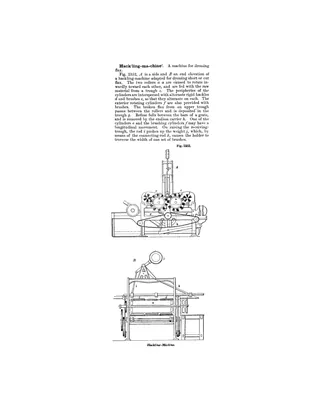
A short dictionary entry from Knight's American Mechanical Dictionary describing a hackling machine for dressing short or cut flax. It explains how paired rotating rollers fitted with alternating rigid hackles and brushes, together with outer brushing cylinders, process flax fed from a trough, with a grate and endless carrier removing refuse. A figure shows side and end elevations of the machine.
Improved Flax Dresser
Scientific American, February 28, 1865
Article · 1 page
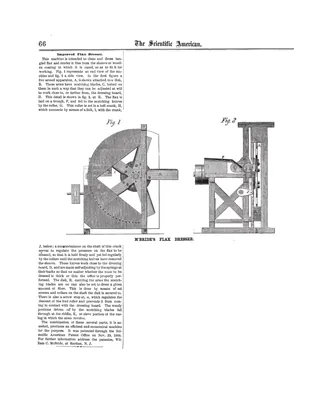
A short 1865 Scientific American article describing William C. McBride's patented flax dressing machine, which cleans tangled flax and removes the woody shoove (shives) using a five-armed rotating scutching apparatus. Two mechanical drawings show an end view and a side view, and the text explains the adjustable scutching blades, dressing board, feed roller, counterbalance, and riddle for removing waste. It notes the patent date of Nov. 29, 1864.
Improved Method of Treating Hemp, Flax, Jute, Grass, &c., US Patent No. 48782
Patent · 1 page
Specification of US Letters Patent No. 48,782, granted July 18, 1865 to Stephen M. Allen of Woburn, Massachusetts. It describes a "flossing process" that rots or ferments long-line fibers such as flax, hemp, jute and China grass, then strands and scrapes them into fibrils with a cotton-like consistency. The treated fiber can then be spun and woven on ordinary cotton and woolen machinery, alone or blended with cotton or wool. Three claims cover the fiber, the yarn, cloth, felt or paper-stock made from it, and mixtures with other fibers.
Improved Mode of Separating the Fibers of Flax, Hemp, &c., US Patent No. 41350
Patent · 1 page
US patent specification No. 41,350, granted January 19, 1864 to Robert Tennent Shaw of New York, for a process of freeing flax and hemp fibers from woody matter. The fiber-bearing plant material is soaked in an alkaline solution (preferably caustic potash), washed, then treated with chlorine gas or bleaching-salt solution so the fibers separate easily. A second claim covers moistening the fibers with coal-oil or naphtha to give them a slight curl like wool, which aids carding and spinning.
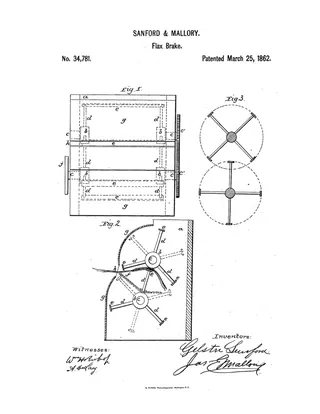
Improvement in Machinery for Scutching Flax and Hemp, US Patent No. 34781
Patent · 3 pages
US Patent No. 34,781, granted March 25, 1862 to Gelston Sanford and James E. Mallory of New York, for an improved machine for scutching flax, hemp and similar fiber plants. The specification describes two series of scutching bars mounted on arms on separate hubs without connecting shafts, geared to rotate in opposite directions so the bars pass between each other and alternately bend the fiber bunch. It includes a single claim and a drawing sheet showing the flax brake in several views.
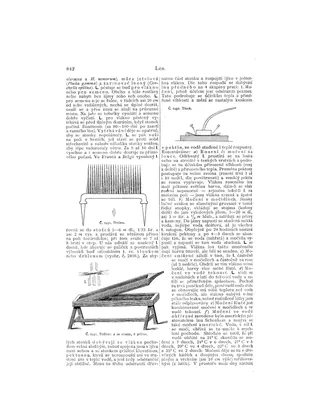
Len [Flax]
Ottův slovník naučný, 1897
Article · 6 pages · Czech
Czech encyclopedia article on flax (len) from Ottův slovník naučný, covering the plant's varieties, climate and soil needs, sowing, diseases, and harvesting for fibre or seed. It describes the stages of fibre preparation in detail: retting (dew, pit, running water, heated water, chemical), breaking, scutching and hackling, by hand and by machine, with illustrated tools and machines. It closes with flax grades and trade (Irish, Belgian, Italian, Egyptian, Bohemian) and the state of flax growing in Bohemia and Europe.
Linen
Article · 1 page
A one-page dictionary entry on linen from Knight's American Mechanical Dictionary. It surveys the history of linen in ancient Egypt and the Bible, with notes on the fineness of Egyptian cloth and the corselet of Amasis. It also covers the start of linen manufacture in England and Ireland and defines linen as a fabric with varieties such as damask, diaper, cambric and huckaback.
Of the Boiling and Cleansing of Linen Yarn
Article · 1 page
A one-page reprint from the 'From the Classics' column of Master Weaver (No. 15, May 1954) of Alexander Peddie's 1822 Glasgow instructions for boiling linen yarn. It describes steeping the yarn in soft water, boiling it with pot ashes and then pearl ashes, washing out the lye, and drying it. The aim is to soften and clean the yarn, make it firmer, and let the weaver set the cloth closer. An editorial footnote gives approximate ash proportions and explains the difference between pot ash and pearl ash.
Retting, Rotting, Rating
Article · 1 page
A dictionary entry from Knight's American Mechanical Dictionary on retting, the steeping of flax or hemp to loosen the fiber from the woody core. It describes traditional water retting, grassing, and dew retting, and several 19th-century mechanical and chemical processes, including Schenck's steam-heated vat apparatus (1851), Bower's process, and ammonia or alkaline treatments. It also notes that hemp is retted much like flax.
Tow
Article · 1 page
A brief encyclopedia entry defining tow as the short fibres produced during scutching and hackling of flax, and the yarns spun from them. It notes that a carding engine or tow card forms the fibres into sliver, which then goes to drawing frames and follows the same steps as line yarn in flax spinning.
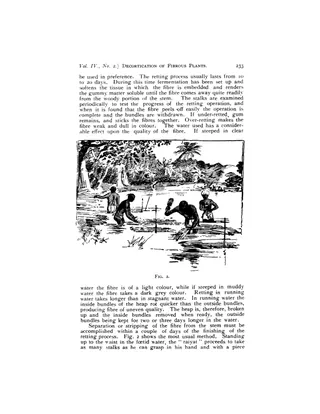
Decortication of Fibrous Plants, with Special Reference to the Belgian Flax Industry
Article · 34 pages
A paper by H. R. Carter of Belfast, read to the Textile Institute and printed in its Journal in November 1913, on separating (decorticating) fibre from flax, hemp, jute, ramie and the leaf fibres such as sisal, Manila and New Zealand flax. It covers retting methods (pool, river-crate, vat and dew retting), the scutching of flax, and the Belgian flax industry along the Lys. A large part describes decorticating, stripping, washing and scutching machines, many shown in photographs and line drawings, with yields, speeds and power requirements. The paper ends with a list of exhibited fibre samples and the recorded discussion.
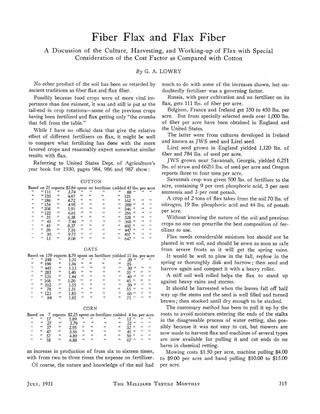
Fiber Flax and Flax Fiber
Article · 5 pages
A 1931 trade-journal article by G. A. Lowry on growing, harvesting, retting, and processing fiber flax, with emphasis on cost compared with cotton. It uses USDA fertilizer-yield tables for cotton, oats and corn to argue that flax would also respond to fertilizing, and compares water, dew and chemical retting (degumming) and several scutching machines, including the Grant or Farmer's machine. It gives test yields and per-acre and per-pound cost figures, and argues that degummed flax spun on cotton machinery could compete with cotton.
Flax
Encyclopaedia Perthensis, 1803
Article · 5 pages
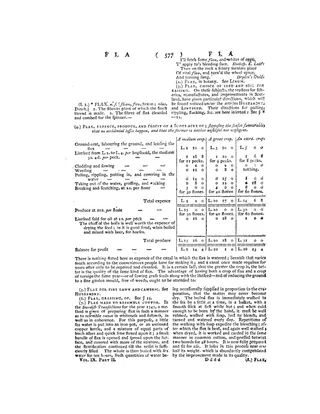
Encyclopedia entry on flax from the Encyclopaedia Perthensis (1803), covering the plant and its cultivation and processing for linen in Scotland. It includes a table of expense, produce and profit for a Scots acre at three crop levels, and detailed instructions for pulling, rippling, stacking, watering in canals, and grassing (field-bleaching) the flax. It also describes a proposed method of scalding flax instead of water-retting, and the flax-dressing operations of breaking, scutching with hand tools and water mills, and heckling, including special dressing for cambric and fine lawn. Cross-references and short dictionary entries (flaxcomb, flaxdresser, flaxen) follow.
Flax
Article · 6 pages
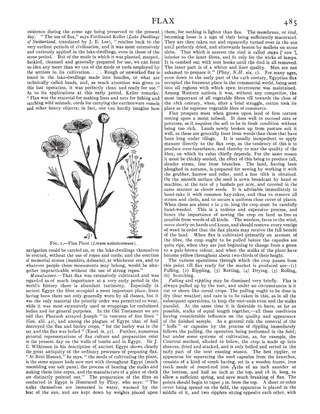
Encyclopedia Britannica (11th ed.) article on flax, covering the botany of Linum usitatissimum, its ancient history and use in Egypt and the Swiss lake-dwellings, and cultivation. It describes the steps from pulling and rippling through retting (water, dew, warm-water, steam and chemical methods) to scutching, with notes on Courtrai flax. The article closes with trade information: acreage by country in 1905, Russian flax grades and base marks, price tables 1897-1906, and imports to the United Kingdom and Irish acreage.
550 documents found