Textile Documents › Publications › Publication: Ottův slovník naučný
12 documents found
Sort: 
Arkwright, Sir Richard
Ottův slovník naučný, 1897
Article · 1 page · Czech
A short Czech encyclopedia entry on Sir Richard Arkwright (1732-1792), the English mechanic and industrialist. It covers his origins as a barber and wig dealer, his cotton spinning machine of 1767, the horse-driven mill in Nottingham and the water-powered mill at Cromford, and the lawsuits that overturned his patent. It also notes the public hostility toward him, his knighthood and his wealth.
Bavlna [Cotton]
Ottův slovník naučný, 1897
Article · 4 pages · Czech
Encyclopedia entry on cotton (bavlna) from Ottův slovník naučný, in Czech. It covers ginning with saw and roller gins, baling, and the criteria for judging cotton quality (fiber length, strength, fineness, color, luster, cleanliness). It also treats trade and the grades and growing regions (European, Levantine, East Indian, African, American, Australian) with production figures for 1876-77 and 1882-83, the microscopic and chemical structure of the fiber, and its uses.
Holbeinova Technika [Holbein Technique]
Ottův slovník naučný, 1897
Article · 1 page · Czech
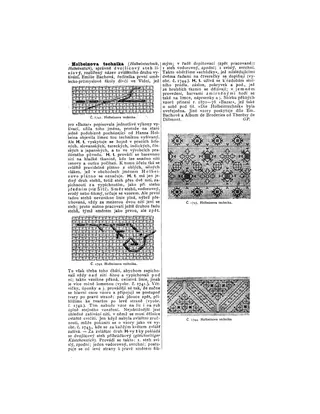
A one-page Czech encyclopedia entry on Holbein technique (Holbeinstich), a double-running line stitch used in counted-thread embroidery on evenweave fabric. It explains how the stitch is worked in two passes to make a continuous line, how branching motifs and thread ends are handled, and the related boxed stitch variant. Four numbered diagrams (figs. 1741-1744) illustrate the stitch, and the entry cites pattern sources by Emilie Bach and Thérèse de Dillmont.
Krajíř z Krajku [Krajíř of Krajek]
Ottův slovník naučný, 1897
Article · 4 pages · Czech
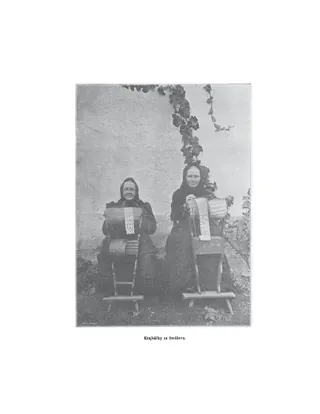
A scan from Ottův slovník naučný (1897) that combines the end of an entry on the Krajíř z Krajku noble family of Bohemia, Moravia and Carinthia with a plate on lace (Krajky). The plate shows Czech bobbin lace from bonnet trimmings, a Slovak lace strip, and a photograph of lace makers from Strážov seated with their pillows. The text is a genealogical account of the family and does not deal with lace.
Kroj [Costume]
Ottův slovník naučný, 1897
Article · 4 pages · Czech
Encyclopedia entry on "Kroj" (costume, dress) from Ottův slovník naučný, in Czech. It surveys the history of European fashionable dress from Roman and Byzantine times through the Middle Ages, Renaissance, Spanish and French fashions, the French Revolution, and the 19th century. It also covers historical costume in painting and the novel and costume reform in the theatre, and ends with a bibliography of costume histories in German, French, English, Polish, Russian and Czech.
Len [Flax]
Ottův slovník naučný, 1897
Article · 6 pages · Czech
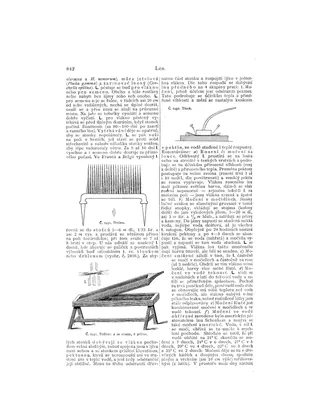
Czech encyclopedia article on flax (len) from Ottův slovník naučný, covering the plant's varieties, climate and soil needs, sowing, diseases, and harvesting for fibre or seed. It describes the stages of fibre preparation in detail: retting (dew, pit, running water, heated water, chemical), breaking, scutching and hackling, by hand and by machine, with illustrated tools and machines. It closes with flax grades and trade (Irish, Belgian, Italian, Egyptian, Bohemian) and the state of flax growing in Bohemia and Europe.
Pletení [Knitting]
Ottův slovník naučný, 1897
Article · 14 pages · Czech
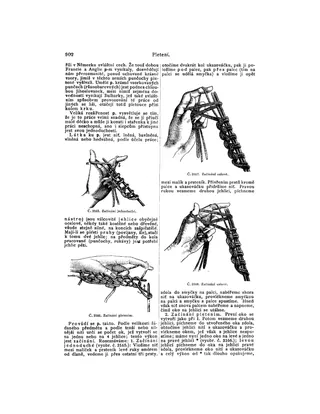
Encyclopedia article on knitting (pletení) from the Czech Ottův slovník naučný. It covers hand knitting with needles (casting on, plain, purl, English and decreased stitches), the history of knitting, and machine knitting on hand and power frames (stávky): weft-knitted (kulírované) and warp-knitted (řetízkové) goods, needles, sinkers, and circular and flat machines such as those of Terrot, Lamb and Berthelot. A final section describes frame-worked cord plaiting or netting ("pletení v rámci", mistakenly called Egyptian knitting), with a bibliography. Illustrated with numbered line drawings of stitches, machine parts and frames.
Tkalcovstvi [Weaving]
Article · 5 pages · Czech
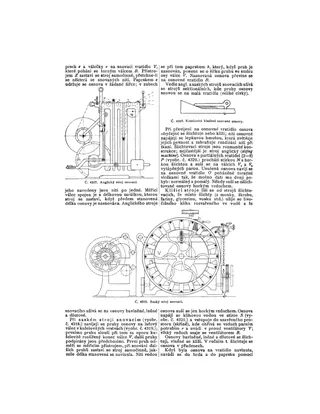
Encyclopedia article on weaving (tkalcovství) from the Czech encyclopedia Ottův slovník naučný. It surveys the history of weaving from antiquity to industrial production, then describes warp preparation: hand warping with a warping frame, bobbin rack and warping board, and English and Saxon warping machines. It also covers sizing and gluing machines and drawing the warp into the heddles and reed with hooks. It closes with statistics on the cotton, wool, linen, jute and silk weaving industries in Europe, Austria and Bohemia, and a short bibliography.
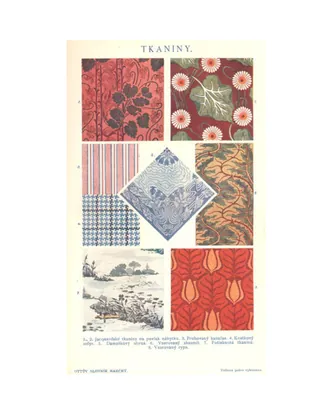
Tkaniny [Woven Fabrics]
Article · 4 pages · Czech · weaving drafts
Encyclopedia article "Tkaniny" (Woven Fabrics) from Ottův slovník naučný, with a plate of eight fabric samples. It classifies woven fabrics (simple, reinforced, double, embroidered, brocaded, pile, gauze, patterned, printed, ribbons and tapes) and explains the plain, twill and satin weaves. Small diagrams show a double-weft weave and cross-sections of double, hollow, velvet and double-plush cloth. The article ends with a section on finishing (appretura) for cotton, linen, jute, wool, worsted and silk fabrics, and a short bibliography of German works.
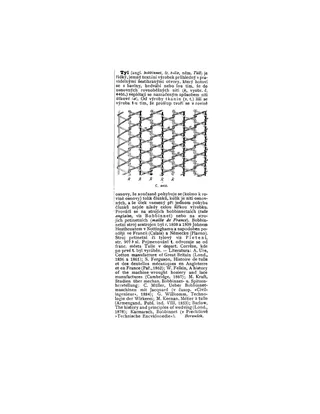
Tyl [Tulle]
Article · 1 page · Czech
A short Czech encyclopedia entry on tulle (bobbinnet), a fine, transparent net fabric with regular hexagonal openings made from cotton, silk or linen. It explains how the weft threads are worked into the parallel warp threads, how this differs from ordinary weaving, and the machines used (bobbinnet and petinet). It mentions Heathcoat's 1808-1809 bobbinnet machine in Nottingham, the origin of the name in the French town of Tulle, and a bibliography. One diagram illustrates the thread construction.
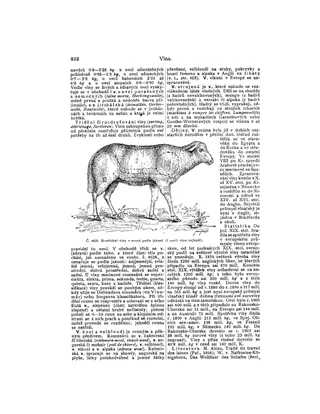
Vlna [Wool]
Article · 3 pages · Czech
Czech encyclopedia entry on wool from Ottův slovník naučný, covering wool as the fleece of sheep, goats and camelids. It describes fibre structure under the microscope, fleece quality, the two main commercial classes (carding and combing wool), washing, shearing, sorting and grading by body region, goat and camelid fibres (cashmere, mohair, alpaca), and shoddy/mungo. It closes with a brief history, production statistics from the late 19th and early 20th centuries, and a bibliography. Illustrations show microscopic fibres and a sheep diagram of wool grades.
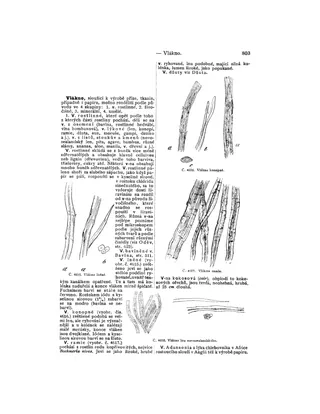
Vlákno [Fiber]
Ottův slovník naučný, 1897
Article · 3 pages · Czech
A three-page Czech encyclopedia entry on fibers from Ottův slovník naučný. It classifies textile and papermaking fibers as plant, animal, mineral and artificial, and describes how to tell them apart by burning, chemical reagents and microscope appearance. Microscope drawings show flax, hemp, ramie, New Zealand flax, wood fibers, wool and hare hair, and the entry closes with the early history of artificial silk (Chardonnet, Pauly and others).
12 documents found