Textile Documents › Authors › Author: Berousek
4 documents found
Sort: 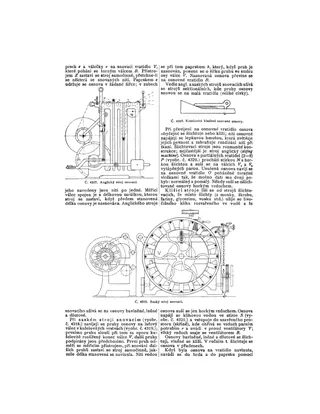
Tkalcovstvi [Weaving]
Article · 5 pages · Czech
Encyclopedia article on weaving (tkalcovství) from the Czech encyclopedia Ottův slovník naučný. It surveys the history of weaving from antiquity to industrial production, then describes warp preparation: hand warping with a warping frame, bobbin rack and warping board, and English and Saxon warping machines. It also covers sizing and gluing machines and drawing the warp into the heddles and reed with hooks. It closes with statistics on the cotton, wool, linen, jute and silk weaving industries in Europe, Austria and Bohemia, and a short bibliography.
Tkaniny [Woven Fabrics]
Article · 4 pages · Czech · weaving drafts
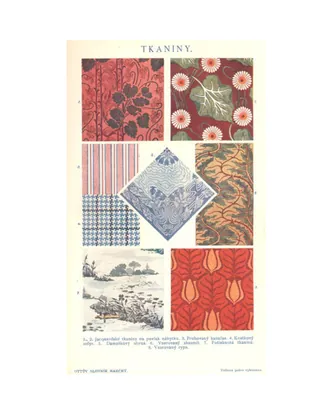
Encyclopedia article "Tkaniny" (Woven Fabrics) from Ottův slovník naučný, with a plate of eight fabric samples. It classifies woven fabrics (simple, reinforced, double, embroidered, brocaded, pile, gauze, patterned, printed, ribbons and tapes) and explains the plain, twill and satin weaves. Small diagrams show a double-weft weave and cross-sections of double, hollow, velvet and double-plush cloth. The article ends with a section on finishing (appretura) for cotton, linen, jute, wool, worsted and silk fabrics, and a short bibliography of German works.
Tyl [Tulle]
Article · 1 page · Czech
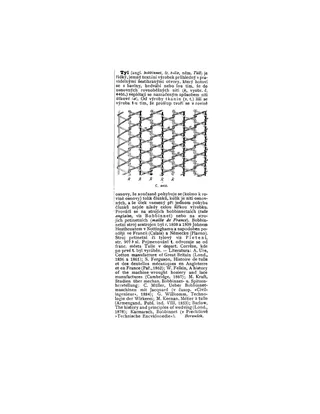
A short Czech encyclopedia entry on tulle (bobbinnet), a fine, transparent net fabric with regular hexagonal openings made from cotton, silk or linen. It explains how the weft threads are worked into the parallel warp threads, how this differs from ordinary weaving, and the machines used (bobbinnet and petinet). It mentions Heathcoat's 1808-1809 bobbinnet machine in Nottingham, the origin of the name in the French town of Tulle, and a bibliography. One diagram illustrates the thread construction.
Vlna [Wool]
Article · 3 pages · Czech
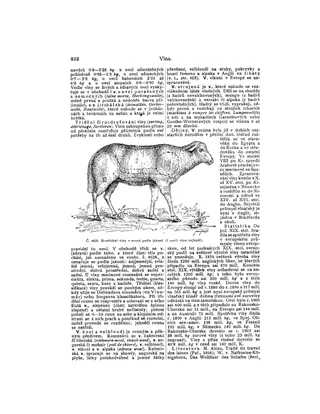
Czech encyclopedia entry on wool from Ottův slovník naučný, covering wool as the fleece of sheep, goats and camelids. It describes fibre structure under the microscope, fleece quality, the two main commercial classes (carding and combing wool), washing, shearing, sorting and grading by body region, goat and camelid fibres (cashmere, mohair, alpaca), and shoddy/mungo. It closes with a brief history, production statistics from the late 19th and early 20th centuries, and a bibliography. Illustrations show microscopic fibres and a sheep diagram of wool grades.
4 documents found