Textile Documents › Publications › Publication: Encyclopaedia Perthensis
16 documents found
Sort: 
Arkwright, Sir Richard
Encyclopaedia Perthensis, 1803
Article · 1 page
A short biographical encyclopedia entry on Sir Richard Arkwright, inventor of machinery for spinning and carding cotton. It traces his path from barber at Wirksworth to cotton-spinning entrepreneur, mentioning John Kay the clockmaker, his patent, his partnership and mills at Nottingham and Cromford, his knighthood in 1786, and his death in 1793.
Bleaching
Encyclopaedia Perthensis, 1803
Article · 18 pages
An encyclopedia article on bleaching linen and cotton cloth and yarn, published in the Encyclopaedia Perthensis. Part I describes the traditional method: steeping, bucking with alkaline leys, grass bleaching, souring with buttermilk or bran, then vitriol (sulphuric acid) souring, rubbing with soap, and starching and blueing. It discusses the chemistry of leys, ashes, lime and acids, citing Dr Home and Dr Black. Part II covers M. Berthollet's new method using dephlogisticated (oxygenated muriatic) acid, with its apparatus, procedure, advantages and costs. An engraved plate shows bleaching apparatus.
Brocade
Encyclopaedia Perthensis, 1803
Article · 3 pages
A three-page encyclopedia entry on brocade, covering the definition of the word and how its meaning broadened from cloth woven wholly of gold or silver to any figured silk. It describes how gilt wire is spun onto silk thread, the Chinese use of gilt paper, and the Venetian domusquete brocade. It also gives Vaucanson's rolling machine for flattening the gilding at Lyons, and a method of cleaning tarnished brocades with spirit of wine.
Callico
Encyclopaedia Perthensis, 1803
Article · 1 page
A short encyclopedia entry defining calico as a cotton cloth resembling linen, and deriving the name from Calicut, where the Portuguese first landed in India. It lists the varieties grouped under the name (plain, printed, painted, stained, dyed, chintz, muslin) and describes decorated pieces with flowers or gold and silver stripes. It notes that calico printing began in London around 1676.
Cloth
Encyclopaedia Perthensis, 1803
Article · 2 pages
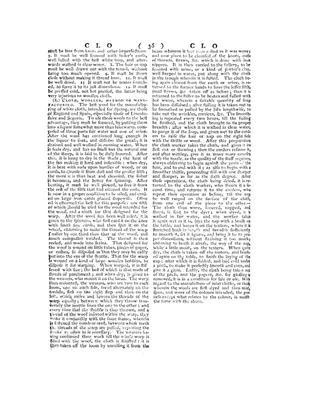
Two pages from an early encyclopedia (Encyclopaedia Perthensis, 1803) with the entry for CLOTH. It gives the dictionary senses of the word with literary quotations, cross-references to related entries (asbestos cloth, linen, bark cloth), and the qualities of good woollen cloth. A longer section describes how woollen cloth was made, from scouring, oiling, carding and spinning the wool through warping, sizing and weaving on a treadle loom to fulling, teasel raising, shearing, dyeing, tentering and pressing.
Cotton
Encyclopaedia Perthensis, 1803
Article · 3 pages
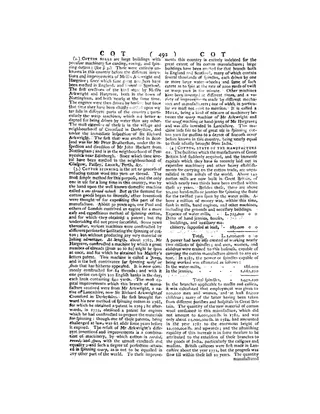
Three pages from the Encyclopaedia Perthensis entry on cotton, covering the end of the discussion of cotton varieties and trade, packing raw cotton in the Antilles, and the cotton manufacture. It describes carding (flock cards and cylinder cards), cotton mills, and spinning machines including Hargreaves' jenny, Arkwright's water frame and the mule. It closes with statistics on the British cotton industry from 1781 to 1787, covering mill investment, spindle counts, raw cotton consumed and the competition from East India Company goods.
Felt
Encyclopaedia Perthensis, 1803
Article · 1 page
A short encyclopedia entry defining felt as a stuff made by fulling wool, or wool and hair, with lees and size, without spinning or weaving. It notes the import duty and export drawback on French-made felts used for cloaks, and adds a dictionary-style definition of the verb 'to felt' with a quotation from Hale.
Flax
Encyclopaedia Perthensis, 1803
Article · 5 pages
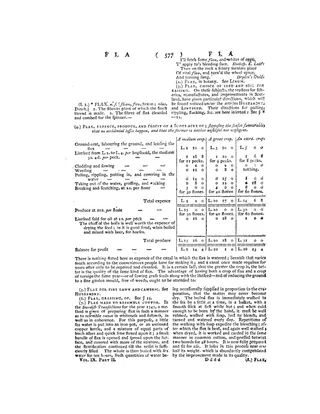
Encyclopedia entry on flax from the Encyclopaedia Perthensis (1803), covering the plant and its cultivation and processing for linen in Scotland. It includes a table of expense, produce and profit for a Scots acre at three crop levels, and detailed instructions for pulling, rippling, stacking, watering in canals, and grassing (field-bleaching) the flax. It also describes a proposed method of scalding flax instead of water-retting, and the flax-dressing operations of breaking, scutching with hand tools and water mills, and heckling, including special dressing for cambric and fine lawn. Cross-references and short dictionary entries (flaxcomb, flaxdresser, flaxen) follow.
Indigo
Encyclopaedia Perthensis, 1803
Article · 2 pages
A short encyclopedia entry on indigo from the early 19th-century Encyclopaedia Perthensis. It describes the final stages of preparing the dye: agitating the vat, settling, draining, and drying the cakes. It also covers uses in laundering, painting and dyeing, the main producing regions (East Indies, Carolina, St Domingo, Mexico, Guatemala), and ways to test quality and detect adulteration.
Lace
Encyclopaedia Perthensis, 1803
Article · 1 page
A dictionary-style encyclopedia entry on lace from the Encyclopaedia Perthensis. It gives the word's senses (a cord, a snare, a plaited fastening string, ornamental woven thread, gold or silver textures) with literary quotations, then describes commercial lace made on a pillow with spindles and pins, and blond lace made with bobbins. It notes lace manufacture in Buckinghamshire, imports from Flanders, and a prohibition on importing gold and silver lace.
Sheep
Encyclopaedia Perthensis, 1803
Article · 9 pages
Encyclopedia article on sheep from the Encyclopaedia Perthensis (1803), covering the animal's usefulness to humankind, including the many wool trades it supports, and its by-products such as skins, tallow, horn and bone. It describes regional breeds in Britain and Ireland, Mr Bakewell's improved Leicestershire breed, and Spanish transhumant flocks in the Pyrenees. It also discusses the quality of mutton, diseases and remedies (rot, scab, rickets, fly-strike), ram letting prices, and lambing management. Relevance to textiles is mainly the wool source and the list of wool-trade occupations.
Silk
Encyclopaedia Perthensis, 1803
Article · 11 pages
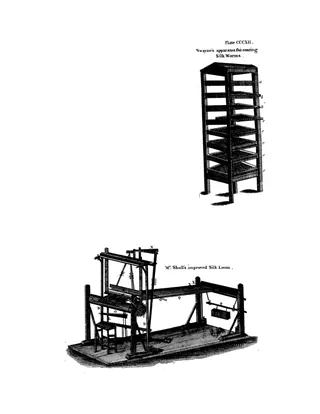
An encyclopedia article on silk from the 1803 Encyclopaedia Perthensis. It covers ancient opinions about silk, the history of the silk trade from China to Persia, Greece and Rome, and the life cycle of the silkworm. It also gives practical instructions for rearing worms in temperate climates, including housing, feeding, mulberry and lettuce leaves, spinning, reviving languishing worms, selecting breeding cocoons, killing the chrysalis in the oven, and winding silk from cocoons. An engraved plate shows Swayne's apparatus for rearing silkworms and Mr. Sholl's improved silk loom.
Tapestry
Encyclopaedia Perthensis, 1803
Article · 3 pages
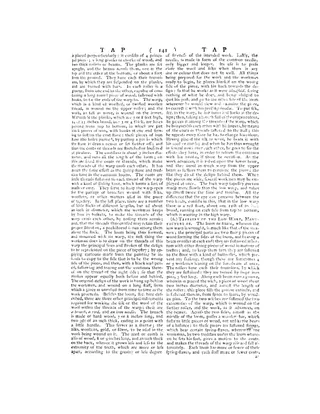
An encyclopedia article on tapestry from the Encyclopaedia Perthensis. It gives a definition and a brief history of tapestry weaving, covering its supposed Saracen origin and the Netherlands, English, Mortlake, Paris and Gobelins manufactories. It distinguishes high-warp and low-warp tapestry, lists the main French and Flemish centres, and describes in detail the looms, tools (broach, reed, needle, flute) and working methods of each kind.
Weaving
Encyclopaedia Perthensis, 1803
Article · 4 pages
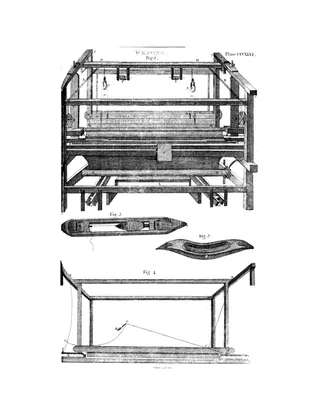
An encyclopedia article on weaving from the Encyclopaedia Perthensis, with an engraved plate of a loom, shuttles and the flying-shuttle mechanism. It defines weaving, describes the parts of the common weaver's loom, and explains the flying shuttle. It then gives reed-setting (caaming) rules and arithmetic for cotton and linen yarn counts, with notes on bed tick, damask, diaper and common tweels. It closes with cross-references for wool, silk and tapestry weaving.
Wool
Encyclopaedia Perthensis, 1803
Article · 6 pages
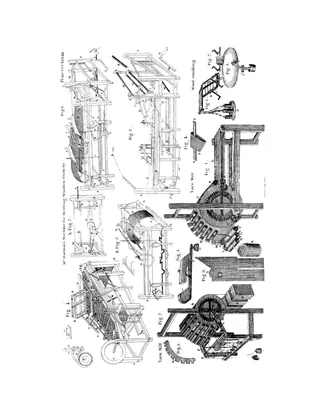
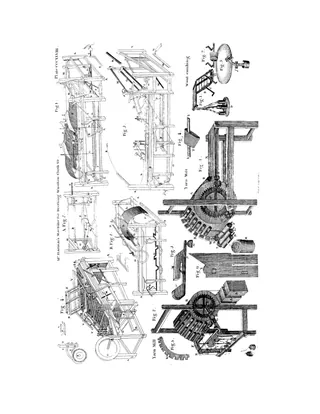
Excerpt from the 'Wool' entry in the Encyclopaedia Perthensis (pp. 261-264 plus an engraved plate). It covers the grading and sorting of fleeces and the regions known for fine wool, and the British Wool Society founded in Edinburgh in 1791. It also describes Edmund Cartwright's patented wool-combing machinery and gives definitions of 'woolfell' and 'woollen'. Most of the text is the 1794 patent specification of Mr Harmar of Sheffield for machines that raise a shag on woollen cloth and crop or shear it, described figure by figure with lettered parts. The final plate shows the cloth-dressing machines, wool-combing machinery, and yarn mills.
Yarn-Mill
Encyclopaedia Perthensis, 1803
Article · 3 pages
Encyclopedia entry (pp. 292-293) describing an early 19th-century yarn mill, a water- or horse-driven machine for preparing and spinning hemp, tow, flax and wool. It explains the cylinder, pressing and drawing rollers, revolving cloth, canister and contractor that form the sliver, the successive drawing machines, and the spinning machine with its spindles. An engraved plate (CCCXVIII) shows the yarn mill parts, Mr Harman's machine for dressing woollen cloth, and wool-combing apparatus.
16 documents found