Textile Documents › Publications › Publication: Scientific American
52 documents found
Sort: 
American Silk Manufacture
Scientific American, 1852
Article · 1 page
A short note from Scientific American reporting on a silk factory at Newport, Kentucky, in operation about four years. It says the factory makes cravats, handkerchiefs, and vestings described as well bodied and soft. The page also carries an engraving of a large classical-style building.
Biography of an Inventor [E. B. Bigelow]
Scientific American, 1854
Article · 1 page
A Scientific American editorial from February 1854 reviewing a biography of power-loom inventor Erastus B. Bigelow, published in Hunt's Merchant's Magazine and written by N. Cleveland. The editors argue the biography exaggerates Bigelow's feat of inventing a coach-lace power loom in six weeks, noting Jacquard's earlier work on figured-fabric looms. They still credit Bigelow with carpet power-loom improvements, many patents, his Lancaster, Mass. carpet factory, and power-woven silk brocatelles shown at the Crystal Palace.
Cause of Sanded Cotton
Scientific American, 1859
Article · 1 page
A letter to the editors of Scientific American, signed E. J. C. of Centerville, Mississippi, dated December 15, 1859. A cotton planter with 26 years of experience explains why so much dirty and sanded cotton reaches market, blaming commission merchants who do not pay a sufficiently higher price for fine cotton over inferior grades. He argues that planters therefore have no incentive to take extra care in picking and handling.
Competition of Shepherds' Dogs at Angerville
Scientific American, May 7, 1898
Article · 1 page
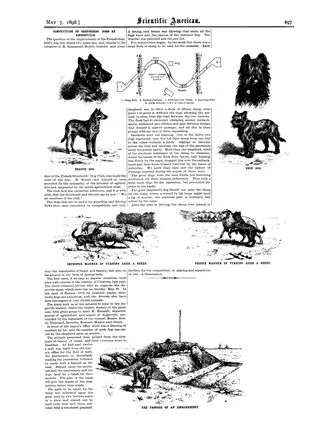
A reprinted article from L'Illustration describing a competition of French shepherds' dogs held at Angerville in the Beauce region, organized by the French Shepherds' Dog Club. It describes the judging for breed and beauty and the herding tests, in which each dog drove fifteen sheep along a marked track with obstacles. Illustrations show a Beauce dog and a Brie dog, proper and improper ways of turning aside a sheep, an embankment passage, and a plan of the track.
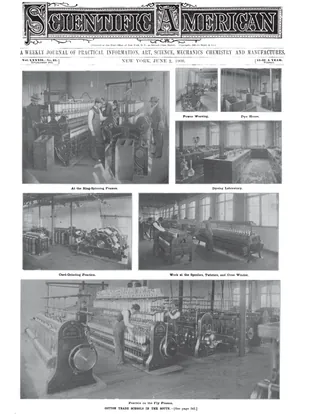
Cotton Trade Schools in the South
Article · 2 pages
A June 2, 1900 Scientific American piece on the new cotton textile schools in the South, chiefly the Georgia school (Georgia Tech) and Clemson College in South Carolina. It describes the mill equipment donated by machine makers, the range of looms and machines students learn on, the four-year and two-year curricula, and the argument for manufacturing cotton goods in the South rather than shipping raw cotton abroad. The cover page carries photographs of the schools' spinning, weaving, dyeing, carding, and winding rooms.
Death of a Distinguished English Inventor [Samuel Hall]
Scientific American, 1854
Article · 1 page
A short obituary notice in Scientific American for Samuel Hall of Basford Hall, near Nottingham, who died aged 82. It credits him with the gassing of lace, in which a gas flame was drawn through the lace by a vacuum to burn off loose fibers, and with the bleaching of starch. It also mentions his marine engineering patents, including a surface condenser for steam, smoke combustion and a paddlewheel reefing device, and his family connections.
E. Burt's Plaid Loom
Scientific American, 1848
Article · 1 page
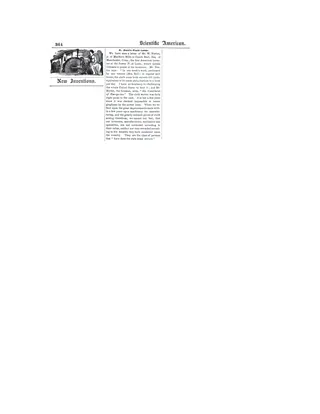
A short 1848 Scientific American item in the 'New Inventions' column about Enoch Burt's power plaid loom. It quotes a letter from W. Norton Jr. of Marlboro Mills reporting that one weaver tended a loom producing 938 yards in a week, about 39 yards per loom per day, at 48 picks to the inch. The piece also comments on the value of American inventors and mechanics, and includes an engraving of a woman seated at a power loom.
Edwards' Improved Wool-Folder
Scientific American, October 6, 1860
Article · 1 page
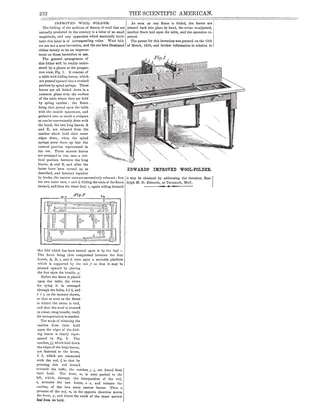
A short illustrated article from Scientific American describing R. M. D. Edwards' improved wool-folder, a table with spring-loaded folding leaves that fold a fleece into a compact bundle. It explains how the leaves, catches, levers and foot-treadle platform operate, and how twine is laid out beforehand so the fleece can be tied immediately. Two figures show a perspective view and the catch-release mechanism.
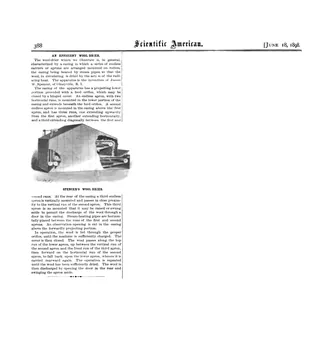
Efficient Wool Drier
Scientific American, June 18, 1898
Article · 1 page
A short Scientific American article describing James W. Spencer's wool-drying machine. A steam-heated casing holds a series of endless aprons on rollers that circulate the wool repeatedly through the heat until it is dry. The text explains the construction and operation, with one perspective illustration of the machine.
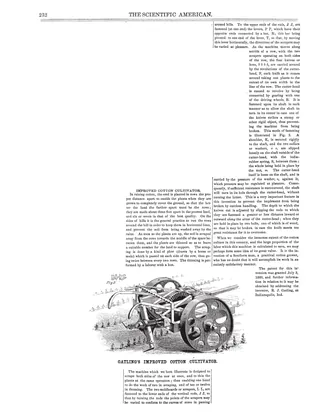
Gatling's Improved Cotton Cultivator
Scientific American, October 6, 1860
Article · 1 page
A single-page article from Scientific American (October 1860) describing R. J. Gatling's improved cotton cultivator, a horse-drawn machine that scrapes both sides of a cotton row and thins the plants in one pass. It explains how cotton rows are planted and worked, then details the mechanism: driving wheels, a cutter-head with four knives, adjustable scraper moldboards, and an india-rubber spring clutch that protects the shaft. An engraving shows the machine at work, and the article gives the patent date (July 3, 1860) and the inventor's address in Indianapolis.
Hand Loom Weaving
Scientific American, 1847
Article · 1 page
A short 1847 editorial note from Scientific American on the fortunes of hand loom weavers after the introduction of the power loom. It reports on a hand loom invented by a Frenchman named Clausenne, operated by a simple crank, said to weave about five times as much as the old loom and produce better cloth. The writer suggests it would suit rural villages in America and help weavers in Ireland, and promises a more detailed account later.
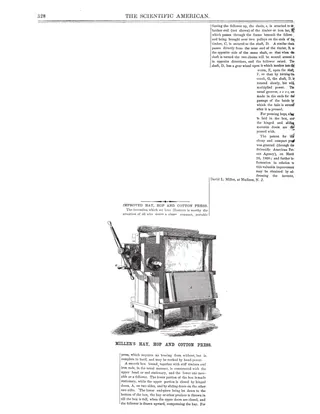
Hand's Improved Cotton Press
Scientific American, May 19, 1860
Article · 1 page
A short Scientific American item from 1860 describing David L. Miller's improved hay, hop and cotton press, with an engraving. It explains the wooden box press with a movable follower raised by chains wound on a geared shaft turned by a hand crank. It also notes use for hops and the patent granted March 20, 1860. The page also carries the end of a preceding article on a press mechanism.
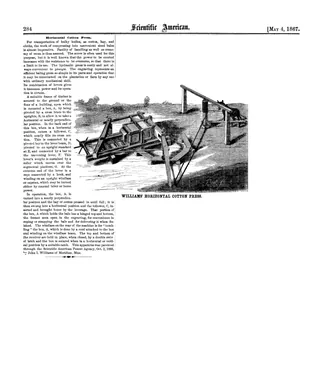
Horizontal Cotton Press
Scientific American, May 4, 1867
Article · 1 page
A short 1867 Scientific American article describing John I. Williams' horizontal baling press for cotton and hay, patented in October 1866. It explains the lever-and-follower mechanism, a tilting box, and a windlass or capstan powered by hand or horse, and notes that the press could be built on a farm or plantation. An engraving of the machine is included.
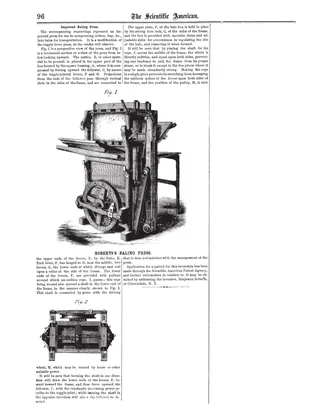
Improved Baling Press
Scientific American, August 9, 1862
Article · 1 page
A short 1862 Scientific American article describing Benjamin Roberts's improved baling press, a toggle-lever machine for compressing cotton, hay and similar material into bales for transport. It explains how an endless rope and pulleys draw the lever ends inward to force up the follower, driven by a horse-powered wheel. Two engravings show a perspective view and a view from below.
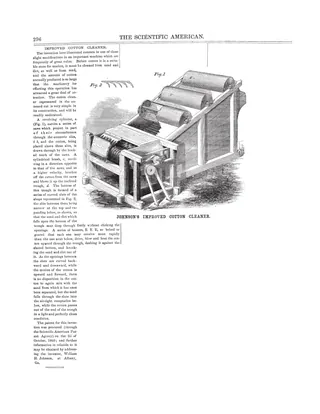
Improved Cotton Cleaner
Scientific American, October 27, 1860
Article · 1 page
A short 1860 Scientific American article describing William H. Johnson's patented cotton cleaner, which removes sand and dirt from raw cotton. It explains how a saw cylinder, a counter-rotating brush, and a series of beaters drive the cotton up an inclined trough with a slatted bottom, so that dirt falls through the slats into receptacles below. Two figures illustrate the machine and the slat shape. It also gives the patent date and the inventor's address.
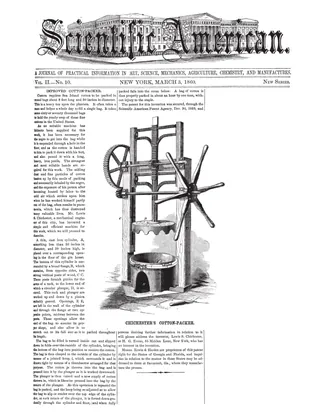
Improved Cotton-Packer
Scientific American, March 3, 1860
Article · 1 page
A short 1860 Scientific American article describing Lewis S. Chichester's patented machine for packing Sea Island cotton into round bags. It explains the former hand method of packing with a worker inside the bag, then the iron cylinder, rack-and-pinion plunger and hoop clamp of the new press, which fills a bag in about an hour. An engraving shows the machine, and the article gives patent and licensing details.
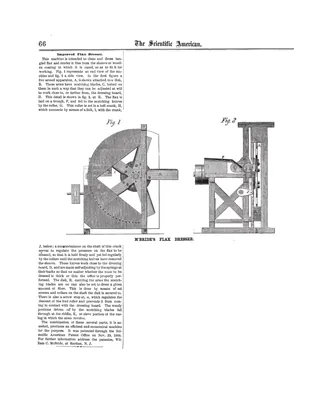
Improved Flax Dresser
Scientific American, February 28, 1865
Article · 1 page
A short 1865 Scientific American article describing William C. McBride's patented flax dressing machine, which cleans tangled flax and removes the woody shoove (shives) using a five-armed rotating scutching apparatus. Two mechanical drawings show an end view and a side view, and the text explains the adjustable scutching blades, dressing board, feed roller, counterbalance, and riddle for removing waste. It notes the patent date of Nov. 29, 1864.
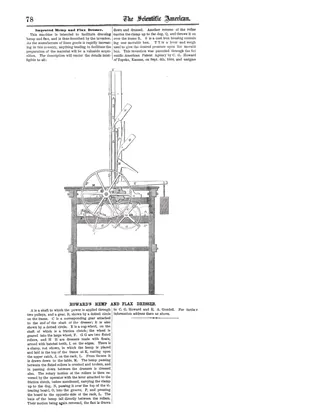
Improved Hemp and Flax Dresser
Scientific American, c. 1865
Article · 1 page
A one-page Scientific American article describing Howard's Hemp and Flax Dresser, a machine for crushing, breaking and hatchelling hemp and flax fibers. It explains the parts (fluted rollers, dressers with hatchel teeth, clamp, rack, friction clutch, gears) and how reversing the rollers carries the fiber through the dressing cycle. A cross-section diagram accompanies the text, and the patent was granted to C. G. Howard of Topeka, Kansas, in 1864.
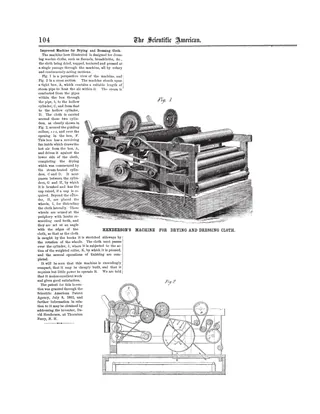
Improved Machine for Drying and Dressing Cloth
Scientific American, August 16, 1862
Article · 1 page
A short illustrated notice from Scientific American describing David Henderson's patented machine for finishing woolen cloths such as flannels and broadcloths. A single pass dries the cloth over steam-heated cylinders and a hot-air fan, then napping rollers, hooked stretching wheels and a weighted pressing roller finish it. Two engravings show a perspective view and a cross-section.
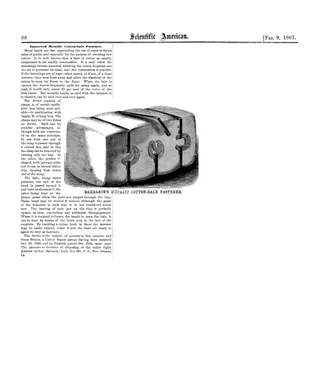
Improved Metallic Cotton-Bale Fastener
Scientific American, February 9, 1867
Article · 1 page
A one-page Scientific American item describing Arthur Barbarin's patented metal clasp for fastening hoop-iron bands around cotton bales, offered as a replacement for rope ties. It explains the fire-resistance argument, how the C-shaped and slotted clasps work, and how the bands can be reused. It gives patent dates (US Oct. 20, 1866; English Oct. 29, 1866) and notes the patentee wished to sell the rights. An engraving shows a banded bale and the two clasp types.

Improved Power Loom
Scientific American, 1847
Article · 1 page
A short 1847 news item from Scientific American about an improved power loom by Richard Collins of Cabotville, Massachusetts. It is claimed to run at 160 picks per minute as easily as a common loom runs at 112. The writer does not know the details of the improvement, only that reports say the harness is moved by an eccentric rather than cams.
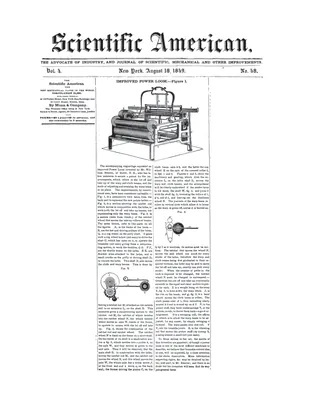
Improved Power Loom
Scientific American, 1849
Article · 1 page
A single-page article from Scientific American (August 18, 1849) describing an improved power loom invented by William Stearns of Dover, N.H. The improvements concern the let-off and take-up of the warp and cloth beams and the way the warp beam is adjusted and held in place. The text gives a lettered part-by-part explanation of three engravings showing the frame, shuttle boxes, ratchet rod and wheel, eccentric, and gearing.
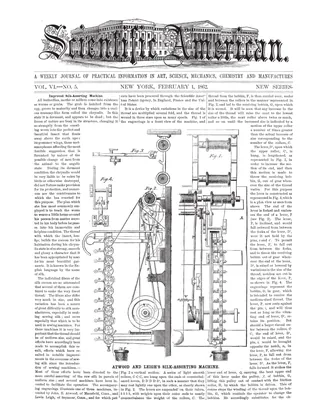
Improved Silk-Assorting Machine
Scientific American, February 1, 1862
Article · 2 pages
A February 1862 Scientific American article describing a silk-assorting machine patented by John E. Atwood and Lewis Leigh of Connecticut. It opens with a short account of the silkworm and cocoon, then explains why uniform thread size matters for sewing-machine silk. The machine passes thread over a stack of counterbalanced rollers that magnify size variations and trip a lever to stop winding so the operator can switch bobbins for three thread sizes. Engraved figures show front, section and detail views.
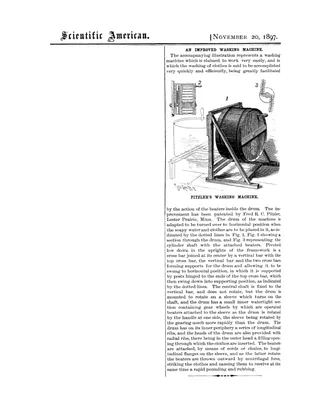
Improved Washing Machine
Scientific American, November 20, 1897
Article · 1 page
A short 1897 Scientific American item describing a patented washing machine by Fred R. C. Pitzler of Lester Prairie, Minnesota. It explains the tilting drum on a wooden frame, the geared inner shaft and sleeve that drive cord-attached beaters, and the ribs that pound and rub clothes as the drum is hand-cranked. One illustration shows the machine beside a tub, with a washboard and hand wringer.
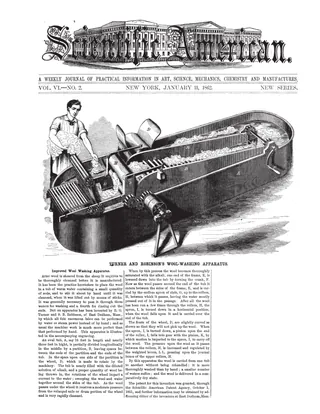
Improved Wool Washing Apparatus
Scientific American, January 11, 1862
Article · 1 page
A short 1862 Scientific American article describing Turner and Robinson's patented machine for washing raw wool, which replaces hand stirring in tubs. An oval tub with a partition and rotating wheel circulates the wool in an alkali solution, and a slatted apron and pressing rollers lift it out and squeeze out the water. The article explains the parts of the engraved illustration and the advantages over hand washing, and gives the patent date of October 1, 1861.
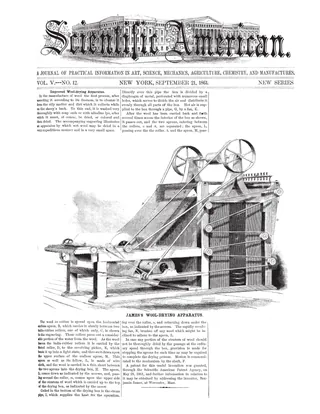
Improved Wool-Drying Apparatus
Scientific American, September 21, 1861
Article · 1 page
A one-page 1861 Scientific American article describing Benjamin James's patented machine for drying washed wool. Wet wool passes between india-rubber rollers, is fluffed by a revolving picker, and is carried between two wire-cloth aprons through a steam-heated drying box with a fan-driven hot air supply. An engraving shows the machine's parts, and the text gives the patent date (May 28, 1861) and the inventor's address in Worcester, Mass.
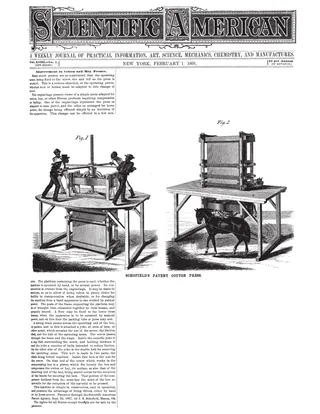
Improvement in Cotton and Hay Presses
Scientific American, February 1, 1868
Article · 1 page
A one-page 1868 Scientific American article describing J. S. Schofield's patented screw press for baling cotton, hay, and other fibrous materials. The press can be driven by hand or by horse power by inverting the apparatus, and the operating arms stay at a constant level. The text explains the platform frame, yoke, friction balls, screw, and piston, and is illustrated with two engravings of the press.
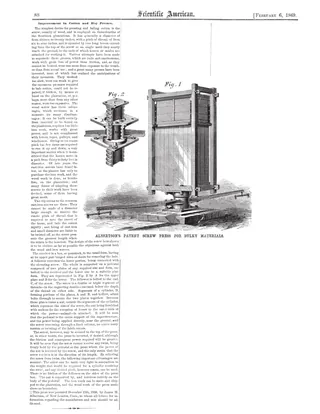
Improvement in Cotton and Hay Presses
Scientific American, February 6, 1869
Article · 1 page
A Scientific American article describing James M. Albertson's patented screw press for baling cotton and hay, patented December 15, 1868. It reviews the traditional wooden screw presses used on Southern plantations and the drawbacks of cast-iron screws. It then explains the new design, in which a fixed pedestal and a rotating nut keep the screw from twisting. One engraving shows the press.
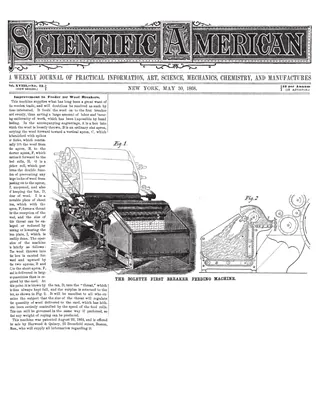
Improvement in Feeder for Wool Breakers
Scientific American, May 30, 1868
Article · 1 page
A short 1868 Scientific American article describing a patented automatic feeder for the first breaker card in woolen manufacture. It explains how aprons, a picker roll, a fan and an adjustable throat plate deliver wool evenly to the card in place of hand feeding. Two engravings show a perspective view and a cross-section of the Bolette First Breaker Feeding Machine, which was sold by Harwood & Quincy of Boston.
Improvement in Knitting Looms
Scientific American, 1849
Article · 1 page
A short 1849 Scientific American item on John Pepper of Portsmouth, New Hampshire, and his improved power knitting looms (machines), as seen in operation at H. and J. Crane's establishment. It compares weekly output of English hand stocking looms with Pepper's earlier rotary looms and his newest plain and ribbed looms. It also notes that the new looms can handle stronger yarns and run in independent sections of any width. A small woodcut of a knitting machine accompanies the text.
Improvement in Looms
Scientific American, July 10, 1869
Article · 2 pages
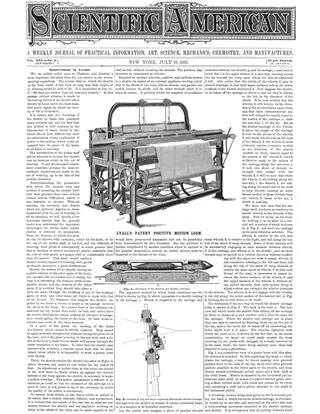
A Scientific American article (July 10, 1869) describing James Lyall's patented positive motion power loom, which drives the shuttle by a wheeled carriage running in a race-way on the lay, rather than by a picker staff. It explains the defects of conventional shuttle throwing (limited width, clashes with the lay, imperfect selvedge) and how the carriage and wheels move the shuttle without lateral motion of the warp threads. Engravings show the whole loom, the shuttle and carriage, and a section of the lay and reed. The article says it could weave very wide goods, such as six-yard-wide drugget.
Improvement in Machines for Planting Cotton
Scientific American, December 14, 1867
Article · 1 page
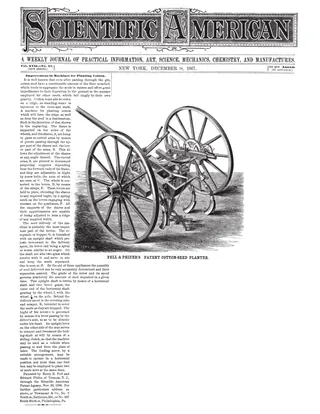
A one-page article from Scientific American describing Fell & Phifer's patented horse-drawn cotton-seed planter. The machine forms a ridge and drops seed in one pass, using a screw-type feed in the hopper to separate the fuzzy ginned seed, with adjustable shares and a covering rake. An engraving shows the machine, and the patent details (Nov. 20, 1866, Trenton, N.J.) are given at the end.
Improvement in the Power Loom
Scientific American, 1848
Article · 1 page
Short 1848 notice from Scientific American's 'New Inventions' column about R. P. Cunningham of Abington, Connecticut, and his improvement to the power loom. It reports that the improvement lets a loom run over a wider range of speeds, up to about 200 picks per minute against a usual 100, with a claimed 15 to 30 percent speed increase and no added yarn breakage or wear. An editorial note asks that loom improvement reports state the weft quality and picks per inch. The page includes an engraving of a power loom with a seated operator.
Improvements in Calico Printing
Scientific American, 1847
Article · 1 page
Short 1847 news item from Scientific American's New Inventions column on improvements at the Merrimack Print Works in Lowell, Massachusetts. It describes Milton D. Whipple's faster method of engraving copper cylinder rollers for calico printing, his patented machine for shearing threads and lint from cloth before printing, and his roller machine for printing paper hangings.
Lace Manufactures
Scientific American, 1852
Article · 1 page
A short 1852 note from Scientific American on the machine-made silk lace trade at Nottingham. It reports that manufacturers blame slack trade on French laws that bar English lace from France. It argues that admitting English lace to Paris would affect fashion in France, England and the United States.
Laces and Embroideries
Scientific American, 1845
Article · 1 page
A short 1845 magazine piece on the market for costly laces and embroideries, reprinted from Sharpe's London Magazine. It describes the trade in lace from Belgium and France, how lace is washed and dried, and the ranking of types such as Mechlin, Point de Venise, Point d'Alençon, Brussels point d'application, Honiton and Chantilly. It also notes that fine embroideries come from France and Switzerland.
Loom for Cylindrical Cloth
Scientific American, 1847
Article · 1 page
A short 1847 news item from Scientific American describing a loom invented by Henry Pease of Clarkson, N.Y., for weaving seamless cylindrical cloth suited to meal bags. Two sets of warps are arranged so the shuttle passes between the halves of the upper warp and returns between the halves of the lower warp, joining the two webs at both edges to form a continuous tube. The note gives no technical drawings or drafts.
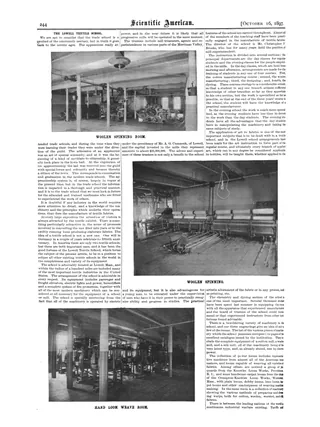
Lowell Textile School
Scientific American, October 16, 1897
Article · 2 pages
A Scientific American article from 1897 describing the newly established Lowell Textile School in Lowell, Massachusetts. It covers the school's equipment, trustees, director, and its four courses (cotton manufacturing, woolen manufacturing, designing, dyeing), with day and evening classes. It also surveys the machinery, including power looms, jacquards, dobby and carpet looms, and argues for trade schools in industrial competition. Three photographs show the woolen spinning rooms and a hand loom weave room.
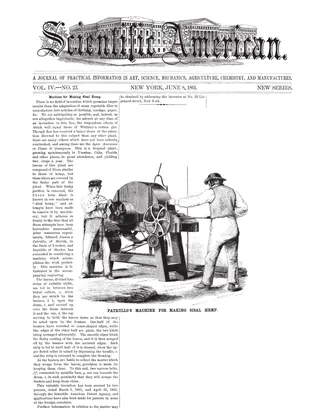
Machine for Making Sisal Hemp
Scientific American, June 8, 1861
Article · 1 page
A one-page 1861 Scientific American article describing Edward Juanes y Patrullo's patented machine for removing the fleshy tissue from agave (sisal) leaves to produce sisal hemp fiber. It explains how the leaves are fed through fluted rollers and struck by alternating smooth and serrated beaters on a drum, with belts that keep the beaters clean. An engraving of the machine accompanies the text, along with patent dates and the inventor's New York address.

Method of Coating Bobbin Net or Lace with Copper
Scientific American, 1847
Article · 1 page
A short 1847 Scientific American note in the "Curious Arts" column describing how to coat bobbin net or lace with copper by electroplating. The net is stretched on a copper wire and brushed with powdered plumbago (black lead). It is then placed between copper plates connected to a galvanic battery. The coated lace can be gilded or silvered and used for small articles such as jewel cases.
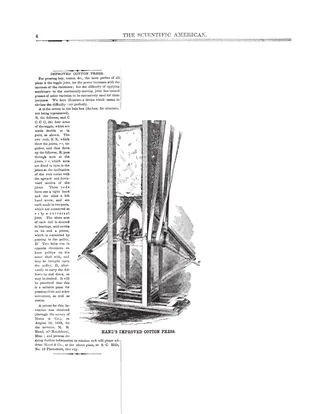
Miller's Hay, Hop and Cotton Press
Scientific American, January 1860
Article · 1 page
A short Scientific American article describing M. B. Hand's improved cotton press, patented August 16, 1859. It explains a toggle-joint press in which two oppositely threaded screw rods with universal joints, driven by gearing and belts, raise and lower the follower. It is intended for hay, cotton and cloth, and the article includes an engraving of the machine.
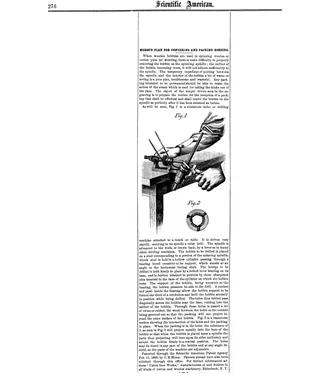
Morse's Plan for Centering and Packing Bobbins
Scientific American, May 2, 1868
Article · 1 page
A short Scientific American article describing C. B. Morse's patented method for centering wooden spinning bobbins on the spindle. A small bench drilling machine bores intersecting diagonal holes near the base of the bobbin, and twine or rubber packing is threaded through them so it projects evenly into the bore and survives steaming. Two figures show the drilling machine and a cross-section of the packed bobbin.
New Check Loom
Scientific American, 1847
Article · 1 page
A short 1847 Scientific American article on a new power check loom invented by Mr. Peacock, agent of Ida Mills in Troy, New York, reprinted from the Mechanics' Mirror. It traces the progress from two-shuttle to three- and four-shuttle looms, including Mr. Neal's revolving shuttle box, and describes Peacock's adjustable single pattern wheel with movable pins that can produce any gingham pattern from two to 220 picks. It stresses the importance of color arrangement and balance in gingham weaving.
Newly Invented Loom
Scientific American, 1847
Article · 1 page
A short 1847 news item from Scientific American's New Inventions column reporting a loom improvement by Edward Norfolk, a young Boston machinist. The main change is a noiseless shuttle movement, which also increases loom speed. A patented working loom was reportedly put into operation at the James Mills in Newburyport, with a satisfactory trial.
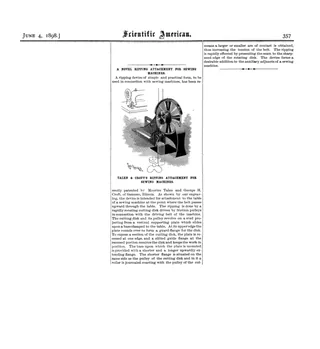
Novel Ripping Attachment for Sewing Machines
Scientific American, June 4, 1898
Article · 1 page
A short Scientific American article describing a ripping attachment for sewing machines, patented by Maurice Talen and George H. Croft of Geneseo, Illinois. A rotating cutting disk, driven by friction pulleys from the machine's driving belt, is mounted on a sliding plate clamped to the machine table, and seams are ripped by presenting them to the disk's sharpened edge. An engraving shows the attachment and a detail view.
The Pemberton Mill to be Re-Built
Scientific American, c. 1860
Article · 1 page
A short Scientific American news item reporting that one owner of the Pemberton Mill has bought out his partner and plans to rebuild the mill promptly with a stronger building. It attributes the collapse to poorly cast iron columns, whose cores floated in the mold and left one side very thin, and to columns straightened while hot, which hid the defect. It cites testimony that a spinning frame fell through the floor first, and notes that the architect's specifications called for far greater strength.
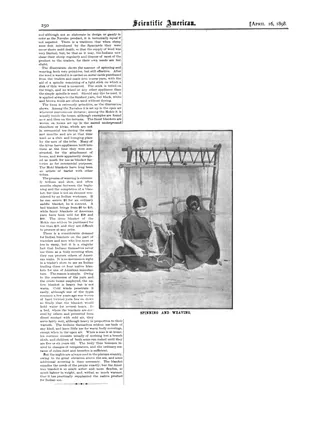
Pueblo Arts and Industries -- II
Article · 2 pages
A 1898 Scientific American article, the second in a series on Pueblo arts, by Cosmos Mindeleff. It describes the native costume of Hopi (Moki) women, especially the black wool lozenge-patterned blanket dress with blue border and green cord, and compares Hopi and Navaho blanket weaving. It covers men's weaving among the Hopi, hand spinning with a spindle, dyeing, the upright loom, weaving in kivas, prices, and why Indians preferred American-made blankets. Two photographs show Hopi maidens with traditional hair dressing and a woman at an upright loom.
Revolving Shuttle Box
Scientific American, 1848
Article · 1 page
A short 1848 note in Scientific American reporting E. Burt of Manchester, Connecticut, on early American power looms for plaids and ginghams. It says the first such loom, patented in 1828, used a revolving shuttle box on the rim of a small wheel, and that boxes at both ends of the lay were tried and dropped. It also mentions Burt's 1837 check loom patent and 1845 stop motion, and John Allan's 1839 introduction of a power check loom from Glasgow to Troy, New York.
Round-Lap Method for Shipping Cotton
Article · 2 pages
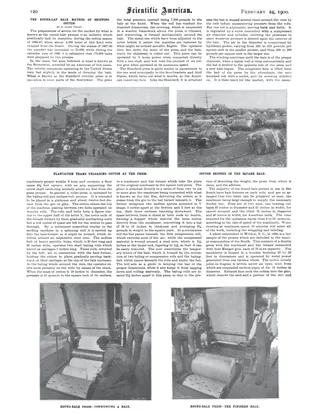
A Scientific American article of February 24, 1900, describing the round-lap (round-bale) method of baling cotton as an alternative to the square bale. It explains how the presses form a continuous bat from the gins and wind it around a steel core, and covers the Bessonette and Standard presses, bale sizes, operating times and power needs, and a sample plant at Weldon, N.C. It also lists the claimed advantages (density, shipping economy, lower fire risk) and the objections (fiber crushing, oil soiling). Illustrated with photographs of presses and bales.
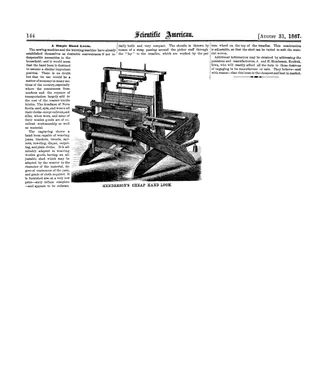
A Simple Hand Loom
Scientific American, August 31, 1867
Article · 1 page
A short 1867 Scientific American notice describing Henderson's Cheap Hand Loom, a treadle loom sold for sixty dollars. The article argues for the household and rural economy of hand looms and says the loom can weave jeans, blankets, tweeds, satinets, toweling, diaper, carpeting, and plain cloths. It describes the adjustable shed, the strap-driven shuttle with picker staff, and the pattern wheel on top of the treadles, and gives the makers' address. An engraving of the loom accompanies the text.
52 documents found