Textile Documents › Publications › Publication: Quarterly Journal of Economics
10 documents found
Sort: 
The Domestic and Foreign Wool Manufactures and the Tariff Problem
Article · 34 pages
A 1921 economic article by Arthur H. Cole that compares the competitive position of the American wool-manufacturing industry with that of Continental Europe and Great Britain, as a basis for the coming tariff revision. It covers postwar recovery of the French, Belgian and German industries, British technical advances (automatic doffers, Northrop looms, research associations), overhead costs and labor organization such as the Whitley councils. It then considers American overexpansion of spinning capacity, equipment, wage levels, standardization of products and industrial organization, and concludes that the prospects for improved American competitiveness are modest.
The Duties on Wool and Woollens
Article · 39 pages
An economics article by F. W. Taussig, published in the Quarterly Journal of Economics in October 1893, examining the effects of the U.S. tariff system on wool and woollens established in 1867. The first part treats duties on clothing, combing and carpet wool, covering domestic production, the westward shift of sheep raising, imports and price comparisons. The second part treats duties on woollen and worsted manufactures, their growth, imports, competition from foreign goods, and the likely effects of free wool and reduced woollen duties.
The Effect of Free Wool in the Northwest, 1893-96
Article · 3 pages
A short economics note arguing that the increase in sheep numbers in the northwestern United States during the free wool period (1894-97) does not show the industry was prosperous without a tariff. The author argues that growers held over flocks in hope of a Republican victory and renewed protection in 1896, citing falling sheep prices, Montana shipment statistics for 1893-98, and a quotation from Senator Warren. It closes by noting that dry land farming, not tariff policy, is displacing large range flocks in Montana.
Flax: The Fiber and Seed. A Study in Agricultural Contrasts
Article · 30 pages
A 1919 economics article comparing flax grown for spinning fiber with flax grown for seed (linseed oil). It describes European handicraft fiber culture, including hand pulling, rippling, water and dew retting, and scutching, against mechanized frontier flaxseed farming in the United States, Canada and Argentina. It also covers failed attempts to mechanize fiber production, the westward migration of the U.S. flaxseed crop, and the principle of comparative advantage. Appendix tables give U.S. flaxseed production by state, 1849-1916 acreage and bushels, and world fiber and seed output for 1911-13.
An International Survey of the Cotton Industry
Article · 21 pages
A 1903 economic article surveying the mechanized cotton industry in Great Britain, continental Europe, the United States, India, Japan and China. It compares raw cotton consumption, spindle counts, power loom adoption and yarn fineness, with statistical tables on British yarn exports to Europe, cotton imports into Shanghai, and imports into India. It also discusses tariffs, labor costs, the rise of Southern US mills and automatic looms, and the prospects for each region.
Recent Events in the New England Cotton Trade
Article · 3 pages
A short economic note from 1902 on the New England cotton goods trade in 1899-1902. It covers raw cotton prices, Southern mill competition and the stoppage of exports to China. It follows the wage disputes in Fall River, New Bedford and Lowell, including M. C. D. Borden's wage advances and the threatened strikes. It is useful for the labor and business history of the textile industry, not for weaving technique.
Some Aspects of the Wool Trade of the United States
Article · 20 pages
A 1911 economics article examining how raw wool is bought and sold between American growers and manufacturers. It describes the private-sale system and how buying differs among eastern fleece wools, western territory wools and Pacific Coast wools. It also covers the role of the Boston and Philadelphia wool merchants. The article reviews attempts to reorganize the trade: the failed New York Wool Exchange (1894-98), local and terminal warehouses such as Omaha and the National Wool Warehouse in Chicago, and improvements like the Boston warehouse and a proposed conditioning house. It includes statistics on US wool production, imports and consumption around 1909.
Specialization in the Woolen and Worsted Industry
Article · 28 pages
Economic article analyzing vertical specialization in the American woolen and worsted industries, using 1904 and 1909 U.S. Census figures on establishments, spindles, looms and combing machines. It describes the carding and combing processes, compares the U.S. industry with England, France and Germany, and discusses the reasons the worsted branch is more specialized than the woolen branch, drawing on Professor Clapham. It ends with the tendency toward separate wool-combing (top-making) mills in the United States.
Statistics of Iron and Cotton 1830-1860
Article · 6 pages
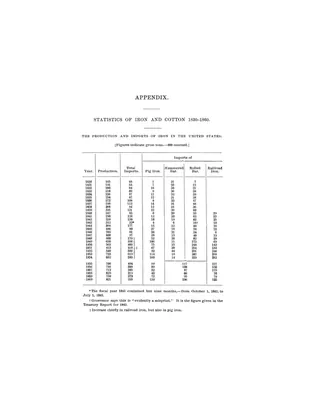
An appendix from the Quarterly Journal of Economics (pp. 379-384) presenting statistical tables on U.S. iron production and imports, 1830-1860, and cotton consumption in the United States and Great Britain. The accompanying text discusses the reliability of the sources (Raymond, Carey, Taylor, Grosvenor, Lesley, Swank, Nourse, Hunt, Ellison) and how the figures were converted. It also gives a table of U.S. exports of cotton manufactures, 1826-1860. Useful for the economic and tariff context of the American cotton textile industry; it has no weaving content.
Wool-Growing and the Tariff Since 1890
Article · 38 pages
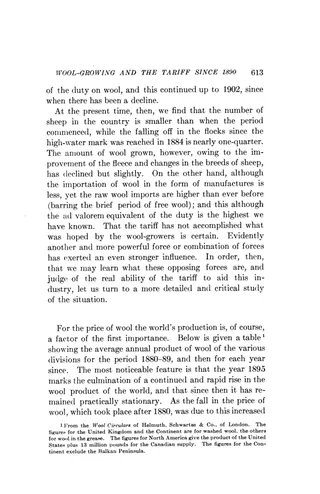
A 1905 economics article reviewing American wool-growing and the effects of the wool tariff from the McKinley Act of 1890 through the Wilson Bill (free wool) and the Dingley Act of 1897 to 1904. It examines world wool production, import trends by wool class, and the limits of the duty in protecting growers. It also covers the shift of sheep-raising from the East to the arid West, competition from dairying, grain and mutton breeds, and falling wool consumption due to shoddy and cotton. Statistical tables of production, imports and sheep numbers by region are included. It concludes that general agricultural conditions mattered more than the tariff.
10 documents found