Textile Documents › Authors › Author: Elijah Helm
7 documents found
Sort: 
Alleged Decline of the British Cotton Industry
Article · 10 pages
Part I of Elijah Helm's article in the Economic Journal, answering a Blackwood's Magazine claim that the British cotton industry, especially in Lancashire, is in permanent decline. Using statistical tables on spindles, cotton consumption, yarn and piece-goods exports, cotton weight in exports versus home use, and loom numbers (roughly 1874-1892), he argues the industry has kept growing, slowly. He discusses the shift of spinning from North to South Lancashire, joint-stock spinning companies, and weaving sheds. The scan ends with the start of an unrelated short note, 'The Villa and the Manor'.
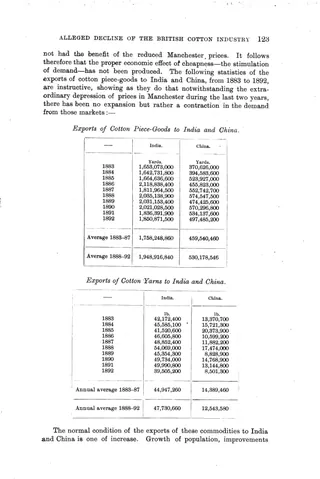
Alleged Decline of the British Cotton Industry
Article · 8 pages
Part II of an 1893 Economic Journal note on whether the British cotton industry is in decline. It argues that the silver-gold exchange disturbance, falling prices and rising effective foreign tariffs have slowed exports, and presents tables of cotton piece-goods and yarn exports to India and China for 1883-1892. It then lists Lancashire's lasting advantages: moist climate, cheap ocean transport, skilled labour, Manchester's commercial organisation and free trade. It concludes that the industry is not in permanent decay.
Cultivation of Cotton in West Africa
Article · 10 pages
A 1902 article arguing that West Africa could become a major source of raw cotton if it were grown systematically as an annual crop rather than gathered from indigenous perennial trees. It reviews the cotton shortages affecting Lancashire spinners, compares Africa with India and the United States, and draws on the records of the Cotton Supply Association (1857-71) and its journal, the Cotton Supply Reporter. It covers attempts at cultivation in Lagos, Yoruba country, Liberia and the Gold Coast, with import statistics for 1859-70, and notes the decline of native handloom weaving as imported cloth spread. It closes with recommendations on gins, buying agencies, native versus exotic seed, and transport.
The Indian Duties on Cotton Goods
Article · 5 pages
A 1896 economic article tracing the history of Indian customs and excise duties on cotton yarns and piece goods, from the 1894 tariff exemption through the Act of December 1894 to the February 1896 Act. It explains why the attempt to exempt coarse goods that did not compete with Indian mills failed, citing the 1879-80 'duty frees' experience of substitution of 30s cloths for finer counts. It also covers Lancashire objections, the exemption of handloom goods from tax, and the final uniform 3.5 percent duty on imported and Indian mill-made cloth.
The Indian Import Duties on Cotton Goods and Yarns
Article · 4 pages
An 1895 article from The Economic Journal on the Indian import duty of 5 per cent on cotton goods and yarns, reimposed in December 1894. It argues that the accompanying excise on Indian yarn finer than 20s does not neutralize the protection given to Indian mills, partly through the 'law of substitution'. It also argues that the duties harm Lancashire manufacturers, especially in the Blackburn district. The scan opens with the end of an unrelated article on the boot trade and closes with the start of a note on the prices of the rupee and silver.
An International Survey of the Cotton Industry
Article · 21 pages
A 1903 economic article surveying the mechanized cotton industry in Great Britain, continental Europe, the United States, India, Japan and China. It compares raw cotton consumption, spindle counts, power loom adoption and yarn fineness, with statistical tables on British yarn exports to Europe, cotton imports into Shanghai, and imports into India. It also discusses tariffs, labor costs, the rise of Southern US mills and automatic looms, and the prospects for each region.
Recent Wages Dispute in the Lancashire Cotton-Spinning Industry
Article · 4 pages
Economic Journal article by Elijah Helm on the 1892-93 wages dispute in the Lancashire cotton-spinning industry, a 20-week stoppage from November 1892 to March 1893 that idled about 50,000 operatives and 16,000,000 spindles. It covers the employers' proposed 5 per cent wage cut, the operatives' preference for short time, the effect on the Manchester yarn and cloth markets, and the final settlement of about 3 per cent. Helm also discusses the strike versus lock-out terminology, the case for a sliding scale of wages, and the refusal of the Manchester Joint Board of Conciliation's offer of mediation.
7 documents found