Textile Documents › Publications › Publication: Economic Journal
13 documents found
Sort: 
Alleged Decline of the British Cotton Industry
Article · 10 pages
Part I of Elijah Helm's article in the Economic Journal, answering a Blackwood's Magazine claim that the British cotton industry, especially in Lancashire, is in permanent decline. Using statistical tables on spindles, cotton consumption, yarn and piece-goods exports, cotton weight in exports versus home use, and loom numbers (roughly 1874-1892), he argues the industry has kept growing, slowly. He discusses the shift of spinning from North to South Lancashire, joint-stock spinning companies, and weaving sheds. The scan ends with the start of an unrelated short note, 'The Villa and the Manor'.
Alleged Decline of the British Cotton Industry
Article · 8 pages
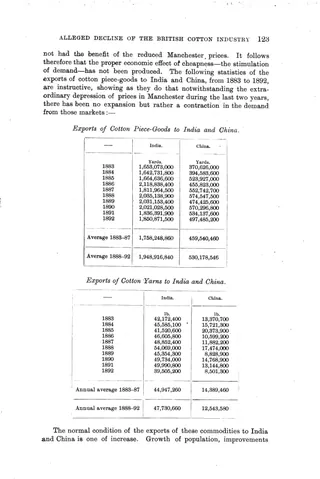
Part II of an 1893 Economic Journal note on whether the British cotton industry is in decline. It argues that the silver-gold exchange disturbance, falling prices and rising effective foreign tariffs have slowed exports, and presents tables of cotton piece-goods and yarn exports to India and China for 1883-1892. It then lists Lancashire's lasting advantages: moist climate, cheap ocean transport, skilled labour, Manchester's commercial organisation and free trade. It concludes that the industry is not in permanent decay.
Early Records of a Great Manchester Cotton-Spinning Firm
Article · 14 pages
Economic history article by G. W. Daniels drawing on the preserved records of McConnel and Kennedy, a Manchester fine cotton-spinning firm founded in 1791. It covers the partnership's origins, its growth in capital, workforce and steam power from 1795 to 1815, and how it bought raw cotton from Manchester dealers, Liverpool brokers and American suppliers. It also describes how it sold yarn to the Manchester, Nottingham, Glasgow and Paisley, and Belfast markets, including credit terms, agents' commissions, exchange losses, carriage and the shortage of coin.
The Indian Duties on Cotton Goods
Article · 5 pages
A 1896 economic article tracing the history of Indian customs and excise duties on cotton yarns and piece goods, from the 1894 tariff exemption through the Act of December 1894 to the February 1896 Act. It explains why the attempt to exempt coarse goods that did not compete with Indian mills failed, citing the 1879-80 'duty frees' experience of substitution of 30s cloths for finer counts. It also covers Lancashire objections, the exemption of handloom goods from tax, and the final uniform 3.5 percent duty on imported and Indian mill-made cloth.
The Indian Import Duties on Cotton Goods and Yarns
Article · 4 pages
An 1895 article from The Economic Journal on the Indian import duty of 5 per cent on cotton goods and yarns, reimposed in December 1894. It argues that the accompanying excise on Indian yarn finer than 20s does not neutralize the protection given to Indian mills, partly through the 'law of substitution'. It also argues that the duties harm Lancashire manufacturers, especially in the Blackburn district. The scan opens with the end of an unrelated article on the boot trade and closes with the start of a note on the prices of the rupee and silver.
Nottingham Lace and Fashion
Article · 7 pages
An 1893 economic essay on how fashion drives the prosperity of Nottingham's machine-made lace industry. It divides the trade into curtain, plain net and fancy lace (cotton, silk and embroidery), and compares Nottingham with rivals in Calais, Switzerland and Plauen. It discusses the supposed ten-year fashion cycle, the effect of the embroidery machine, boom-and-bust conditions for machine owners and twist hands, and the influence of fashion magazines.
The Progress of the Nation, in its Various Social and Economic Relations, from the Beginning of the Nineteenth Century
Article · 5 pages
A review by W. J. Ashley, published in the Economic Journal in 1912, of the new edition of G. R. Porter's The Progress of the Nation, revised by F. W. Hirst and staff of The Economist. Ashley criticizes the editorial method of abridging Porter's text and adding later statistical chapters, citing omitted passages and inconsistent figures such as the silk export tables. The review touches on the silk industry, the Jacquard loom and the Cobden Treaty. The scan begins with the end of a preceding review by I. G. Gibbon on German insurance and ends at the start of a review of Cunningham's The Case Against Free Trade.
Recent Wages Dispute in the Lancashire Cotton-Spinning Industry
Article · 4 pages
Economic Journal article by Elijah Helm on the 1892-93 wages dispute in the Lancashire cotton-spinning industry, a 20-week stoppage from November 1892 to March 1893 that idled about 50,000 operatives and 16,000,000 spindles. It covers the employers' proposed 5 per cent wage cut, the operatives' preference for short time, the effect on the Manchester yarn and cloth markets, and the final settlement of about 3 per cent. Helm also discusses the strike versus lock-out terminology, the case for a sliding scale of wages, and the refusal of the Manchester Joint Board of Conciliation's offer of mediation.
Regulation of Wages by Lists in the Spinning Industry
Article · 8 pages
An 1899 economic history article by S. J. Chapman on how wages in the Lancashire cotton spinning industry came to be regulated by printed price lists. It traces the origins of private and district lists from about 1810 through the 1830s, their decline, and their revival at Preston, Bolton and Oldham, and corrects the 1887 British Association report on the date of the first list. It compares the Oldham and Bolton lists, discusses speed lists, a universal list, piece rates, piecers' wages, and sliding scales.
The Selling and Financing of the American Cotton Crop
Article · 11 pages
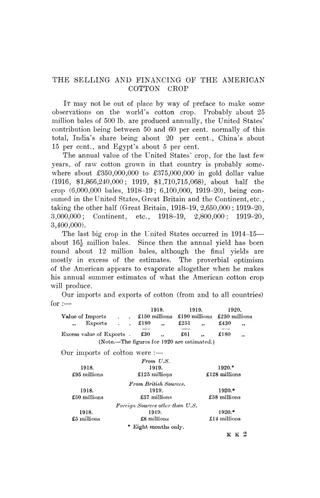
A 1920 article from the Economic Journal on how the American cotton crop is financed and sold. It covers world and U.S. production figures, British cotton imports and exports, and credit from farmer to storekeeper, factor, gin receipts, bills of lading and banks. It also treats sterling versus dollar pricing and exchange risk, the cotton futures market and hedging, financing in England through acceptances, and postwar economic conditions. It is economic and banking history with no textile technique content.
Some Policies of the Cotton Spinners' Trade Unions
Article · 7 pages
An economic history article by S. J. Chapman on the policies of British cotton spinners' trade unions, aimed at keeping wages high. It traces the shift from apprenticeship restrictions modeled on the weavers' clubs to enforcing a fixed ratio of spinners (minders) to machinery, and discusses the position of piecers. It also covers employer countermeasures such as coupling of wheels, the doffing system, the apprenticeship system and the joining system, and the union responses, with footnotes citing parliamentary reports and union records.
The Weavers of Bradford, Their Work and Wages
Economic Journal, December 1893
Article · 1 page
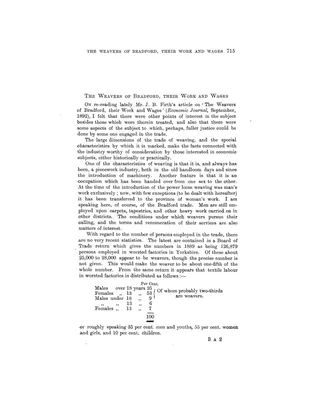
A single-page opening of an 1893 Economic Journal article on weavers in the Bradford worsted trade, written as a supplement to J. B. Firth's earlier article of September 1892. It introduces weaving as a piecework industry that shifted from men to women with the power loom, and gives Board of Trade figures for 1889 on worsted factory employment in Yorkshire, broken down by sex and age.
The Wool Trade in War Time
Article · 23 pages
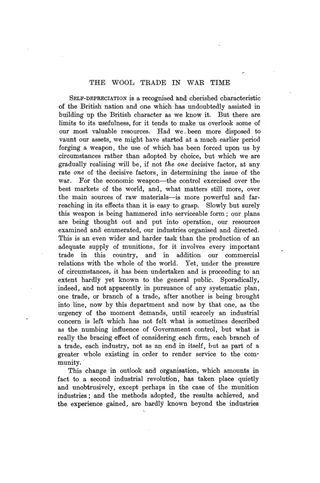
A 1918 Economic Journal article describing how British Government control reshaped the wool textile industry during the First World War. It outlines the pre-war structure of woollen, worsted, hosiery and carpet manufacture, with a table of workers, firms and machinery by district. It then covers requisitioning and pricing of war goods, purchase of the Australasian wool clip, labour supply and women's employment, allocation of contracts, reduced working hours, rationing of wool, tops and yarn, and the Board of Control. It also treats export licensing to the Allies, control of wool waste, and prospects for postwar trade.
13 documents found