Textile Documents › Publications › Publication: New International Encyclopedia
119 documents found
Sort: 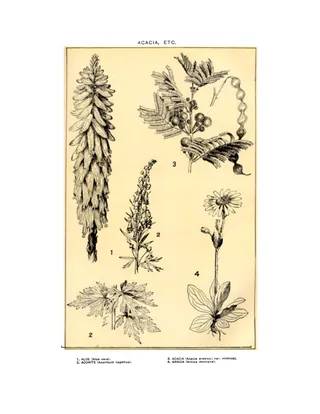
Acacia
Article · 2 pages
An encyclopedia entry on the plant genus Acacia, covering its botany, distribution, and economic uses such as gum arabic, tanning bark (wattle), catechu, and timber. A second page carries a botanical plate showing aloe, aconite, acacia, and arnica. It is general botany and has no weaving content, though the tanning and gum uses touch on materials used in textile and leather processing.
Alpaca
Article · 1 page
A short encyclopedia entry on the alpaca, a domesticated Andean cameloid related to the llama, guanaco and vicuña. It describes the animal, its semi-domesticated flocks in Peru, and the annual shearing. It also covers the qualities of the fleece, its use in Andean ponchos and blankets, and the start of the European alpaca cloth industry under Sir Titus Salt at Saltaire from 1836.

Beetling
Article · 1 page
A short encyclopedia entry defining beetling, a mechanical finishing process for linen and for cotton cloth imitating linen. It describes how rows of upright wooden stamps strike cloth passing over a roller to flatten the yarn and give a hard, wiry look, and notes its use on fine linen damask. It also mentions beetling or hammering linen weft yarn for sailcloth to soften it for weaving.
Blanket
Article · 1 page
A page from the New International Encyclopedia on blankets. It covers the Navajo blanket (reservation, sheep, spinning on a spindle, upright loom, colors, geometric patterns, value by weight) and the history of blanket manufacture in the United States from the War of 1812 through the Civil War. It also notes cotton-warp and woolen-filling blankets, finishing to a fleecy surface, and fine Mysore blankets.
Bleaching
Article · 2 pages
Encyclopedia article on bleaching of textile fibers, covering its ancient origins and historical development from sun and grass bleaching to Dutch buttermilk and sulphuric acid methods, then chlorine (1785) and bleaching powder (1799). It describes modern (early 20th-century) processes for cotton, linen, wool, and silk, including scouring of wool and degumming of silk, and ends with a bibliography of English and German works.
Blue
Article · 1 page
A one-page encyclopedia entry on the color blue from the New International Encyclopedia. It covers the etymology of the word, the color's use in military uniforms, and blue minerals and gems. Most of the text lists blue pigments and blue dyestuffs with their chemical origins, including Prussian blue, cobalt blue, ultramarine, indigo, logwood blue and the aniline-derived blues.
Bobbin
Article · 1 page
A short encyclopedia entry defining the bobbin as a small wooden or metal roller, flanged at one or both ends, used to hold thread or yarn for sewing, weaving and other work. It notes that weaving bobbins usually have a flange at one end only, and that sewing-thread spools and sewing machine shuttle bobbins are common examples. It briefly describes automatic machine manufacture of wooden bobbins and cross-references the Loom entry.
Brocade
Article · 1 page
A brief encyclopedia entry defining brocade as a silk fabric with figures formed by raised warp or filling threads. It notes the long history of brocade manufacture in Oriental countries and in Europe since the thirteenth century, and mentions the early use of gold and silver threads.

Buckram
Article · 1 page
A brief encyclopedia entry defining buckram as a coarse linen or cotton cloth sized with glue. It notes the uses of buckram as a stiffener in clothing and in bookbinding, gives the Old French origin of the word, and says the name first applied to a more costly material used for ecclesiastical purposes and garments.
Calendering
Article · 1 page
A one-page encyclopedia entry defining calendering, the finishing process that gives paper and textile fabrics such as linen and cotton a glazed or polished surface by passing them between pressure rolls. It describes calender construction (3 to 12 rolls of wood, paper, cotton, or heated metal), starching and paraffin or soap additions, friction glazing, and watering patterns. It closes with references to Beaumont and Edge and cross-references to Beetling and Paper.
Cambric
Article · 1 page
A short encyclopedia entry defining cambric as the finest, thinnest plain woven linen fabric. It gives the derivation of the name from Cambrai, France, notes that fine cambrics are now made in Switzerland, and mentions cotton imitations made with hard-twisted fibre.

Camlet
Article · 1 page
A short encyclopedia entry defining camlet, a fabric originally made of camel's hair and later of Angora goat hair, with a waved surface. It gives the Arabic origin of the word and notes that camlets are woven from wool alone or mixed with cotton or linen and spun hard.
Canvas
Article · 1 page
A short encyclopedia entry defining canvas as a strong coarse cloth of cotton, flax, or hemp. It covers its use on ships for sails, awnings and covers, including the numbered weight grades of flax sailcloth, and its use by artists as a stretched linen painting support, with standard portrait canvas sizes.
Carding
Article · 1 page
A short encyclopedia entry defining carding as the mechanical process of disentangling and aligning cotton, wool, or flax fibres with wire-toothed cylinders before spinning. It describes card clothing, the carding engine attributed to Lewis Paul (1738), the doffer and doffing knife, and how slivers are formed. It also notes the machine arrangements used for wool, cotton, and worsted, and refers readers to Murphy's The Textile Industries and the article on Spinning.
Carmine
Article · 1 page
A short encyclopedia entry on carmine, a red pigment made from cochineal. It covers the word's etymology, its uses in inks, silk dyeing, artificial flowers and painting, and its reported accidental discovery by a Franciscan monk at Pisa. It gives two preparation methods, describes carminic acid, and notes carmine lake and its replacement by coal-tar colors.
Carpets and Rugs
Article · 3 pages
An encyclopedia article defining carpets and rugs and surveying the main types sold in the early twentieth century, including Brussels, Wilton, tapestry, velvet, ingrain, Axminster, Smyrna, chenille Axminster, Aubusson, savonnerie, and rag rugs. It outlines how each is woven and how they differ, along with the history of hand-knotted rugs in Europe. It also covers the growth of the American carpet industry from colonial hand weavers to power looms, with production statistics for 1850, 1899, and 1909, and ends with a short bibliography.

Chay Root
Article · 1 page
A short encyclopedia entry on chay root (Oldenlandia umbellata), a perennial plant of the madder family native to India. It describes cultivation on the Coromandel coast for its orange roots, whose bark yields a red dye. It notes the dye's use for painting red figures on chintz and its role as Indian madder.
Child Labor
Article · 4 pages
Encyclopedia article on child labor in industry, tracing its growth with the English factory system and the cotton and woolen mills of the late eighteenth century. It outlines British factory legislation from 1802 to 1902, then conditions and laws in the United States (minimum ages, hours, night work, dangerous trades, enforcement, child-labor committees) and in continental Europe. It ends with a bibliography of English, Italian and German sources.
Chintz
Article · 1 page
A short encyclopedia entry defining chintz as a highly glazed printed cotton fabric with multicolored patterns on a white or light ground. It gives the word's Hindi, Bengali and Sanskrit origins and notes its use for bed hangings, and cross-references cretonne.
Coal Tar
Article · 1 page
A one-page encyclopedia article describing coal tar, the black oily by-product of making illuminating gas from soft coal. It explains the fractional distillation of the tar into first runnings, light oil, carbolic oil, creosote oil, anthracene oil and pitch, and the products from each (benzene, naphtha, phenols, naphthalene, anthracene). It notes that anthracene is used to make alizarin dyes, which replaced madder root.
Coal Tar Colors
Article · 4 pages
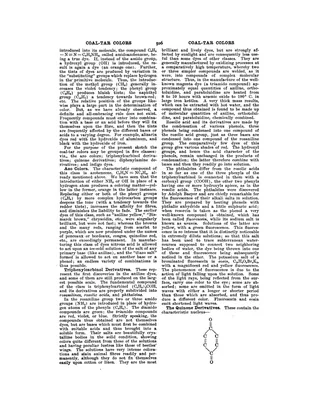
Encyclopedia article on coal-tar (aniline) dyes from the New International Encyclopedia. It covers the history of the synthetic dye industry from Runge and Perkin's mauve to artificial alizarin and indigo, how the dyes are classified by chemical constitution (azo, triphenylcarbinol, quinone, diphenylamine, indigo), and how they are made and applied to fibres. It ends with an alphabetical list of commercial coal-tar colors with formulas and manufacturing methods, plus a bibliography.
Coccidae
Article · 1 page
A one-page encyclopedia entry on the Coccidae, the family of scale insects, mealy bugs and bark lice. It covers their biology and the coverings they secrete, and notes the products derived from them: lac or shellac, the red dye lake, cochineal, other dyes, and waxes. It cites Newstead's monograph and a U.S. Department of Agriculture bulletin, and cross-references Lac Insect and Scale Insect.
Cochineal
Article · 1 page
A single-page encyclopedia entry on cochineal, the scale insect (Coccus cacti) used to produce scarlet and crimson dye. It covers the insect's etymology and life cycle, cultivation on nopal cactus in Mexico, harvesting, killing and drying methods, and transplantation to the Canary Islands, Java and Algeria. It notes the dye's use on wool and silk and its decline due to cost and replacement by coal-tar dyes.
Coconut
Article · 2 pages
Encyclopedia article on the coconut palm (Cocos nucifera), covering its origin, distribution, botany, and yield. It describes the uses of the fruit, oil, copra, sap, leaves, wood, and especially coir fibre from the husk, along with related species. Of interest to textile researchers for the passages on coir, cordage, and leaf plaiting for mats and baskets.
Coir
Article · 1 page
A short encyclopedia entry on coir, the coconut husk fibre, covering its etymology, the two grades of fibre (ordinary and brush fibre), and its spinning into yarn for doormats and matting. It gives 1913 US import figures and mentions uses of the refuse for mattress stuffing and horticulture.

Corduroy
Article · 1 page
A short encyclopedia entry defining corduroy as a cotton fabric with a cut, ribbed pile like velvet. It explains that the pile weft is bound to the cloth and cut by a special knife during weaving on a plush loom, and cross-references fustian.
Costume
Article · 9 pages
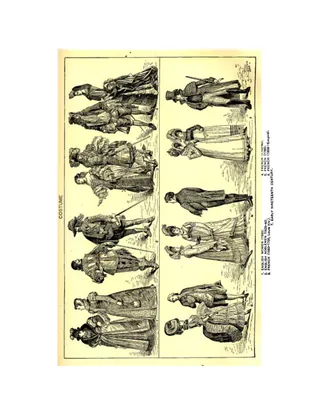
An encyclopedia article on costume as dress considered from the standpoint of style, surveying clothing across periods and cultures. It discusses the origins and purposes of clothing, the division between trouser-based and skirt-based dress, and the costume of ancient Egypt, China, India, Greece, Etruria, and the Arab world. It then follows European dress from the Middle Ages through the eighteenth century and the French Revolution. Two plates show engraved figures in period dress from Greek and Roman times to the early nineteenth century.
Costume, Ecclesiastical
Article · 7 pages
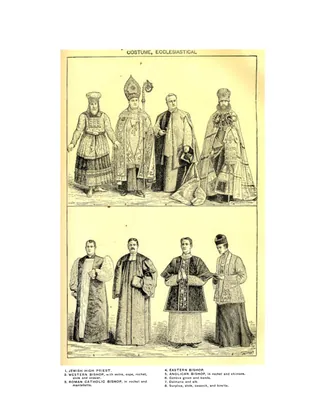
Encyclopedia article on the official dress of clergy, covering its development from Jewish priestly dress and the early Christian church to the present. It describes Western vestments (chasuble, stole, alb, cope, surplice, and episcopal items such as mitre and pallium), Eastern, Anglican, Protestant and monastic costume, and liturgical colors. It includes engraved plates of vestments, a bishop series, and a Jesuit in mandarin dress, and ends with a bibliography.
Cotton
Article · 8 pages
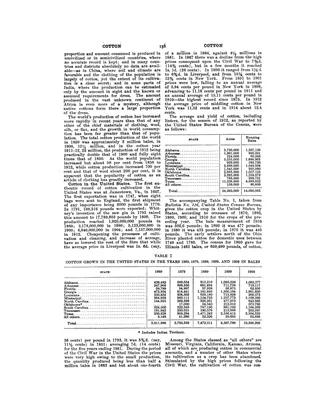
An encyclopedia article on cotton from the New International Encyclopedia, covering the fibre's botany, species and commercial grades, cultivation, diseases, baling and marketing, and the history of production in the United States and worldwide. It includes statistical tables on U.S. production by state, world exports of cotton goods, spindles in mills and world consumption. It also touches on the cotton industry in Japan, India and China, including household weaving in Japan.
Cotton, Artificial
Article · 1 page
A very short encyclopedia entry defining artificial cotton as filaments made by chemically treating wood pulp or other cellulose so they can be woven into textiles. It notes that these filaments are also called artificial silk or wood-pulp yarns and refers readers to the entry on wood-pulp yarns.

Crape
Article · 1 page
A short encyclopedia entry defining crape, a thin crinkled fabric made from tightly twisted raw silk. It describes the weaving as a thin gauze, the gum dressing that produces the wrinkled surface, and its use in black as mourning wear. It also mentions Japanese and Chinese crapes and wool crape cloth made by roller embossing.
Cretonne
Article · 1 page
A short encyclopedia entry defining cretonne, a thick, strong printed cotton fabric used for curtains and furniture coverings. It notes the name's origin from a French manufacturer, contrasts cretonne with glazed chintz, and describes its uneven woven surface, cheaper weft yarns of waste cotton, and fugitive printed colors.
Crinoline
Article · 1 page
Encyclopedia entry on crinoline, explaining the name's origin from Latin words for hair and flax and its first use for a stiff horsehair fabric. It traces the history of skirt-distending fashions from the Elizabethan farthingale and the eighteenth-century hoop petticoat to the steel-hoop crinolines of the mid-nineteenth century and their collapse around 1866. It ends by noting that by the late nineteenth century the term meant a glue-stiffened cotton gauze sold to milliners and dressmakers.

Crochet
Article · 1 page
A very short encyclopedia entry defining crochet. It gives the etymology of the word (French for hook) and describes crochet as fancywork in which linen, cotton, worsted, or silk thread is looped with a hooked needle to make decorative and useful articles. It notes that varied patterns and openwork come from twisting the thread or passing over loops.
Crotalaria
Article · 1 page
A short encyclopedia entry on Crotalaria, a genus of about 250 leguminous plants with inflated rattling pods. It describes the species that yield commercial fibers, especially Sunn hemp (Crotalaria juncea) and Jubbulpore hemp (C. tenuifolia) of India, and notes C. burhia grown in Sinde. It also mentions U.S. species thought to poison horses.
Damask
Article · 1 page
A short 1922 encyclopedia entry defining damask as a textile with satin, twill, or taffeta figures on a satin ground. It contrasts damask, a warp-manipulated weave made with a harness, with tapestry, a weft weave. It also covers materials (silk, wool, linen, cotton), upholstery silk damasks, linen table damasks, and the loose historical use of the term.
Dimity
Article · 1 page
A short encyclopedia entry defining dimity, a figured cotton fabric first made in Spain and used mainly for bed hangings. It gives the etymology of the name from Greek, notes that Massachusetts colonists made dimities and fustians by 1643, and describes the raised and depressed figure or stripe that is reversed on the two faces. It also mentions the finer dimity used for dresses.
Dornick
Article · 1 page
A short encyclopedia entry defining dornick (also spelled dornic or dornock) as a stout linen cloth woven in a simple diaper pattern. It gives the origin of the name from Dornich, or Tournay, in the Netherlands, and notes the likely spread of manufacture to Norfolk, England, with Dutch emigrants fleeing the Duke of Alva's persecution.
Drill
Article · 1 page
A very short encyclopedia entry defining drill, a heavy twilled linen or cotton fabric with a satiny finish. It gives the etymology of the word, tracing it from German Drillich and Old High German drilich to Latin trilex, 'three-threaded'.
Drying Machines
Article · 1 page
A short encyclopedia entry describing machines used to dry textile materials. It explains centrifugal extractors, with a perforated inner drum spinning inside an outer cylinder, and roller wringers that squeeze out moisture. It notes that remaining moisture is removed by air drying, hot chambers, or heated cylinders and steam pipes.
Dyeing
Article · 4 pages
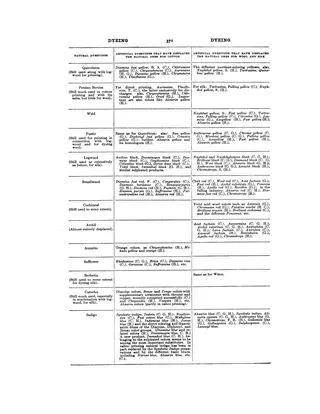
Encyclopedia article on dyeing from the New International Encyclopedia (pp. 370-373). It covers the history of dyeing from antiquity (Tyrian purple) to Perkin's mauve in 1856, a table of natural dyestuffs and the artificial dyes that replaced them for cotton, wool and silk, and an explanation of mordants and classes of dyes. It also discusses theories of dyeing, preparation and bleaching of fibres, dyeing apparatus, methods such as skein, piece, cross, resist and discharge dyeing, colorfastness, and a bibliography.
Embossing
Article · 1 page
Encyclopedia entry defining embossing as the art of producing relief figures on paper, leather, wood, metal, and cloth. It describes dies and counterdies, fly presses, and roller embossing of large textile surfaces such as table covers. It also covers methods for embossing wood and mentions embossing in needlework done by embroidering over padded figures.
Embroidery
Article · 2 pages
An encyclopedia article surveying embroidery from prehistoric skin decoration through the early twentieth century. It traces the history by region (Near East, Greece, Rome, Byzantium, Italy, Spain, Germany, the Netherlands, France, England, and the Orient), citing notable surviving pieces such as the Syon cope. It closes with a short account of tools and principal stitches (cross, tent, chain, buttonhole, satin, couching, appliqué) and a bibliography.
Fashion
Article · 2 pages
Two-page encyclopedia entry defining fashion as the style of dress of a brief period, and distinguishing it from costume by scale and permanency. It uses examples from Munich and Bavarian peasant dress, then outlines changes in men's and women's dress from the French Revolution through the Louis Philippe era, the crinoline and hoopskirt period, Bloomer's rational dress, the princess dress and the tailor-made gown, up to about 1920. It ends with a short bibliography of works on dress history.
Felt
Article · 2 pages
Two-page encyclopedia article on felt as a fabric made without weaving. It covers the origin of felt making, the scaly structure of wool and hair that causes fibres to interlock, the first mechanical felting process (J. R. Williams, c. 1820), and the uses of felt, including hats, floor coverings, piano hammers, and roofing and lining felts. It ends with a bibliographic pointer to Murphy's The Textile Industries and 1909 U.S. census statistics on felt manufacture.
Fibre
Article · 3 pages
Encyclopedia article defining 'fibre' and surveying the animal, vegetable and mineral fibres used for textiles, cordage and other purposes. It covers wool, hair, silk and byssus, then bast, structural and surface plant fibres, how they are separated, a chemical test for separating wool or silk from cotton, and the principal commercial fibres with their regions of production. It ends with six categories of use and a short bibliography.
Flannel
Article · 1 page
A short encyclopedia entry defining flannel as a woven fabric used mainly for underclothing and other garments, usually of wool, sometimes combined with silk, linen, cotton or worsted. It covers dyeing and printing, the decline of all-wool flannel against cotton blends and knitted goods, and describes French, Canton, outing and Domett flannels. It refers readers to the entry on wool and worsted manufactures for production details.
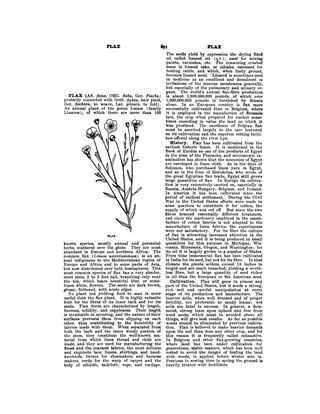
Flax
Article · 3 pages
Encyclopedia article on flax (Linum usitatissimum) from the New International Encyclopedia, pp. 671-673. It covers the botany of the plant, its uses for linen fibre and linseed oil, history of cultivation, and world production statistics. It describes soil and growing requirements, then the dressing steps of rippling, retting (dew, pool, running water, and chemical or heated-tank methods), breaking, scutching, and heckling, up to the point of spinning.
Flax, New Zealand
Article · 1 page
A short encyclopedia entry on New Zealand flax (Phormium tenax, harakeke), a leaf fibre unrelated to common flax. It describes the plant, its native range and growing conditions, and its traditional Maori uses for clothing, rope, twine and mats. It also covers fibre extraction by maceration, the older hand method using thumb nails and combs, and later machine stripping, with yields per acre.
Floss Silk
Article · 1 page
A short encyclopedia entry defining floss silk as the soft fibre taken from the outer part of the silk cocoon after reeling. It notes that the fibre is carded and spun but not twisted, giving a downy, lustrous texture, and that it is used mainly for embroidery. It includes a brief etymology and a cross-reference to the article on silk.
119 documents found