Textile Documents › Publications › Publication: Master Weaver
297 documents found
Sort: 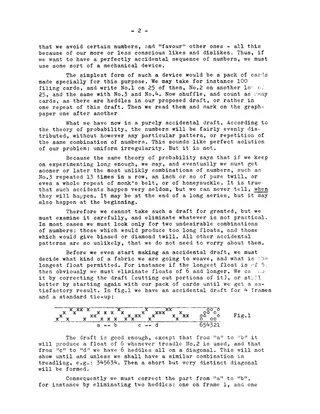
Accidental Weaves (Drafts based on Theory of Probability)
Master Weaver, March 1956
Article · 6 pages · weaving drafts
An article from Master Weaver No. 26 (March 1956) on designing irregular, fully random 'accidental' weaving drafts for textured but uniform fabrics. It explains using card packs, dice, telephone directories, roulette or bingo to generate random threading and treadling sequences, then checking for long floats and accidental twill or diamond patterns. Worked examples for 4 and 8 shafts are given in Figs. 1-5, along with a practical coat-length project in heavy wool with a seven-end colour warp (Fig. 6).
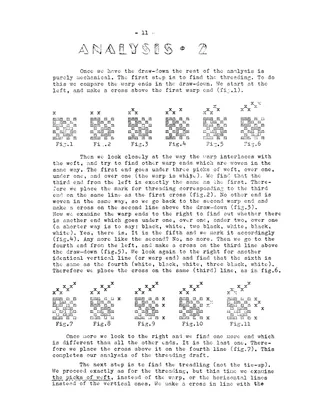
Analysis 2
Master Weaver, September 1956
Article · 2 pages · weaving drafts
A two-page instructional lesson from Master Weaver on analysing a woven fabric from its draw-down. It explains step by step how to find the threading by comparing warp ends, then the treadling by comparing weft picks, and finally how to deduce the tie-up for a four-shaft sample. Illustrated with small numbered figures (1-17) showing the marks being built up on the grid.
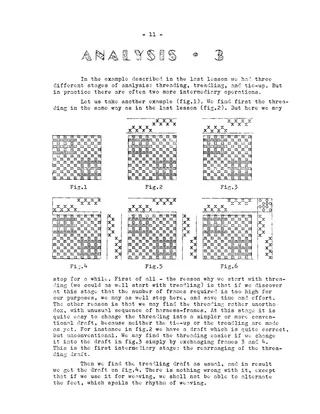
Analysis 3
Master Weaver, November 1956
Article · 2 pages · weaving drafts
A short lesson from the Master Weaver series on analyzing woven cloth into a draft, continuing from the previous lesson. It adds two intermediary steps, rearranging the threading and rearranging the treadling, to make a five-stage analysis. It explains how to simplify drafts, make them easier to thread, adapt them to standard tie-ups, and arrange treadling so the feet alternate. Nine figures illustrate the examples.
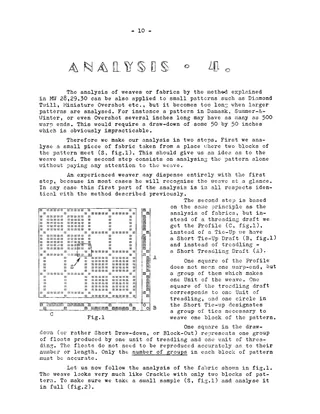
Analysis 4
Master Weaver, March 1957
Article · 2 pages · weaving drafts
Fourth and final lesson in a series on analyzing woven fabrics, from the Master Weaver newsletter. It explains a two-step method for large patterns: first analyze a small sample to identify the weave, then reduce the pattern to a profile draft, short tie-up, and short treadling draft. A worked example of a two-block fabric that resembles Crackle turns out to be Summer-and-Winter woven Crackle-style, and the full threading and treadling are reconstructed from the profile.
Analysis of Fabrics
Master Weaver, February 1952
Article · 3 pages · weaving drafts
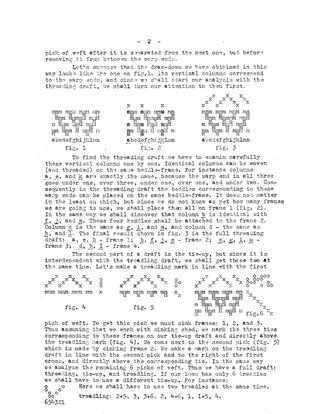
An article from Master Weaver (Z-Handicrafts, Fulford, Quebec) explaining how a handweaver analyses a single-layer fabric sample. It describes marking one repeat, making a draw-down on graph paper, identifying identical warp columns to derive the threading, and deriving the tie-up and treadling together. It also covers counting the frames needed, rearranging threading and tie-up into standard forms, and recording yarn and finishing data. Illustrated with draw-down and draft figures; it closes by announcing follow-up articles on short analysis and three-dimensional fabrics.
Analysis of Patterns
Master Weaver, April 1952
Article · 4 pages · weaving drafts
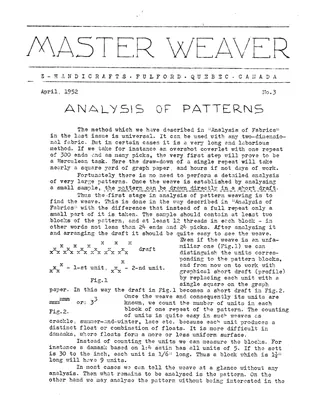
An article from Master Weaver (April 1952) on analyzing woven pattern structure without drawing down a full repeat. It explains how to identify the weave from a small sample, convert units to graphical short drafts (profiles), and develop them into full drafts for lace and summer-and-winter. For overshot, all-over spot, and crackle, which lack distinct units, it describes numerical short drafts and how to read float lengths and positions from a sample.
Analysis of Yarns
Master Weaver, May 1956
Article · 4 pages
An article from the Master Weaver (1956) explaining how handweavers can identify common yarns. It reviews unreliable appearance and physical tests (luster, tensile strength, elasticity), then gives a step-by-step burning test and microscope test, with instructions for building a simple alcohol lamp and a cheap microscope setup. It identifies wool, silk, cotton, linen, hemp, jute, ramie, rayon, acetate, nylon, Orlon, metallics and fiberglass, and notes the limits of the tests for mixed or treated yarns.
Another Texture Weave
Master Weaver, November 1957
Article · 3 pages · weaving drafts
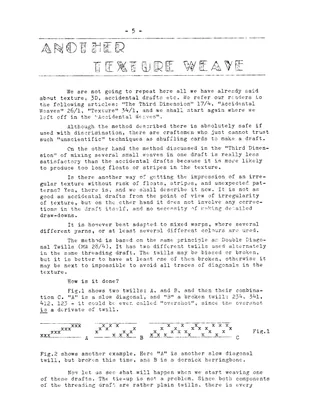
A short article from Master Weaver describing a method of producing an irregular, textured (3D) fabric surface by alternating two twill threadings, at least one of them broken, in a single draft. It gives example threadings and two draw-downs with different treadlings, and explains how mixed warp colors or yarns, with a warping repeat that does not divide evenly into the threading repeat, lengthen the effective texture repeat. It includes a table of recommended threading and warping repeat combinations and a practical project for a mercerized cotton upholstery fabric with warp colors, sett, threading and treadling.
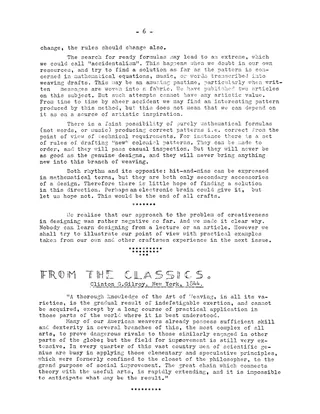
Art of Weaving
Article · 1 page
A single page from Master Weaver, No. 22, July 1955. It opens with the end of an editorial on creativity in weaving design, which warns against relying on mathematical formulas, music or words transcribed into drafts as a source of artistic pattern. It closes with a short "From the Classics" excerpt from Clinton G. Gilroy's 1844 book on the art of weaving, which comments on the skill of American weavers and the progress of the textile arts.
Art or Craft?
Master Weaver, March 1958
Article · 3 pages
An editorial from the Canadian periodical Master Weaver arguing that most handweavers are craftsmen rather than artists and should not be pressured to be "creative" or "modern". It contrasts craft, grounded in technique and tradition, with "arty" experimental weaving, cites Scandinavian folk-based design as a model, and says craftsmen preserve handweaving knowledge. It ends with a short "From the Classics" excerpt from the History of Brome County, about a woman who sheared, spun and wove cloth for trousers in three days.
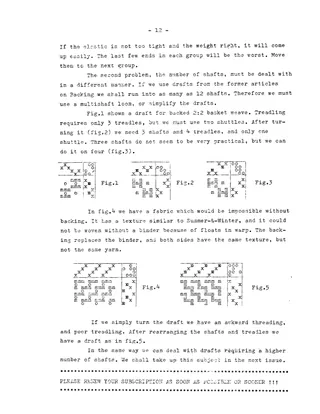
Backing in Warp
Master Weaver, September 1962
Article · 2 pages · weaving drafts
A two-page article from Master Weaver explaining how to move backing yarn from the weft to the warp by turning a draft 90 degrees, so threading becomes treadling and vice versa. This lets a backed fabric be woven with one shuttle and only four treadles. It covers practical warping problems (twisting of face and backing ends, sett, tension, threading with a weighted bunch) and the shaft count needed. Five drafts illustrate backed 2:2 basket weave and a Summer-and-Winter-like fabric.
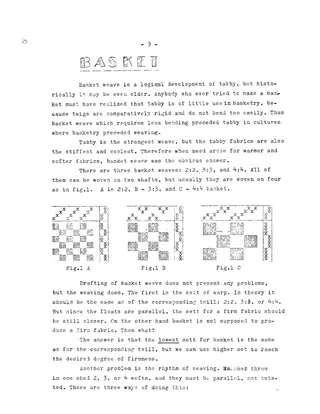
Basket
Master Weaver, September 1962
Article · 2 pages · weaving drafts
A short instructional article on basket weave (2:2, 3:3 and 4:4) from the Master Weaver series. It explains how basket weave relates to tabby and twill, offers guidance on warp sett, and describes three ways of handling the multiple parallel weft picks: one shuttle, several numbered shuttles, or a threading with tabby edges. It also covers beating rhythm and the 50:50 balance of the fabric, illustrated with drafts for four shafts.
The Best Loom
Master Weaver, August 1952
Article · 4 pages
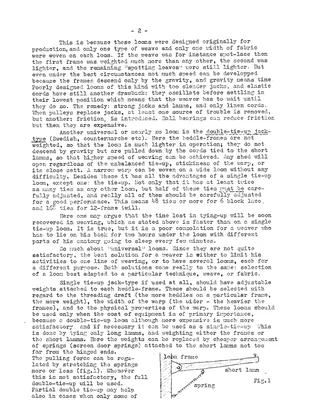
An essay from the Master Weaver newsletter (Fulford, Quebec) arguing that no single loom is best for every purpose. It compares single tie-up jack looms, double tie-up (countermarche) jack looms, counterbalanced looms, draw-looms, two-harness looms, fly-shuttle and automatic looms, frame looms, and table looms, covering the strengths and drawbacks of each. It concludes that a weaver should specialise or own several looms, and suggests a basic set of four. Two figures show a spring-weighted short lamm and counterbalanced harness arrangements. A short errata notice for issue 4 follows.
Borders on All Sides
Master Weaver, January 1953
Article · 3 pages · weaving drafts
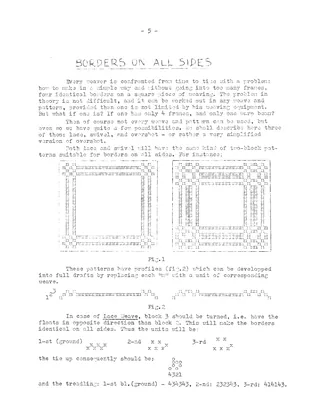
An article from Master Weaver (No. 7, January 1953) on weaving identical borders on all four sides of a square piece using only four shafts and one warp beam. It gives profile and unit drafts, tie-ups and treadlings for lace weave and swivel, then discusses a simplified single-block overshot (spot-weave) on three shafts with a fourth shaft carrying colored pattern warp for vertical borders. A complete project draft is included with color, sleying, treadling and loom tips. The last page begins a short 'Weaving Terminology' item quoting remarks from Mary M. Atwater on vague technical terms.
Bronson Lace
Master Weaver, November 1960
Article · 3 pages · weaving drafts
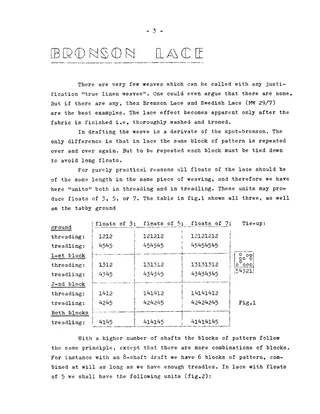
A short article from Master Weaver explaining Bronson Lace, a linen-friendly weave derived from spot Bronson in which the same pattern block repeats and is tied down to avoid long floats. It gives threading and treadling units for floats of 3, 5 and 7, extends the principle to 8 shafts with 6 pattern blocks, and discusses the number of possible block combinations and patterns. It also walks through designing a pattern from a draw-down and profile to a threading, treadling and tie-up, and notes practical issues such as sett and sagging warp ends.
Cannelé
Master Weaver, November 1953
Article · 2 pages · weaving drafts
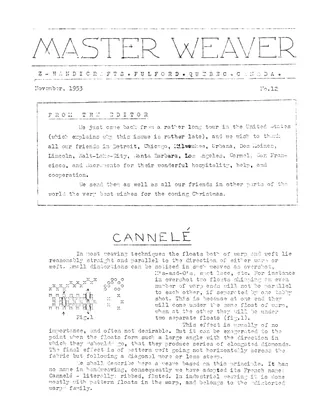
A short article from Master Weaver No. 12 (November 1953) describing cannelé, a handweaving technique in which short warp floats pull a heavier pattern weft into diagonal lines and elongated diamonds. It explains the principle with float diagrams and threading, tie-up and treadling drafts for counterbalanced and rising-shed looms. Practical advice covers float length, warp and weft yarns (10/2 cotton at 24 epi, candlewick, chenille, silk cord or ribbon), and beating. The page also carries a short editor's note about a tour of the United States.
Catalogne or Plain Rag Rugs
Master Weaver, September 1965
Article · 2 pages
A short critical article from Master Weaver arguing that plain rag rugs (catalogne) are economically and aesthetically poor and wear badly. It explains that the usual fine, closely set 16/2 cotton warp is exposed and breaks down under foot traffic. It recommends a strong, open warp (heavy carpet warp or 8/3 linen at no more than 8 ends per inch) with a twisted weft, hard beating, and locked wefts for patterns. It concludes that heavy cotton rug filler is a better choice than cut rags.
Certificates
Master Weaver, May 1957
Article · 2 pages
A short editorial from the Master Weaver newsletter proposing a way to issue weaving skill certificates for Apprentice, Journeyman and Master Weaver levels without any national or international authority. A candidate would complete the published list of requirements and have a guild, studio, school or teacher review the work. The certificate would state that the work meets generally accepted requirements, would list those requirements, and would be free of charge. The article suggests making criteria measurable, such as edge straightness in fractions of an inch and pick-per-inch variation within 5%, and invites readers' suggestions.
Certificates
Master Weaver, November 1960
Article · 2 pages
Article from the Master Weaver bulletin (Fulford, Quebec) announcing certificates of skill for handweavers at four levels: Junior Weaver (Apprentice), Advanced Weaver (Journeyman), Junior Master Weaver and Senior Master Weaver, plus an Instructor certificate. It sets out conditions for issuing such certificates, then lists the samples, projects and written descriptions required at each level, from tabby and twill samplers to double weave, damask, drawloom and rug work.
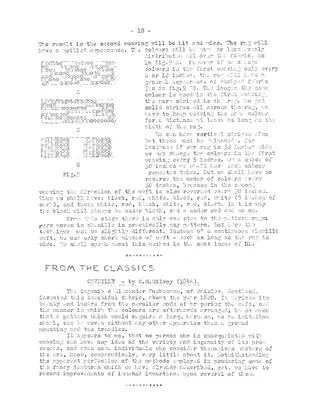
Chenille
Article · 1 page
A single page from Master Weaver No. 19 (January 1955). It concludes a discussion of weaving chenille rugs, explaining how colour changes in the first weaving of the chenille weft produce mottled, striped or vertical-stripe effects in the finished rug. It then begins a 'From the Classics' excerpt from C.G. Gilroy (1844) crediting Alexander Buchanan of Paisley with inventing chenille fabric around 1820.
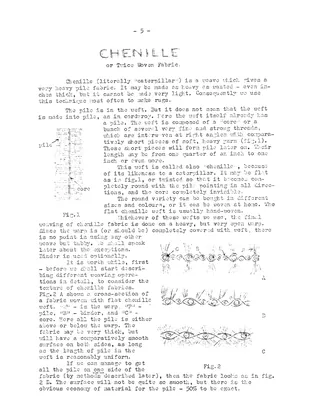
Chenille or Twice Woven Fabric
Master Weaver, January 1955
Article · 6 pages
An instructional article from the Master Weaver series on weaving chenille rugs by the two-stage method. It explains the structure of flat and round chenille weft, how to plan, thread, sley and weave the first warp that produces the weft, and how to cut and store the strands. It then covers weaving the rug itself with the chenille weft, including combing the pile, the use of binder, and colour effects (mottled, striped, vertical stripes). A short excerpt on chenille from C.G. Gilroy (1844) closes the piece.
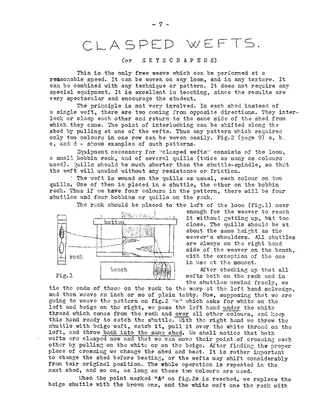
Clasped Wefts (or Skyscrapers)
Master Weaver, June 1952
Article · 3 pages
A short instructional article describing the clasped weft technique (also called skyscrapers), a free weaving method in which two wefts enter each shed from opposite sides and interlock, with the meeting point shifted by pulling either weft. It covers the equipment (a bobbin rack and extra quills), how to set up and weave, color changes, vertical lines and ground areas, yarn choice, and methods for using three colors in a shed. A page of six diagrams (a-f) shows sample patterns.
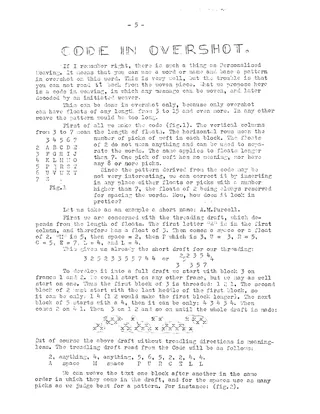
Code in Overshot
Master Weaver, July 1954
Article · 3 pages · weaving drafts
An article from Master Weaver describing a method of weaving coded messages in overshot. A code table assigns each letter of the alphabet to a float length (3-7) and a number of weft picks per block (2-7), with floats of 2 used as word spacers. The article works through the name A.M.Purcell, showing how to derive the threading and treadling and how to decode a woven piece. It also suggests placing short messages such as 'Merry Xmas' in borders, and says a second method for any overshot draft will follow in the next issue. A short editor's note on the out-of-print Encyclopedia of Handweaving and back issues follows.
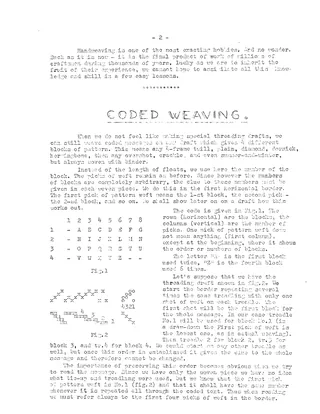
Coded Weaving
Master Weaver, September 1954
Article · 2 pages · weaving drafts
A two-page article from Master Weaver explaining how to weave a coded message into cloth using any four-block draft. Each letter is encoded by a block number and a number of weft picks, with a code table in Fig. 1 and a clue border woven at the start to establish block order. The example message "MERRY XMAS" is worked out with treadling directions and a drawdown, and the article explains how to read the message back from the fabric.
Colour and Design
Master Weaver, July 1955
Article · 6 pages
An essay from the Master Weaver newsletter (Fulford, Quebec) on what creativity means in handweaving. It argues that weavers cannot compete with industry on technical innovation and should focus on colour, texture and pattern, and that a good designer must know the materials and techniques of weaving. It discusses folk-art traditions, the limits of formulas for colour and design (Leonardo, Van Gogh, Oswald), and 'accidentalism' such as turning words or music into drafts. A short 1844 quotation from Clinton G. Gilroy closes the piece, and the author promises practical examples in the next issue.
Colours in Corduroy
Master Weaver, May 1954
Article · 3 pages · weaving drafts
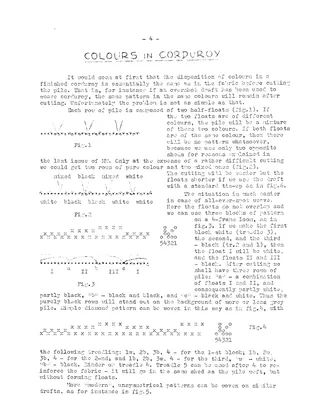
A 1954 article from Master Weaver explaining how colour patterns behave in handwoven corduroy (cut-pile weft) after the pile is cut. It covers pile floats made of two half-floats, all-over-spot drafts for blocks of black and white pile on four shafts, treadling sequences with dimensions, stripes and checks, and the difficulty of using three or four colours on overshot-style drafts. It also mentions combining corduroy with locked wefts, and ends with a short note on the terms "lifting plan" and "peg plan" for looms without tie-ups.
Colours in Crackle
Master Weaver, January 1963
Article · 4 pages · weaving drafts
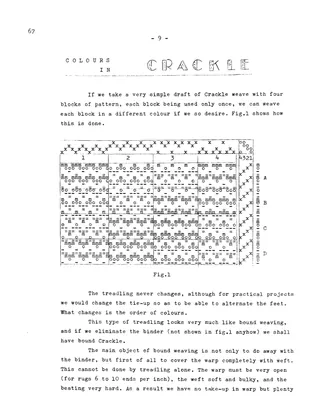
A short article from Master Weaver No. 67 on using colour in Crackle weave, especially bound Crackle for rugs. It explains how a four-block draft can be woven in different colour orders, how blended and pure colour areas arise, and how to design colour patterns using profiles and short drafts. It ends with a practical rug project (36" by 45", 8/4 cotton warp, heavy 2/2 wool weft in black and white) with threading and treadling, plus an erratum correcting a tie-up in the previous issue's project.
Colours in Simple Weaves
Master Weaver, August 1952
Article · 4 pages · weaving drafts
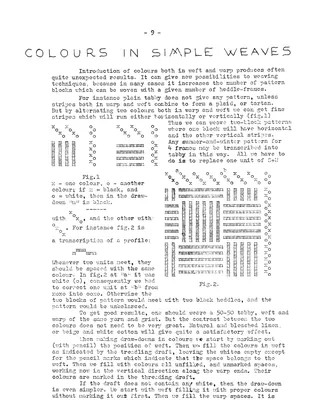
A short article from Master Weaver (No. 5, August 1952) on how alternating two or three colours in warp and weft can create pattern effects in simple weaves such as tabby, basket weave and twill. It explains how two-block summer-and-winter patterns can be transcribed into coloured tabby or twill, how to make colour draw-downs, and how colour arrangement can imitate more complex weaves needing more heddle-frames. Twelve figures show drafts and draw-downs. The scan also includes a 'From the Classics' excerpt from Clinton G. Gilroy (1844) on striking up the weft, loom mounting and the swing of the lay.
Colours in Summer-and-Winter
Master Weaver, February 1952
Article · 1 page · weaving drafts
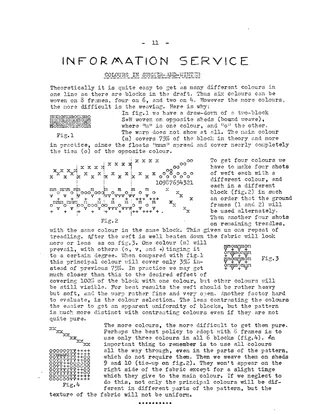
A one-page technical note from the Master Weaver Information Service on weaving several colours in one row of Summer-and-Winter. It explains how many colours a given number of shafts allows, how weft shots are ordered across blocks, and why more colours make clean block colour harder to achieve. Four draw-down figures illustrate bound weave versus multicolour treadling, with advice on weft and warp choice, colour contrast, and carrying all colours through the whole pattern.
Compound Sleying
Master Weaver, July 1956
Article · 2 pages
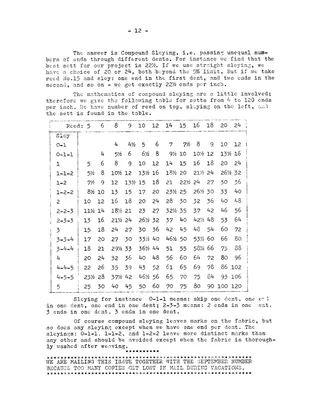
A short article on choosing and adjusting warp sett by sleying the reed with unequal numbers of ends per dent (compound sleying). It explains how much a sett can be varied from a calculated value, then gives a table of ends per inch for reeds No. 5 to 24 combined with sleying patterns such as 1-2, 1-1-2 and 0-1-1. It warns that some patterns leave more visible marks in the cloth unless it is washed.
Conclusions
Master Weaver, September 1958
Article · 4 pages
An editorial from the Canadian bulletin Master Weaver (September 1958) criticizing the state of contemporary handweaving: poor looms and yarns, and exhibition juries with little knowledge of weaving. The author gives examples of technically fine work rejected by juries, quotes reader letters praising an earlier article on exhibitions, and notes some shows that adopted fairer judging practices. The last page begins a 'Shortcuts - 3' piece on multishaft looms, advising against buying looms with more than four shafts unless necessary.
Cotton
Master Weaver, January 1955
Article · 2 pages
A two-page article from the Master Weaver newsletter (Z-Handicrafts, Fulford, Quebec) on cotton as a textile fiber. It outlines the history of cotton cultivation and use from ancient China and India to 20th-century US production, then covers fiber length and quality by variety, physical and chemical properties, yarn count, ginning, carding and combing, and mercerizing and other finishing treatments.
Crackle & Twill
Master Weaver, January 1956
Article · 2 pages · weaving drafts
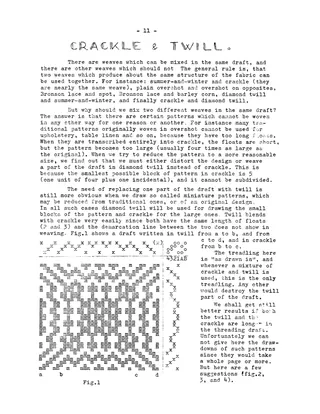
A two-page article from Master Weaver on combining crackle weave with diamond twill in one draft. It explains why the two can be mixed (similar float lengths, so no visible demarcation), and when it is useful: reducing overshot patterns and drawing miniature patterns. Four threading drafts with treadling sequences are given, plus a table cloth project (10/2 cotton warp and weft, 20/2 binder) and advice on avoiding and detecting weaving mistakes.
Crackle Old & New
Master Weaver, November 1955
Article · 5 pages · weaving drafts
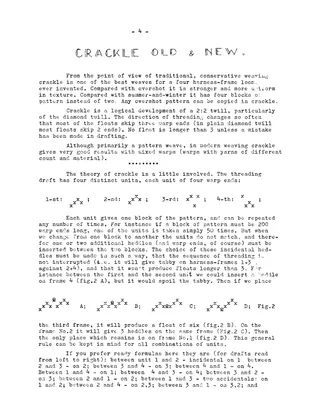
An article from the Master Weaver explaining crackle weave on four harness frames, comparing it with overshot and summer-and-winter. It covers the four threading units, the incidental heddles needed between blocks, and three basic treadling methods (traditional, summer-and-winter style, and woven as drawn in). It also gives a tie-up for upholstery fabric with long floats on one side, hit-and-miss treadling experiments, and a project for an upholstery fabric in linen with full threading and treadling directions.
Craft or Business
Master Weaver, July 1953
Article · 3 pages
An article from the Master Weaver newsletter (July 1953) discussing whether handweaving should be pursued as a craft or as a business. It compares the craftsman's path, with moderate income supplemented by teaching, lecturing and publishing, with the business path of designing simple-to-weave fabrics for hired "shuttle pushers", pre-made warps and warping mills. A second short piece, "Dropped Weaves", begins on page 3 and introduces weaves in which parts of the fabric are left unwoven as floats, including frame requirements for dropped tabby and twill.
Crazy Twills
Master Weaver, March 1963
Article · 4 pages · weaving drafts
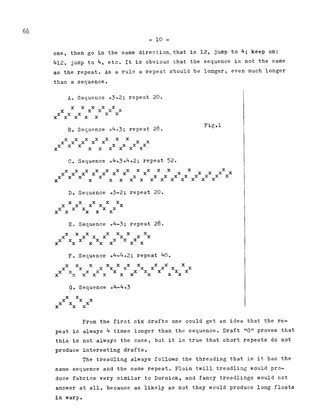
An article from Master Weaver on "crazy twills," four-shaft twills in which the diagonal is broken into short runs separated by gaps, producing irregular texture and pattern that suggests many more shafts. It explains how to design them from a sequence of short diagonals (marked + or -) and a longer repeat, with threading diagrams for sequences A to G and draw-downs in Figs. 2 to 6. It also covers treadling (which follows the threading), the resulting fabric effects (wavy diagonals, arrowheads, distorted diamonds), and balanced sequences. It ends by promising a follow-up article on practical projects.
Crepe
Master Weaver, March 1955
Article · 4 pages · weaving drafts
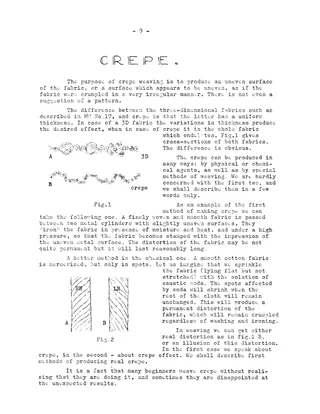
An article from Master Weaver No. 20 on weaving crepe fabrics, in which the whole cloth undulates, as distinct from 3D fabrics. It briefly covers mechanical and chemical crepe finishing, then describes weaving methods: same-direction yarn twist, alternating right- and left-hand twist yarns, differential warp tension, mixed linen and cotton warps, and tabby combined with satin or satinet. It gives a four-harness crepe draft with ten treadling variations and refers to multiharness crepe weaves from Oelsner. A short book note on Mary E. Black's Handweavers' Reference follows.
Cross Weave 2 - Pickets & Riddles for Four Harness-Frames
Master Weaver, January 1957
Article · 3 pages · weaving drafts
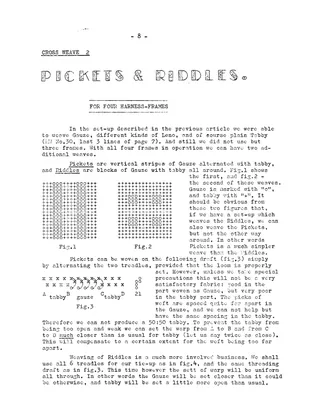
Second article in a Master Weaver series on cross weave (leno/gauze) for four-harness frames. It explains how to weave Pickets (vertical gauze stripes alternating with tabby) and Riddles (gauze blocks surrounded by tabby), with six-treadle tie-ups, treadling orders, and two methods for compensating for the differing pick spacing of gauze and tabby. It ends with a practical project for a rayon scarf, giving the threading draft, warp, sett, reed and treadling.
Cross-Weave
Master Weaver, November 1956
Article · 5 pages · weaving drafts
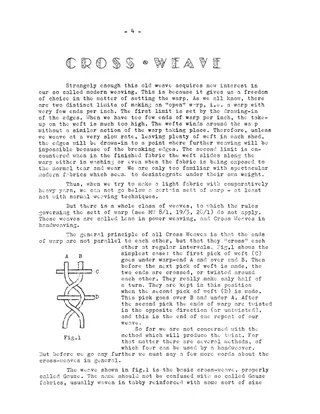
An instructional article from Master Weaver on cross-weaves (gauze, leno, pickets and riddles) for handweavers on four-shaft looms. It explains why cross-weaves allow very open warp setts, defines the terms, and surveys four methods of crossing warp ends. It then details the doup-without-standards method: making the doups, threading, tie-up, treadling sequences, and adjusting the sheds, including adding a spring-loaded roller to lengthen the warp ends. Diagrams show the crossings, the threading and the tie-ups.
D.D. Twills with Double Diagonal
Master Weaver, July 1956
Article · 5 pages · weaving drafts
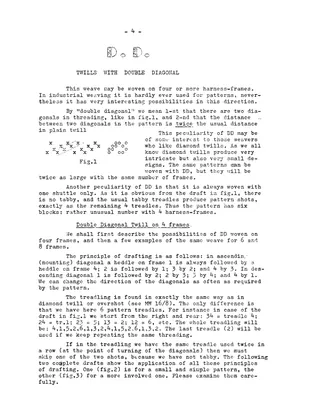
An article from Master Weaver explaining double diagonal (DD) twills, in which the threading has two diagonals and the spacing between diagonals in the pattern is twice that of plain twill. It covers drafting rules and treadling for 4 frames, then variations for 6 and 8 frames, tie-up options, and the lack of tabby. Treadling suggestions and two practical projects (upholstery on 4 frames, curtains on 8 frames) with sett, reed and yarn details are included, along with advice on combining treadles on a direct tie-up.
Designing Made Easier - Colour
Master Weaver, March 1957
Article · 5 pages
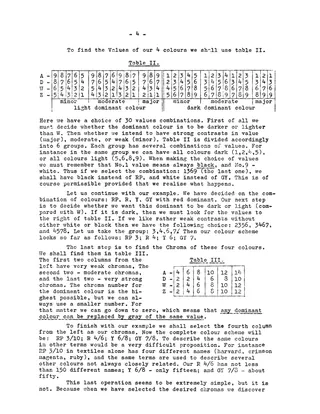
An article from the Master Weaver bulletin (March 1957) introducing a rule-based method for choosing colour schemes in handweaving. It explains hue, value and chroma using the Munsell notation, and names four colours (A, D, W, Z) by area and contrast. Three tables are used to select hues, values and chromas, and worked examples show how to adjust a scheme when a colour is unavailable in the sample cards. It is the first in a planned series on colour, pattern and texture.
Designing Made Easier - Numerical Patterns
Master Weaver, September 1957
Article · 4 pages
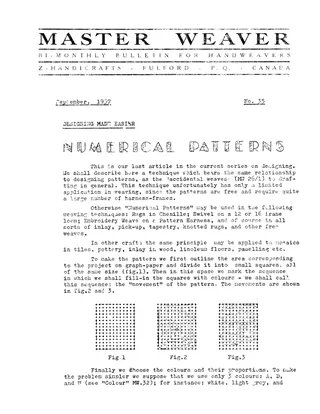
Final article in the Master Weaver series on designing, describing a method of generating patterns from numerical formulas. A graph-paper grid is filled with colours in a chosen path (the 'movement') using fixed colour proportions such as 6, 3, 4 for dominant, accent and subdominant. Figures compare circular, horizontal and S-shaped movements and different colour ratios. The author notes the method suits free weaves needing many harness frames (chenille rugs, swivel, inlay, pick-up, tapestry, knotted rugs) and discusses whether formula-made designs have any value. The issue page ends with a short 'From the Classics' quotation by C.C. Gilroy (1844) on the pattern drawer's need for imagination and knowledge of geometry.
Designing Made Easier - Proportions
Master Weaver, May 1957
Article · 4 pages
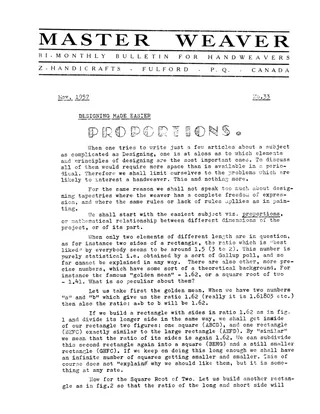
An article from the Master Weaver bulletin (No. 33, May 1957) on proportions in design for handweavers. It explains the golden mean (1.62) and the square root of two (1.41) rectangles, and shows how to apply 1.62 ratios to pattern areas, such as a Turned Swivel project, and to colour stripe sequences, with tables of pick counts and examples. The last page begins a new article on rugs in bound weaving (overshot, crackle, summer and winter on four frames, with no tabby).
Designing Made Easier - Texture
Master Weaver, July 1957
Article · 4 pages · weaving drafts
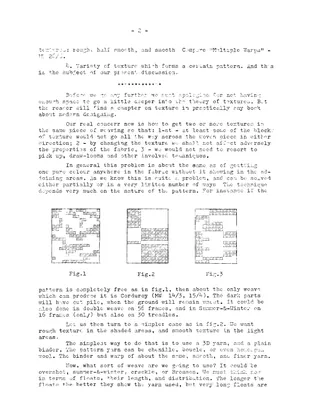
An installment of the "Designing Made Easier" series from Master Weaver (No. 34, July 1957) on using texture as a design element in handweaving. It distinguishes real from visual texture and shows how to get areas of rough and smooth texture in one fabric using a heavy textured weft with a plain binder in summer and winter, overshot, crackle or Bronson. Drafts and treadling are given for block patterns, with advice on float length and sampling. The scan ends with the start of a section on synthetic yarns that classifies fibers as natural, processed, artificial or mixed.
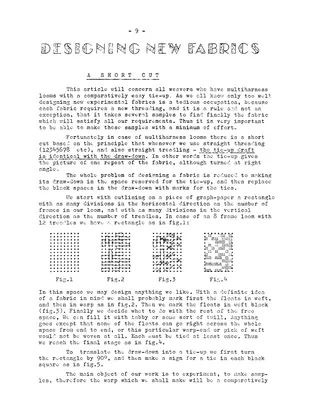
Designing New Fabrics A Short Cut
Master Weaver, November 1956
Article · 2 pages · weaving drafts
A short two-page article from Master Weaver explaining a shortcut for designing experimental fabrics on multiharness looms with straight threading and straight treadling. In that case the tie-up is identical to the draw-down, turned 90 degrees, so the weaver designs the cloth directly in the tie-up space. It walks through the steps on an 8-frame, 12-treadle loom, then shows 12-frame, 16-treadle examples (diamond twill, waffle, texture, a turned twill pattern weave, and a tabby-rich weave) with suggested uses. It also gives sampling advice and notes the method's limits for larger projects.
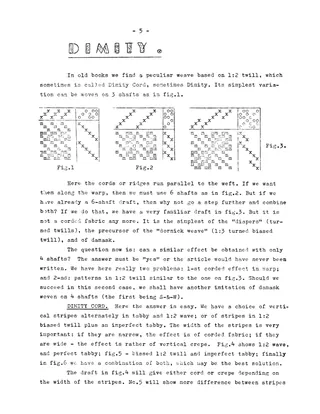
Dimity
Master Weaver, July 1958
Article · 5 pages · weaving drafts
An article from Master Weaver on dimity, a weave based on 1:2 twill, and how to adapt it to 3, 4 and 6 shafts. It gives drafts for dimity cord (ridges along the weft or warp) and for two-block pattern dimity on four shafts, with notes on take-up, float length and fabric strength. It also covers the history of 3-shaft looms and twill, and includes a table runner project in single linen with threading, warp, weft and treadling instructions. A short note on weaving terminology (harness vs. shaft) closes the piece.
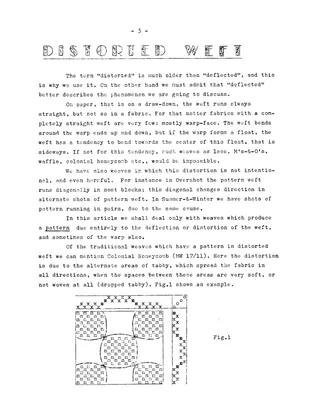
Distorted Weft
Master Weaver, September 1961
Article · 4 pages · weaving drafts
A short article from Master Weaver explaining distorted (deflected) weft, where the pattern comes from weft or warp shifting out of its straight path rather than from a conventional interlacement. It covers colonial honeycomb with alternating tabby and 4:4 basket blocks, sett recommendations (50 to 80 percent closer than for tabby), and Bronson and Overshot based drafts in which heavy pattern weft floats over a fine ground. It includes seven figures with drafts, a variant with long and short floats, and a practical project for a centerpiece in 10/2 cotton with warp and weft details.
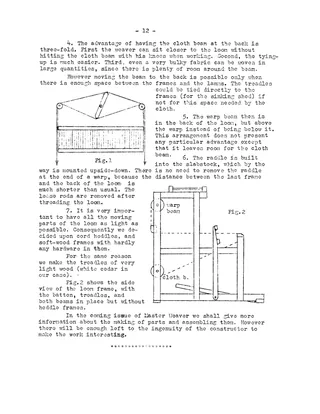
Double Tie-Up Loom - 1
Master Weaver, September 1953
Article · 2 pages
A 1953 Master Weaver article proposing the design of a loom for advanced amateur weavers, built at home from hardware-store parts. It lists seven features: double tie-up with side-by-side floating lamms, friction brakes on both beams, a cloth beam at the back, a warp beam on top, a built-in raddle, and very light cord-heddle frames. Each feature is explained, and two figures show the lever and pulley arrangement and a side view of the frame. Construction details are promised for a later issue.
Double Tie-Up Loom - 3
Master Weaver, November 1953
Article · 2 pages
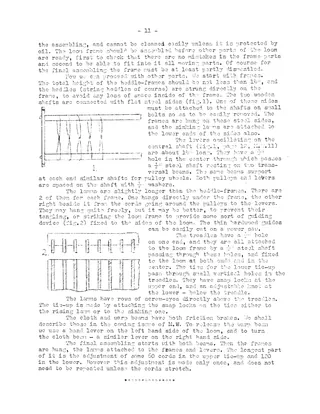
Third installment of a series on building a double tie-up loom, covering the materials list and construction steps. It gives approximate quantities of lumber, hardware, pulleys and cord, and explains how to scale up the plans from the previous issue's drawing. It then describes making the loom frame, heddle frames, levers, lamms, treadles and tie-up, and the final assembly. Brakes for the beams are deferred to the next issue.
Double Weaves - Circular and Double-Width Cloth
Master Weaver, January 1953
Article · 4 pages · weaving drafts
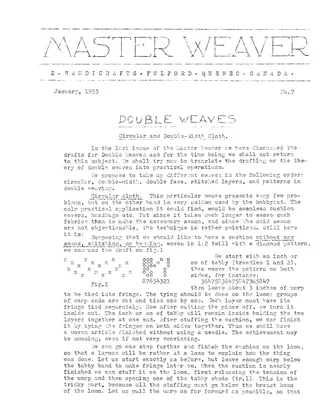
An article from Master Weaver No. 7 (January 1953) on putting double-weave theory into practice, covering circular cloth and double-width cloth. It explains weaving a seamless cushion on the loom, including stuffing it while still on the loom and finishing the ends with tabby bands and fringe. It then covers the problems of double-width weaving: getting an invisible fold at the edge, compensating for draw-in by spacing the warp ends or using special reeds, uneven stretching of the two layers on the cloth beam, and the greater friction from doubled warp density. It closes with advice on reeds, looms and yarns for double weaving, followed by a short editor's note.
297 documents found