Textile Documents › Authors › Author: Clinton G. Gilroy
7 documents found
Sort: 
Art of Weaving
Article · 1 page
A single page from Master Weaver, No. 22, July 1955. It opens with the end of an editorial on creativity in weaving design, which warns against relying on mathematical formulas, music or words transcribed into drafts as a source of artistic pattern. It closes with a short "From the Classics" excerpt from Clinton G. Gilroy's 1844 book on the art of weaving, which comments on the skill of American weavers and the progress of the textile arts.
The Art of Weaving, by Hand and by Power
Book · 617 pages · weaving drafts
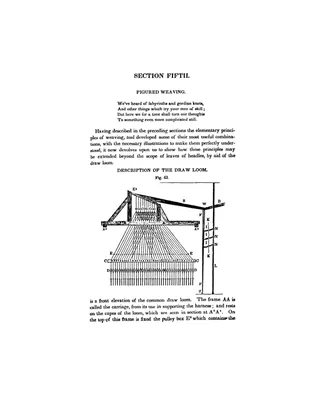
A comprehensive 1844 American treatise on hand and power weaving by Clinton G. Gilroy, a practical weaver and manufacturer. It opens with a long, partly humorous introductory account of the history of weaving, then covers plain weaving, tweeling (twill), double cloth, velvets, gauze and net weaving, figured weaving with draw looms, barrel looms and the Jacquard machine, carpet manufacture, lace and embroidery, and power-loom weaving with its machinery. The book is heavily illustrated with engraved loom and machine diagrams, includes drafts for twills, satins, quilts and nets, and ends with design paper samples, web calculation tables, Jacquard mounting examples and an index.
Chenille
Article · 1 page
A single page from Master Weaver No. 19 (January 1955). It concludes a discussion of weaving chenille rugs, explaining how colour changes in the first weaving of the chenille weft produce mottled, striped or vertical-stripe effects in the finished rug. It then begins a 'From the Classics' excerpt from C.G. Gilroy (1844) crediting Alexander Buchanan of Paisley with inventing chenille fabric around 1820.
From the Classics - Harmonious Colouring
Article · 1 page
A one-page "From the Classics" excerpt reprinted in Master Weaver, quoting passages on harmonious colour arrangement from Clinton G. Gilroy's 1844 book The Art of Weaving. It compares the science of colour to musical harmony, describing three primary colours, secondary colours, seven distinct colours matching the musical scale, and the idea of a key colour or tone governing an arrangement. The page also begins with the end of an unrelated passage on cutting pile fabric.
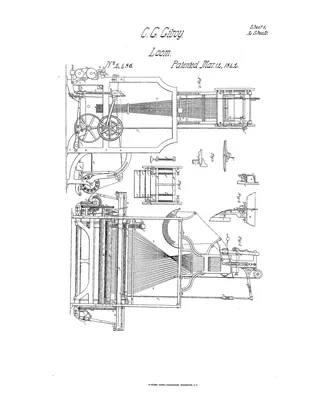
Loom, US Patent No. 2486
Patent · 5 pages
US Patent No. 2,486, granted March 12, 1842, to Clinton Grey Gilroy of Great Britain (assignor to Jeremiah Wilbur) for a power loom for weaving figured and other fabrics. The specification describes take-up rollers and cloth roller tension, a warp-beam friction brake with a weighted lever, a "weft puller" used with an eccentric-driven Jacquard, card protectors on the Jacquard cylinder, a shuttle with a brush and tension wire, a picker-staff regulating iron, and a weft-break stop motion. It ends with eight claims and includes two sheets of patent drawings.
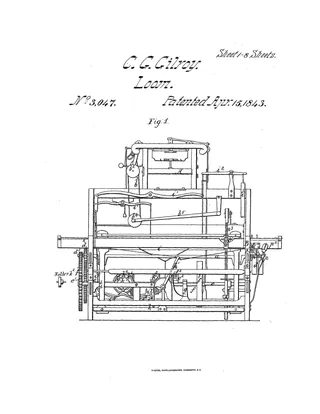
Loom, US Patent No. 3047
Patent · 11 pages
US Patent No. 3,047, granted April 15, 1843 to Clinton Gray Gilroy of New York, for a loom for weaving figured fabrics. It consists of eight sheets of patent drawings (Figs. 1-10) followed by the written specification and five claims. The loom combines a jacquard mounted above the frame with a front harness of eight leaves for twill or satin grounds. It also has sliding double cams that let the shuttle miss one pick while the jacquard card changes, a cylinder with adjustable rollers acting on the harness marches, a friction-strap warp tension device, and a weft/warp-break stop motion.
Striking up the Weft
Article · 1 page
A one-page excerpt from Master Weaver (No. 5, August 1952). It opens with the end of a discussion of colour-and-weave draw-downs, in which a 3:3 twill with wide colour bands gives arrow-head checks and fine colour distribution gives broken zig-zag lines. The rest is a reprinted 1844 passage by Clinton G. Gilroy, "Striking Up the Weft," in the "From the Classics" section. It covers beating with the lay, mounting the loom so the lay's range suits the cloth, the pendulum-like swing of the batten, the fell, and keeping treadling, throwing the shuttle and beating regular.
7 documents found