Textile Documents › Publications › Publication: United States
376 documents found
Sort: 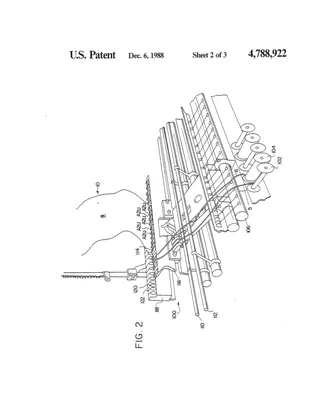
Adhesively Applied Schiffli Embroidery, US Patent No. 4788922
Patent · 8 pages
US Patent 4,788,922, granted to H. William Clarius and assigned to Lion Brothers Co., describes a heat-sealable Schiffli embroidery appliqué. The design is stitched in mirror image on a heat-degradable cellulosic backing, with bobbin yarn forming the top surface. The needle yarn combines a fusible thermoplastic monofilament with a non-fusible one, so the design bonds to a garment under heat and pressure and keeps its structure while the backing is brushed away. The document includes background on prior art, a description of the Schiffli loom setup, three drawing sheets and 20 claims.
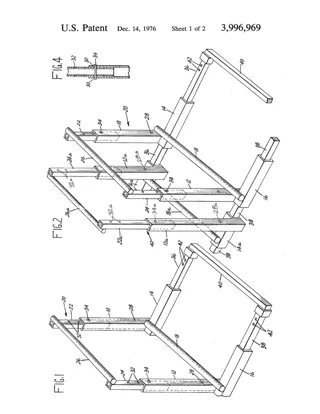
Adjustable Loom, US Patent No. 3996969
Patent · 10 pages
US Patent 3,996,969 for an adjustable frame loom intended for Navajo-type weaving, granted to George W. McCullough, Henrietta Tragitt McCullough and Timothy E. Doyle of Indiana. The loom has hollow uprights and legs, a telescoping upper frame held by pins at selectable heights, and a stabilizing frame that slides into the legs and can be removed for use as a warping frame. A second upright frame can be added for two-layer weaving. The scan includes the USPTO database printout (abstract, claims, description), the patent's front page, drawing sheets (FIGS. 1-6) and the printed patent text.
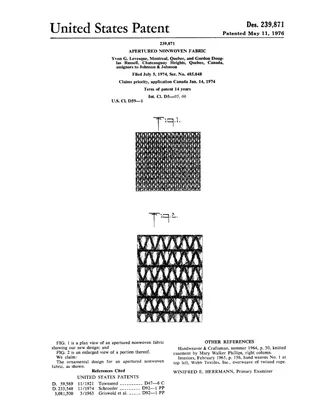
Apertured Nonwoven Fabric, US Patent No. D0239871
Patent · 1 page
US design patent D239,871 (granted May 11, 1976) for the ornamental design of an apertured nonwoven fabric, assigned to Johnson & Johnson. It consists of a single page with two figures: a plan view of a dense, repeating open-mesh pattern and an enlarged detail showing teardrop-shaped apertures. The references cited include earlier patents and two magazine citations on handwoven and knitted open fabrics.
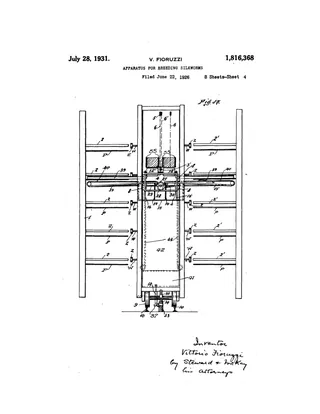
Apparatus for Breeding Silkworms, US Patent No. 1816368
Patent · 15 pages
US Patent No. 1,816,368, granted July 28, 1931 to Vittorio Fioruzzi of Piacenza, Italy, for an automated apparatus for rearing silkworms from hatching through cocoon spinning. A series of intermittently driven endless conveyor belts moves the worms along as they grow, with bridging sheets transferring them between belts. A travelling carriage feeds cut mulberry leaves, removes leaf beds, and triggers the belt movements. Spinning huts at the end of the line let the worms spin cocoons, and a rake detaches the cocoons. The document has eight sheets of drawings (Figs. 1-28), the specification, and 13 claims.
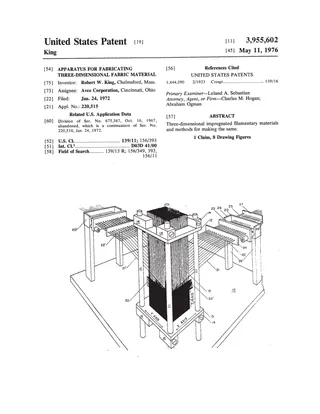
Apparatus for Fabricating Three-Dimensional Fabric, US Patent No. 3955602
Patent · 16 pages
US Patent 3,955,602 (Robert W. King, assigned to Avco Corporation, granted 11 May 1976) describes a loom-like apparatus that uses needles to weave filaments along the X and Y axes into a bundle of Z-axis filaments, producing a three-dimensional woven block. The structure is held together by inter-yarn friction, compressed, then impregnated with resin or another matrix and cured into a billet that can be machined. The document includes a web-printed copy of the patent record, the original patent drawing sheets (8 figures, including a cylindrical variant), and the typeset specification and claim.
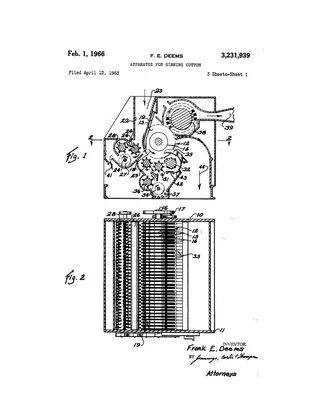
Apparatus for Ginning Cotton, US Patent No. 3231939
Patent · 6 pages
US Patent 3,231,939, granted to Frank E. Deems of Birmingham, Alabama, for a saw-type cotton gin that removes the roll box. Seed cotton passes in a thin stream over a bed of rotating pinned drums or saw cylinders, between the huller ribs and the ginning ribs. This is meant to cut fiber damage, saw wear, and power use. The document has three sheets of drawings (Figs. 1-10), the specification describing three variants, two claims, and a list of earlier patents cited.
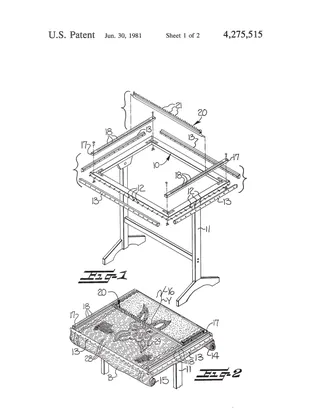
Apparatus for Making a Handcrafted Pile Rug, US Patent No. 4275515
Patent · 16 pages
US Patent 4,275,515 (Betty R. Hinson, granted 30 June 1981) for a frame-and-guide apparatus for making handcrafted pile rugs. A backing fabric is stretched on a pinned rectangular frame, and a comb-like pile forming guide set at adjustable heights holds yarn loops while each tuft is sewn and knotted into the backing with a needle, giving uniform pile spacing and height. The document includes the USPTO web printout (abstract, claims, description) and the original patent print with two sheets of drawings (Figs. 1-9).
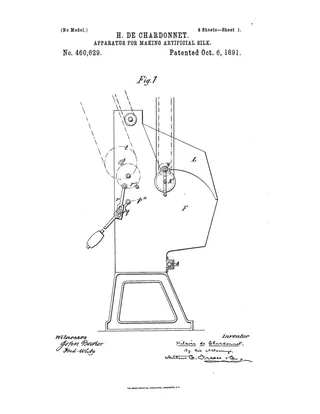
Apparatus for Making Artificial Silk, US Patent No. 460629
Patent · 11 pages
US Patent No. 460,629, granted October 6, 1891 to Hilaire de Chardonnet of Besançon, France, for improvements in a machine that spins collodion (nitrated cellulose) into artificial silk filaments. Six sheets of drawings (Figs. 1-14) show the frame, spinning dies, nippers, bobbins and reeling mechanism, followed by a specification and 13 claims. The text describes the collodion solution, die and valve design, water-cooled coagulation, bobbin winding, and recovery of ether and alcohol solvents with potash and sulphuric acid. It builds on his earlier US patents on artificial silk.
Apparatus for Making Threads, US Patent No. 1202766
Patent · 3 pages
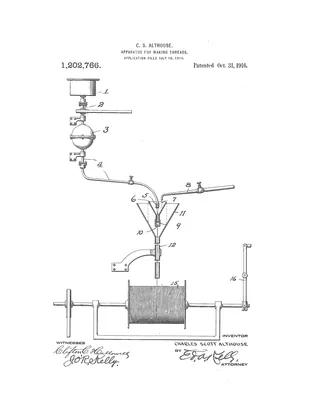
US Patent No. 1,202,766, granted 31 October 1916 to Charles Scott Althouse of Reading, Pennsylvania, for an apparatus that makes threads from cellulose solution (artificial silk or rayon type filaments). It describes a centrifugal separator that cleans the solution without changing the pressure at the spinning nozzle. It also describes a two-funnel system in which a setting liquid draws the thread to the desired fineness before it reaches the winding reel. The patent has a drawing sheet, a specification and four claims.
Apparatus for Rearing Silkworms, US Patent No. 3727580
Patent · 14 pages
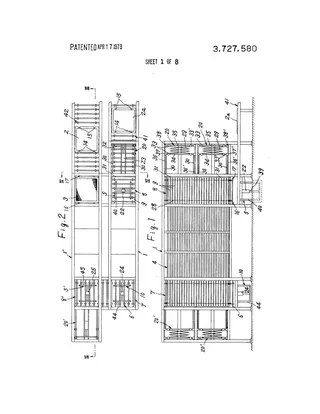
US Patent 3,727,580 (granted 17 April 1973) describes an automated apparatus for rearing silkworms, developed by Japanese inventors and assigned to Ganze Limited and Takeda Chemical Industries. Rearing units, each a feeding tray with a net on top, move through elevator conveyors, a multi-shelf rearing frame, pushers, loaders, unloaders and a carriage that returns the nets for reuse. The text gives the background, 16 figure descriptions, a worked embodiment with two rows of frames, a prepared artificial diet recipe, a rearing example (240,000 fifth-instar silkworms yielding about 440 kg of cocoons) and 8 claims. Eight sheets of line drawings accompany it.
Apparatus for Reeling Silk from the Cocoon, US Patent No. 399937
Patent · 6 pages
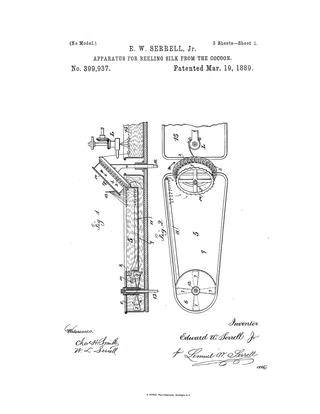
US Patent No. 399,937, granted March 19, 1889 to Edward William Serrell Jr., for a machine that automatically fills cocoon-holders (magazines) when reeling silk from the cocoon. Cocoons float in a charging basin with a circulating water current into a rotating pocketed magazine, which then ejects them one at a time into the reeling basin near the lance-bout finger. The document has three sheets of drawings (Figs. 1-8), a specification describing the locking, rotating and ejecting mechanisms, and five claims.
Apparatus for Separatur Waste Floss from Cocoons, US Patent No. 399936
Patent · 3 pages
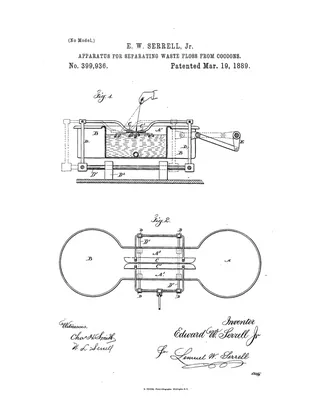
US Patent No. 399,936, granted March 19, 1889 to Edward William Serrell Jr. of New York, for a machine that removes waste floss from silk cocoons before reeling. Plates held over a hot-water basin are moved back and forth, agitating the cocoons while the floss is pulled out, replacing the hand-cleaning (débavage) that required great skill and labor. The document has a drawing sheet (side section and plan view), the specification, and three claims. It also lists the foreign patents granted for the invention.
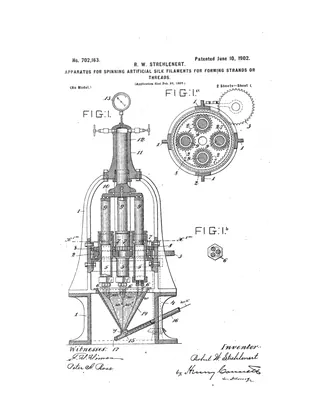
Apparatus for Spinning Artificial Silk Filaments for Forming Strands or Threads, US Patent No. 702163
Patent · 5 pages
US Patent No. 702,163, granted June 10, 1902 to Robert Wilhelm Strehlenert of Stockholm, for an apparatus that spins artificial silk filaments into strands or threads. Revolving and rotating mouthpieces dip into a liquid reservoir so the filaments twist together as they form, and a broken filament is caught and twisted in without stopping the machine. The patent describes batch and continuous versions plus a horizontal variant, and ends with six claims. It includes two sheets of drawings (Figs. 1, 1a, 1b, 2 and 3).
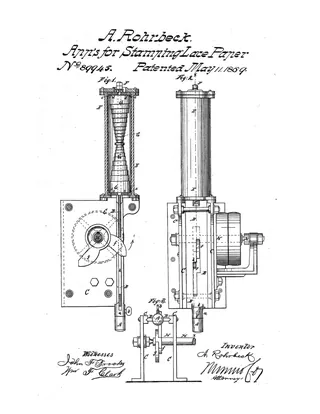
Apparatus for Stamping Lace Paper, US Patent No. 89945
Patent · 2 pages
US Patent No. 89,945, granted May 11, 1869 to Albert Rohrbeck of New York, for a machine that stamps perforated lace paper of the kind used by confectioners and cigar-makers. A spring-driven hammer, raised by a shaft with two fingers acting in a slotted plate, drops onto a steel cutting-plate and replaces hand-struck perforating tools. The document has a drawing sheet with three figures, followed by the specification and three claims.
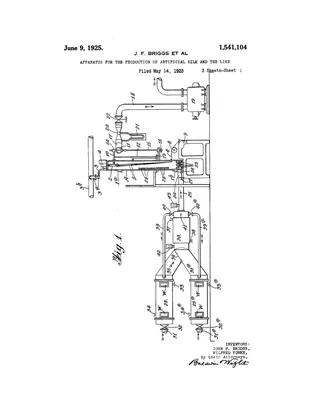
Apparatus for the Production of Artificial Silk and the Like, US Patent No. 1541104
Patent · 10 pages
US Patent 1,541,104, granted June 9, 1925 to John Frederick Briggs and Wilfred Yorke of Spondon, near Derby, England, assignors to the American Cellulose and Chemical Manufacturing Company. It describes dry (evaporative) spinning apparatus for artificial silk made from cellulose acetate and other cellulose derivatives. The apparatus is divided into spinning cells, each with its own outlet pipe, flow meter (water gauge) and regulating valve for the vapour-laden air, plus independent temperature control and air dehumidifying and preheating equipment. The patent has three sheets of drawings (Figs. 1-5), a specification and 13 claims.
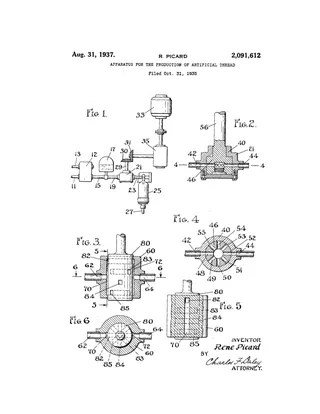
Apparatus for the Production of Artificial Thread, US Patent No. 2091612
Patent · 3 pages
US Patent 2,091,612, granted 31 August 1937 to René Picard of Vaulx en Velin, France, and assigned to E. I. du Pont de Nemours & Company. It describes a rotating-plug regulating valve placed in the pipeline between the pump and spinning nozzle of a viscose or similar artificial-thread spinning machine. The valve intermittently interrupts the flow of spinning solution, producing filaments of uneven denier with nubs or sharp thick-thin variations that imitate materials such as pongee silk. The document includes a drawing sheet (Figs. 1-6), the specification and a single claim.
Apparatus for the Production of Threads, US Patent No. 1450131
Patent · 3 pages
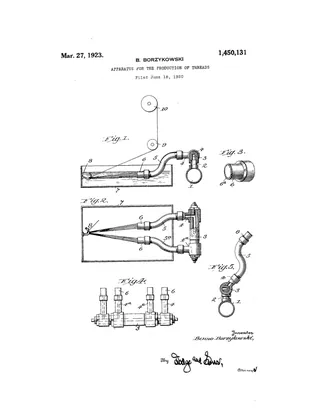
US Patent 1,450,131, granted 27 March 1923 to Benno Borzykowski of Paris, for an apparatus that spins artificial (viscose) threads. Several fine nozzles are submerged in a setting bath and their filaments are united into one bundle, which is drawn off by a driven cylinder and stretched onto a take-up spool. The patent claims finer threads (5 deniers and below) and replaces a separate doubling frame. It includes five drawing figures, a specification and four claims.
Apparatus for Use in a Weaving Process, US Patent No. 4195671
Patent · 21 pages
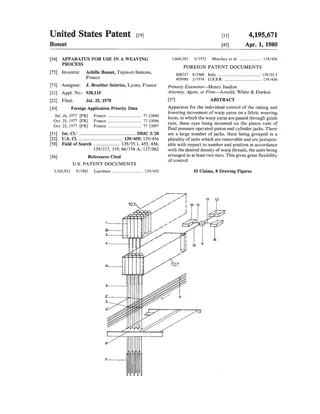
US Patent 4,195,671, granted 1 April 1980 to Achille Bossut and assigned to J. Brochier Soieries of Lyons, describes a loom apparatus for controlling each warp yarn individually. Each warp yarn passes through an eye on the piston rod of a fluid-pressure jack. The jacks are grouped in removable, juxtaposable units arranged in at least two tiers, so warp density can be changed (up to about 150 threads/cm) for jacquard-type silk patterning without a repeat across the fabric width. The scan has a USPTO web printout with abstract, claims and description, followed by the patent's original front page, five drawing sheets and the printed specification and claims.
Apparatus for Use in the Production of Textile Fibers or Filaments from Solutions of Cellulose, or of Other Material from which Fibers or Filaments Can Be Formed, and for Twisting and Putting into Coil Form Such or Other Fibers or Filaments, US Patent No. 702382
Patent · 4 pages
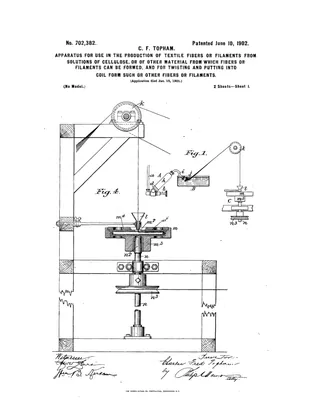
US Patent No. 702,382, granted June 10, 1902 to Charles Fred Topham of Kew, England (assignor to James Yate Johnson), for an apparatus that forms artificial fibers or filaments by forcing cellulose solution through fine nozzles into a setting bath. It also covers a device that twists the filaments and coils them by centrifugal force in a rapidly rotating box. The patent has two sheets of drawings and a specification with seven claims describing the filter plug, air-space nozzle tube, and coiling box.
Art of Weaving, US Patent No. 1764576
Patent · 7 pages
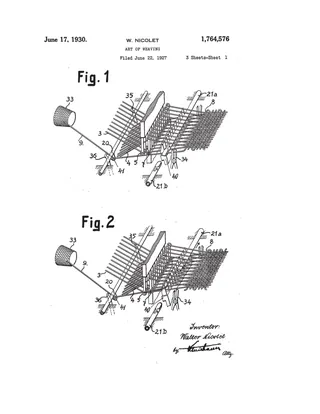
US Patent 1,764,576, granted 17 June 1930 to Walter Nicolet of Leipzig, Germany, for a loom that weaves two fabrics' worth of shedding at once using two sets of warp threads and guide combs. A single rigid weft bobbin supplies weft that is entered into a closed front shed and an open rear shed as a hairpin loop, then cut off, which produces a proper selvedge. The scan has three sheets of drawings (Figs. 1-6 showing consecutive loom positions), the specification, and 17 claims covering the method and the loom.
Artificial Feed for Domestic Silkworms, US Patent No. 3794499
Patent · 3 pages
US Patent 3,794,499 (granted Feb. 26, 1974) describes an artificial feed for domestic silkworms (Bombyx mori) that combines a conventional mulberry-leaf-powder feed with at least 30% unicellular green alga such as Chlorella or Scenedesmus. The patent covers the background on sericulture and artificial diets, example feed compositions, and a rearing-trial table (chlorella content 0-90%) showing faster growth, a shorter larval period, more uniform pupation, and heavier cocoons at 30% or more. It ends with two claims and the references cited.
Artificial Feed for Silkworms and Method of Using the Same, US Patent No. 3583871
Patent · 3 pages
US Patent 3,583,871 (granted June 8, 1971) describes an artificial feed for silkworms made from a hydrogel of maize and/or sorghum with soybean solids, which can replace mulberry leaves after the second instar. Examples compare feed compositions, cooking conditions, and particle size by larval weight and cocoon yield, and show that combining penicillin or tetracycline with a macrolide antibiotic protects larvae from flacherie. The patent ends with nine claims and a list of cited references. It was assigned to Ajinomoto Co. and Katakura Industry Co.
Artificial Feed for Wild Silkworms, US Patent No. 3792172
Patent · 2 pages
US Patent 3,792,172 (granted Feb. 12, 1974) describes an artificial feed for rearing wild silkworms indoors, such as Chinese tusser, Japanese tusser and eri silkworms. The feed adds unicellular green algae (chlorella or scenedesmus) to conventional feeds of oak, castor bean or tree-of-heaven leaf powder, soybean, sugar, starch and vitamin C. Two examples with comparison tables show shorter larval period, higher survival and cocoon yield, and heavier cocoon shells than the prior-art feed. The patent includes the claim, cited references and background on wild silk.
Artificial Filament, Yarn, or Thread, US Patent No. 1996796
Patent · 5 pages
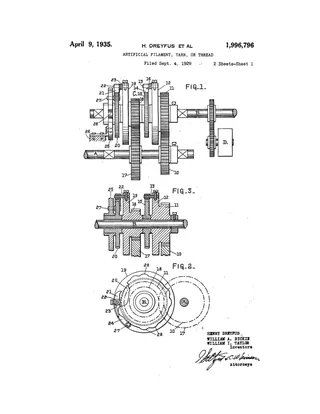
US Patent 1,996,796, granted 9 April 1935 to Henry Dreyfus, William A. Dickie and William I. Taylor, assignors to Celanese Corporation of America. It describes making artificial filaments, yarns or threads with a regular, systematic variation in denier by varying the output of the spinning pump, using a pawl-and-ratchet drive with cam control or a multi-cylinder cam-driven pump. The text notes use of the resulting yarns in weaving, knitting, braiding and lace-making, and the effects when dyed. It includes two sheets of apparatus drawings and two claims.
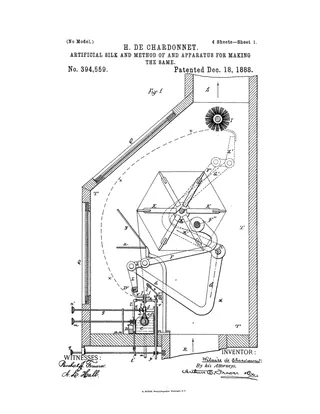
Artificial Silk and Method of and Apparatus for Making the Same, US Patent No. 394559
Patent · 9 pages
United States Patent No. 394,559, granted December 18, 1888 to Hilaire de Chardonnet of Besançon, France, for artificial silk and a method and apparatus for making it. The specification describes making filaments from a collodion (pyroxyline) solution in ether and alcohol. The solution is forced through fine nozzles into cold water, and the filaments are drawn onto a reel and dried with warm air in an enclosed casing. Four sheets of drawings show the spinning apparatus, and the document ends with 25 claims covering the textile material, the method, the composition and the machine parts.
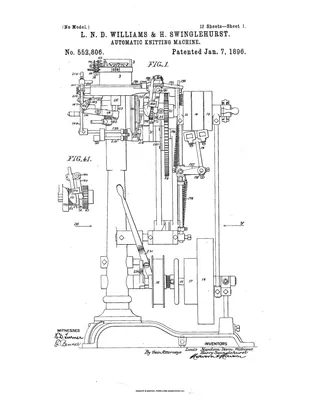
Automatic Knitting Machine, US Patent No. 552806
Patent · 25 pages
US Patent No. 552,806, granted January 7, 1896 to Louis N. D. Williams of Ashbourne and Harry Swinglehurst of Philadelphia, for an automatic circular knitting machine that makes socks and stockings. Twelve sheets of drawings show the needle cylinder, cam box, needle lifters, thread-feeding mechanism, pattern chain and clutch and belt-shifting gear. The specification explains how the machine switches between rotary and reciprocating motion to form the heel and toe pocket, shapes the leg by varying needle draft, and adds a reinforcing thread at intervals. It ends with numbered claims.
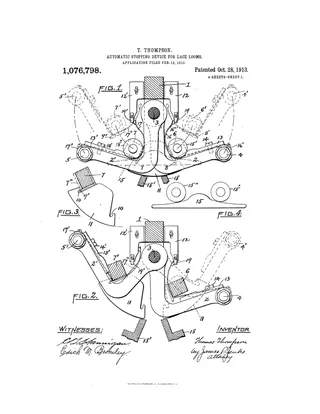
Automatic Stopping Device for Lace Looms, US Patent No. 1076798
Patent · 8 pages
US Patent No. 1,076,798, granted October 28, 1913 to Thomas Thompson of Pawtucket, Rhode Island, for an automatic stopping device for "lever" or "go through" lace looms. The device uses the loom frame as part of an open electric circuit. When a displaced shuttle forces the catch bars out of engagement, spring contacts close the circuit and an electromagnet trips the shipper to move the belt to the loose pulley. A variant breaks the fuses of a motor-driven loom. The scan has four sheets of mechanical drawings (Figs. 1-15) followed by the specification and four claims.
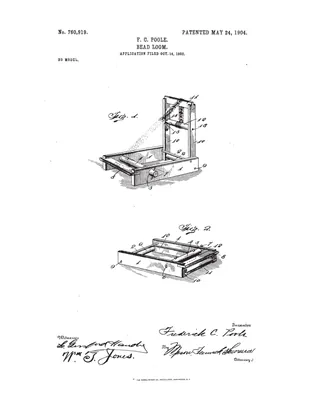
Bead Loom, US Patent No. 760919
Patent · 3 pages
US Patent No. 760,919, granted May 24, 1904 to Frederick C. Poole of Gloucester, Massachusetts, for an upright folding hand loom for beadwork. The specification describes a base frame with a pivoted upright section, warp combs, and two rollers for tension and take-up, and explains how the loom is threaded and folded for storage. It closes with seven claims; the drawings show the loom in open and folded positions.
Braiding Machine, US Patent No. 672
Patent · 2 pages
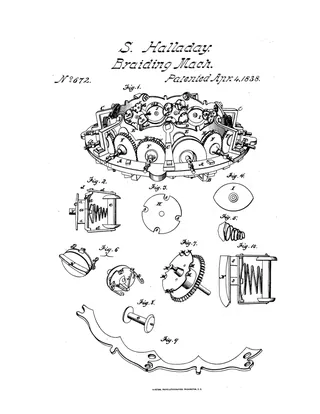
US Patent No. 672, granted April 4, 1838 to Seymour Halladay of Westfield, Massachusetts, for an improvement on John Thorp's braiding machine, described as a plaiting machine for covering whips. The specification describes oval guide plates (forms) that replace Thorp's cant wire, a carrier wheel with single cavities, and a racer with one outside stud and an inner shoe. It includes one drawing sheet with Figures 1-10 and the written specification with three claims.
Building, US Patent No. 518274
Patent · 4 pages
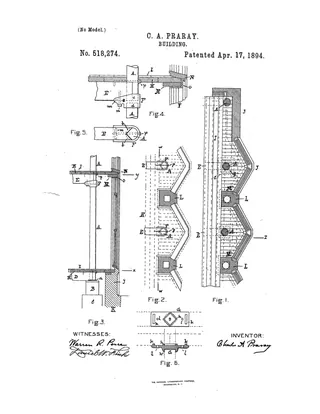
US Patent No. 518,274, granted April 17, 1894 to Charles A. Praray of Providence, Rhode Island, for an improved building construction aimed at mills and other large buildings. Iron columns on separate piers carry the floor beams, while the outer walls, with bayed surfaces and pilasters, stand on their own foundations and carry no floor load. The patent includes a drawing sheet with six figures, a specification and five claims; the advantages cited are cheaper walls, more window space, easier removal of walls after a fire, and protection of beam ends from rot.
Carding Machine, US Patent No. X0001588
Patent · 1 page
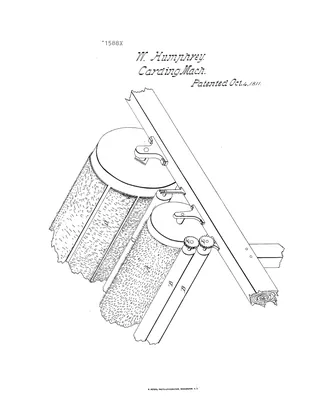
A single-page drawing from an early US patent for a carding machine, issued to W. Humphrey on October 4, 1811. It shows a perspective view of two large cylindrical card drums covered with wire teeth, mounted on a wooden frame with diagonal side members and lettered reference parts. No descriptive specification text is included in the scan, only the sheet heading.
Carpet, US Patent No. D0019208
Patent · 2 pages
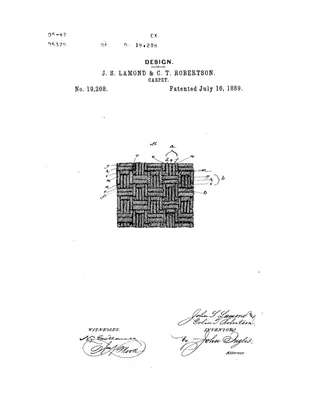
US design patent D19,208, granted July 16, 1889 to John S. Lamond and Colin T. Robertson of Paterson, New Jersey, for a carpet design. The drawing shows a square pattern of woven-looking blocks with lettered parts. The specification describes two alternating groups of bars: group a has three long bars with shorter outer bars, and group b has two transverse long bars with a short outer bar. It claims the design as shown and gives no weaving structure or draft.
Carpet-Looms, US Patent No. 6806
Patent · 14 pages
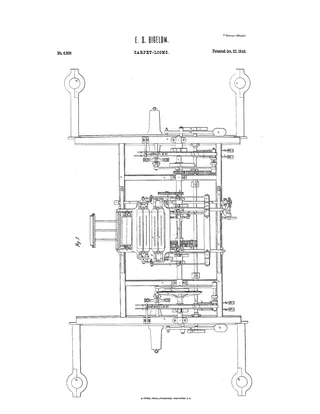
US Patent No. 6,806, granted October 23, 1849 to Erastus B. Bigelow of Clintonville, Massachusetts, for improvements in the power loom for weaving carpets and other figured fabrics with a Jacquard. It has seven sheets of drawings and a specification describing a Jacquard frame with its own shafts, driven from the loom and adjustable in height to suit the harness cords. It also covers overhead drive of the picker staffs and shuttle-box shifting for pendulous shuttle-box frames, and a reversing motion for the power loom. Four claims are listed, followed by a disclaimer dated Boston, September 11, 1863, that narrows the reversing-motion claim.
Cases for Laces, Ribbons, &c., US Patent No. 137297
Patent · 2 pages
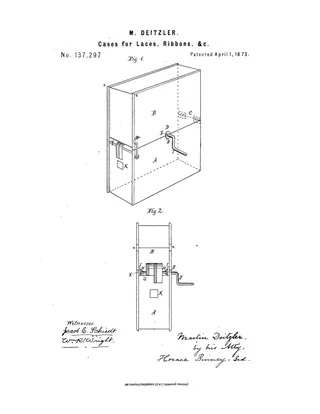
US Patent No. 137,297, granted April 1, 1873 to Martin Deitzler of Ashland, Pennsylvania, for a hinged case that stores an original package of lace or ribbon wound on a pasteboard strip. Spring clamps and spools hold the package so the lace can be drawn out through a front opening and rewound with a key. A recess on the front holds marking-cards. The first page is the patent drawing (Figs. 1 and 2); the second is the specification and claim.
Circular Loom for and Method of Weaving Ribbon-Shaped Weft, US Patent No. 5293906
Patent · 52 pages · weaving drafts
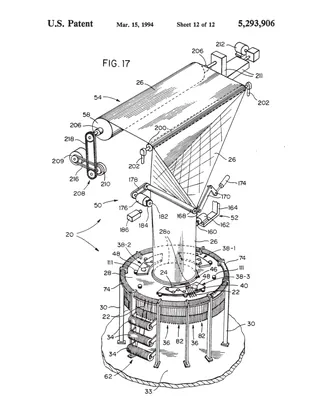
US Patent 5,293,906 (Suresh K. Amin, assigned to Quadrax Corporation, granted 15 March 1994) describes a circular loom and method for weaving fabric with ribbon-shaped weft, intended for fiber-reinforced plastic tapes. Warp sheds are formed by pneumatic air cylinders that a control system presets ahead of the rotating shuttles. Electrical brakes control warp and weft tension, a ring-shaped fabric-forming member produces tubular fabric, and the fabric is slit, pulled and wound on a take-up reel. The scan includes the USPTO web printout, the full specification, the claims and 12 sheets of drawings. These show mechanical assemblies, 5-harness and basket-weave pattern grids, control tables, a flowchart and a block diagram.
Circular Loom for Weaving Ribbon-Shaped Materials, US Patent No. 4977933
Patent · 36 pages · weaving drafts
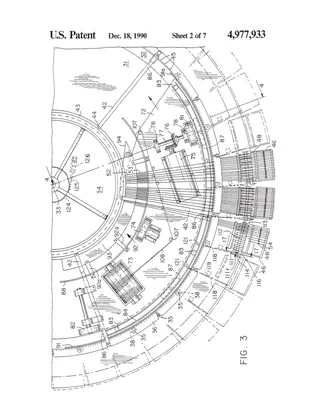
US Patent 4,977,933 (Joseph E. Brais, assigned to Joss Company, granted 18 Dec 1990) for a circular loom that weaves tubular fabric from flat ribbon-shaped weft. The shuttle assembly travels a circular path carrying its own weft supply, motor and shed-forming means. A cam-driven disk and ratchet mechanism pre-orients the warp ends for the pattern. The scan includes a USPTO database printout with abstract, citations and claims, the patent as printed with 7 sheets of drawings, and the full specification. The specification describes the shuttle, fabric take-up and warp orienting mechanisms, with plain weave and herringbone pattern examples.
Circular Loom having Improved Shuttle Retention, US Patent No. 5409044
Patent · 23 pages
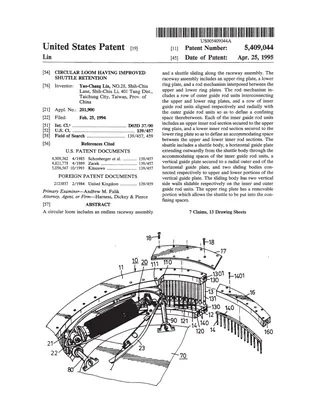
US Patent 5,409,044, granted to Yao-Chang Lin of Taichung, Taiwan, on April 25, 1995, for a circular loom with improved shuttle retention. The invention adds inner and outer guide rod units between the upper and lower ring plates of the endless raceway, so the shuttle cannot be pulled out of the raceway by centrifugal force and weft tension. The scan has a USPTO database printout (text and claims) plus the patent itself, with 13 sheets of drawings (Figs. 1-6 prior art, Figs. 7-13 five embodiments), background, summary, detailed description and claims.
Circular Loom, US Patent No. 1139073
Patent · 18 pages
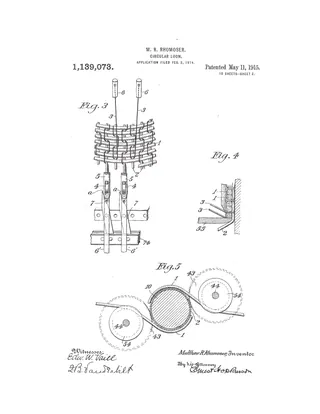
US Patent No. 1,139,073, granted May 11, 1915 to Matthew R. Rhomoser of Sandy Hook, Connecticut, assignor to Fabric Fire Hose Company, for a circular loom. The machine weaves tubular fabric for fire-hose jackets, with stationary warp strands, helically laid weft from rotating shuttles, and binder strands looped by groups of heddles and switches. The scan has ten sheets of patent drawings (Figs. 1-16) showing the fabric structure, shuttle drive, heddles and cam tracks, followed by the specification and numbered claims.
Circular Loom, US Patent No. 1426641
Patent · 12 pages
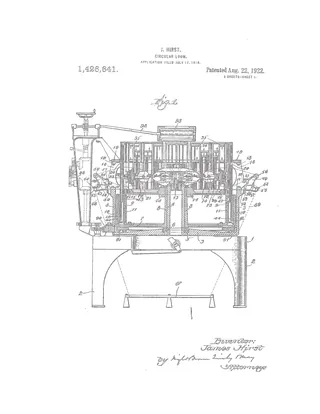
US Patent No. 1,426,641, granted 22 August 1922 to James Hirst of Melrose, Massachusetts, for a circular loom that weaves seamless tubular fabric. The loom uses gear-driven shuttles that travel in a circle around a mandrel, with heddles driven directly by rotating inner and outer cylindrical cams. The specification covers removable heddle frames, warp tension fingers, an adjustable weft packer and spreader on the shuttle, and a modified form with separate heddle bars. It has six sheets of mechanical drawings, the written specification, and ten claims.
Circular Loom, US Patent No. 1495311
Patent · 7 pages
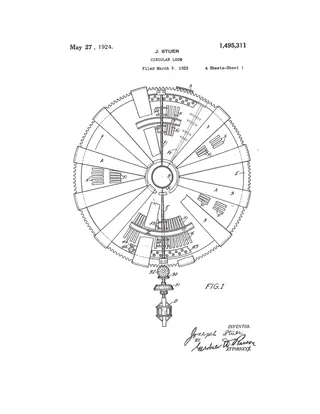
US Patent No. 1,495,311, granted May 27, 1924 to Joseph Stuer of Lawrence, Massachusetts, for a circular loom that weaves a seamless tube of cloth with no selvages. Warp carriers sit in concentric rings and are raised and lowered by cams on rotating filling arms, which carry the weft bobbins and lay the filling into the shed. The document has four sheets of drawings (Figs. 1-16) followed by the specification and two claims.
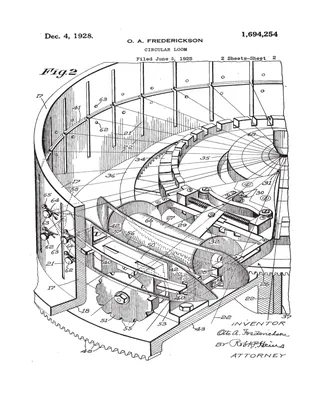
Circular Loom, US Patent No. 1694254
Patent · 6 pages
US Patent No. 1,694,254, granted 4 December 1928 to Otto A. Frederickson of Wethersfield, Connecticut, and assigned to the Wire-Mold Company. It describes a circular loom in which a tilting nose on the shuttle replaces heddles for opening the shed, directing warp threads over or under the shuttle. Fixed pins on the drum wall tilt the nose, and the pins can be repositioned to change the order of thread shifting. The patent has two sheets of drawings (side section, perspective detail, and diagrammatic view of the drum), a specification, and ten claims.
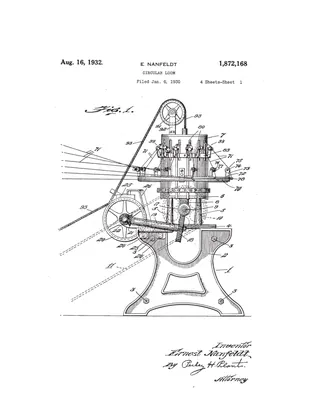
Circular Loom, US Patent No. 1872168
Patent · 11 pages
US Patent No. 1,872,168, granted August 16, 1932 to Ernest Nanfeldt of New Haven, Connecticut, assignor to Respro, Inc., for a circular loom that weaves tubular fabric. Weft thread carriers travel around a circular path while cam-driven pivoting guide arms place warp threads above or below each carrier in a set pattern. The loom can weave the tube around a central pin or as a covering on a wire or tube drawn through the hollow shaft. The document has four sheets of patent drawings (side elevation, top plan, vertical section, cam-groove diagram, gear detail, guide-arm detail), then the specification and 14 claims.
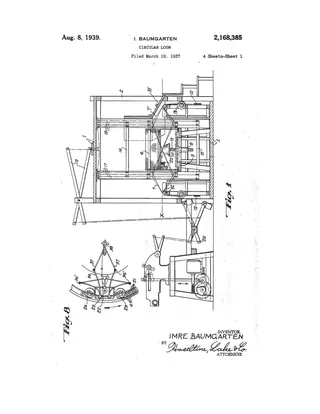
Circular Loom, US Patent No. 2168385
Patent · 7 pages
US Patent 2,168,385, granted 8 August 1939 to Imre Baumgarten of Budapest, for a circular loom that weaves hats and other cylindrical fabrics. Warp threads run radially from a central hat form through healds arranged in a circle. An electric-motor-driven shuttle carries the weft bobbin around a circular comb-like track, laying weft in a spiral. The text describes the heald frames, the Jacquard attachment for patterned fabrics, the warp-increasing procedure, a spring-loaded weft-laying device, and the adjustable hat form, followed by three claims. Four sheets of drawings (Figs. 1-9) accompany the specification.
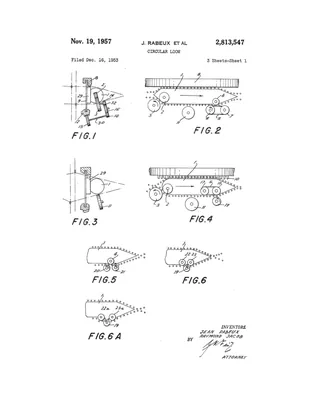
Circular Loom, US Patent No. 2813547
Patent · 6 pages
US Patent 2,813,547, granted 19 November 1957 to Jean Rabeux and Raymond Jacob of France, for a circular loom. It covers a way of supporting and guiding the shuttles of circular looms with a horizontal shed, using driven and idler wheels, belts and a toothed crown in place of rails that hold the shuttle against the warp threads. The inventors say this reduces strain and breakage of the warp, allows fine, fragile threads and tightly woven cloth, and lets the shuttle be removed easily. The document has three sheets of drawings (Figs. 1-12), a specification and 24 claims.
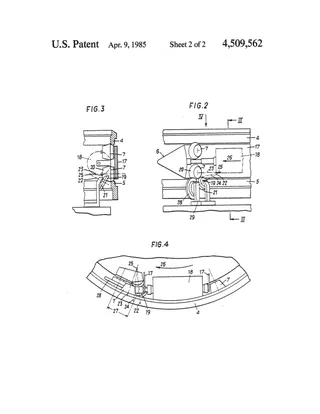
Circular Loom, US Patent No. 4509562
Patent · 8 pages
US Patent 4,509,562, granted April 9, 1985 to Johann Schönberger and co-inventors, assigned to Chemiefaser Lenzing AG (Austria). It describes a circular loom with an improved shuttle drive in which the catch roller on the rotor contacts a running roller at the shuttle's front end, so the shuttle is pulled rather than pushed and is not forced out of the running races. The scan includes a USPTO database printout (abstract, claims, description) and the original patent pages with two sheets of drawings (Figs. 1-4), a description of the harness and shed formation, and two claims.
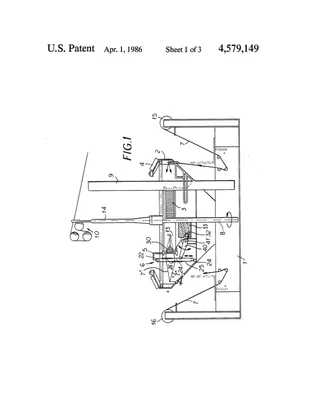
Circular Loom, US Patent No. 4579149
Patent · 7 pages
US Patent 4,579,149, granted 1 April 1986 to Franz X. Huemer of Vienna, for a circular loom whose shaft-driving mechanism uses two-armed control levers. The levers connect a revolving plate cam to belt-type partial healds, which move the inner and outer yarn guiding eyes up and down to form a travelling shed for tubular fabric. The patent gives the abstract, background, description of the drawings (Figs. 1-5), alternative lever-to-belt anchorages and five claims. It has three sheets of mechanical drawings.
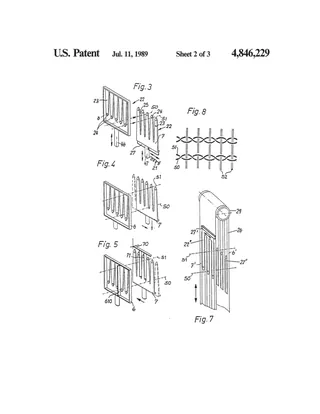
Circular Loom, US Patent No. 4846229
Patent · 12 pages
US Patent 4,846,229 (Franz X. Starlinger-Huemer, granted 11 July 1989) describes a circular loom adapted to weave leno fabric, mainly tubular fabric from narrow plastic strands for sacks. Pairs of inner and outer partial healds carry comb-like guides with thread eyes. After each shedding motion, displacement means shift the healds laterally so that warp threads jump across their neighbors to form the leno crossing. The scan includes an abstract, claims, description and three sheets of patent drawings, in both a USPTO web printout and the printed patent.
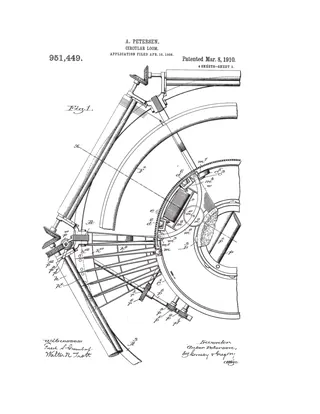
Circular Loom, US Patent No. 951449
Patent · 11 pages
US Patent No. 951,449, granted to Anker Petersen of Chelsea, Massachusetts, on March 8, 1910, for a circular loom that weaves tubular fabric at high speed using several shuttles. The document has four sheets of patent drawings (Figs. 1-9) followed by the specification and 23 claims. The specification describes a circular shuttle raceway made of two rings joined by vertical reed dents, a cam ring that drives both the shed-forming heddle levers and the shuttles, a weft-packing wheel on each shuttle that replaces the reed, spring warp take-ups, and the let-off and take-up mechanisms. It notes that one cam groove gives plain weave and that extra grooves and levers could produce a twill surface.
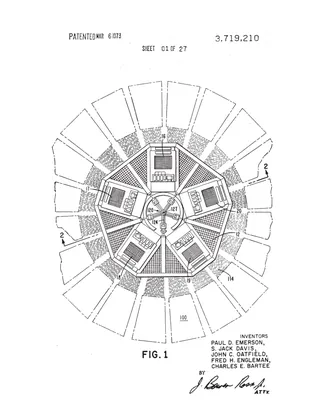
Circular Weaving Apparatus Product and Process, US Patent No. 3719210
Patent · 53 pages
US Patent 3,719,210 (granted March 6, 1973; Emerson et al., assigned to Monsanto) describes a circular weaving machine and the process for making thick-walled, integrally woven, three-dimensionally shaped fabrics on a mandrel. Several Jacquard heads form warp sheds around a vertical axis while filling yarn inserters travel around the mandrel and the mandrel is raised at the rate of weaving. The fabric can be a cylinder, a cone, or an irregular shape such as an airplane wing or boat hull. The patent has 27 sheets of drawings (77 figures) covering mechanical assemblies, mandrel shapes, hydraulic and electrical control circuits, and diagrams of warp and filling yarn arrangements, followed by the specification and 69 claims.
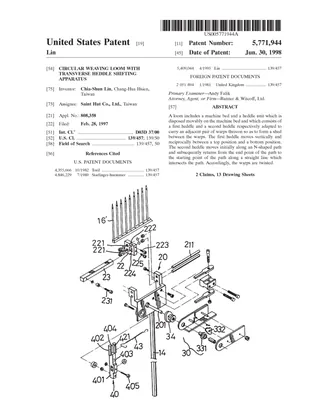
Circular Weaving Loom with Transverse Heddle Shifting Apparatus, US Patent No. 5771944
Patent · 9 pages
US Patent 5,771,944 (Lin, granted 30 June 1998) describes a circular weaving loom in which one heddle moves vertically while a second heddle follows an N-shaped path driven by a cam, ratchet, pawl and swing-arm assembly. The movement twists the warps around the wefts to give a thicker, stronger leno-type cloth. The scan holds the USPTO database printout (abstract, claims, description) and the patent drawing sheets, including prior-art figures and an exploded view of the driving assembly.
376 documents found