Textile Documents › Authors › Author: Edward William Jr. Serrell
10 documents found
Sort: 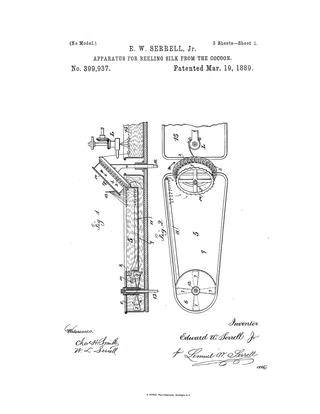
Apparatus for Reeling Silk from the Cocoon, US Patent No. 399937
Patent · 6 pages
US Patent No. 399,937, granted March 19, 1889 to Edward William Serrell Jr., for a machine that automatically fills cocoon-holders (magazines) when reeling silk from the cocoon. Cocoons float in a charging basin with a circulating water current into a rotating pocketed magazine, which then ejects them one at a time into the reeling basin near the lance-bout finger. The document has three sheets of drawings (Figs. 1-8), a specification describing the locking, rotating and ejecting mechanisms, and five claims.
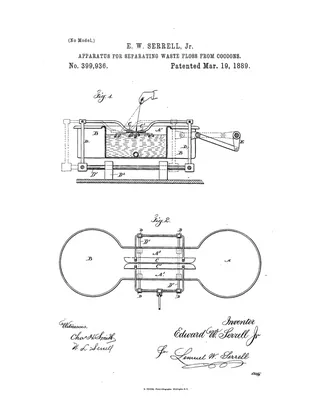
Apparatus for Separatur Waste Floss from Cocoons, US Patent No. 399936
Patent · 3 pages
US Patent No. 399,936, granted March 19, 1889 to Edward William Serrell Jr. of New York, for a machine that removes waste floss from silk cocoons before reeling. Plates held over a hot-water basin are moved back and forth, agitating the cocoons while the floss is pulled out, replacing the hand-cleaning (débavage) that required great skill and labor. The document has a drawing sheet (side section and plan view), the specification, and three claims. It also lists the foreign patents granted for the invention.
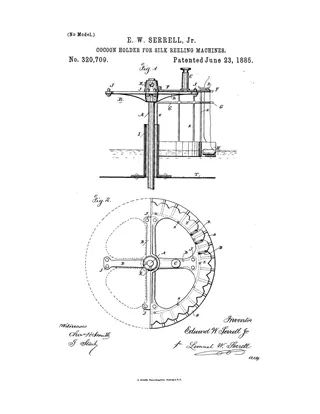
Cocoon Holder for Silk Reeling Machines, US Patent No. 320709
Patent · 2 pages
US Patent No. 320,709, granted June 23, 1885 to Edward W. Serrell Jr. (temporarily living at Chabeuil, Drôme, France), for an improved cocoon holder for silk-reeling machines. It replaces the one-piece circular magazine with sectional magazines, so an emptied half can be lifted off and replaced with a full one without stopping the machine. The patent has a drawing sheet (side elevation and plan view) and a specification with two claims.
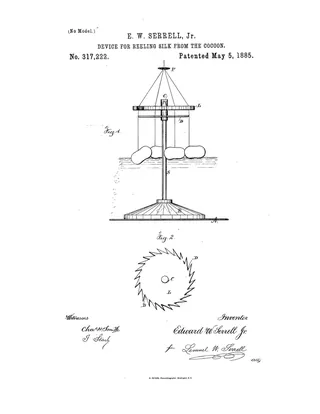
Device for Reeling Silk from the Cocoon, US Patent No. 317222
Patent · 2 pages
US Patent No. 317,222, granted May 5, 1885 to Edward W. Serrell Jr., for an improvement to silk-reeling machinery. A notched, freely oscillating leather disk with a circular guide sits between the water basin and the agate guide, catching lumps of filament and chrysalides before they enter the thread. The patent includes a drawing sheet (side elevation and plan) and the specification with two claims.
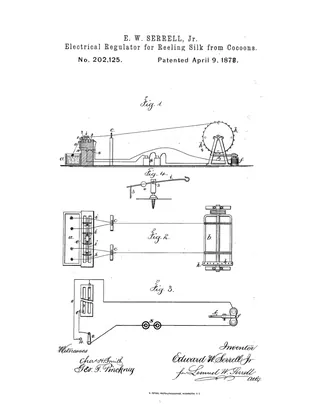
Electrical Regulator for Reeling Silk from Cocoons, US Patent No. 202125
Patent · 3 pages
US Patent No. 202,125, granted April 9, 1878 to Edward W. Serrell Jr. of Castleton, New York, for an electrical regulator for reeling silk from cocoons. It describes an electro-magnetic brake that stops the reel automatically when a silk filament breaks or runs out. Delicate wire lever-guides act as circuit-closers using mercury cups, and a switch lets the operator start or stop the reel. The document has a drawing sheet with four figures, the specification, and two claims.
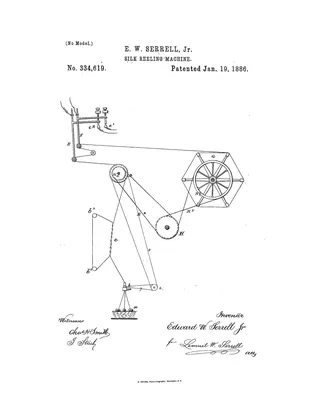
Silk Reeling Machine, US Patent No. 334619
Patent · 3 pages
US patent No. 334,619, granted January 19, 1886 to Edward W. Serrell Jr., for an improvement to automatic silk-reeling machines. It moves the croisure (the point where filaments are twisted to consolidate and dry the thread) to a position between the filament-attaching device and the feeding drum. This keeps uneven thread motion from disturbing the levers that control filament supply and the stop motion. The document has a drawing page and a two-page specification with a single claim.
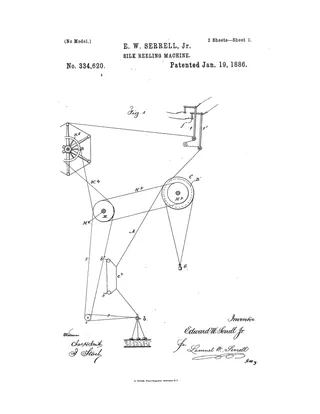
Silk Reeling Machine, US Patent No. 334620
Patent · 4 pages
US Patent No. 334,620, granted January 19, 1886 to Edward W. Serrell Jr. for an improvement in silk-reeling machines. It uses two drums of slightly different diameter on one shaft, with a movable guide between them, so that silk thread stretched while drawn through the croisure can contract to its normal length before being wound onto the reel. The scan has two sheets of patent drawings (Figs. 1 and 2) and a two-page specification with a single claim. The specification also describes the lance-bout filament-attaching device and the electric-circuit levers that add cocoon filaments when the thread falls below the required size.
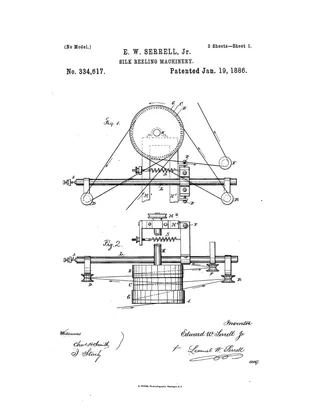
Silk Reeling Machinery, US Patent No. 334617
Patent · 4 pages
US Patent No. 334,617, granted January 19, 1886 to Edward W. Serrell Jr. of New York, then living in Chabeuil, France, for an improvement in silk-reeling machinery. It describes a three-drum arrangement of different diameters, with a spring-loaded pivoted lever and guide pulleys, that compensates for thread stretch after the croisure. The thread's tension on the lever then closes an electric circuit that adds cocoon filaments when the thread falls below standard size. Two sheets of drawings (Figs. 1-3) are followed by the specification and three claims.
Silk Reeling Machinery, US Patent No. 334621
Patent · 3 pages
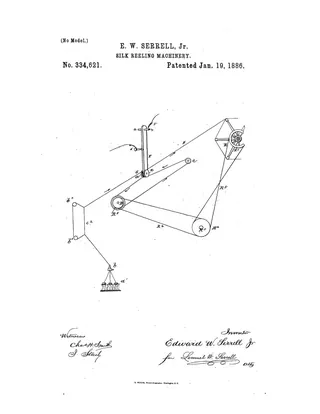
US Patent No. 334,621, granted January 19, 1886 to Edward W. Serrell Jr. for an improvement to an automatic silk-reeling machine. The specification describes a regulating lever carrying two small pulleys, placed so that tensions from the croisure and from cocoon unwinding cancel out and the lever responds only to changes in thread size. The lever closes an electric circuit that adds a cocoon filament when the thread weakens. The document has a patent drawing page followed by the two-page specification and claim.
Silk Reeling Machinery, US Patent No. 406598
Patent · 9 pages
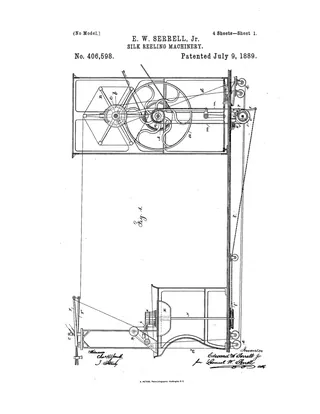
US Patent No. 406,598, granted July 9, 1889 to Edward W. Serrell Jr., for an automatic silk-reeling machine. The machine gauges the tension of the thread being reeled from cocoons. When the thread weakens, an electro-magnet circuit advances a magazine of cocoons so that a new filament is attached, keeping the silk uniform in size and strength. A second lever stops the reel when the thread breaks. The document has four sheets of patent drawings, then the specification and five claims.
10 documents found