Textile Documents › Publications › Publication: Report of the Commissioner of Agriculture
9 documents found
Sort: 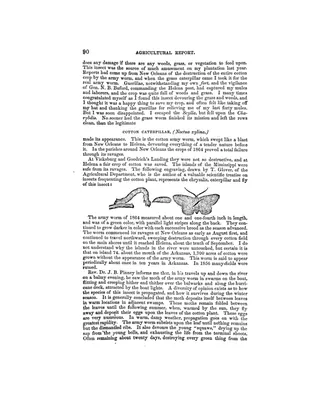
Cotton (by Free Labor)
Article · 5 pages
An 1864 article from the U.S. Commissioner of Agriculture's report, written by M. D. Landon of Helena, Arkansas, describing how 1,040 acres of cotton were raised with free (formerly enslaved) labor. It covers seed selection and chemical analysis, soil preparation, planting, cultivation, insect pests (cotton louse, grass caterpillar, cotton army worm), ginning, and picking. It also gives a wage table for freedmen and an estimate of production costs per acre.
Flax Culture
Article · 6 pages
A practical essay on growing and preparing flax, written from the author's 27 years of experience in Ireland and addressed to American farmers during the Civil War cotton shortage. It covers soil, ploughing, seed sowing, pulling, rippling, steeping (retting), and spreading, with cost and return tables for an acre of unrotted and of rotted flax. It also covers raising two crops in one season, tests of late-pulled samples at Pusey's mill in Wilmington, flax-cotton as a cotton substitute, the flax flea, and a proposal for local scutch mills.
Sheep in Iowa
Article · 21 pages
An 1864 agricultural report article by Dr. J. M. Shaffer, Secretary of the Iowa State Board of Agriculture, on the growth of sheep raising and wool production in Iowa. It covers sheep and wool statistics for 1850-1864, state legislation on sheep and dogs, shelter, pasturage and grasses, regional reports from counties, woollen manufacturing facilities, and the profits of wool growing. It includes two plates of Merino sheep (ram and ewe) and tables on population, sheep numbers, wool production and wool imports.
Sheep-Husbandry in Nebraska
Article · 4 pages
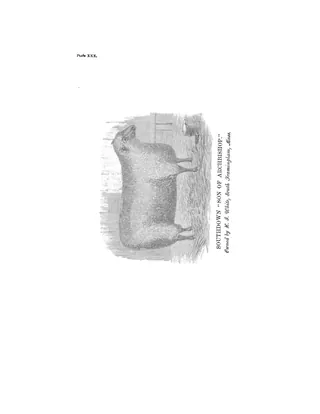
A short 1864 agricultural report article by D. J. M'Cann of Nebraska City on raising sheep in Nebraska Territory. It covers the region suited to sheep, climate, soil, winter feeding (Hungarian grass, corn, oats), and breed choice, favoring Spanish merino over French merino and coarse wools. It also discusses wool prices, yields per fleece, and the cost of shipping wool east. A plate shows a Southdown ram.
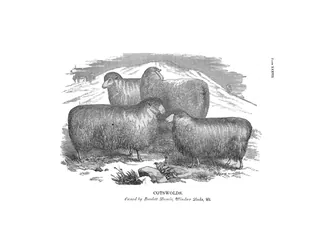
[Sheep]
Illustration · 3 pages
Three plates of sheep illustrations from an agricultural report. One engraved plate shows Cotswold sheep (a ram and a ewe) owned by Burdett Loomis of Windsor Locks, Connecticut. Two further plates show a Cotswold and Leicester cross owned by Richards Bradley of Brattleboro, Vermont. The pages carry only captions and plate numbers, with no other text.
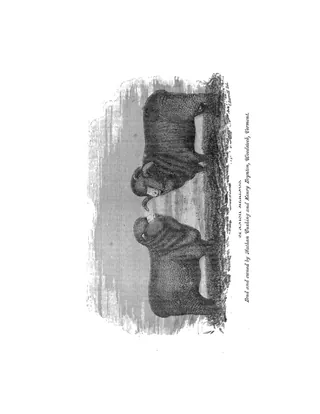
Spanish Merinos and their Management
Article · 10 pages
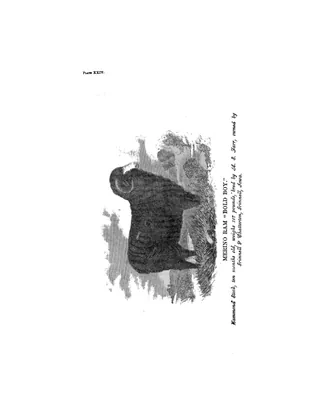
A mid-19th-century American agricultural article by Henry Boynton of Vermont on Spanish merino sheep. It covers the breed's history and antiquity, the 1860s demand and prices for thoroughbred stock, and projections for U.S. wool consumption and production. The practical management sections cover winter housing, water, feeding of hay, turnips and grain, docking lambs, summer pasture, salting, and breeding. Two pages show photographs of prize merino rams.
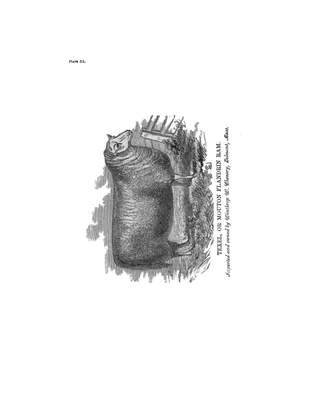
"Texel" or "Mouton Flandrin" Sheep
Article · 9 pages
An 1864 article by Winthrop W. Chenery on the Texel (Mouton Flandrin) breed of sheep, from a U.S. agricultural report. It argues that American farmers should raise long, lustrous combing wool and mutton sheep because manufacturers of worsted, alpaca-type and other fabrics are short of this wool. It compares long-wool and merino sheep on fleece weight, scouring loss and meat yield, and gives the history of the Texel breed and the author's 1863 importation to Massachusetts. Two plates show a Texel ram and ewe.
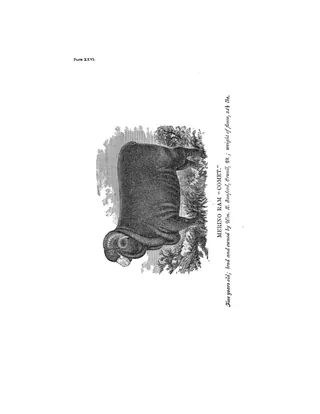
Textile Fibres of the Pacific States
Article · 12 pages
An 1864 agricultural report article by William R. Sanford of Orwell, Vermont, on the history and breeding of fine-wooled Merino sheep in Vermont. It traces the Jarvis, Paular, Infantado and Saxon flocks and describes the author's 1851 buying trip to France, Spain and Germany. It also covers in-and-in breeding, winter feeding, shearing and the wartime outlook for wool prices and tariffs. Plates show the ram Comet, Merino ewes, a Paular ram and a Paular ewe.
Textile Fibres of the Pacific States
Article · 17 pages
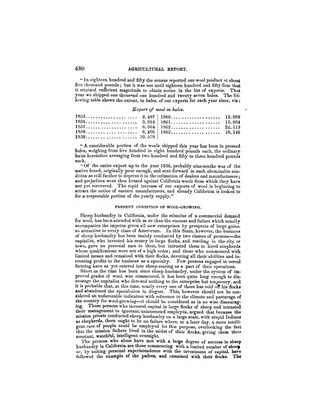
An 1864 agricultural report article by Wilson Flint of Sacramento on the prospects for producing textile fibres in California, Oregon, Washington Territory and neighboring territories. It argues that the dry climate makes cotton, flax and hemp unprofitable there, reviews the growth of sheep and wool production from the mission era onward (with wool export figures for 1855-1863), and makes the case that California's climate is favorable for silk culture. It is concerned with fibre agriculture and economics rather than weaving or cloth structure.
9 documents found