Textile Documents › Publications › Publication: Knight's American Mechanical Dictionary
339 documents found
Sort: 
Asbestus
Article · 1 page
A dictionary entry on asbestus (asbestos), the fibrous, fire-resistant mineral also called amianthus or earth-flax. It covers the name's Greek origin, its mineralogy, and its use by the ancients for cloth, paper, napkins and burial wrappings, citing Herodotus, Pliny, Strabo and Marco Polo. Most of the entry is a numbered list of 19 categories of modern uses, each with patents from about 1834 to 1872, including a final entry on asbestus yarn prepared by alkaline treatment and treated like wool.
Bale
Article · 1 page
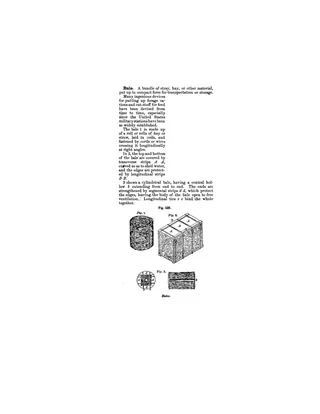
A short dictionary entry on the bale, defined as a bundle of straw, hay, or other material put up compactly for transport or storage. It describes three bale designs for forage, shown in Fig. 588: a coiled cylindrical bale, a rectangular bale with curved cover strips, and a hollow cylindrical bale with end strips for ventilation. The entry concerns hay and straw bales and does not discuss cotton or textiles.
Baleen
Article · 1 page
A short dictionary entry on baleen (whalebone), the fibrous plates hanging from the upper jaw of the right whale. It describes their number and size and lists uses such as umbrella ribs, corset stiffening, brooms, brushes, flax heckles, and splints for plaiting. It also mentions pressed baleen articles (Kortright's 1841 English patent) and the German artificial substitute called wallosine.
Balling-Machine
Article · 1 page
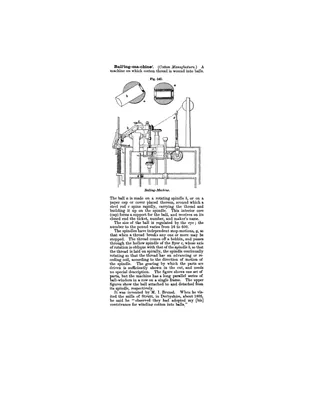
A short dictionary entry describing the balling machine used in cotton thread manufacture to wind thread into balls on a rotating spindle or paper cap. It explains the flyer, spindle, stop-motions, and ball sizes (16 to 600 to the pound), with an illustration of the machine and sectional views of a ball. It also credits the invention to M. I. Brunel and notes its adoption at Strutt's mills in Derbyshire around 1805.
Basket
Article · 2 pages
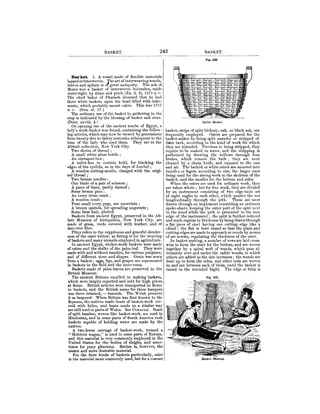
A two-page dictionary entry on baskets from Knight's American Mechanical Dictionary (1876). It surveys the history of basketry from biblical and ancient Egyptian examples, ancient Britons, and basket-work boats and carriages, then describes preparing osiers and splints and the method of weaving a basket from the bottom, sides, brim and handles. It closes with remarks on fruit baskets and veneer baskets, and includes illustrations of a splint basket and basket-making.
Basket-Making Machine
Article · 1 page
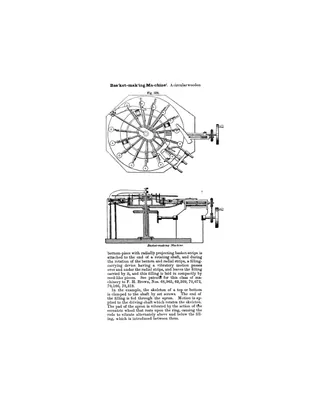
A short dictionary entry describing a machine for making baskets, with two illustrations (Fig. 594). A circular wooden bottom with radiating strips is mounted on a rotating shaft, while a vibrating device carries the filling over and under the strips and reed-like pieces pack it down. The entry cites F. H. Brown's patents and explains how the example machine operates.
Batting-Machine
Article · 1 page
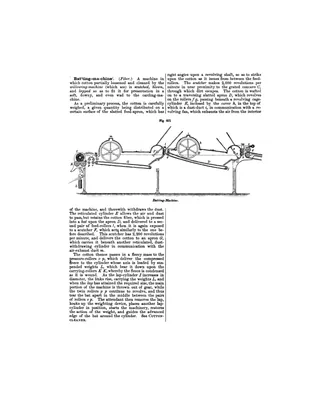
A dictionary entry from Knight's American Mechanical Dictionary describing the batting-machine used in cotton processing. The machine scutches, blows, and laps cotton already loosened by the willowing machine, forming a soft, even wad for the carding machine. The text walks through the feed apron, scutchers, cage cylinders, fans, and pressure and lap rollers, and is illustrated with an engraving (Fig. 601).
Beater-Press
Article · 1 page
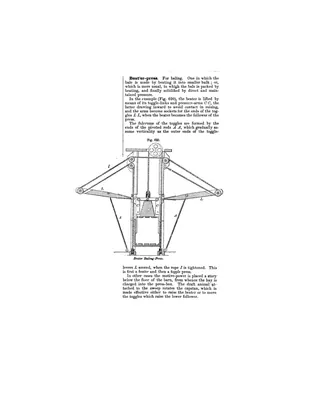
A short dictionary entry defining a beater-press, a baling press in which the bale is packed by beating and then solidified by sustained pressure. It describes the example in Fig. 620, where a beater lifted by toggle-links and pressure-arms becomes the follower of the press, worked by a rope and toggle levers. It also mentions arrangements with a capstan and draft animal for hay baling. The entry concerns agricultural baling machinery, not weaving.
Blanket Washer
Article · 1 page
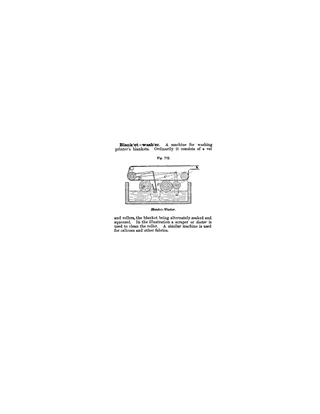
A short dictionary entry describing a blanket-washer, a machine for washing printer's blankets. It consists of a vat and rollers that alternately soak and squeeze the blanket, with a scraper or doctor blade cleaning the roller. The entry notes that a similar machine is used for calicoes and other fabrics, and includes a cross-section line drawing (Fig. 702).
Bleaching
Article · 1 page
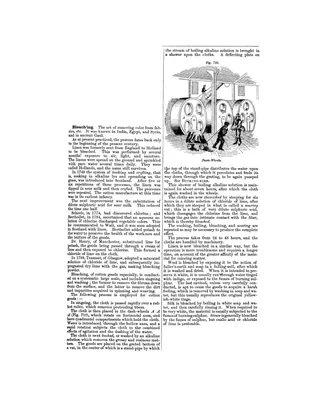
A dictionary entry on bleaching textiles from Knight's American Mechanical Dictionary. It traces the history from ancient exposure bleaching and the Dutch 'Hollands' linen, through bucking and crofting, sulphuric acid, chlorine and bleaching powder. It then describes the nineteenth-century factory process for cotton (singeing, dash-wheels, bucking, chemicking, souring) and briefly covers linen, wool, silk and straw. An engraving shows dash-wheels in operation.
[Bleaching]
Article · 1 page
A single page of short dictionary entries on bleaching terms and equipment from Knight's American Mechanical Dictionary. It defines chemicking (steeping goods in dilute chloride of lime), the dash-wheel for washing calico, and the hanging-machine for drying cloth with tenter hooks.
Blowing-Machine
Article · 1 page
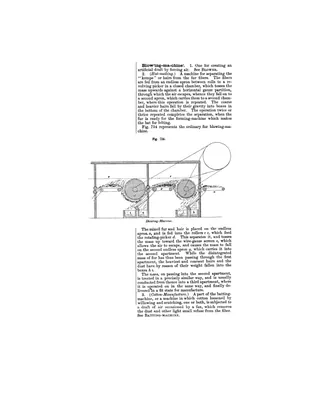
A dictionary entry from Knight's American Mechanical Dictionary defining 'blowing-machine' in three senses: a general air-blowing device, a hat-making machine that separates coarse hairs (kemps) from fur fibers, and part of the cotton batting machine that removes dust with a fan. The fur machine is described in detail with a cross-sectional figure (Fig. 734) showing aprons, rollers, rotating pickers, gauze screens and collection boxes.
Bobbin
Article · 1 page
A dictionary entry defining the bobbin as a spool for holding thread or yarn, covering uses in sewing-machine shuttles, spinning, warping, looms and braiding machines. It notes one-headed and two-headed forms, the Wheeler and Wilson lenticular bobbin, and a braiding-machine bobbin patented by Greenhalgh in 1869. It ends with lists of bobbin materials and construction types.
Bobbin and Fly Frame
Article · 2 pages
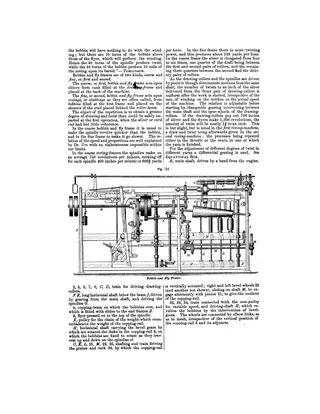
Dictionary entry from Knight's American Mechanical Dictionary describing the bobbin and fly frame, the roving machine of cotton manufacture that draws and twists sliver and winds the roving onto bobbins. It explains the flyer, spindle and bobbin motions, the cone-pulley speed compensation, the copping-rail traverse, and the difference between coarse (first) and fine (second) frames, with a quotation from Tomlinson and twist and speed figures. An engraved cross-section (Fig. 751) is keyed with lettered and numbered parts.
Bobbin Stand
Article · 1 page
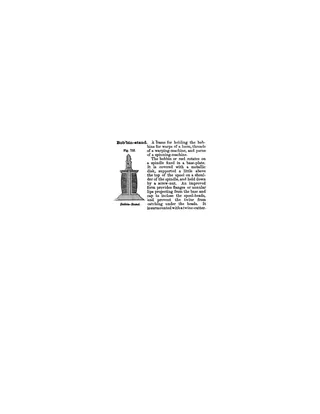
A short dictionary entry defining a bobbin stand, a frame that holds bobbins for loom warps, warping-machine threads, and spinning-machine yarns. It describes a spool rotating on a spindle fixed in a base-plate, covered by a metallic disk held with a screw-nut. An improved form adds flanges to enclose the spool heads, and the stand is topped with a twine-cutter. Illustrated by Fig. 758, a cross-section.
Bobbin-Winder
Article · 2 pages
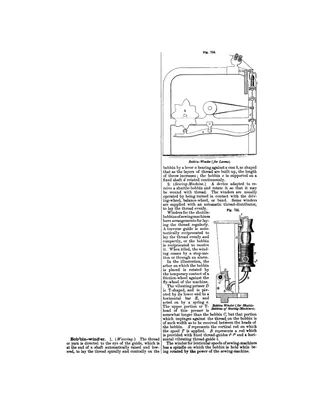
A short dictionary entry on bobbin-winders from Knight's American Mechanical Dictionary. It describes a loom bobbin-winder that uses a lever and cam to lay thread in conical layers, and winders for sewing-machine shuttle bobbins with traverse guides, presser, tension device and automatic cutoff. Three line drawings (Figs. 754-756) illustrate the mechanisms.
Bobbinet
Article · 1 page
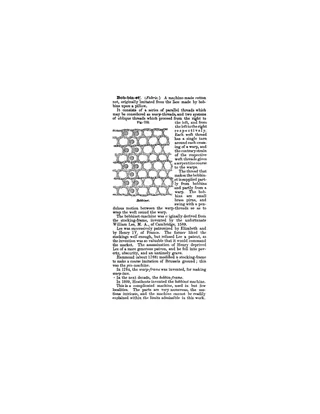
A short dictionary entry defining bobbinet as a machine-made cotton net originally imitating pillow-made bobbin lace. It describes the thread structure of warp threads and two systems of oblique threads, and the brass bobbins that swing between the warps. It also gives a brief history from William Lee's stocking-frame (1589) through Hammond's pin-machine, the warp-frame (1754) and the bobbin-frame to Heathcote's 1809 bobbinet machine. A diagram of the net structure (Fig. 752) accompanies the text.
Bowing
Article · 1 page
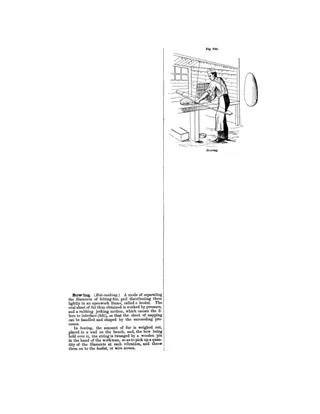
A short dictionary entry on bowing, the hat-making process of separating felting-fur fibers with a vibrating bowstring and depositing them on a basket or wire screen. The resulting sheet of fur is then worked by pressure and rubbing so the fibers felt together. An engraving (Fig. 544) shows a workman at a bench with a suspended bow over a wad of fur.
Box-Plaiting
Article · 1 page
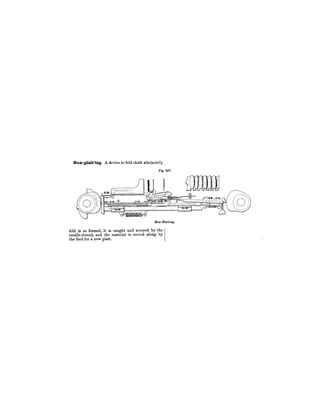
A short dictionary entry on box-plaiting, a machine device for folding cloth into alternating box pleats, from Knight's American Mechanical Dictionary. It explains that each fold is caught and secured by the needle thread while the feed moves the material along for the next plait. A line drawing (Fig. 849) shows the sewing-machine mechanism with an inset of box-pleated fabric.
Braid Sizing and Polishing
Article · 1 page
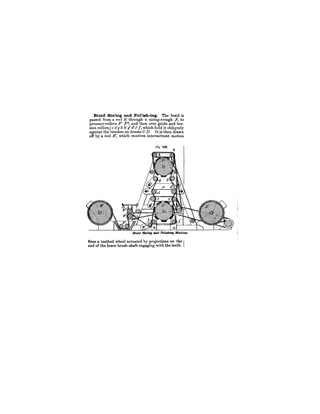
A short dictionary entry from Knight's American Mechanical Dictionary describing a machine for sizing and polishing braid. The braid runs from a reel through a sizing trough and pressure rollers, then over guide and tension rollers that hold it against brushes on rotating drums, and is taken up on a second reel with intermittent motion. Includes one cross-sectional diagram (Fig. 869) of the machine.
Braiding-Machine
Article · 1 page
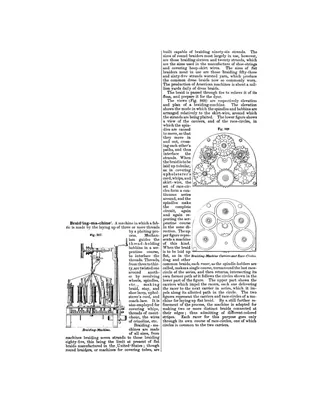
Dictionary entry on the braiding machine from Knight's American Mechanical Dictionary. It describes how the machine plaits three or more threads by guiding bobbin-carrying spindles along serpentine race-circles, and covers machine sizes, round (tubular) and flat braiding, and products such as shoe laces, dress braids, upholsterer's cord and covered skirt wires. Two figures show the machine in elevation and its carriers and race-circles.
Broadcloth
Article · 1 page
A short dictionary entry defining broadcloth as a wide, superior woolen cloth, plain or twilled, dyed in the wool or in the piece. It outlines the manufacturing sequence: sorting, oiling, carding, spinning, weaving oversize, felting and fulling, tentering, napping with teasels on a gigging machine, shearing, and hot pressing.
Brussels Carpet
Article · 1 page
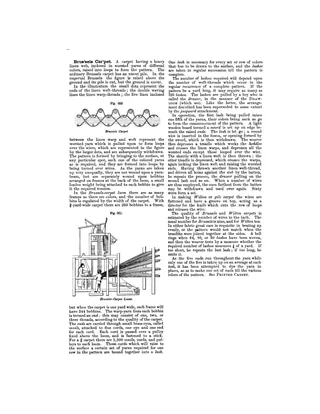
An encyclopedia entry from Knight's American Mechanical Dictionary describing how Brussels carpet is made. It explains the linen warp and weft with worsted pile yarns raised in loops over wires, and the multi-frame bobbin loom with mails, cords and lashes pulled by a drawer. It also covers Wilton (cut pile) carpet, the wire count used to grade quality, and the jacquard attachment that replaced the lash system. Two figures show the carpet structure and the loom.
Bucking-Keir
Article · 1 page
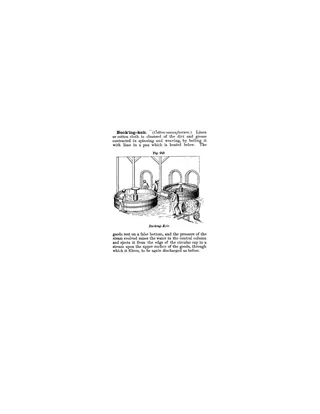
A short dictionary entry describing the bucking-keir, a heated vessel used in cotton and linen manufacture to cleanse cloth of dirt and grease from spinning and weaving. The cloth is boiled with lime, and steam pressure raises water through a central column to spray over the goods. An illustration shows two circular wooden keirs in a shed.
Burring Wheel
Article · 1 page
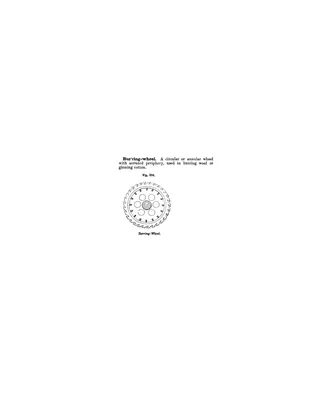
A short dictionary entry for the burring-wheel from Knight's American Mechanical Dictionary. It defines the tool as a circular or annular wheel with a serrated edge, used for burring wool or ginning cotton, and includes a line drawing (Fig. 994) of the wheel.
Calendering
Article · 1 page
A one-page dictionary entry from Knight's American Mechanical Dictionary describing calendering, the finishing operations applied to woven goods between bleaching or dyeing and packing. It covers wetting, rolling, mangling, starching, drying over heated cylinders or on frames, and the patent finish for muslins. It refers readers to the entry on the calendering machine for the glossy surface finish.
Calendering Machine
Article · 1 page
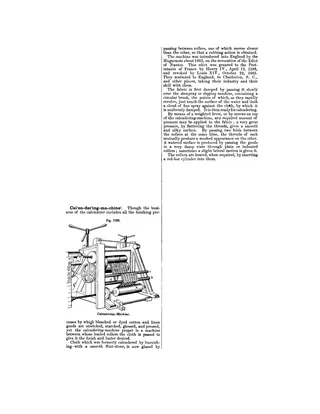
A one-page dictionary entry describing the calendering machine used to finish bleached or dyed cotton and linen cloth. It explains how cloth is damped and passed between loaded, heated rollers to gain gloss, a smooth surface or a watered effect, and notes the machine's introduction to England by the Huguenots around 1685. It includes a line drawing of the machine (Fig. 1026).
Calico Printing
Article · 4 pages
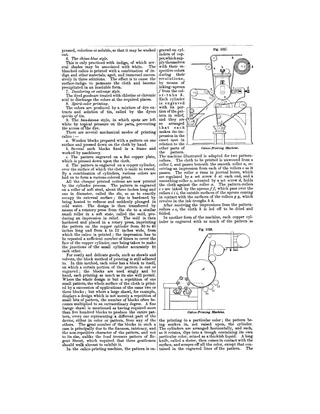
A dictionary article on calico printing from Knight's American Mechanical Dictionary. It traces the history of printing figured designs on cloth from China, India, Egypt and Europe to the introduction of calico printing in England and France. It then describes the main printing styles (madder, steam, padding, resist, discharge, china-blue, bandanna) and the mechanical methods: wood blocks, copper plates and engraved cylinders. Two figures show calico-printing machines with pattern rollers, color troughs and prism-type printers.
[Calico-printing terms from Knight's American Mechanical Dictionary]
Article · 1 page
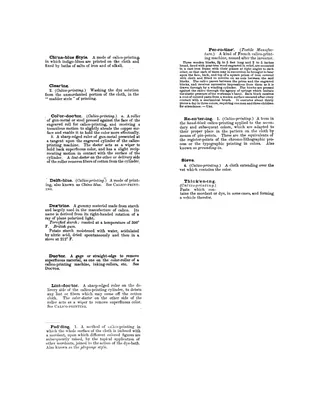
A single page of dictionary entries from Knight's American Mechanical Dictionary (1876) defining terms used in calico printing. Entries cover styles (China blue, Delft blue, padding), machine parts (color-doctor, lint-doctor, ductor, sieve), the Perrotine block-printing machine, and materials and processes (dextrine, thickening, clearing, re-entering).
Can-Roving Machine
Article · 1 page
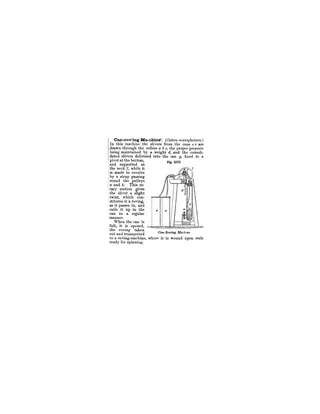
A short dictionary entry describing a can-roving machine used in cotton manufacture. Slivers from cans are drawn through weighted rollers and delivered into a rotating can, whose motion gives the sliver a slight twist to make roving. The roving is then taken to a roving machine and wound on reels for spinning. One line drawing (Fig. 1073) with lettered parts accompanies the text.
Can-Roving Machine
Article · 1 page
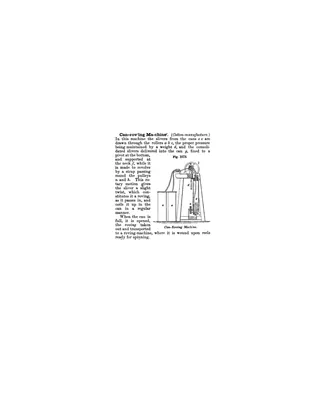
A short encyclopedia entry from Knight's American Mechanical Dictionary describing a can-roving machine used in cotton manufacture. Slivers from cans are drawn through rollers under a weighted pressure and delivered into a rotating can, where a slight twist turns them into roving. The entry includes one line drawing (Fig. 1073) with lettered parts.
Cane Stripper
Article · 1 page
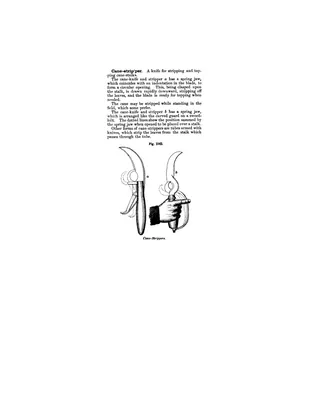
A short dictionary entry from Knight's American Mechanical Dictionary describing cane-strippers, knives used to strip leaves from and top sugar-cane stalks. It describes two knife designs with spring jaws (illustrated in Fig. 1062) and mentions tube-type strippers fitted with knives. The entry concerns agricultural tools for sugar cane, not basketry cane or weaving.
[Cane]
Article · 2 pages
A group of short dictionary entries from Knight's American Mechanical Dictionary (1876) on cane and rattan. It defines cane (Calamus stem) and its use in chair seats and basketry, and covers machines for splitting, scraping and polishing rattan splints. It also covers cane-knives, sorghum cane tools and cane presses, and gives a brief entry on rattan.
Canvas Cutter
Article · 1 page
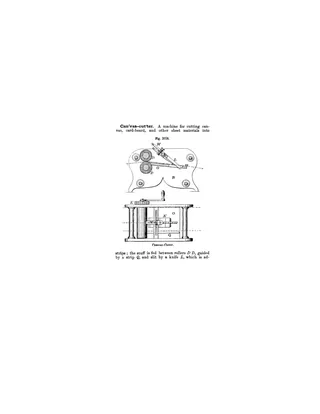
A short dictionary entry from Knight's American Mechanical Dictionary describing a canvas-cutter, a machine that slits canvas, card-board and other sheet materials into strips. Material is fed between rollers, guided by a strip, and cut by a knife. The page includes a line drawing (Fig. 1076) showing an upper elevation and a front elevation of the machine.
Card
Article · 1 page
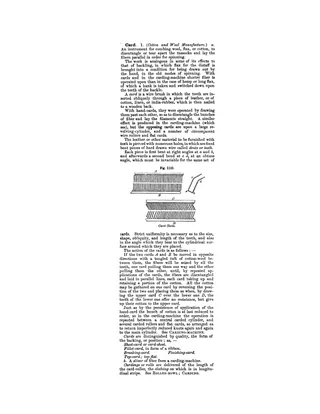
Dictionary entry on the card, the wire-toothed tool used to disentangle and align wool, flax, and cotton fibers before spinning. It describes how cards are built (bent wire teeth set obliquely in leather or other backing on a wooden back) and how two cards working in opposition align the fibers. It also notes the carding-machine equivalent and lists card types such as sheet, fillet, breaking, finishing, and top cards. Includes one figure of card-teeth.
Carding-Machine
Article · 3 pages
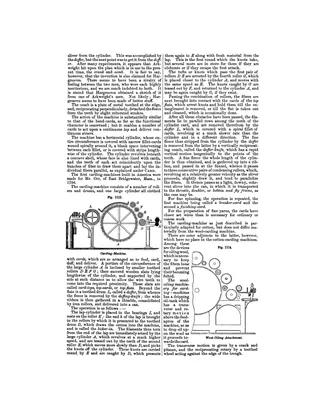
Dictionary article on the carding-machine from Knight's American Mechanical Dictionary. It covers the history of mechanical carding (Lewis Paul, Hargreaves, Arkwright, first American machines in 1786) and describes how the cylinder, licker-in, workers, top flats, doffer and comb operate. It also covers the wool-oiling attachment and the feeder, with three illustrated figures.
Carpet
Article · 2 pages
A dictionary entry on carpets from Knight's American Mechanical Dictionary (1876). It gives a historical survey of carpets from ancient Egypt, Babylon, Persia, Turkey and India to their introduction in France and England (Axminster, 1755). It then lists nine manufacturing processes, including tufted, Brussels, Wilton, tapestry, ingrain, felted and printed carpets, and ends with cross-references to carpet varieties.
Carpet Beater
Article · 1 page
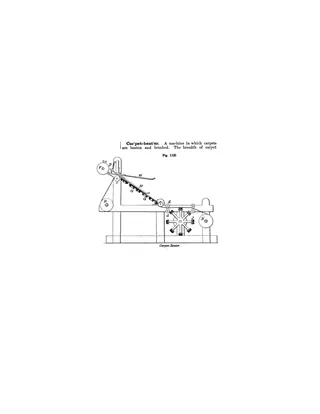
A short dictionary entry on the carpet-beater, a machine for beating and brushing carpets to clean them. It includes a side-elevation line drawing (Fig. 1125) of a frame-mounted machine with rollers and a beater mechanism with brushes, with the carpet passing over the rollers. The sampled text gives only the definition's opening, so the mechanical description is not fully visible.
Carpet Cleaning Machine
Article · 1 page
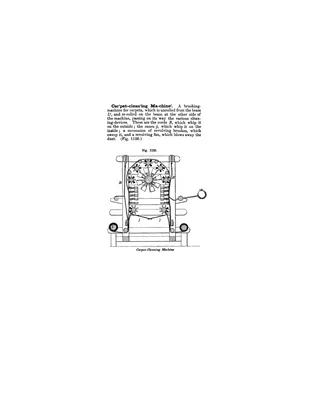
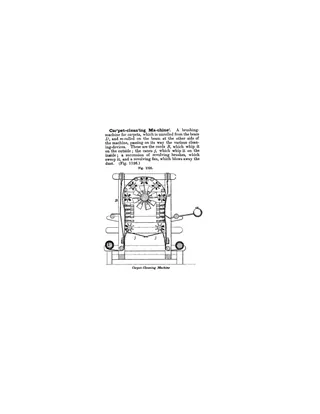
A short dictionary entry describing a mechanical carpet-cleaning machine. The carpet is unrolled from one beam, passes cords that whip its outside, canes that whip its inside, revolving brushes, and a fan that blows away dust, then is re-rolled on another beam. A cross-sectional diagram (Fig. 1126) shows the arrangement of rollers, cords, canes, and brushes.
Carpet Stretcher
Article · 1 page
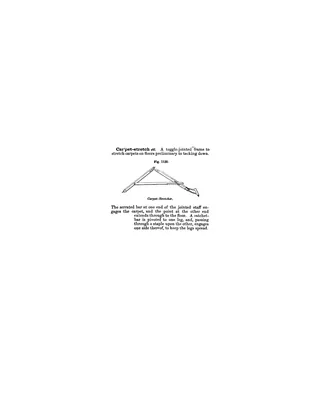
A short dictionary entry defining the carpet stretcher, a toggle-jointed frame used to stretch carpets on floors before tacking them down. The text describes how the serrated bar grips the carpet, the point braces against the floor, and a ratchet bar holds the legs spread. A line drawing (Fig. 1130) illustrates the tool.
Carpet Sweeper
Article · 1 page
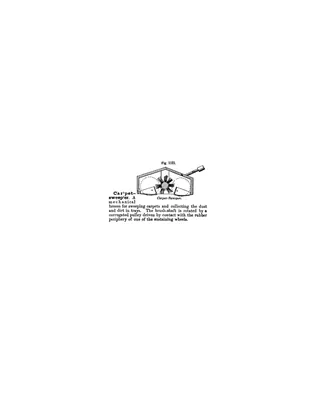
A short dictionary entry defining the carpet sweeper as a mechanical broom that sweeps carpets and collects dust and dirt in trays. It explains that the brush shaft is turned by a corrugated pulley driven by contact with the rubber rim of one of the supporting wheels. A cross-section diagram (Fig. 1131) shows the housing, brush roller, wheels and dust trays.
Carpet-Cleaning Machine
Article · 1 page
A short dictionary entry describing a carpet-cleaning machine, with one cross-sectional diagram (Fig. 1126). The carpet is unrolled from one beam and re-rolled on another while passing cords that whip it on the outside, canes that whip it on the inside, revolving brushes, and a fan that blows away the dust.
Carpet-Lining
Article · 1 page
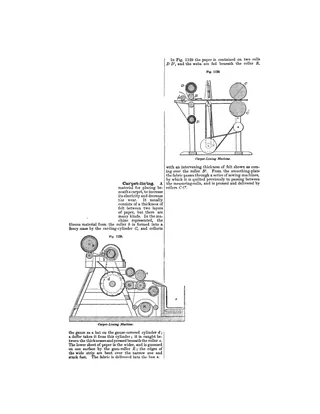
A short dictionary entry defining carpet-lining, a felt-and-paper underlay placed beneath carpets to add elasticity and reduce wear. It describes two machines for making it, shown in Figs. 1128 and 1129, which card fibre into a bat, enclose it between paper layers (gummed in one machine, quilted by sewing machines in the other), and deliver the finished lining.
[Carpets]
Article · 2 pages
A set of short dictionary entries on carpets and rugs from Knight's American Mechanical Dictionary (1876). It defines carpet types including chenille, ingrain/Kidderminster/Scotch, two-ply and triple-ingrain, Brussels-related pile and Wilton velvet-pile, Persian/Turkey, Venetian, damask, rag, and printed carpets, and also covers rugs. The entries describe how each is woven or made, with one cross-section figure of double cloth.
Cashmere
Article · 1 page
A dictionary entry on cashmere as a fabric, describing the Kashmir shawl made from the downy wool of the Thibet goat and how it was woven, with figures added by shuttle or by needle. It also covers European imitations woven on the Jacquard loom in Paris, Lyons and Nismes, a French loom that makes both sides alike, and the Hindoo shawl. A final sense defines cashmere as a woolen and cotton figured dress goods.
Circular Loom
Article · 1 page
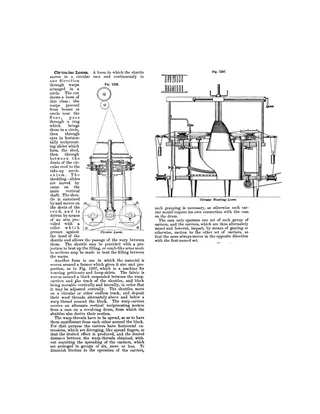
A one-page dictionary entry on the circular loom, in which a shuttle travels continuously in one direction around a circular race through warps arranged in a ring. It describes how the warps, shedding slides, circular reed, cam-driven shuttle and take-up mechanism work. It also describes a second type, shown in Fig. 1297, that weaves tubular fabric such as petticoats and hoop-skirts around a block, with grouped warp-carriers raised and lowered by a cam on a drum. Two engraved figures (Figs. 1296 and 1297) illustrate the machines.
Circular Shuttle-Box Loom
Article · 1 page
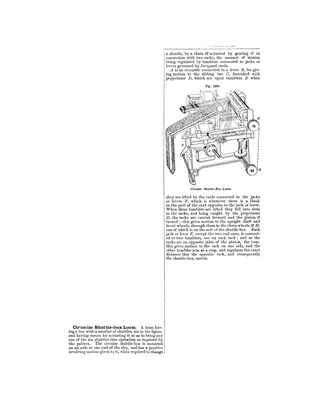
A short dictionary entry describing a circular shuttle-box loom, in which a revolving box holds six shuttles and any one can be brought into use as the pattern requires. It explains how an eccentric, lever, sliding bar, tumblers, racks, pinion and chain drive the box, with the tumblers governed by Jacquard-card-controlled jacks. Illustrated with an engraving (Fig. 1300) with lettered parts.
Cloth
Article · 1 page
A short dictionary entry on cloth from Knight's American Mechanical Dictionary. It defines cloth as a woven fabric of cotton, linen, or wool, then lists the finishing processes for woolen cloth after weaving: scouring, burling, milling or fulling, teasel dressing, shearing, and pressing. It also covers hot-pressing, picking, fine-drawing, marking, and baling, with cross-references to related entries.
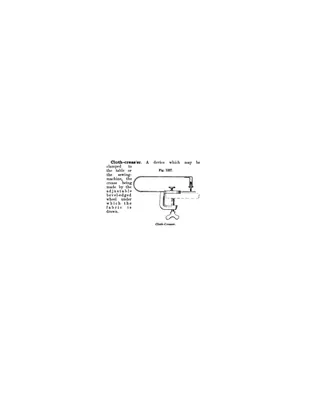
Cloth Creaser
Article · 1 page
A short dictionary entry on the cloth-creaser, a device clamped to a table or sewing machine that makes creases in fabric as it is drawn under an adjustable bevel-edged wheel. It includes a line drawing (Fig. 1337) showing the bent metal arm, clamp, wheel and thumbscrew handle.
[Cloth finishing terms from Knight's American Mechanical Dictionary]
Article · 1 page
A single page of short dictionary entries from Knight's American Mechanical Dictionary (1876) on cloth finishing terms. It defines cloth-paper (used between folds in the finishing press), picking cloth (removing blemishes with tweezers and touching up undyed spots), snugging (rubbing down fuzzy rope fibers), and tabbying (passing fabric between engraved rollers to give a watered or moiré effect).
339 documents found