Textile Documents › Publications › Publication: Appletons' Cyclopaedia of Applied Mechanics
27 documents found
Sort: 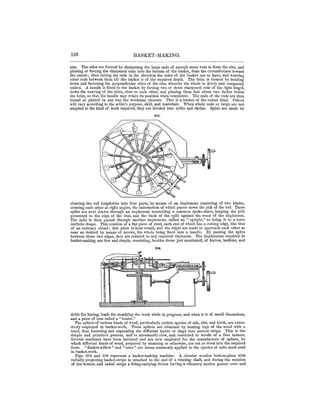
Basket-Making
Article · 3 pages
A short encyclopedia entry describing how baskets are made from split hickory, oak, black ash, osier and similar rods. It covers weaving the slat base, raising the sides on sharpened rib rods, forming the brim and fitting a handle. It also describes preparing splits and splints, the hand tools used (spoke-shave, upright, knives, bodkins, drills, beater), and a basket-making machine shown in Figures 305 and 306.
Braiding and Covering Machines
Article · 3 pages
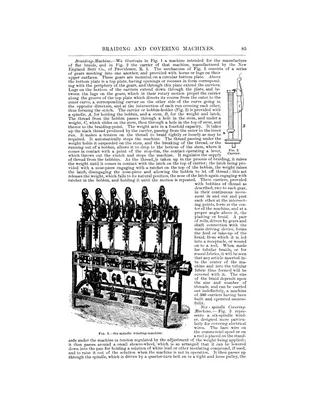
An article from Appletons' Cyclopaedia of Applied Mechanics describing braiding machinery for flat and round plaited fabrics such as trimmings, wicks, laces and cords, and for covering electrical wire. It explains the gear-driven carrier mechanism of a flat braiding machine made by the New England Butt Co., including the weighted bobbin carrier. It also describes a six-spindle wire-covering (winding) machine with flier, stop-motion and feed-wheel. Illustrated with three engravings and line drawings.
Calender
Article · 6 pages
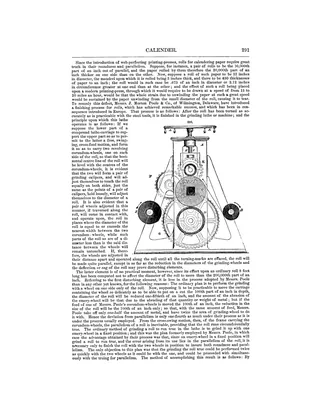
Encyclopedia article on the calender, a machine of heavy rollers that gives a smooth, glossy finish to paper and to cotton and linen cloth. It describes the construction of paper and iron rollers, the lever and screw pressure systems, gearing for glazing, and how cloth is passed through a five-roller machine, with a related water-mangle for wet goods. The last pages cover a roll-grinding lathe using two corundum wheels to make calender rolls round and parallel.
Calico Printing
Article · 6 pages
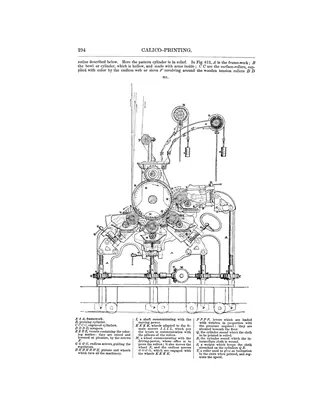
An encyclopedia article from Appletons' Cyclopaedia of Applied Mechanics describing the industrial printing of designs on cotton cloth. It covers mordants, thickeners and the eight styles of calico printing, the nineteen steps of the madder style, and the engraving of copper printing cylinders by steel die and mill. It also describes cylinder, surface-roller and perrotine block printing machines, and the starching and finishing of printed cloth. Engravings of the machines are included, along with a list of reference works.
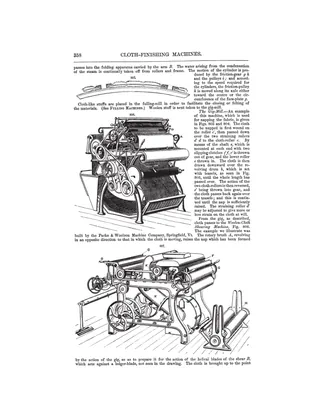
Cloth-Finishing Machines
Article · 11 pages
Encyclopedia article from Appletons' Cyclopaedia of Applied Mechanics (1889) describing the machines used to finish woven cloth. It covers drying and starching machines, the gig-mill for napping, woolen and cotton shearing machines, brushing machines, hot and steam presses, singeing machines, beetling, craping, measuring, winding and folding machines, and a rubber-roller stretching machine. Engraved figures (802-819) illustrate the machines with lettered parts. The scan also includes the start of an unrelated entry on coal-cutting machines.
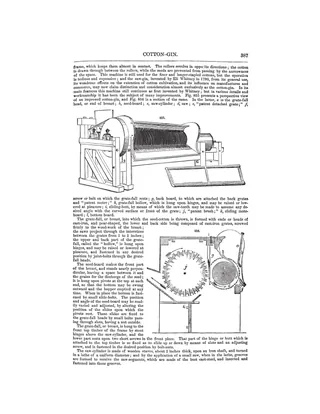
Cotton-Gin
Article · 4 pages
Encyclopedia article on the cotton-gin from Appletons' Cyclopaedia of Applied Mechanics. It describes the ancient roller-gin and Eli Whitney's 1793 saw-gin, with a parts-by-parts account of an improved saw-gin (grate-fall, seed-board, saw-cylinder, brush, mote-board, patent detached grate). It also covers later designs, namely the Macarthy, Cowper lock-jaw, knife-roller and Scattergood needle gins, plus a self-feeding apparatus, and ends with a table of claimed capacities in pounds of cotton cleaned per hour.
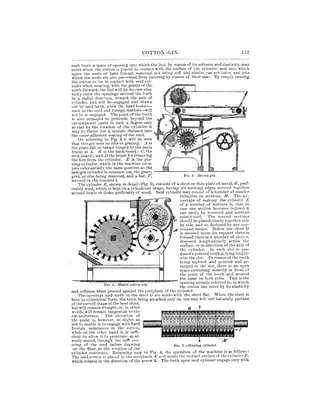
Cotton-Gin
Article · 4 pages
Encyclopedia article on improvements in cotton-gins from Appletons' Cyclopaedia of Applied Mechanics. It discusses condensers and feeders and describes three standard gins: the Eagle gin, the Brown gin, and the Mason gin, which replaces saws with a toothed ginning cylinder. Line drawings show external views, sections and the cylinder construction.
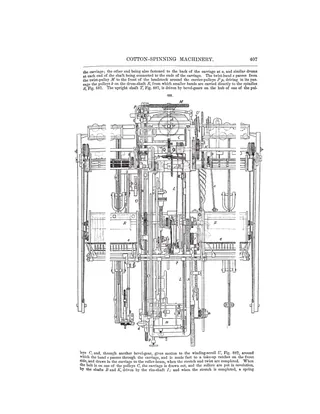
Cotton-Spinning Machinery
Article · 22 pages
An encyclopedia article on the machinery that turns raw cotton into warp and weft yarn in 19th-century mills, with emphasis on American builders. It covers openers, eveners and lappers, carding engines and card-clothing manufacture, drawing frames, roving frames (speeders and fly frames), ring spinning frames and spindles, self-acting mules, spoolers, warpers and slashers (dressing). Each machine is explained with lettered engravings (Figs. 859-893), operating principles, and output and horse-power figures.
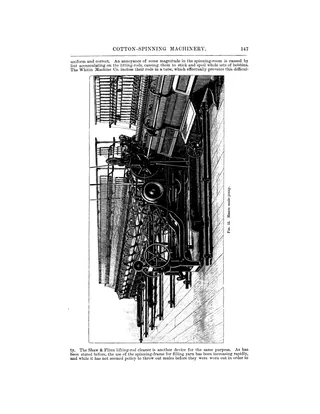
Cotton-Spinning Machinery
Article · 15 pages
An encyclopedia article surveying advances in American cotton-spinning machinery over the preceding ten years, following cotton from the bale through the picker room, carding, drawing, roving, spinning, spooling, warping, and chain-quilling. It describes machines and improvements from makers such as Whitin, Howard & Bullough, Platt Bros., Draper, and Hopedale, with 18 engraved figures of cards, roving frames, spindles, ring frames, mules, spoolers, warpers, twisters and a quilling machine. It ends at the point where weaving begins.
Electric Loom
Article · 1 page
A one-page encyclopedia entry describing Cavaliere G. Bonelli's electric loom, which replaces Jacquard punched cards with an electromagnetic arrangement. A pattern made of tin foil and insulating varnish is read by a metal comb, and electro-magnets position pistons in a perforated plate that stands in for the card. It also explains how multiple colors and shuttles are handled and how sparking is avoided.
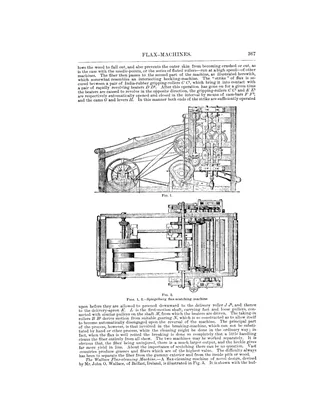
Flax Machines
Article · 3 pages
A three-page encyclopedia article on machinery for processing flax, from Appletons' Cyclopaedia of Applied Mechanics. It briefly explains retting and scutching, then describes two machines: the Spiegelberg flax-scutching machine, with a side elevation and plan view, and the Wallace flax-cleaning machine from Belfast, with an engraving. Details given include operating principles, parts, capacity, attendants and power requirements.
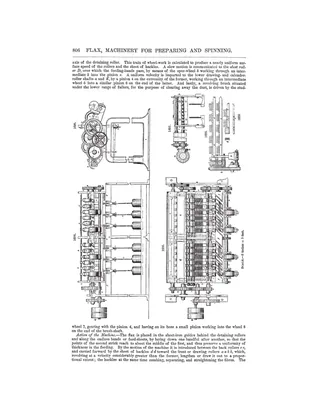
Flax, Machinery for Preparing and Spinning
Article · 14 pages
An encyclopedia article from Appletons' Cyclopaedia of Applied Mechanics describing the industrial preparation and spinning of flax. It follows the process from pulling, retting, breaking and scutching through hackling (by hand and machine), sorting, spreading and drawing frames, roving, and wet spinning with hot-water troughs. It ends by touching on warping and the lease for linen yarn. Many pages of engraved engineering figures show gearing, rollers, fallers, bobbin lifters and spinning frames, with text keyed to their lettered parts.
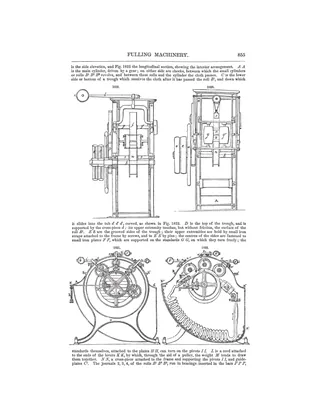
Fulling Machinery
Article · 5 pages
An encyclopedia article on machines used to full (mill) woolen cloth, taken from Appletons' Cyclopaedia of Applied Mechanics. It describes a squeezing-cylinder fulling machine, a rotary fulling mill with a main cylinder, rolls and a trough, and the older fulling-stocks with wooden beaters driven by wipers. It also covers cast-iron versus malleable-iron wipers and briefly mentions Dusseaux's and Desplas's machines shown at the 1878 Paris Exposition. Illustrated with engineering drawings (Figs. 1818-1827).
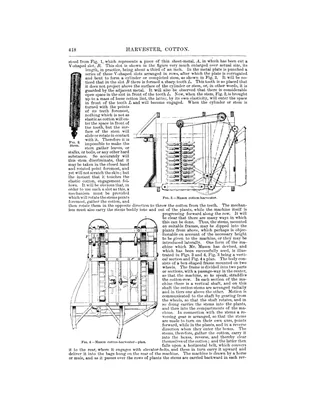
Harvester, Cotton
Article · 3 pages
Encyclopedia article on mechanical cotton harvesters, explaining why cotton's uneven ripening makes machine picking difficult and why earlier machines using claws, card clothing, suction or electrified belts failed. It describes Charles T. Mason Jr.'s selective 'stem', a slotted sheet-metal cylinder with guarded teeth that catches only elastic lint, and the Mason harvester that carries rotating stems on vertical shafts through the cotton row. It gives test results from the National Cotton Planters' Association and a list of Mason's patents from 1883 to 1886.
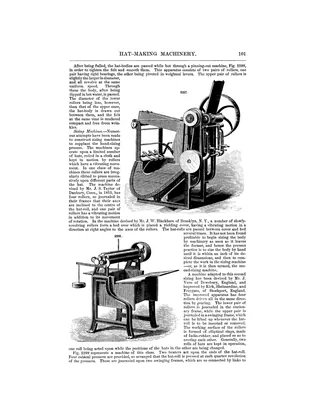
Hat-Making Machinery
Article · 12 pages
An 1889 encyclopedia article describing the machinery used in 19th-century American felt hat manufacture, covering both fur hats and wool hats. It follows the process from fur preparation and blowing, forming, hardening, sizing, fulling and stiffening through stretching, blocking, pouncing, ironing and finishing. Machines are illustrated with numbered engravings (Figs. 2295-2316), many credited to R. Eickemeyer of Yonkers, N.Y.
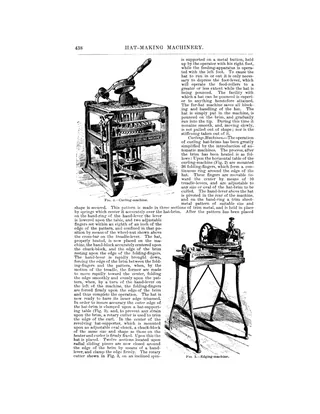
Hat-Making Machines
Article · 3 pages
A three-page encyclopedia article on late-19th-century hat-making machinery, drawn from Appletons' Cyclopaedia of Applied Mechanics. It describes automatic tip- and brim-stretching machines, a blocking machine, pouncing machines for wool and fur hats, a curling machine and an edging machine for hat brims, and the Blanchard lathe adapted to turn hat blocks and flanges. Four engraved figures show the machines, all designed and patented by Rudolph Eickemeyer of Yonkers, N.Y.
Knitting Machinery
Article · 5 pages
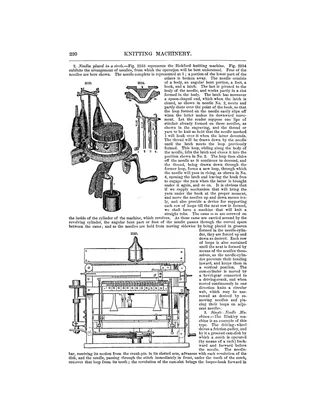
A five-page encyclopedia article from Appletons' Cyclopaedia of Applied Mechanics on knitting machinery as of the 1880s. It covers the manufacture and gauging of spring-beard knitting needles, hosiery yarn designation, and hand knitting machines (straight-bed, circular, and single-needle types such as the Lamb, Bickford and Hinkley machines). It then describes power machines, both straight and circular, the Tompkins upright rotary machine with its output figures, and the Tompkins cone-winder. Illustrated with engravings and diagrams of needle action.
Laundry Machinery
Article · 8 pages
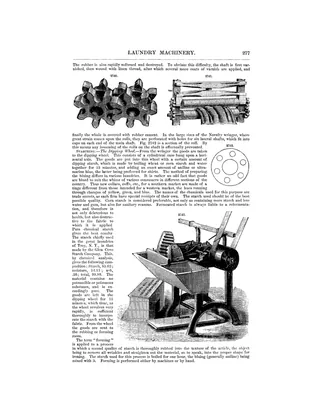
An 1889 encyclopedia article describing 19th-century American commercial laundry machinery, organized by stage: bleaching, washing, wringing, starching, and ironing. It covers dash-wheel, Brown, and Nonpareil power washers, hand washers, hydro-extractors, rubber-roll wringers, starching machines, hot mangles, gas-heated ironing machines, and collar and cuff finishing equipment. Engraved figures (Figs. 2733-2754) illustrate the machines.
Looms, Construction and Use Of
Article · 12 pages · weaving drafts
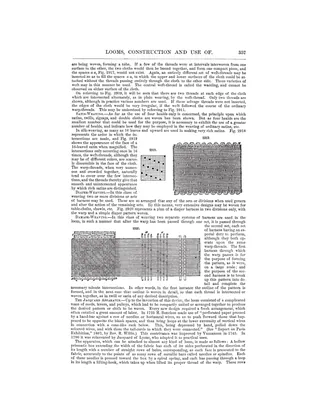
A 19th-century encyclopedia article explaining how looms are built and used. It covers the warp and weft, the loom's essential parts, heddles, the shed, the fly-shuttle and batten, drop-boxes, let-off and take-up motions, and the temple. It then moves to plain weave, twill, double cloth and satin, the Jacquard machine with its punched-card chain, ribbon weaving, and velvet and pile weaving. It is illustrated with numbered engravings (Figs. 2896-2940) and a few small design-paper drafts.
Looms, Power
Article · 10 pages
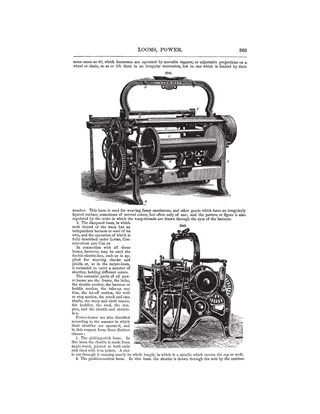
An encyclopedia article on power looms from Appletons' Cyclopaedia of Applied Mechanics. It classifies power looms by shedding (plain, twill, multi-harness/chain, Jacquard) and by shuttle drive (picking-stick, positive-motion, rack-and-pinion), and describes specific American machines such as Whitin, Mason, Crompton, and the Lyall and Bullough positive-motion looms. It also covers a needle-type silk loom, bag and corset looms, temples, and let-off and take-up motions, illustrated with numbered engravings.
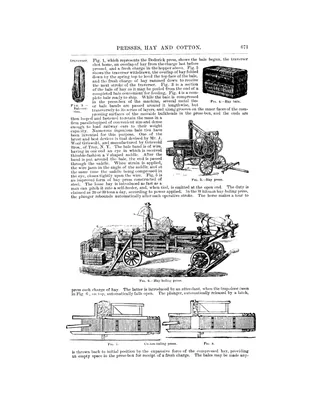
Presses, Hay and Cotton
Article · 3 pages
A three-page encyclopedia entry on machine presses for baling hay and cotton, from Appletons' Cyclopaedia of Applied Mechanics. It describes the Dederick hay press and other steam- and horse-powered hay balers, bale ties including the Griswold wire band, and the Dederick cotton press, which makes compact 'quarter' bales for plantation use. Ten line illustrations show the presses, bales, and ties.
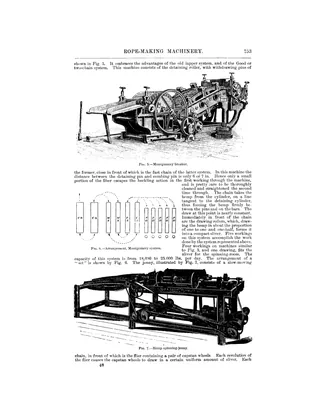
Rope-Making Machinery
Article · 8 pages
An 1889 encyclopedia article on the machinery used to make hemp and wire rope. It describes chain-type hemp preparation machines (drawing, breaker, spreader, Montgomery system), spinning jennies, strand-forming and rope-laying machines, and the rope-walk process. It also covers tarring and its effect on strength, rope tests, Lang lay and locked-coil wire rope, and wire-stranding and rope-closing machines. Illustrated with engravings and diagrams.
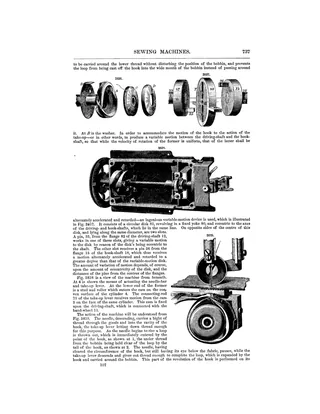
Sewing Machines
Article · 20 pages
An encyclopedia article on sewing machines from Appletons' Cyclopaedia of Applied Mechanics (1889). It traces the development of stitch-forming mechanisms (running, chain, double-loop, lock stitch), needles, shuttles, rotary hooks and the four-motion feed, then describes specific machines (Wheeler & Wilson, Wilson, New Home, White, Domestic, Willcox & Gibbs, Grover & Baker, Keats shoe-sewing machines), a buttonhole machine and Smyth's book-sewing machine. It closes with a section on sewing-machine attachments such as gauges, hemmers, rufflers, binders, braiders, tuck-markers and seam-trimmers. Illustrated with numbered engravings (Figs. 3830-3889).
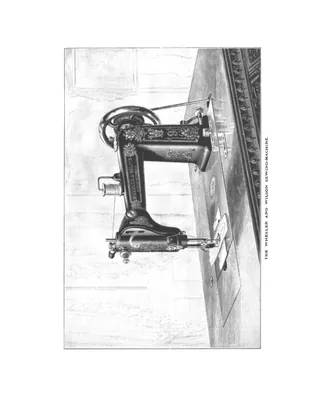
Sewing Machines
Article · 8 pages
An 8-page encyclopedia article on late-19th-century sewing machines from Appletons' Cyclopaedia of Applied Mechanics. It describes domestic lock-stitch machines (Wheeler & Wilson, Domestic, Willcox & Gibbs), combined lock and chain-stitch machines, and Singer chain-stitch machines. It then covers industrial and heavy-work machines: two-needle, cylinder, over-seaming, carpet-sewing, straw-hat and canvas/belting machines. Seventeen figures show machines, bobbins, face plates and ornamental stitch patterns.
Silk-Spinning Machinery
Article · 3 pages
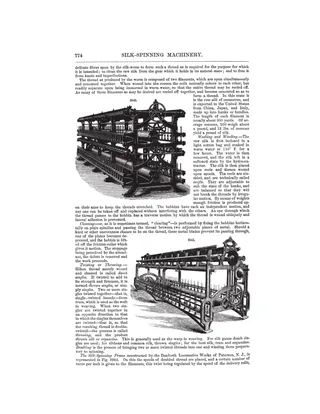
A three-page encyclopedia entry on the machinery and processes used to prepare silk thread. It covers reeling, washing and winding raw silk, cleaning, and twisting or throwing into singles, tram and organzine. It also describes the Danforth silk-spinning frame and reel-mill, shown in two engraved figures, and the sequence of machines for spinning waste silk.
Steam Compression of Cotton
Article · 6 pages
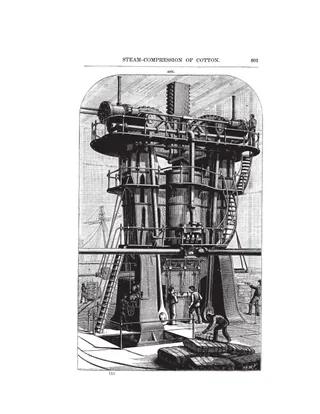
Encyclopedia article on steam compression of cotton bales for shipping, explaining why density matters for freight and stowage. It describes Tyler's early steam press, Grader's Standard Compress, and Capt. S. H. Gilman's Champion Compress in New Orleans with dimensions, valve gear, boilers and a table of daily performance data. It also covers steam bale-band tighteners, the grip-tie, and the doubling of bales, with examples of ship cargo gains.
Wool Machinery
Article · 7 pages
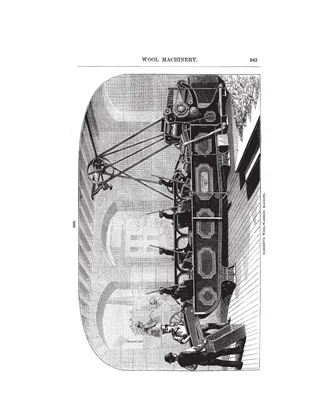
An encyclopedia article from Appletons' Cyclopaedia of Applied Mechanics (1889) on the machinery of woolen manufacture. It outlines the process from wool sorting and grades, scouring, drying, picking and burring, oiling, carding, spinning and warping, and also describes felted cloth production. Engravings show Sargent's wool-washing machine, wool drier, wool-picker and burr machine, Davis & Furber's wool-carding machine and wool-warping machine, with explanations of the lettered parts.
27 documents found