Textile Documents › Authors › Author: Alfred Barlow
28 documents found
Sort: 
The History and Principles of Weaving by Hand and by Power
Book · 458 pages · weaving drafts
Alfred Barlow's 1878 treatise covers the history and mechanics of weaving by hand and by power, reprinted with additions from the journal Engineering, plus a chapter on lace-making machinery from the Journal of the Society of Arts. It opens with a chronological account of weaving and the textile trades, then covers ancient looms, warping, the hand loom, the fly shuttle, twills, satins, double cloth, diaper weaving, the draw loom, the Jacquard machine and harness, gauze and swivel weaving, pile fabrics and carpets. Later chapters treat the power loom and its motions (tappets, let-off, take-up, weft stop, shuttles, drop boxes), the needle loom, Jacquard card preparation and weaver's calculations, the levers lace frame, bobbin-net machine, stocking loom, and fibres and their preparation. It ends with a summary and statistical appendix of British textile factories. Hundreds of mechanical line drawings and a few weaving drafts illustrate it.
Looms, Construction and Use Of
Article · 12 pages · weaving drafts
A 19th-century encyclopedia article explaining how looms are built and used. It covers the warp and weft, the loom's essential parts, heddles, the shed, the fly-shuttle and batten, drop-boxes, let-off and take-up motions, and the temple. It then moves to plain weave, twill, double cloth and satin, the Jacquard machine with its punched-card chain, ribbon weaving, and velvet and pile weaving. It is illustrated with numbered engravings (Figs. 2896-2940) and a few small design-paper drafts.
Weaving. -- No. I: A Brief Account of its History
Article · 2 pages
The first installment of a series in the engineering periodical Engineering, giving a brief history of weaving from antiquity to the mid-18th century. It covers early weaving in Egypt and Britain, guilds, Flemish and Huguenot immigrant workers, William Lee's stocking frame, silk throwing and Thomas Lombe's Derby mill, and John Kay's fly shuttle and tappet shaft for the Dutch loom. The text is narrative history with no drafts or illustrations.
Weaving. -- No. II: A Brief Account of its History (concluded)
Article · 2 pages
The concluding part of a two-part historical survey of weaving, published in the engineering journal Engineering in 1874. It covers the drop box, the fly shuttle, Edmund Cartwright's power loom with his own account of inventing it, and Radcliffe's warp dressing machine. It then treats Crawford's doubling patent, the draw loom and draw boy, and the history and introduction of the Jacquard machine in Britain, including the precursors Bouchon, Falcon and Vaucanson. It closes with later improvements to power looms and Jacquard apparatus.
Weaving. -- No. III: Ancient Looms
Article · 2 pages
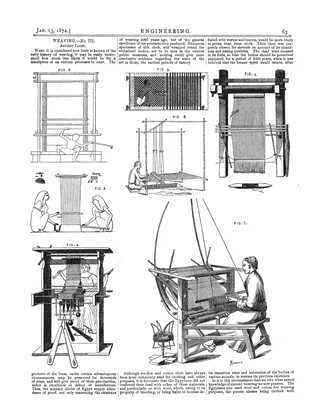
Third installment of a series on weaving in the periodical Engineering, surveying ancient and primitive looms. It covers Egyptian mummy linen, Egyptian vertical and horizontal looms from Theban paintings (after Wilkinson), the Greek warp-weighted loom compared to the Icelandic loom, a loom from the Vatican Virgil manuscript, the Indian loom used for Dacca muslins, and a Chinese loom. It gives a detailed account of Dacca loom construction, working conditions and figured muslin technique, and includes seven figures of looms.
Weaving. -- No. IV: Hand-Loom Weaving
Article · 2 pages
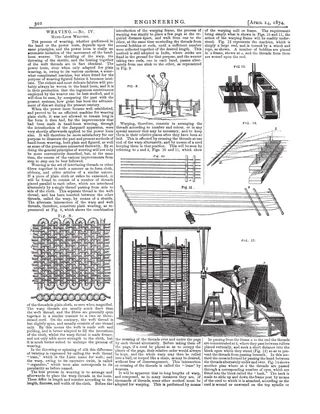
Fourth article in a series on weaving from the periodical Engineering (1874). It explains that hand and power looms work on the same principles and describes plain weave, the difference between warp and weft yarns, and silk terms (tram and organzine). Most of it covers warping: peg warping as still done in India, the lease or cross, the warping mill with its heck, and beaming the warp with a comb. Illustrated with line figures (Figs. 8-18); no weaving drafts.
Weaving. -- No. IX: Shedding
Article · 2 pages · weaving drafts
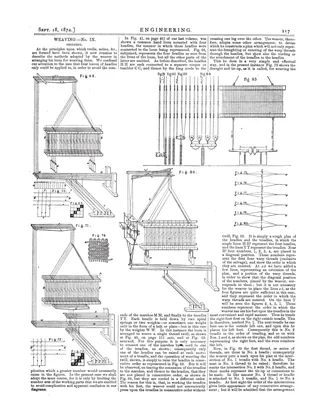
Installment No. IX of the series "Weaving" in Engineering (Sept. 18, 1874), on shedding: how a weaver ties up headles (heddles) to treadles on a hand loom for twills and satins. It explains the draught and tie-up plan, treadling order, and the long and short marches (countermarch) arrangement. It also classifies six types of shed (through, rising, rising and falling, double), describes ways of holding down headles with weights or springs, and ends with the "Jack-in-the-box" shedding motion invented by Theodore Jennings around 1840.
Weaving. -- No. V: Hand-Loom Weaving
Article · 2 pages
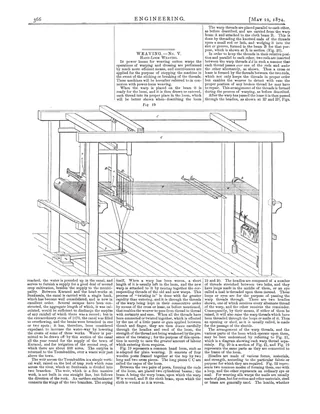
A two-page installment (No. V) of a serial on weaving from the journal Engineering, describing hand-loom weaving for plain cloth. It covers placing the warp beam in the loom, the lease rods and cross, twisting in a new warp to an old one, and the parts of a common four-post hand loom. It also explains healds (heddles) with loops or mails, treadles, pulleys, and the reed, including the old method of cleaving reed strips. Illustrated with engravings of the loom and its components (Figs. 19-26).
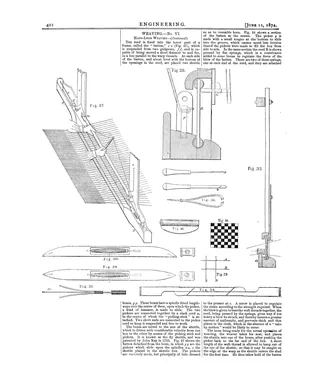
Weaving. -- No. VI: Hand-Loom Weaving (continued)
Article · 3 pages
Part VI of a serial in the British journal Engineering (June 12, 1874) on the mechanics of weaving, continuing the description of the hand loom. It covers the batten, reed, fly shuttle (John Kay, 1733) with its pickers and shuttle boxes, shuttle construction and quills, the hand-thrown shuttle, warp tension weights, take-up, temples, winding tools, and small weaver's implements. It closes with plain (tabby) weave shown as a designer's draft and as a headle-and-treadle tie-up, and a note on shedding in plain weaving.
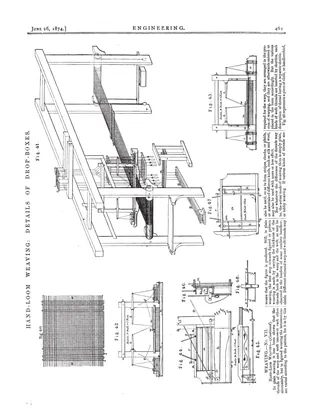
Weaving. -- No. VII: Hand-Loom Weaving (continued)
Article · 2 pages
A two-page installment from a Victorian engineering series on weaving, covering the hand loom's drop-box. It first notes how plain weaving can be varied with threads of different thickness or colour, and how several shuttles are used for different wefts. It then gives a detailed mechanical description of Robert Kay's drop-box (c. 1760), a three-shuttle version with shelves, pickers, hooks, pins, cords and levers, illustrated by Figs. 40-48. It closes with remarks on the difficulty of fitting multiple shuttles to power looms.
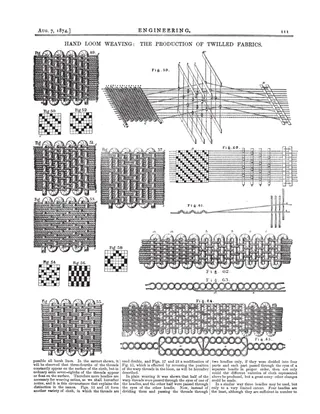
Weaving. -- No. VIII
Article · 3 pages · weaving drafts
Installment No. VIII of a serial on hand-loom weaving from the British journal Engineering, 7 August 1874. It introduces swivel and circle shuttles, then explains twill, zig-zag (point twill), satinet and satin interlacements, with their representation on design paper. It also covers the four-headle hand loom with tumblers and marches, double cloths, and selvage threads raised by special leash arrangements. Most of the content is carried by numbered figures (Figs. 49-67) of cloth structures, drawdown grids and loom threading diagrams.
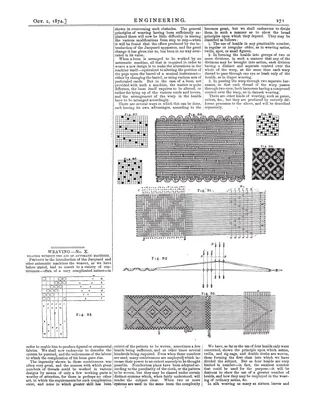
Weaving. -- No. X: Weaving Without the Aid of Automatic Machines
Article · 2 pages · weaving drafts
Installment No. X of a serial on weaving from the periodical Engineering, describing how figured and ornamental cloth was woven on looms without Jacquard or other automatic machines. It classifies the systems of using healds (heddles) and explains satin weaves of five, eight and sixteen leaves, then shows how twills and small figures or spots are made with a few headles. Figures show the warp plan, the section of the shed, and the threading and treadling plan with circles marking raised headles and numbered treadles. It ends by introducing the draw-boy machine, to be covered with the draw loom.
Weaving. -- No. XI: Diaper Weaving
Article · 2 pages · weaving drafts
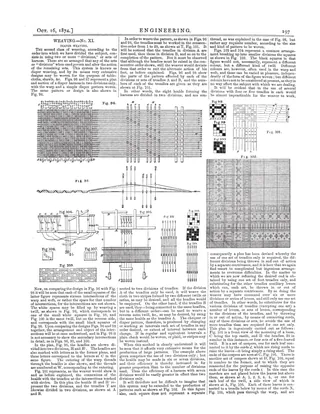
Installment No. XI of a serial on weaving in the journal Engineering, explaining diaper weaving, in which two or more divisions of harness and treadles are combined to weave large checker or diaper patterns for tablecloths and shawls. It describes a two-division harness with its threading and treadling plans, the twills that fill the pattern squares, and a mounting that controls up to twenty leaves with a single set of treadles using coupers, levers and handles. It closes with the construction of healds, leashes, lingoes and the comber board for figure weaving.
Weaving. -- No. XII: Hand Loom Weaving; The Draw Loom
Article · 2 pages · weaving drafts
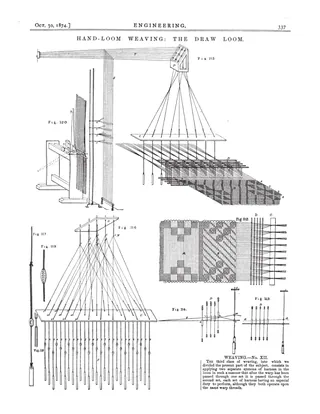
Part XII of Alfred Barlow's series "Weaving" in Engineering, covering hand-loom damask weaving on the draw loom. It explains the two-harness system, in which a pattern harness forms the large outline and a ground harness works the detail intersections, here a five-leaf twill. It describes the leashes, comber board, pulley box, tail cords, simple cords, lingoes and mails, with a page of engineering diagrams (Figs. 112-120). It also gives a brief account of the origin of damask weaving and its supposed introduction to England in 1567.
Weaving. -- No. XIII: Draw Loom for Damask Weaving
Article · 2 pages
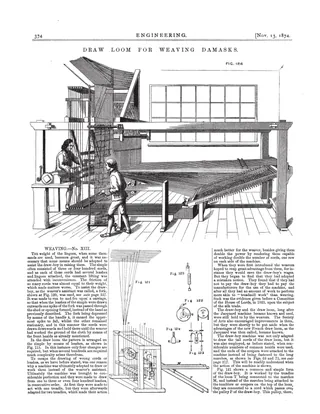
Installment XIII of Alfred Barlow's 'Weaving' series, as printed in Engineering, covers the draw-boy and the draw loom used for damask weaving. It explains how the draw-boy's work of lifting the simple cords was assisted by a fork and later by a draw-boy machine with a pecker, ratchet wheel, and knotted cords worked from the treadles. It also describes a French eighteenth-century draw loom for figured velvet damasks with 400 pulleys and a bobbin frame, and compares it to the Jacquard. The text refers to Figs. 120-126, with an engraved view of the draw loom and mechanical diagrams.
Weaving. -- No. XIV: Jacquard Apparatus -- Introduction
Article · 2 pages
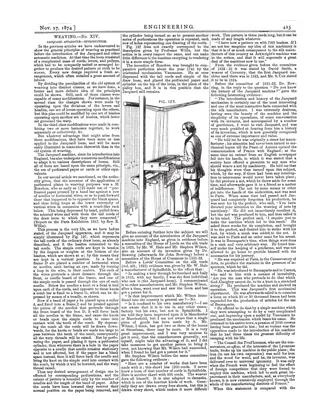
Installment XIV of the 1874 series "Weaving" in Engineering introduces the Jacquard apparatus. It explains the principle of perforated paper pressing against needles to select cords, illustrated by Fig. 127 using a draw-loom arrangement with needle box, comb bar and treadle. It traces the idea from Bouchon (1725) and Vaucanson (1745) to Jacquard, and reproduces testimony before British parliamentary committees (1823, 1831-32) by W. Hale, Stephen Wilson and Dr. Bowring on the Jacquard loom's introduction to England and its invention. The article closes by questioning Jacquard's claim as sole inventor.
Weaving. -- No. XIX: Tissue Weaving
Article · 2 pages
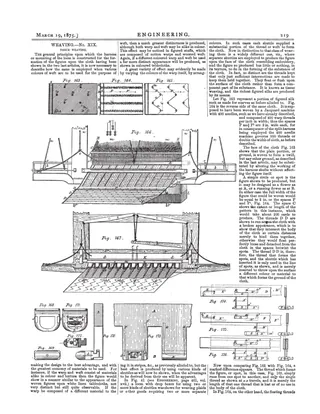
Nineteenth installment of a serial on weaving in the engineering journal Engineering, dated 19 March 1875, describing tissue weaving for figured silks on a Jacquard loom. It explains how a separate figure shuttle floats weft on the cloth surface, bound only at intervals, and compares full-width shuttles with small shuttles used only where spots occur, which saves silk. The second half details swivel shuttles mounted in a frame on the batten, including the slide-and-peg mechanism, the swivel's construction, bobbin tension pressers and horsehair loops. Illustrated with numbered engineering figures (Figs. 163-176) and no weaving drafts.
Weaving. -- No. XV: The Jacquard Loom
Article · 2 pages
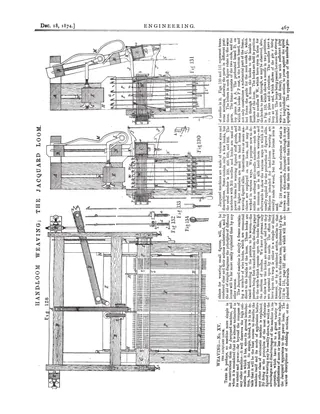
A two-page installment (No. XV) of a serial on weaving from the periodical Engineering, 18 December 1874, describing the Jacquard machine as used on hand looms for figured silk. It explains a 400-needle machine: the hooks, needles, springs, spring box, griffe, neck cords, card cylinder and the S-bar that moves the cylinder. Engineering drawings (Figs. 128-134) show elevation and sections of the mechanism.
Weaving. -- No. XVI: The Jacquard Loom (continued)
Article · 3 pages
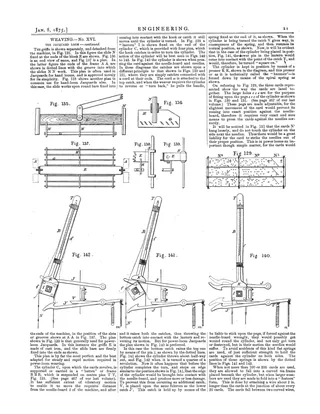
Installment XVI of Alfred Barlow's serial on weaving in Engineering, continuing the description of the Jacquard machine. It covers the griffe designs for hand-loom and power-loom Jacquards, the card cylinder, lantern, catches, hammer and springs, how cards are laced and festooned, and needle and hook wire sizes. It also notes Vaucanson's 1746 placement of the machine on the draw loom and includes an engraving of a Spitalfields hand silk loom.
Weaving. -- No. XVII: The Jacquard Apparatus
Article · 2 pages
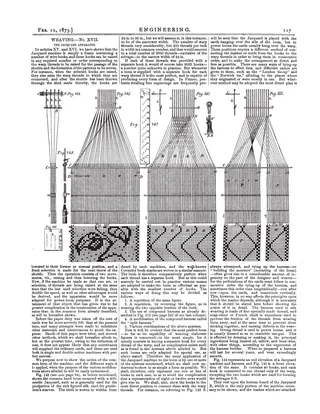
A two-page installment (No. XVII) of a serial on weaving from the journal Engineering, dated 12 February 1875, explaining how the Jacquard apparatus is applied to the loom. It describes a 40-hook example with harness, leashes, comber board and mails, and shows how designs are repeated, reversed or mirrored across the cloth to reduce the number of hooks needed. It covers selvage hooks, a point harness, tie-ups (London and Norwich), harness materials and the use of an eight-leaf satin ground. Figures 144-154 are engraved diagrams of the machine and design grids.
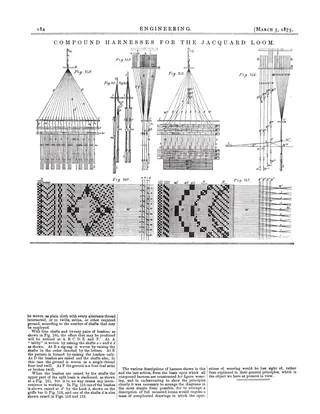
Weaving. -- No. XVIII: The Jacquard Loom -- Compound Harnesses
Article · 2 pages · weaving drafts
Installment XVIII of Alfred Barlow's 'Weaving' series in Engineering (5 March 1875), explaining compound harnesses for the Jacquard loom. It describes the damask harness, which uses headles combined with Jacquard hooks, and the Rooke 'shaft monture' and Gough split harness used for fine silks. Diagrams (Figs. 155-162) show harness cords, leashes, griffe bars and shafts, with small drawdown-style figures of tabby, zig-zag, twill and satin grounds.
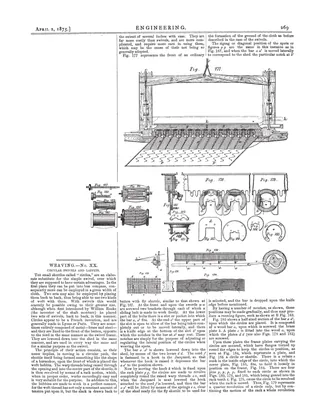
Weaving. -- No. XX: Circular Swivels and Lappets
Article · 2 pages
Installment No. XX of a series on weaving from the British journal Engineering, dated April 2, 1875. It describes circular swivels ("circles"), small horseshoe-shaped shuttles moved by a rack motion to weave silk spots or figures on a ground cloth. It covers how they are mounted on the batten and operated by the Jacquard, and details the spring-tensioned bobbin and spindle. It closes with the older lappet needle-frame method of producing figures, including a gauze-like variant. Illustrated with engineering figures (Figs. 177-196).
Weaving. -- No. XXI: Cross Weaving
Article · 3 pages
A 19th-century engineering journal article, number XXI in a series on weaving, explaining gauze (cross) weaving, in which whip threads are twisted around adjoining warp threads by doups and extra leashes. It covers half and full twists, doup and leash arrangements for ordinary and Jacquard looms, gauze selvages for cutting wide cloth into narrow strips, net weaving, and bobbin tension devices for the separate warp supplies. Illustrated with line diagrams (figs. 197-217) of looms and harness mechanisms, with no weaving drafts.
Weaving. -- No. XXII: Pile Weaving
Article · 2 pages
Two-page installment (No. XXII) of Alfred Barlow's series on weaving in Engineering, covering pile weaving: velvets, terry velvet, Brussels and tapestry carpets. It explains the velvet loom with separate ground and pile beams, the insertion of grooved wires, and the cutting of loops with the trevette knife. It then describes the cloth beam with needle-point laths, the headle motions, and the construction of tapestry carpet (printed pile threads) and Brussels carpet (Jacquard-selected pile colours), with brief mention of Axminster and Wilton. Illustrated with numbered engineering figures (Figs. 218-231).

Weaving. -- No. XXIII: Pile Weaving (continued)
Article · 2 pages
A two-page installment (No. XXIII) of Alfred Barlow's 'Weaving' series in Engineering, continuing the discussion of pile weaving in power looms. It describes early velvet-weaving methods using wires, including Thompson's 1842 velvet ribbon loom, Collier's multiple-wire plan and Weild's 1855 grooved-cylinder wire inserter. It also covers knife-edged wires for cut pile, double (face-to-face) velvet and plush weaving with cutting knives, and the start of a discussion of chenille weft. Illustrated with small engineering diagrams of wires, cloth sections and mechanisms.
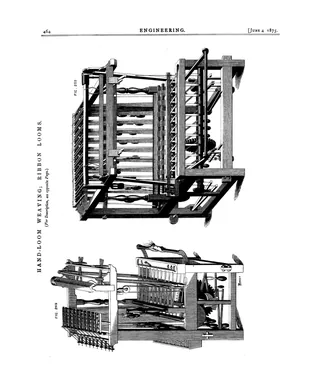
Weaving. -- No. XXIV: The Ribbon Loom
Article · 3 pages
An 1875 installment (No. XXIV) of the Engineering series on weaving, dealing with the ribbon loom, also called the Dutch engine loom or swivel loom. It traces the loom's history from 16th and 17th century Dantzic and Leyden, through the bans and riots it provoked across Europe, to the Kay and Stell patents of 1745 and 1760 and the later bar loom and rack-and-wheel shuttle motion. It also describes how the swivel loom works: warp reels, weights, heddles and treadles, and the swivel shuttles driven by a peg driver or by rack and star wheels. The pages carry engraved figures (Figs. 248-256) of hand ribbon looms and their mechanisms.
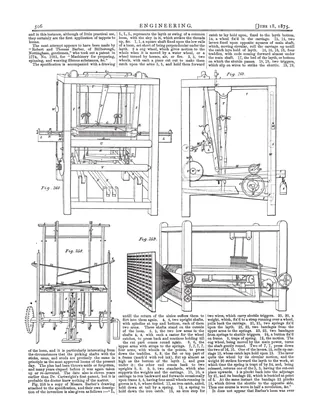
Weaving. -- No. XXV: The Power Loom
Article · 3 pages
Installment No. XXV of the series "Weaving" in Engineering (18 June 1875), tracing the early history of the power loom. It lists the operations a power loom must perform and describes early attempts: de Gennes's 1678 machine, the Barbers' 1774 patent (with their full specification text), Cartwright's patents from 1785, and the Miller "wiper" loom, Johnson/Radcliffe "dandy" loom, and Horrocks "crank" loom. Illustrated with engraved drawings (Figs. 257-261) of the early machines.
Weaving. -- No. XXVI: The Power Loom -- concluded
Article · 2 pages
Concluding installment of a serialized history of weaving in the journal Engineering (June 25, 1875), covering the early development of the power loom. It quotes Edmund Cartwright's patent specification in detail, including its warp and weft stop motions, take-up and let-off motions, temples, and warp dressing. It then covers William Radcliffe's dressing frame and his 1828 book, Horrocks's picking mechanism, and later inventions such as the Ewart pneumatic loom, barrel looms, Bowman and Woodcroft tappet motions, and the application of the Jacquard principle to power looms. It ends with a note that the series will go on to describe recent and approved machines.
28 documents found