Textile Documents › Publications › Publication: Engineering Weekly
121 documents found
Sort: 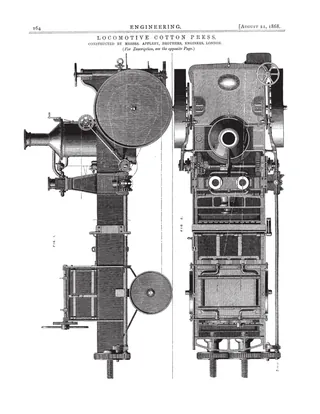
Appleby's Locomotive Cotton Press
Engineering Weekly, August 21, 1868
Article · 3 pages
A three-page article from the journal Engineering (21 August 1868) describing a portable steam-driven cotton baling press built by Appleby Brothers of London for cotton-growing districts, especially India. It explains the engine, drive and steering arrangements, and the screw and hydraulic ram pressing sequence that forms 100-ton bales in about seven minutes. It also covers the plan to drive extra presses and the benefits of compressed bales for rail transport and fire risk. The first page is a full-page pair of engineering elevation drawings.
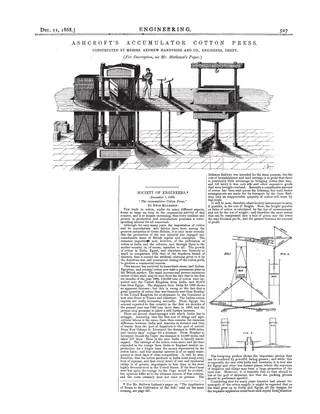
Ashcroft's Accumulator Cotton Press
Article · 2 pages
Two-page article from Engineering (11 December 1868) reproducing Ewin Matheson's paper to the Society of Engineers on George Ashcroft's accumulator cotton press, built by Andrew Handyside and Co. of Derby. It discusses the cotton trade, freight costs, and why compressing bales matters for India and Egypt. It surveys earlier lever, screw and hydraulic presses (McComb, Mason, Hodgart, Nasmyth), then describes the three-ram hydraulic press with its accumulator, differential cylinder and revolving boxes. An engraving and three diagrams illustrate the machinery.
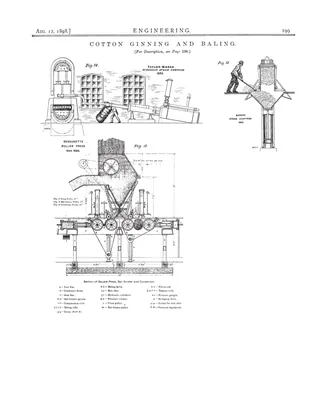
Century of Cotton Ginning and Baling
Engineering Weekly, August 12, 1898
Article · 3 pages
Three pages from the British journal Engineering (Aug. 12, 1898) reporting on George A. Lowry's paper "One Hundred Years of Ginning and Baling Cotton," read before the American Society of Mechanical Engineers. It describes the Whitney saw gin and its improvements (mote board, lint room, condenser), compares saw and roller gins, and traces cotton baling presses from early screw presses to steam, hydraulic and cylindrical-bale presses. Engraved plates show the Churka gin, Whitney and Carver gins, the Bessonette roller press, the Taylor-Birage hydraulic compress and the Lowry cotton compress. The pages begin with the end of an unrelated item on French marine engines.
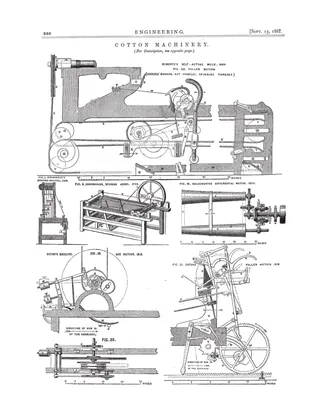
Cotton Machinery
Article · 8 pages
Reprint of John Platt's paper on machinery for preparing and spinning cotton, published in the journal Engineering in September 1867. It traces the development of mechanical spinning from Lewis Paul and Arkwright through Hargreaves' jenny and Crompton's mule to Roberts' self-acting mule. It also covers preparation machinery such as openers, scutchers, carding engines, drawing frames and roving frames. Half the pages are engineering plates of the machines.
Cotton Manufacturing Industry in Mexico
Engineering Weekly, July 15, 1898
Article · 2 pages
A two-page 1898 trade article summarizing a British Foreign Office report by Lionel Carden on the Mexican cotton manufacturing industry. It covers the history of the industry from pre-conquest times, the 1830 bank for supplying machinery, tariff protection and smuggling, and 1896 statistics on mills, looms, spindles, workers and output. It also discusses machinery types, power sources, working hours, wages, profits, the effect of silver depreciation, and the implications for British cotton exports.
Cotton Mills in Hong Kong
Engineering Weekly, October 29, 1897
Article · 1 page
A one-page 1897 trade-journal article on the flotation of the Hong Kong Cotton Spinning, Weaving, and Dyeing Company by Jardine, Matheson, and Co. It covers the share capital, the increase in planned spindles from 50,000 to 100,000, comparison with the Shanghai mills, and the climate, site and exchange-rate advantages. It also quotes the Times correspondent and the British Minister at Peking on competition with Indian, Japanese and Lancashire yarn.
Cotton Spinners' Trust in Japan
Engineering Weekly, April 20, 1900
Article · 1 page
A short 1900 news note reporting, from the Japan Weekly Mail, that Japanese cotton spinners in Tokio, Nagoya, Osaka, Okayama and Kinshin have arranged a trust. It describes the aims of pooling market information on raw cotton and yarn, the levy per bale, the fixed profit built into the selling price, and an export bounty on yarns funded by deductions from profits on domestic yarn.
Cotton-Spinning Industry in Japan
Engineering Weekly, November 3, 1899
Article · 1 page
A one-page 1899 trade article reporting on the recovery of Japan's cotton-spinning industry after the 1898 depression. It covers government loans, Osaka labor competition, export of yarn to China, sources of imported raw cotton (British India, United States, China, Egypt), a new import duty, and the Union Cotton Spinners' decisions on curtailing production.
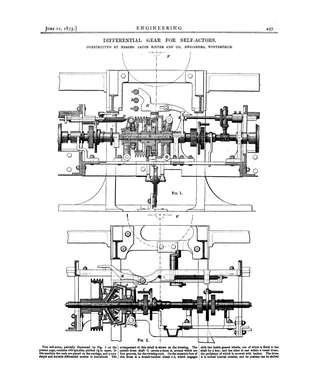
Differential Gear for Self-Actors
Engineering Weekly, June 11, 1875
Article · 2 pages
A two-page 1875 article from the journal Engineering describing differential gear mechanisms on self-acting spinning mules built by Jacob Rieter and Co. of Winterthur. It covers a 468-spindle self-actor with a differential motion on the spindle drum shaft, and a 504-spindle self-actor for fine yarns built on the Parr-Curtis system. The text explains the drums, cones, levers and catches, and gives a gear-ratio calculation, with two cross-section drawings.
Difficulties in the Cotton-Spinning Industry in Japan
Engineering Weekly, August 19, 1898
Article · 1 page
A short 1898 newspaper article on the over-expansion and financial troubles of Japan's cotton-spinning industry. It reports 65 mills with 773,738 spindles, a surplus of unsold yarn, and competition from Chinese mills after the Shimonoseki Treaty. It also covers the Industrial Bank of Japan's inquiries into mill costs, depreciation and dividend practices, and the conditions it set for loans.
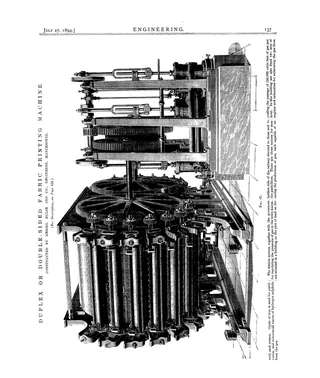
Duplex or Double-Sided Fabric Printing Machine
Engineering Weekly, July 27, 1894
Article · 1 page
A single page from an 1894 issue of the engineering journal Engineering, carrying a full-page engraving (Fig. 67) of a duplex, double-sided fabric printing machine built by Messrs. Hulse and Co., Engineers, Manchester. The caption refers readers to the description on page 134. The page also has unrelated text fragments about gas purification and gasworks equipment, apparently from an adjoining article.
Howarth's Cotton Mills
Engineering Weekly, August 25, 1899
Article · 1 page
A short passage from the journal Engineering describing a party visit to the cotton mills and weaving sheds of Messrs. Richard Howarth and Co., Limited, at Ordsal-lane, Salford. It notes that the firm's works were fully illustrated and described in 1894 in connection with the Institution of Mechanical Engineers summer meeting in Manchester, and that additions have since been made. The text is a brief introduction and gives no technical detail.
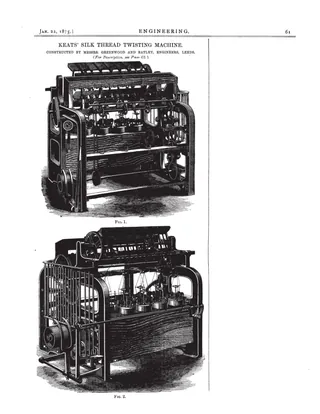
Keats' Silk Thread Twisting Machine
Engineering Weekly, January 22, 1875
Article · 2 pages
A two-page illustrated article from Engineering describing John Keats' machine for laying (twisting) silk sewing thread, built by Greenwood and Batley of Leeds. It explains how a sizing machine winds silk onto bobbins and a laying machine twists three strands together by counter-rotating spindles and frame, replacing hand laying and allowing threads of much greater length. Page 1 has two engraved views of the machines (Figs. 1 and 2).
Lancashire Cotton Industry
Engineering Weekly, October 15, 1897
Article · 1 page
A one-page 1897 editorial on the troubled state of the Lancashire cotton industry. It blames foreign competition (India, Japan, China), famine and plague in India, the fall in silver, uncertain exchange and hostile tariffs. It reports a proposed wage cut of 5 percent in spinning mills and 10 percent in weaving factories, and the operatives' preference for reduced output to raise prices. It also discusses the risk of a large labour dispute.
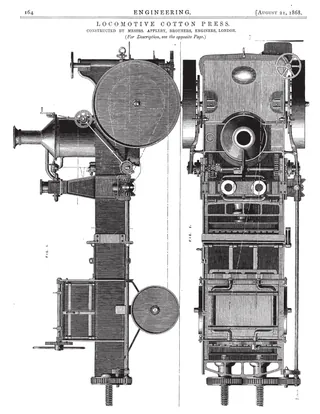
Locomotive Cotton Press
Engineering Weekly, August 21, 1868
Article · 2 pages
A two-page 1868 engineering article describing a steam-driven locomotive cotton press built by Appleby Brothers of London, with two elevation drawings. It explains how the self-propelled machine compresses cotton into bales using screws and a hydraulic ram, and why it would suit cotton districts such as India. It is about baling machinery, not weaving.
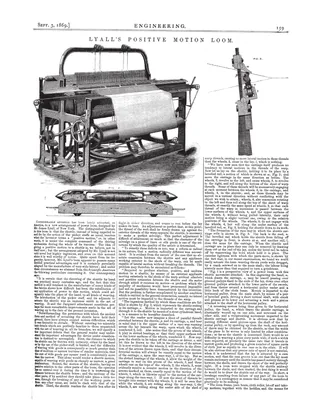
Lyall's Positive Motion Loom
Engineering Weekly, September 3, 1869
Article · 2 pages
A two-page 1869 article from Engineering describing James Lyall's "positive motion" power loom, in which the shuttle is driven by a carriage and cylindrical band rather than by picker staffs. It explains the roller-and-wheel carriage that moves the shuttle through the warp shed without lateral strain on the threads, and the band, pulley, rack-and-pinion drive. It claims advantages for very wide fabrics (up to a six-yard-wide drugget), better selvedges and fewer shuttle collisions. Figures show the loom, the shuttle and carriage, and the race-way. The text is abstracted from the Scientific American.
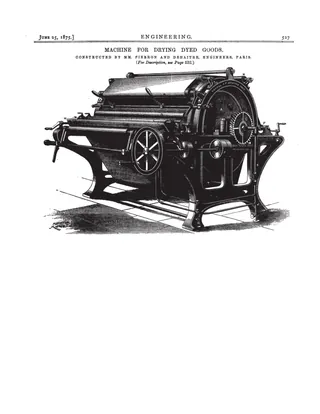
Machine for Drying Dyed Goods
Engineering Weekly, June 25, 1875
Article · 2 pages
Two-page item from Engineering (25 June 1875) describing a drying machine for dyed fabrics built by Pierron and Dehaitre, engineers of Paris. Page 1 is an engraved illustration of the machine; page 2 gives the description. A steam-heated copper cylinder drives small rollers carrying an endless web, and dyed material passes between a feed roller and the web, which expresses moisture and dries the fabric in one revolution.
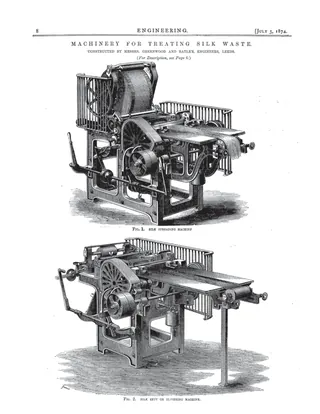
Machinery for Treating Silk Waste, Part 1
Engineering Weekly, July 3, 1874
Article · 2 pages
An 1874 article from the engineering journal Engineering on the utilisation of silk waste, with a page of engraved illustrations of machines made by Greenwood and Batley of Leeds. It describes the classes of waste (damaged cocoons, knubs, throwsters' waste), softening and degumming, and the opening, filling and dressing machines that produce graded draifts. It then explains the screw gill-box spreader and the sett or slivering machine, which draw the silk into laps and slivers for spinning. The article ends with "To be continued".
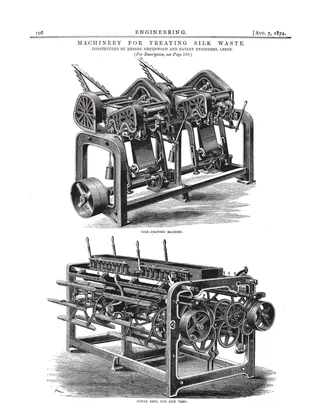
Machinery for Treating Silk Waste, Part 2
Engineering Weekly, August 7, 1874
Article · 4 pages
Concluding part of an 1874 Engineering article on machinery for spinning silk waste, built by Greenwood and Batley of Leeds. The text describes the later stages: drawing, roving with a screw gill and flyer, spinning, doubling or twisting, and reeling into hanks. Engraved plates show the spinning frame, screw gill roving frame, silk-drawing machine and power reel. It closes with the uses of waste-silk yarn in weft, ribbons, velvet, satin and sewing threads.
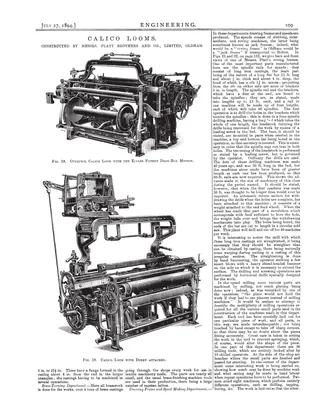
Manchester Meeting of the Institution of Mechanical Engineers
Engineering Weekly, July 27, 1894
Article · 26 pages
A special Manchester issue article from the journal Engineering (27 July 1894) previewing the summer meeting of the Institution of Mechanical Engineers. It describes a typical cotton spinning mill and weaving shed (Richard Haworth and Co., Salford) and the Platt Brothers and Co. textile machinery works at Oldham. Coverage includes the cotton processes from scutching, carding, roving, and spinning to warping, sizing and power weaving, plus the shop-floor manufacture of textile machines. Illustrations include photographs of mill interiors, early hand looms and weavers' cottages, and engravings of Platt calico looms (drop-box, dobby), slashers, mules, carding engines, winders and warping frames.
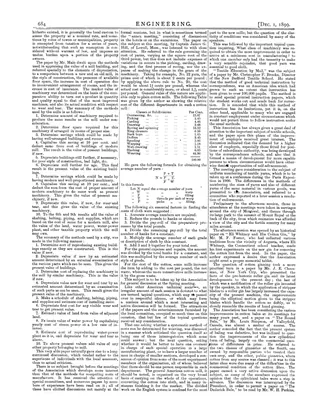
New England Cotton Manufacturers' Association
Engineering Weekly, December 1, 1899
Article · 4 pages
Report from the weekly Engineering on the 67th meeting of the New England Cotton Manufacturers' Association, held in Montreal in October 1899. It summarizes the papers presented, including export trade, taxation valuation of mills, cost accounting in cotton mills, textile education by mail, cotton gins and bales, and mill power topics such as electric transmission, turbines, coke and mechanical stokers. It also describes the social program and the excursion to the Valleyfield mills.
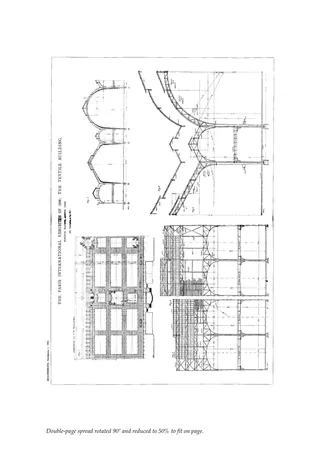
Paris Exhibition of 1900 (Textile Building)
Engineering Weekly, September 1, 1899
Article · 3 pages
An 1899 article from the engineering journal Engineering describing the Textile Building under construction on the Champ de Mars for the Paris Exhibition of 1900. It covers the building's location, facades, dimensions, naves, galleries and steel roof framing, along with the contractors' travelling erection staging and steam hoists. A plate of engineering plans, sections and elevations is included. It deals with the building's architecture and construction, not with textiles or weaving.
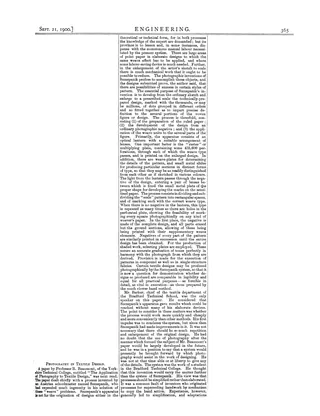
Photography in Textile Design
Engineering Weekly, September 21, 1900
Article · 1 page
A one-page report from the journal Engineering (21 September 1900) on a paper by Professor R. Beaumont about applying photography to textile design. It describes Jan Szczepanik's photographic apparatus for enlarging a sketch and automatically marking weave units on point paper, using a lantern, a perforated raster plate, weave plates and selecting plates. It also summarizes the comments of Mr. Barker of the Bradford Technical School, who favored simpler processes.
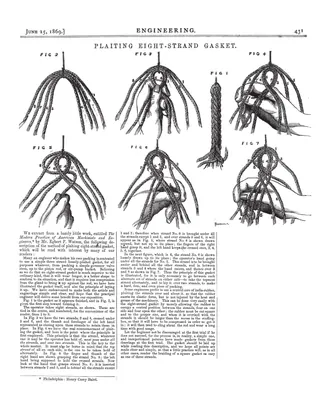
Plaited Eight-Strand Gasket
Engineering Weekly, June 25, 1869
Article · 1 page
A one-page 1869 article from the journal Engineering that reproduces Egbert P. Watson's instructions for plaiting an eight-strand square gasket, used as packing for engine stuffing-boxes. Seven engraved figures show the hands and numbered strands at each stage. The text states the rule that each strand passes under all the others and over two, and it suggests an optional india-rubber core.
Platt's Textile Machinery Works
Engineering Weekly, August 2, 1899
Article · 1 page
A one-page report from the journal Engineering on an excursion to Platt Brothers and Co.'s textile machinery works at Oldham, during a meeting of engineers. It gives figures on the size and workforce of the works, its history from 1821, and its departments: forge, sawmills, packing cases, foundries, steel, machine shops and spindle works. It concerns the manufacture of textile machinery, not weaving technique.
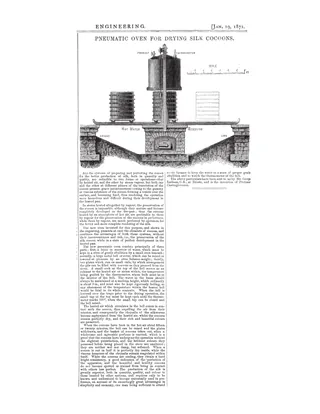
Pneumatic Oven for Drying Silk Cocoons
Engineering Weekly, January 19, 1872
Article · 1 page
A short 1872 engineering journal article describing a pneumatic oven for stifling and drying silk cocoons, an apparatus devised by Professor Castrogiovanni and reported by George Latham at Trieste. It compares hot-air and steam methods of treating cocoons and explains the oven's parts: a water reservoir heated by a small furnace, a counterweighted metal bell with exhaust cock and thermometer, and two trays on rails. It also gives operating details such as the 100° thermometer reading and 15-20 minutes of exposure, and claims better silk quality and colour. A cutaway engraving illustrates the apparatus.
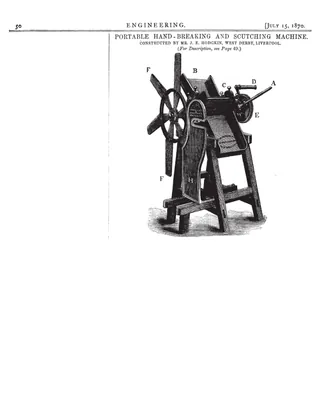
Portable Scutching Machine
Engineering Weekly, July 15, 1870
Article · 2 pages
A short 1870 trade-journal article describing the "Shamrock" portable hand flax breaker and scutcher, built by J. E. Hodgkin of West Derby, Liverpool, and shown at the Royal Agricultural Society show at Oxford. The text explains the fluted breaking rollers, the ratchet-and-pawl mechanism that gives a longer forward than backward stroke, and the separate scutching blades driven by a second handle. Page 2 is an engraved illustration of the machine with labeled parts.
Prevention of Accidents in the Cotton Trade
Engineering Weekly, January 19, 1900
Article · 2 pages
An editorial from the journal Engineering (19 January 1900) on a report by two H.M. Inspectors of Factories about preventing machinery accidents in cotton mills. It gives accident statistics for 1897 and 1898, notes that guards are fitted to machines built for Germany and Russia but often omitted on those for Britain, and discusses the inspectors' six general recommendations (set screws, toothed wheels, loose pulleys, shaft ends, close-fitting clothing). It also mentions a shuttle guard for looms, guards for spinning mules, and a Mulhouse society's book of safety appliances, and considers employers' liability under the Workmen's Compensation Act.
Profits on Cotton Spinning in Japan and China
Engineering Weekly, July 1, 1898
Article · 2 pages
A two-page 1898 article from the British journal Engineering on the economics of cotton spinning in Japan and China. It reviews Japanese mill returns for the half-year ending December 1897, covering spindle numbers, profits per spindle, rising costs of coal, raw cotton and wages, and reserve funds. It then looks at the new foreign-owned mills at Shanghai, with their costs, labour, dividends, yarn prices and yarn import figures for 1896-97, and considers what this competition means for British (Lancashire) manufacturers.
Recent Developments in the Textile Industries
Engineering Weekly, October 26, 1900
Article · 1 page
A one-page report in Engineering (26 Oct 1900) summarizing a paper by Dr. A. Liebmann on recent developments in textile industries, chiefly silk imitations. It covers chlorinated wool yarns with silk-like lustre, early artificial silks from cotton and cellulose (Chardonnet, Lehner, Vivier, Millar, Pauly), and mercerisation of cotton, followed by brief discussion remarks. It appears to be a report of a British Association meeting.
Self-Acting Woolen Mule
Engineering Weekly, January 1, 1875
Article · 3 pages
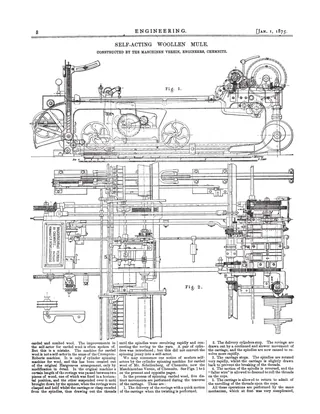
An 1875 article from Engineering describing a self-acting mule for spinning carded wool, built by the Maschinenbau Verein of Chemnitz to Mr. Schellenberg's design. It briefly places the machine against Hargreaves's jenny and the Crompton-Roberts self-actor, then lists the five movements of the carriage during spinning. It goes on to explain the mechanism: eccentrics, levers, snails, brakes and the winding motion for cops. The article closes with gear ratios, pulley sizes and speeds, and is marked to be continued. Three pages with engineering drawings (Figs. 1-5).
Self-Acting Woollen Mule
Engineering Weekly, January 29, 1875
Article · 3 pages
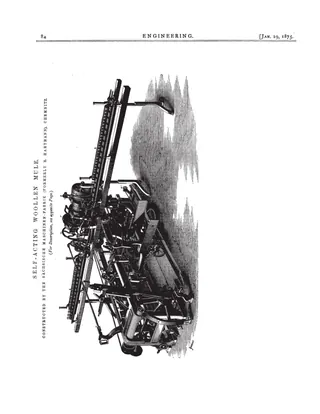
Three pages from the British journal Engineering (29 January 1875) on a self-acting woollen mule, a spinning machine built by the Sächsische Maschinen-Fabrik (formerly R. Hartmann) of Chemnitz. Two pages are full-page engraved perspective views of the machine. The text is part of Dr. H. Grothe's series 'Self-Actors'. It describes the machine's three spindle speeds, the counter, backing-off regulation, supplementary twisting and carriage return mechanisms, and gives machine dimensions and spindle counts.
Sir Isaac Holden, Bart.
Engineering Weekly, August 20, 1897
Article · 1 page
An obituary of Sir Isaac Holden, Bart., who died in August 1897 at age 90, published in the journal Engineering. It traces his rise from a Renfrewshire miner's son and teacher to bookkeeper, manager and partner in a woollen firm, and describes his work on mechanical wool-combing. It explains hand combing, the competing inventions of Heilmann, Lister, Donisthorpe and Holden, Holden's square-motion comb patented in 1848, and the mills at Bradford, St. Denis, Rheims and Croix, closing with brief notes on his business and later life.
Textile Industry at the Vienna Exhibition -- No. I
Article · 3 pages
First installment of a series by Dr. H. Grothe in the journal Engineering reviewing textile industry exhibits at the 1873 Vienna Universal Exhibition. It first discusses how prominently textiles figure among different nations' displays, outlines the planned scope (raw materials, spinning, weaving, dyeing, printing, finishing), and gives exhibitor counts by country. It then surveys raw fibres on show, including nettle/rhea, Brazilian and palm fibres, cotton, jute, bamboo, Panama-hat leaf, New Zealand flax, flax, hemp, wool, silk and sea-silk (Pinna).
Textile Industry at the Vienna Exhibition -- No. II
Article · 2 pages
Second installment of a series by Dr. H. Grothe reviewing textile machinery at the 1873 Vienna Exhibition, focusing on the woollen industry. It surveys exhibited machines for wool washing, combing, carding and spinning of carded wool (self-actors, water-spinning frames, Avery's continuous spinner), plus card clothing and grinding apparatus, naming exhibitors from Germany, Austria, Belgium, England, Switzerland and the U.S. Detailed descriptions and illustrations are deferred to later installments.
Textile Industry at the Vienna Exhibition -- No. III
Article · 1 page
Third installment of a series by Dr. H. Grothe reviewing textile machinery at the 1873 Vienna Exhibition. It covers silk reeling, throwing and waste-silk spinning machinery from Italy, France, Switzerland, Germany and Austria, naming exhibitors and assessing their workmanship. It closes with brief remarks on the sparse cotton-spinning exhibits, notably Platt Brothers of Oldham and Rieter of Switzerland.
Textile Industry at the Vienna Exhibition -- No. IV
Article · 1 page
A single page from Engineering (5 September 1873) reporting on flax, hemp and jute preparation and spinning machinery at the 1873 Vienna Exhibition. It describes flax-breaking and scutching machines from Belgian, Austrian, Hungarian, German and American exhibitors, and a Reynolds-system spinning machine shown by T. Barraclough. It also notes the exhibits of Combe, Lawson and other firms, Dutch hand tools for flax, and wood-shaving and cane or straw preparation for plaiting and weaving.
Textile Industry at the Vienna Exhibition -- No. IX: Wool-Spinning Machinery (continued)
Article · 3 pages
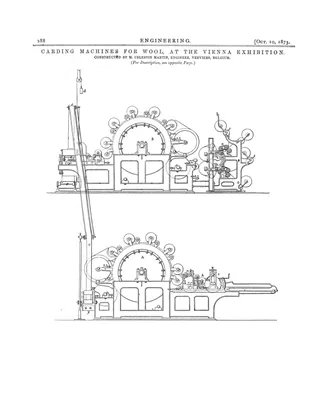
Part IX of Dr. H. Grothe's series on the textile industry at the 1873 Vienna Exhibition, from the journal Engineering. It describes wool-carding machinery, card-cleaning (stripper-sharpening) apparatus and a new wool spinning machine exhibited by M. Celestin Martin of Verviers, Belgium. It also discusses the spinning experiments of Vimont and Sykes, and includes a table of yarn weights from a 360-spindle self-actor. Illustrations are engineering drawings of the carders, sharpening apparatus and spinning machine.
Textile Industry at the Vienna Exhibition -- No. V: Weaving Machinery
Article · 2 pages
Part V of a series by Dr. H. Grothe on the textile industry at the 1873 Vienna Exhibition, covering silk weaving machinery and preparatory apparatus. It describes Caspar Honegger's silk skein-sorting device, warping mills, beaming machines and power looms for taffeta, satin and marzelline. It also notes silk and ribbon looms from Swiss, German and Austrian exhibitors, and mentions that Japanese, Indian and Chinese looms were shown.
Textile Industry at the Vienna Exhibition -- No. VI: Weaving Machinery (continued)
Article · 3 pages
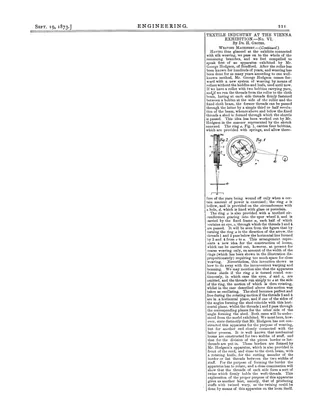
Installment VI of a series by Dr. H. Grothe reviewing weaving machinery shown at the 1873 Vienna Exhibition. It opens with George Hodgson's ring-and-bobbin shed-forming apparatus for making selvage borders, then surveys power looms by British, American, Swiss, French, Belgian, German and Austrian exhibitors (Hodgson, Livesey, Platt Brothers, Schoenherr, Crompton and others), with notes on picks per minute, floor space and power needs. It also covers heald knitting machines, reed-making machines and a wire-weaving loom, and ends with a list of looms by class of cloth.
Textile Industry at the Vienna Exhibition -- No. VII
Article · 2 pages
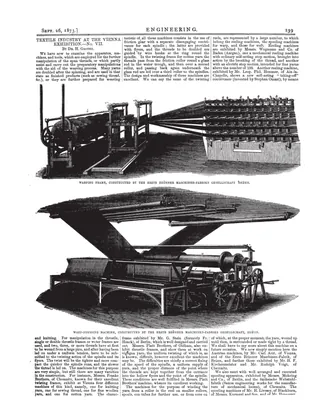
Part VII of a series on textile industry exhibits at the 1873 Vienna Exhibition, written by Dr. H. Grothe for Engineering. It surveys machinery for twisting, reeling, spooling, warping, warp dressing and beaming, balling, and the auxiliary pattern-making devices (shaft/dobby machines, Jacquard machines), plus reeds, mill furnishings, regulators and temples, naming exhibitors by country. Two engravings show a warping frame and a warp-dressing machine by the Erste Brünner Maschinen-Fabriks Gesellschaft, Brünn.
Textile Industry at the Vienna Exhibition -- No. VIII: Wool-Spinning Machinery
Article · 3 pages
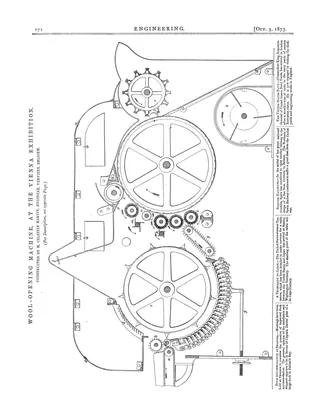
Part VIII of a series on textile industry at the 1873 Vienna Exhibition, by Dr. H. Grothe, covering wool-spinning machinery exhibited by M. Celestin Martin of Verviers, Belgium. It describes his breaking cylinder, a wool-opening machine with toothed drum, grille and doffing cylinder (400 lb of wool per hour), and a self-acting oiling machine that distributes oil and water onto the wool (about 3000 lb in twelve hours). Two engineering line drawings illustrate the opening and oiling machines.
Textile Industry at the Vienna Exhibition -- No. X: The Preparation of Silk Waste
Article · 2 pages
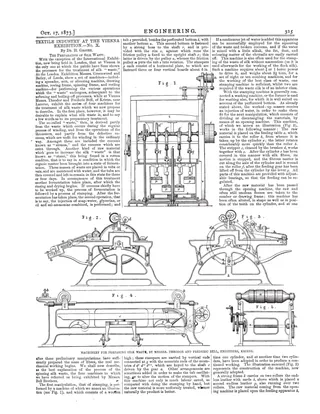
A two-page installment (No. X) of a series on the textile industry at the 1873 Vienna Exhibition, by Dr. H. Grothe. It explains what silk waste is (waste from winding and throwing, defective cocoons, strazza, stami) and its preparatory fermentation, then describes the machines shown by Theodor and Frederic Bell of Kriens, near Lucerne. These are a stamping machine, an opening machine, a comber or drawing frame, and a carding machine. The text covers how each works and gives output and power figures, with an illustrated plate of six machinery figures.
Textile Industry at the Vienna Exhibition -- No. XI
Article · 2 pages
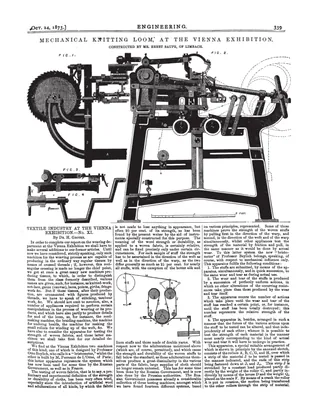
Part XI of a series on the textile industry at the 1873 Vienna Exhibition, by Dr. H. Grothe. It describes machines for testing the strength of woven fabrics, chiefly Professor Beylich's "bristometer" (friction and wear testing) and the Perreaux de L'Orne tension tester. It then turns to knitting machines, surveying German, French and other exhibitors and giving a detailed mechanical description of Ernst Saupe's knitting loom, illustrated with engraved figures.
Textile Industry at the Vienna Exhibition -- No. XII
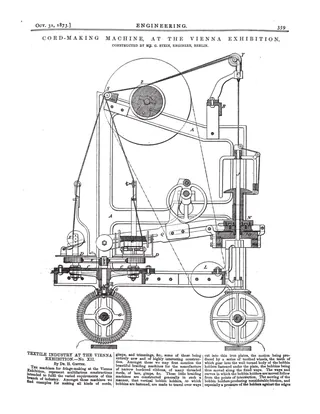
Article · 4 pages
Part XII of Dr. H. Grothe's report on the textile industry at the 1873 Vienna Exhibition, printed in the journal Engineering. It covers machines for making fringe, cords, gimps and trimmings: braiding machines (Diebold, Demuth), G. Stein's Berlin cord-making machine and his covering and twisting machine, and other covering machines. It ends with embroidering machines, including tambouring machines and Heilmann-system embroidery machines. Engraved illustrations show Stein's machines.
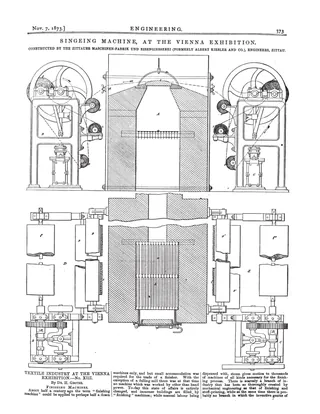
Textile Industry at the Vienna Exhibition -- No. XIII
Article · 2 pages
Installment XIII of a series by Dr. H. Grothe in the journal Engineering, reviewing the finishing machines shown at the 1873 Vienna Exhibition. It covers fulling mills, gig mills, teasel and metal cards, shearing machines and cutters, frizing machines, and singeing machines, naming exhibitors from Germany, Austria, Belgium, France and Italy. It describes in detail a plate singeing machine by the Zittauer Maschinenfabrik, with two small steam engines, illustrated by an engineering drawing with front elevation and plan.
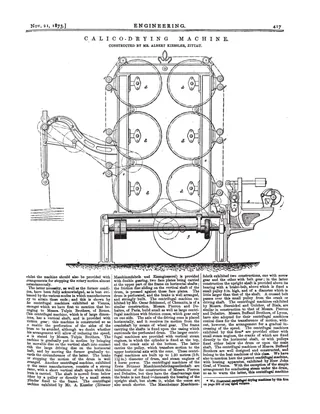
Textile Industry at the Vienna Exhibition -- No. XIV
Article · 3 pages
Installment No. XIV of Dr. H. Grothe's series on the textile industry at the 1873 Vienna Exhibition, printed in Engineering. It first describes F. Gebauer's apparatus for laying down the continuous band of calico in printing works, then turns to finishing machinery for removing water from fabric and drying it. It surveys centrifugal hydro-extractors and steam-heated cylinder and tenter drying machines from firms in France, Germany, Austria, Belgium and England, with an illustrated calico-drying machine by Albert Kiessler of Zittau.
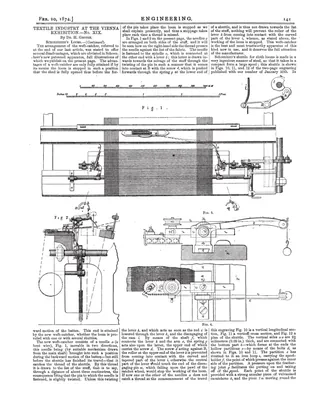
Textile Industry at the Vienna Exhibition -- No. XIX: Schoenherr's Looms
Article · 2 pages
Part of a series in Engineering on the textile industry at the 1873 Vienna Exhibition, this installment concludes the description of Schoenherr's power looms. It details the new patented weft-catcher (needle and lever mechanism that stops the loom when a weft thread is missed), Schoenherr's steel shuttle with spool holder, a Sächsische Webstuhlfabrik shuttle with wedge spool fastening, the shuttle-driving levers and springs, and the temple for cloth with strong selvages. Illustrated with engineering drawings; the author judges it among the best mechanical looms in use.
Textile Industry at the Vienna Exhibition -- No. XV
Article · 4 pages
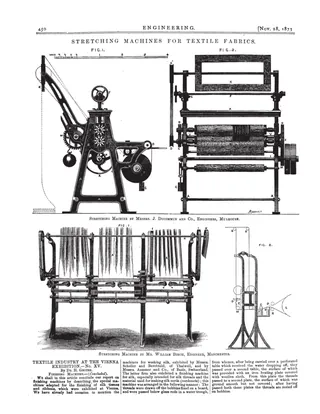
Concluding installment (No. XV) of Dr. H. Grothe's series on textile machinery at the 1873 Vienna Exhibition, covering finishing machines. It describes machines for finishing silk threads and ribbons, moir\u00e9 calendering, fabric stretching machines (Ducommun, Rosshardt, Birch), starching, craping, a calender for woollen fabrics, and folding and measuring machines. Engineering line drawings illustrate the Kiessler calender and craping machine, the stretching machines, and the Charlottenburg folding machine.
Textile Industry at the Vienna Exhibition -- No. XVI
Article · 3 pages
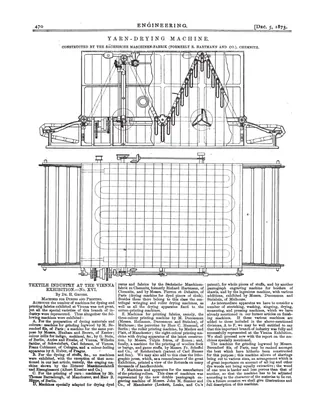
Installment No. XVI of Dr. H. Grothe's series on textile machinery at the 1873 Vienna Exhibition, printed in the journal Engineering. It surveys the machines for preparing dyestuffs, printing yarn and fabrics, drying, and making printing rollers, with detailed descriptions of a continuous yarn-drying machine from the Sächsische Maschinenfabrik, a three-colour roller printing machine, and an eight-colour Perrotine printing machine by C. Bialon (formerly Hummel) of Berlin. Illustrated with engineering drawings of the yarn dryer and the Perrotine.
121 documents found