Textile Documents › Publications › Publication: Science
17 documents found
Sort: 
African Basketry Weaves
Article · 1 page
A short note from Science describing a collection of Barotse and Bechuana baskets recently received by the American Museum of Natural History. The author lists the woven and coiled basketry techniques present, including wicker, checker, twill, wrapped, twine variants, the California 'ti' weave, and several coil types, and compares them with Californian and Aleutian basketry. She notes the emphasis on sturdy storage chests and the black-only coil decoration.
Artificial Silk
Science, 1889
Article · 2 pages
A 1889 article in Science, reporting from the Paris Exposition, on Comte de Chardonnet's process for making artificial silk from cellulose. It explains how natural silk is formed, then describes nitrating paper pulp, dissolving it as collodion, forcing it through capillary tubes, and denitrating the filament. It describes the three demonstration machines, compares cost and strength with natural silk, and mentions fabrics and a chasuble made from the product.
Competition Between the Aniline and Madder Dyes
Article · 2 pages
A short 1880 article from Science discussing the commercial rivalry between synthetic aniline dyes and natural madder dye. It traces how aniline was derived from coal tar via naphtha, benzole and nitro-benzole, lists early aniline colors, and describes madder cultivation and Turkey red prints. The author argues that limited aniline supply and high prices leave madder secure as the dye of popular, cheap goods.

A Cotton Fabric
Science, April 5, 1889
Article · 2 pages
A short note from Science (April 5, 1889) describing an English-patented cotton cloth made to imitate chamois leather. It gives the construction: dyed, sized cotton warps, soft-spun undyed weft, napping on cylinder raising machines, and a soap finish. The note lists uses as a washable substitute for chamois leather in cleaning, polishing and underclothing.
The Cultivation and Utilization of Ramie in the United States of America
Science, February 1, 1889
Article · 4 pages
A 1889 article in Science summarizing a consular report by Joseph Zervas on the Brussels Exhibition, arguing for ramie cultivation in the United States. It covers the white and green ramie species, history of use, propagation, soil, planting, harvesting, and Italian yield figures. It also includes a chemical analysis of the fibre and a comparison of decorticating machines and their prices, ending with the Norbert de Landtsheer machine.
Flax Culture in Russia
Science, 1891
Article · 2 pages
A short 1891 article in Science summarizing a U.S. consul's report from Odessa on flax growing in European Russia. It covers the northern fibre region and southern seed region, acreage by government, yields, seed sowing and harvest practice, soil needs, and the poor quality of Russian fibre compared with Irish and western European flax. It closes by urging American farmers, especially in the Northwest, to grow flax for fibre and set up linen, twine and textile industries.
The Flock by Mary Austin
Article · 3 pages
A review by Vernon L. Kellogg, published in Science in 1907, of Mary Austin's book 'The Flock' (1906), which records her observations of sheep, shepherds, and sheep dogs in California. Kellogg quotes passages on flock behavior (leaders and followers, panic flight, bedding habits), the loss of native instincts through domestication, poisonous plants and water, and the training of sheep dogs. He argues that a literary nature writer's observations can still be of value to scientists.
Hemp Cultivation in the Philippine Islands
Article · 2 pages
A two-page article from Science (June 5, 1891) on Manila hemp cultivation in the Philippine Islands, based on a report by the British consul at Manila. It covers soil and climate, planting and crop timing, harvesting and hand-cleaning of the fibre with knife and board, drying, costs, labor arrangements, land ownership rules for foreigners, and 1890 export figures. It does not deal with African basketry or weaving.
An Interesting Old Weaving Technic
Article · 1 page
A one-page note from Science (1911) by Mary Lois Kissell of the American Museum, New York, describing a nearly vanished wrapped-weaving technique found on an expedition to the Pima of southern Arizona. Stiff slats, often saguaro cactus ribs, are bound with a pliable element such as thong, string, rope, cloth strips or wire. Variations include a simple wrapped weaving and a lattice-wrapped form with a perpendicular slat. The author speculates that it is an early technique and notes similar work in Malaysia, the Lower Congo, Mexico and among Pacific Northwest and Plateau peoples.
An Interesting Old Weaving Technic
Article · 1 page
A short note from 1911 describing a remnant technique of wrapped weaving found among the Pima of southern Arizona, in which a pliable binding element is wrapped over parallel slats of saguaro cactus rib. It describes three variations, including lattice wrapping, in which a perpendicular slat is added for strength. The author speculates that this simple technique may be among the earliest basketry methods and notes similar wrapping in the Malaysian Islands, the Lower Congo, Mexico, and several Native American groups of the north.
Origin of Black Sheep in the Flock
Article · 2 pages
A short scientific article by C. B. Davenport testing whether black coat color in sheep is a Mendelian recessive trait. Using the records of 877 sheep in Alexander Graham Bell's Beinn Bhreagh flock in Nova Scotia, he applies four breeding criteria for recessiveness and finds that black wool behaves as a Mendelian recessive, with some deviation in matings of two heterozygous parents.
Origin of the Ass, the Cat, and the Sheep in China
Science, February 5, 1892
Article · 2 pages
A short report, reprinted in Science from Nature, on a paper read by Dr. Macgowan to the China Branch of the Royal Asiatic Society in Shanghai. He argues from Chinese texts, the zodiacal cycle and the written characters that the ass, cat and sheep were not native domestic animals in China but came from abroad. The section on sheep notes that early references to lamb-skins and sheep-skins may actually mean goat skins. The article also covers Chinese cat-spirit superstitions and the discussion that followed the paper.
Sheep-Goat Hybrid
Article · 2 pages
A short note from Science reporting a supposed sheep-goat hybrid born in spring 1907 on E. Arnaud's farm in Monett, Missouri. It describes the animal's goat-like coat and reddish hair mixed with short white wool-like hairs, its intermediate tail and sheep-like ears. It also covers the uncertain maternity, since the animal was a twin to an ordinary lamb. The author asks for reports of similar hybrids.
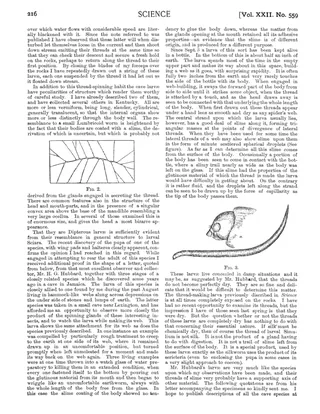
Silk Spinning Fly Larvæ
Article · 3 pages
A 1893 note from Science by H. Garman on silk-spinning fly larvae (Diptera), including cave-dwelling Mycetophilid larvae from Kentucky caves and Simulium larvae in streams. He argues that their threads count as silk in a biological sense, produced by special glands and used like the silkworm's product, even if not chemically identical to commercial silk. The article describes web-building behavior, the slime coating on the larvae, the pupa, and a letter from H. G. Hubbard on a similar Jamaican cave larva. Four line figures show larvae, a web and a pupa.
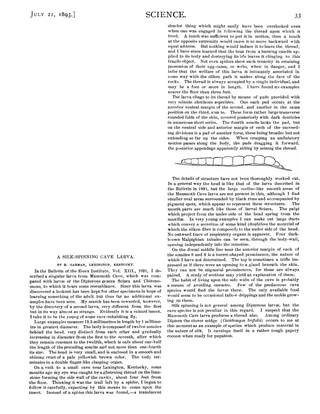
Silk-Spinning Cave Larva
Article · 1 page
A short 1893 entomological note by H. Garman describing a silk-spinning larva found on limestone cave walls near Lexington, Kentucky, probably the young of a cave-dwelling fly. It covers the larva's body structure, the pads it uses to cling to and move along its silken thread, and its likely habits and food. The author compares it with a Mammoth Cave larva he described in 1891 and with other silk-producing Diptera. It has no connection to weaving or textile practice beyond the natural silk thread.
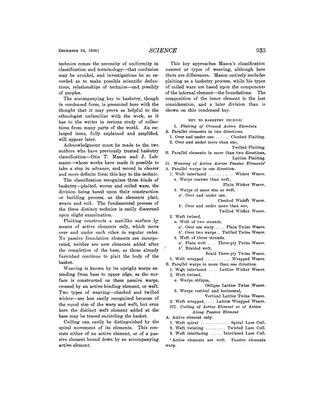
System of Basketry Technic
Article · 3 pages
A short 1909 article in Science proposing a uniform classification and terminology for basketry techniques. Kissell divides basketry into plaited, woven (wicker and twine) and coiled ware according to construction process, and compares her scheme with those of Otis T. Mason and J. Lehmann. It ends with a condensed outline key listing types such as checked and twilled plaiting, wicker and twine weaves, and the various lace and plain coils.
Textile Fabrics of the Ancient Inhabitants of the Mississippi Valley
Article · 1 page
A short note in Science summarizing a paper by Judge J. G. Henderson on the textile fabrics of the ancient inhabitants of the Mississippi Valley. It describes similarities between the spinning and weaving tools and processes of modern Indians and these ancient peoples, and lists the materials used: tree bark, nettle, and the hair of bear, buffalo, deer and dog. It outlines the development from rolling fiber on the thigh to spindles and looms, and notes the paper was illustrated with drawings, raw materials and models.
17 documents found