Textile Documents › Publications › Publication: Zell's Encyclopedia
77 documents found
Sort: 
Acacia
Zell's Encyclopedia, 1876
Article · 1 page
A one-page encyclopedia entry on the genus Acacia, covering its etymology, botanical character, geographic range and uses. It notes species that yield catechu, gum arabic and tannin, describes several notable species, and gives brief propagation advice. An engraving of Acacia catechu accompanies the text.
Agave
Zell's Encyclopedia, 1876
Article · 1 page
A single page from Zell's Encyclopedia containing the entry for Agave, the genus that includes the American aloe or maguey. It covers the plant's botany and slow growth, the Mexican drinks pulque and mezcal made from it, and the leaf fibre known as aloe-fibre, maguey pita or pita hemp. The entry begins on the page and its text starts mid-sentence from the preceding entry.
Bambusa
Zell's Encyclopedia, 1876
Article · 1 page
A one-page encyclopedia entry on Bambusa, the bamboo genus, describing its botany, native range (India, Sunda Islands, tropical America) and many uses. Uses include building, water pipes, masts, paper, and fibers for weaving mats, baskets, window-blinds and boat sails. Includes an engraved illustration of Bambusa spinosa with a stem cross-section.

Beetling
Zell's Encyclopedia, 1876
Article · 1 page
A brief encyclopedia entry defining beetling as a finishing process in which wooden stampers pound cloth to give cotton shirting a hard, linen-like appearance. It notes that the process was first used on linen shirting.
Bleaching
Zell's Encyclopedia, 1876
Article · 1 page
A one-page encyclopedia entry defining bleaching as the art of whitening cloth and other materials. It describes the traditional process for cotton and linen (removing weaver's paste, bucking in alkaline lye, grass exposure, souring, washing) and the later use of chlorine and chloride of lime. It also covers how wool, raw silk, cotton stockings and straw are whitened, including sulphur fumes.
Blue
Zell's Encyclopedia, 1876
Article · 1 page
A short encyclopedia entry defining the color blue, with etymology and a brief dyeing section. It notes that blues are generally dyed with indigo or Prussian blue (using iron salt and potassium ferrocyanide baths), and that aniline blue dissolved in sulphuric acid is used for silk and wool. Cross-references point to related entries such as Indigo Blue and Prussian Blue.

Bobbin
Zell's Encyclopedia, 1876
Article · 1 page
A brief encyclopedia entry defining the word 'bobbin' with its French and Greek/Latin etymology. It describes the bobbin as a notched wooden pin used to wind thread in lace making, a spool for sewing thread, a quill for a spinning wheel, and a type of round lace.

Braid
Zell's Encyclopedia, 1876
Article · 1 page
A short dictionary-style entry for the word 'braid' from Zell's Encyclopedia. It gives the Anglo-Saxon etymology, defines the verb as to weave, knit, intertwine or wreath, and the noun as a texture formed by weaving strands together. Quotations from Dryden and Milton illustrate the usage.

Brocade
Zell's Encyclopedia, 1876
Article · 1 page
A short encyclopedia entry defining brocade as a stout silk fabric variegated with gold and silver and enriched with foliage, flowers and other ornaments. It notes use in dress during the 17th and 18th centuries, quotes prices from an inventory of Charles II's wardrobe, and says brocade reached England only after the 13th century. It includes a brief etymology.

Buck
Zell's Encyclopedia, 1876
Article · 1 page
A short dictionary entry on the word 'buck' in the sense of an alkaline lye in which clothes are steeped to cleanse or whiten them. It gives the etymology (Swedish, Gothic and Old French roots), the senses of the clothes so steeped and of the verb meaning to steep or wash in lye, and Shakespeare quotations illustrating each.

Buckram
Zell's Encyclopedia, 1876
Article · 1 page
A short dictionary entry defining buckram as a coarse linen cloth stiffened with glue, originally with open holes or interstices, with its French and Italian etymology. It also notes the plural sense as a name for wild garlic and the adjective use, with two Shakespeare quotations.
Calico Printing
Zell's Encyclopedia, 1876
Article · 2 pages
An encyclopedia article describing calico printing, the impressing of cotton, wool or silk fabrics with colored patterns using mordants and dyes. It covers the preparatory steps of singeing and bleaching, the four printing methods (hand blocks, machine blocks/Perrotine, copper plates, copper cylinders), and the five or six styles: mordant, discharge, resist, steam, spirit and pigment. It also touches on ancient Egyptian and Indian practice and compares English and French industry in 1876.

Cambric
Zell's Encyclopedia, 1876
Article · 1 page
A short dictionary-style encyclopedia entry defining cambric as a thin, fine white fabric of flax or linen, thought to have been first made at Cambray, which gave it its name. It also notes the term for an imitation of linen cambric and includes a one-line quotation from Gay.

Camlet
Zell's Encyclopedia, 1876
Article · 1 page
A brief encyclopedia entry defining camlet as a stuff originally made from camel's hair and later made mainly of wool or goat's hair. It gives the French and Greek origins of the word, notes the variant spelling camelot, and quotes a line from Bacon describing a gown of water camlet.
Canvas
Zell's Encyclopedia, 1876
Article · 1 page
A short encyclopedia entry defining canvas. It describes canvas as a coarse unbleached hemp or flax cloth used for sails and tents, and as an open-mesh material used for tapestry and Berlin-wool work. It also covers painter's canvas, which is closely woven and primed, and the nautical sense of canvas as a ship's sails.
Carding Machine
Zell's Encyclopedia, 1876
Article · 1 page
A short encyclopedia entry defining the carding machine used in cotton manufacture. It describes the wire-toothed cylinders that comb out the fibres, the doffer and doffing-knife that remove the fleece, and the narrowing of the film into card ends or slivers ready for drawing or doubling.
Carpet
Zell's Encyclopedia, 1876
Article · 1 page
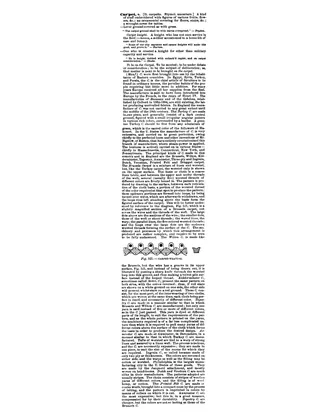
A one-page encyclopedia entry on carpets from Zell's Encyclopedia. It gives the word's definitions and idioms (carpet knight, on the carpet), then a history of carpet manufacture from the East to Europe and the United States. It describes the main types: Brussels, Wilton, Kidderminster, Tapestry, Axminster, Ingrain, Dutch and Venetian, and Printed Felt. Fig. 521 is a magnified cross-section diagram of a Brussels carpet showing wires, weft and warp.

Chintz
Zell's Encyclopedia, 1876
Article · 1 page
A brief encyclopedia entry defining chintz as a pattern on printed calicoes, in which flowers and other devices are printed in five or six colors on white or colored grounds. It gives the word's Hindi, Arabic and Persian origins. It is a one-sentence definition with no technical or historical detail.
Cochineal
Zell's Encyclopedia, 1876
Article · 1 page
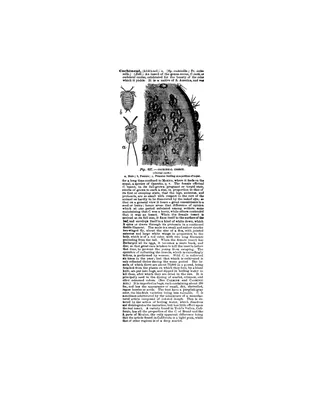
A one-page encyclopedia entry on cochineal, the insect Coccus cacti, which yields a scarlet and crimson dye. It describes the insect's life cycle, its cultivation on nopal cactus in Mexico and South America, how it is collected, killed and dried, and how it is packed and graded. It also covers adulteration with colored dough and a Californian variety, and includes an engraving of male and female insects on nopal (Fig. 637).
Cocoa
Zell's Encyclopedia, 1876
Article · 1 page
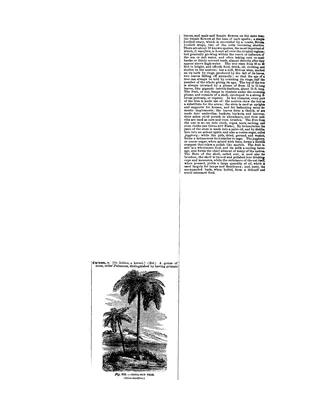
A one-page encyclopedia entry on the cocoa-nut palm (Cocos nucifera) from Zell's Encyclopedia. It describes the tree's botany, range and height, and lists the uses of its parts, including the fibre (coir) woven into cloth, ropes, mats and sacking, and leaves made into thatch and baskets. It includes an engraving of the tree and refers readers to a separate entry on cocoa-nut fibre.
Cordage
Zell's Encyclopedia, 1876
Article · 1 page
A short encyclopedia entry defining cordage as the general term for cords, ropes and cables, especially those used in ship rigging. It distinguishes cord, rope and cable by size, lists the materials they can be made from, and notes the loss in length of hemp fibres when twisted. It also mentions wire ropes and the replacement of hempen cables by iron chains.
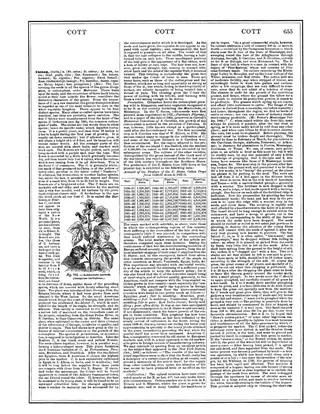
Cotton
Zell's Encyclopedia, 1876
Article · 2 pages
An encyclopedia article on cotton from Zell's Encyclopedia (1876). It covers the botany of the cotton plant (Gossypium species and varieties), US cotton production statistics from 1830 to 1868, cultivation, picking, ginning and plant diseases such as rust. It also gives a history of cotton manufacture, from its origins in India to the inventions of Hargreaves, Arkwright, Cartwright and Whitney, and the mill process from mixing to roving.

Crape
Zell's Encyclopedia, 1876
Article · 1 page
A short encyclopedia entry defining crape (crêpe) as a thin, loosely woven silk stuff used for clerical dress and mourning. It notes that the raw silk is gummed and twisted on the mill and woven without crossing, and that crapes are either crisped or smooth and are dyed raw.
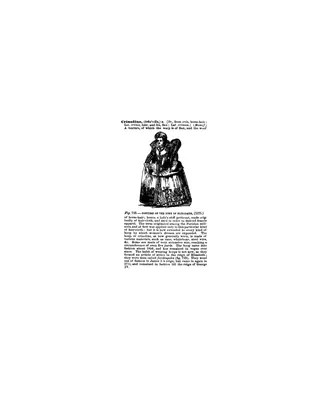
Crinoline
Zell's Encyclopedia, 1876
Article · 1 page
A short encyclopedia entry defining crinoline, originally a fabric with a flax warp and horse-hair weft, and later the stiff petticoat or hoop skirt used to expand women's dresses. It covers the word's French and Latin origins, the materials used for hoops (cane, whalebone, steel wire), and the fashion's history from Elizabethan farthingales through the 1850s hoop. An engraving shows Elizabethan costume of 1575 with a farthingale skirt.
Crotalaria
Zell's Encyclopedia, 1876
Article · 1 page
A short encyclopedia entry on Crotalaria, a large genus of tropical herbs and shrubs in the pea family. It highlights C. juncea (Sun, Sunn or Shunum hemp), cultivated in India for its fibre, which is said to equal or surpass Russian hemp. It also describes the North American rattlebox, C. sagittalis, covering its habitat, stem, leaves, flowers and seed pods.
Damask
Zell's Encyclopedia, 1876
Article · 1 page
A short encyclopedia dictionary entry defining damask as a wrought linen chiefly made in Flanders, named for the silk fabrics with raised floral figures first made at Damascus. It notes the use of damask linen for tables, the term 'damask service' for a tablecloth and a dozen napkins, and the adjective and verb senses of the word.
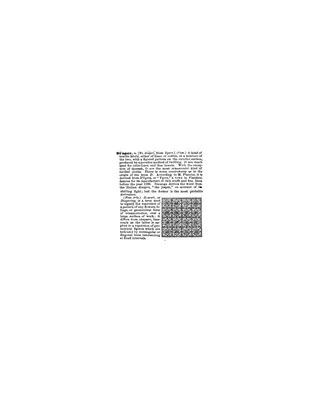
Diaper
Zell's Encyclopedia, 1876
Article · 1 page
A short encyclopedia entry defining diaper as a linen or cotton textile with a figured pattern produced by a special kind of twilling, used for table linen and towels. It discusses the disputed origin of the word (Ypres in Flanders versus Italian diaspro) and also defines diaper-work in the fine arts as a repeated ornamental pattern over a surface. A small illustration shows a patterned block of rosettes in square cells.

Dimity
Zell's Encyclopedia, 1876
Article · 1 page
A short dictionary-style encyclopedia entry defining dimity as a thick cotton cloth, usually striped or patterned in the loom. It gives the word's etymology from Greek and Latin roots meaning a double thread, and notes its uses for women's dress, bed furnishings and window curtains, and that it is rarely dyed.

Duck
Zell's Encyclopedia, 1876
Article · 1 page
A brief dictionary entry defining 'duck' as a coarse, light-textured cloth or canvas used for small sails, bed-sacking, awnings and men's clothing such as trousers. It gives the word's Swedish, German and Low Saxon etymology. No weave structure or construction details are given.
Dyeing
Zell's Encyclopedia, 1876
Article · 1 page
A one-page encyclopedia entry on dyeing as understood in the 1870s. It distinguishes substantive and adjective dyes, describes the stages of mordanting, ageing, dunging, dyeing and clearing, and lists common mordants and dung substitutes. It also summarizes how blacks, blues, reds and yellows were produced on wool, silk, cotton and linen, and mentions the new aniline dyes and the chemists who studied dyeing.
Embossing
Zell's Encyclopedia, 1876
Article · 1 page
A one-page encyclopedia entry defining embossing as the art of producing patterns or inscriptions in relief on cloth, leather, felt, metal, pasteboard or paper. It describes die stamping for paper and envelopes and the use of engraved cylinders and bed-rollers for woollen goods, velvets and bookbinding cloth. It also covers heated rollers and the embossing of leather.
Felt
Zell's Encyclopedia, 1876
Article · 1 page
A one-page encyclopedia entry on felt, giving its etymology and describing how it is made by carding, then combining and compressing fibres of wool or fur with heat, moisture and pressure. It lists uses including hats, printed and embossed table-cloths and carpets, roofing felt, boiler covering and ship sheathing linings, and closes with legendary accounts of its invention by St. Clement and by the Saracens.
Fibre
Zell's Encyclopedia, 1876
Article · 1 page
A one-page encyclopedia entry defining fibre as a filament or thread of animal or vegetable origin and surveying the materials used for textiles and cordage. It covers animal fibres (wool, hair, silk), the one fibrous mineral (asbestos), and vegetable fibres by plant source: bark (flax, hemp, jute), fruit and seed hairs (cotton, coir), and leaves (New Zealand flax, Manila hemp, pita). It also briefly mentions how bark and leaf fibres are separated, by steeping or by beating and rolling.
Flax
Zell's Encyclopedia, 1876
Article · 1 page
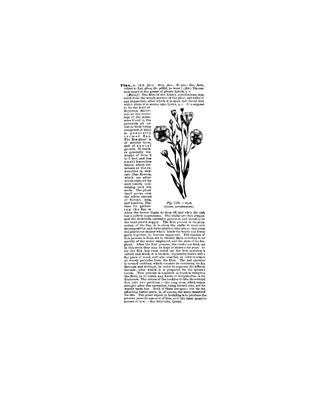
A one-page encyclopedia entry defining flax as both the plant genus Linum and the fibre of Linum usitatissimum used for linen. It describes the plant's appearance and range, harvesting, retting, drying, breaking, scutching and heckling, and the division of the dressed flax into line and tow for spinning. A botanical illustration of the flax plant accompanies the text.
Fustian
Zell's Encyclopedia, 1876
Article · 1 page
A short encyclopedia entry defining fustian as a cotton cloth similar to velvet, with a pile of doubled threads thrown up in ridges over the warp and weft ground. It explains that the loops are cut and sheared to leave an evenly ribbed surface, and names related fabrics such as cotton-velvet, velveteen, moleskin and corduroy.
Gauze
Zell's Encyclopedia, 1876
Article · 1 page
A short encyclopedia entry defining gauze as a light, transparent silken fabric, said to be named after Gaza in Palestine. It explains that the open texture comes from crossing the warp threads between each weft pass, which holds the threads apart. It notes that France and Switzerland were major producers and that inferior grades mix silk and cotton.

Gingham
Zell's Encyclopedia, 1876
Article · 1 page
A short encyclopedia entry defining gingham as a cotton fabric, usually with a colored check pattern produced by weaving colored threads rather than by dyeing or printing the finished cloth. It notes the French origin of the word and mentions that several kinds are sold under different trade names, including umbrella gingham woven in a single color.
Goat
Zell's Encyclopedia, 1876
Article · 1 page
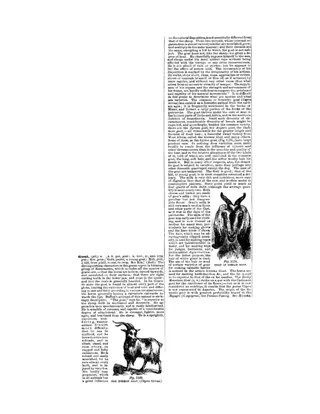
A one-page encyclopedia entry on the goat (genus Capra), covering its zoological characters, domestic varieties, and temperament as described by Buffon. It lists uses of goat milk, meat, skin, hair, horns and fat, and notes the long-haired Syrian, Angora and Cashmere breeds valued for fibre. Two engravings show the common goat and the Syrian goat.

Gossypium
Zell's Encyclopedia, 1876
Article · 1 page
A short encyclopedia entry defining Gossypium, the botanical genus of the cotton plant, in the Malvaceae family. It describes the plants as tall shrubs with lobed leaves, yellow mallow-like flowers and angular pods whose seeds are covered in the cellular filaments that make commercial cotton. It refers readers to the separate Cotton entry.

Heddle
Zell's Encyclopedia, 1876
Article · 1 page
A one-paragraph dictionary entry defining the heddle (heald) as one of the sets of parallel double threads that, with their mounting, make up the harness guiding the warp threads to the lathe or batten. It also defines the heddle-eye, the loop in each heddle that receives a warp thread, and credits Webster as the source.
Hemp
Zell's Encyclopedia, 1876
Article · 1 page
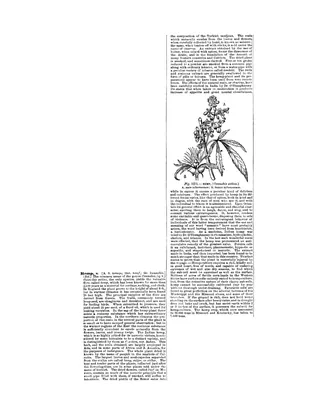
A one-page encyclopedia entry on hemp (Cannabis sativa) with a botanical illustration showing male and female inflorescences. It covers the plant's use as a fibre for cordage, sacking and cloth, its seed and oil, and its narcotic resin and preparations (hashish, ganjah, churrus) with their medical use. It ends with notes on soil requirements for hemp culture in the United States and the decline of the Missouri and Kentucky crop.
Indigo
Zell's Encyclopedia, 1876
Article · 1 page
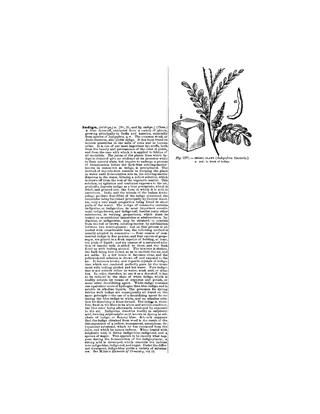
A one-page encyclopedia entry on indigo as a blue dye-stuff, from Zell's Encyclopedia. It covers the source plants (Indigofera species and woad), the fermentation and precipitation process used to make commercial indigo, and its chemical constituents such as indigotine, indigo-red and indigo-brown. It also explains why indigo must be reduced to soluble white indigo for dyeing, with a deoxidizing agent and an alkali, and then developed blue by exposure to air. An engraving shows the Indigofera tinctoria plant, a pod, and a block of indigo.
Jacquard Loom
Zell's Encyclopedia, 1876
Article · 1 page
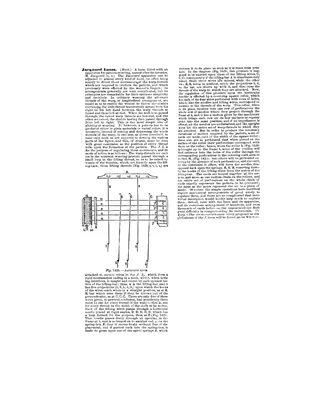
A one-page encyclopedia entry explaining the Jacquard loom and how its apparatus controls the warp threads to weave patterns. It describes the lifting bar, hooked lifting wires, horizontal needles and springs, and the rotating square roller covered by perforated cards that select which warp threads rise. A diagram (Fig. 1429) illustrates the mechanism, and the entry compares the card chain to musical notation.
Knitting
Zell's Encyclopedia, 1876
Article · 1 page
A short encyclopedia entry defining knitting as an art allied to weaving, formed from a single thread making a continuous series of interlocking loops. It notes that machines have made hand knitting uneconomical for staple goods such as stockings and gloves. It describes the improved Lamb knitting machine, with two parallel rows of needles worked by cams, adjustable loop length, hand-crank operation, and a speed of four to five thousand loops a minute.
Lace
Zell's Encyclopedia, 1876
Article · 1 page
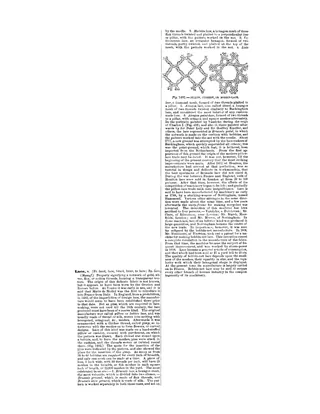
A one-page encyclopedia entry on lace, covering its definition, uncertain origins, and early history in Venice, France and England. It describes pillow or bobbin lace making on a cushion with pins and bobbins, and lists the best-known laces (Brussels, Mechlin, Valenciennes, Lisle, Alençon) by mesh type. It also traces the 18th and 19th century shift to machine production, including warp-frame lace, Heathcote's 1809 bobbin-net patent, and the Nottingham trade. A line illustration shows bobbin-lace mesh structures.
Linen
Zell's Encyclopedia, 1876
Article · 1 page
A single encyclopedia entry on linen from Zell's Encyclopedia. It outlines the history of linen from ancient Egypt through the Romans and the Middle Ages, then describes the mechanized steps of flax processing: scutching, heckling, drawing, roving and wet spinning. It also explains the lea system for numbering flax yarn and notes the introduction of the linen industry to the United States in 1834.
Llama
Zell's Encyclopedia, 1876
Article · 1 page
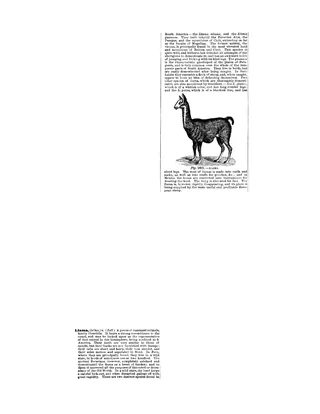
A one-page encyclopedia entry on the llama, a South American camelid, from Zell's Encyclopedia. It describes the llama genus and its species (vicuna, guanaco, and the domesticated L. glauca and L. pacos), their range in Peru, Bolivia, Chile and Patagonia, and their habits. It notes that llama wool is made into cords, sacks and stuffs for ponchos, and that in Mexico the bones were made into weaving implements. Includes an engraving of a llama (Fig. 1603).
Madder
Zell's Encyclopedia, 1876
Article · 1 page
A short encyclopedia entry on madder that gives its Anglo-Saxon origin and refers readers to the entry for Rubia. It then describes pigments prepared from madder for painting: madder carmine (Field's carmine), madder orange, madder purple (Field's purple) and madder yellow. It compares their color, transparency and durability.
Mangle
Zell's Encyclopedia, 1876
Article · 1 page
A single encyclopedia entry defining the mangle, a machine for smoothing linen and cotton articles. It describes the common form, a weighted wooden chest of stones rolling back and forth on two cylinders over linen laid on a smooth bed, driven by a toothed wheel and pinion. It also mentions patent varieties, such as one in which linen is rolled on a cylinder pressed by hanging weights against a sliding curved bed, and gives the verb sense 'to calender'.
Mohair
Zell's Encyclopedia, 1876
Article · 1 page
A short encyclopedia entry defining mohair as the hair of the Angora goat. It covers the annual clipping, fleece yields, the relative value of male and female hair, and the places where it is spun and manufactured (France, England, Scotland). It lists products made from it, including camlets, plush, laces, buttons, trimmings and cloth for paletots, and notes that mohair dresses were replaced by alpaca cloths.
77 documents found