Textile Documents › Publications › Publication: The Melliand
138 documents found
Sort: 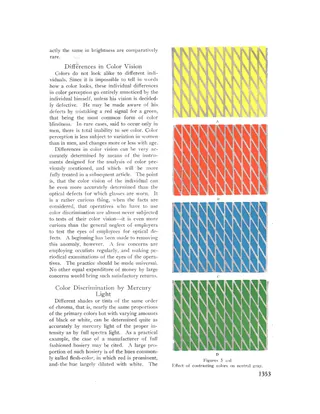
The Adaptation of Light for Color Workers
Article · 5 pages
A 1929 article from The Melliand on how lighting affects color perception and discrimination in textile factories. It covers the effect of illumination intensity on different hues, eye fatigue and reflex action, variation in daylight, individual differences in color vision, and the use of mercury, incandescent, and mixed lighting for color matching. Examples are drawn from hosiery, woolen and worsted weaving, carpets, and patterned knitting.
Advertisement for textile magazine
Ephemera · 1 page
A one-page advertisement promoting The Melliand, a monthly textile industry journal. It argues that the magazine gives mill managers and textile workers specialized, authoritative information on machinery, materials and methods. It also advertises the cloth-bound monthly issues, the complete annual index, and a subscription price of under 9 cents a day.
African Wild Silk and Its Uses
Article · 4 pages
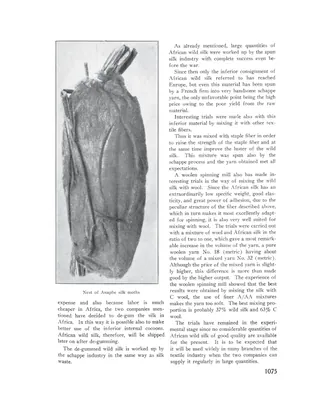
A 1929 article by Consul Max Saurenhaus on African wild silk (Anaphe species) as a textile raw material. It traces the failed early European trials, the pre-war Anglo-German exploitation company in East Africa, and new French and Belgian Congo ventures planned for 1930. It describes the fiber's properties (fineness, strength, dyeing, poor luster) with a strength and elongation table comparing its schappe to Bombyx mori schappe, and reports trials of spinning it alone and blended with staple fiber and wool. One photograph shows a nest of Anaphe silk moths.
Ancient History of the Spinning Wheel
Article · 3 pages
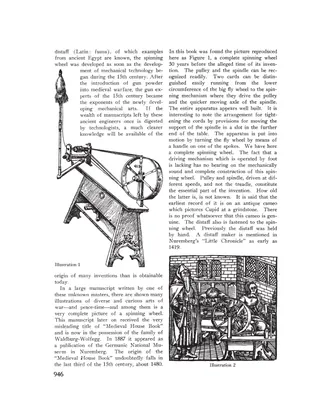
A short historical article by F. M. Feldhaus examining the claim that a Brunswick wood carver named Juergen invented the spinning wheel in 1530. Feldhaus traces the claim to a 1722 chronicle and argues against it, citing a complete spinning wheel drawn in the c. 1480 "Medieval House Book" and drawings by Leonardo da Vinci. The article is illustrated with five woodcuts and line drawings of early spinning wheels and spinning scenes.
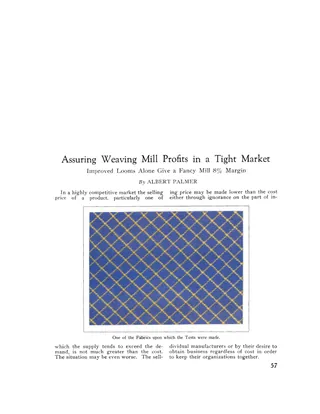
Assuring Weaving Mill Profits in a Tight Market: Improved Looms Alone Give a Fancy Mill 8% Margin
Article · 4 pages
A 1929 article from The Melliand arguing that new automatic looms can protect profit margins for weaving mills in a depressed, price-competitive market. It compares the Crompton & Knowles Cotton King automatic dobby loom with the older automatic dobby dress goods loom on a cotton and rayon dress fabric, using four months of mill data. Tables give production, seconds, waste, weaver operations, looms per weaver and cost per yard, and conclude with an 8% total cost saving and a 21% return on the investment.
Avoidance of Color Troubles Caused by Electric Light, Part 1
Article · 6 pages
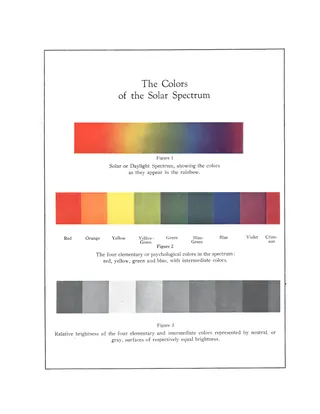
Part 1 of an article on avoiding color problems under electric light in industry, concentrating on the fundamentals of color theory. It argues that color vision matters for only a small share of workers, chiefly in textiles, and then explains color as a mental sensation, a property of light and a property of surfaces. Topics include elementary colors, chroma, brightness, saturation, tints, shades, hues, wave lengths, reflection, fluorescence, and the difference between mixing pigments and mixing lights. Three spectrum figures are included, and the article is continued in a later part.
Avoidance of Color Troubles Caused by Electric Light, Part 2
Article · 7 pages
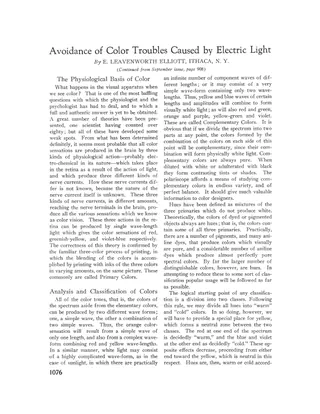
Second part of a series on how electric lighting distorts color in textile work. It covers the physiological basis of color vision, a classification of hues (warm, cold, browns, grays), and how incandescent and mercury light change the appearance of surfaces compared with daylight, with a figure comparing spectra. It then distinguishes colorists (designers, dyers) from workmen who only need to avoid mistaking colors, and recommends educating workers, using numbers or symbols for identification, and choosing distinguishable color series for fugitive silk dyeing under different lights.
Biological Investigations of the Silk Worm
Article · 3 pages
A 1930 article by W. Wagner of Krefeld, Germany, reporting incomplete biological experiments aimed at raising healthier silk worms and improving silk yield and quality. It describes treating eggs and larvae with direct induction electric current and ultra-violet light, and rearing worms outdoors, and compares disease losses, development time, cocoon size and silk color against indoor-reared controls. The author stresses that results are preliminary.
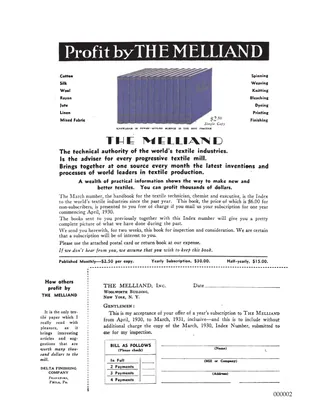
Card for subscription with trial copy
The Melliand, 1930
Ephemera · 2 pages
A two-page 1930 promotional subscription card from The Melliand, an English-language textile technical journal published in New York. It offers a free copy of the March 1930 Index Number to those who subscribe for a year starting April 1930, and includes an acceptance form with billing options. The second page reprints testimonials from American textile firms and has a postage-paid reply card.
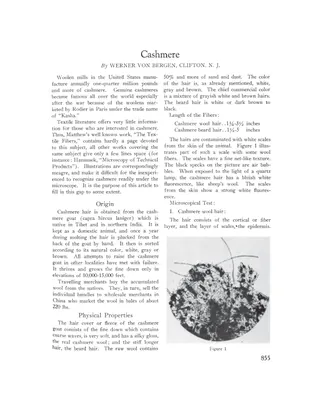
Cashmere
Article · 5 pages
A 1929 article from The Melliand on the microscopic identification of cashmere fiber. It covers the origin of the cashmere goat and how the hair is harvested and traded, then the physical properties of the fleece, including down and beard hair. The author describes scale counts, which separate cashmere from sheep's wool, along with fiber diameter measurements, cross-sections and pigment in brown hairs. Illustrated with photomicrographs, cross-section drawings and charts of scale counts and diameter variation.
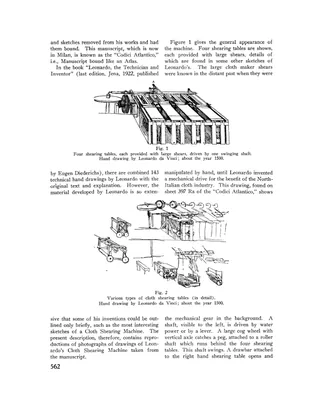
Cloth Shearing Machine of Leonardo Da Vinci
Article · 4 pages
Article by Franz M. Feldhaus describing Leonardo da Vinci's designs, from about 1500, for a mechanically driven cloth shearing machine. It opens with a short biography of Leonardo and the fate of his manuscripts, then goes through six drawings from the Codex Atlanticus. These show four shearing tables driven by a swinging shaft, tension rolls, gearing, spring and springless shear mechanisms, and Leonardo's own notes. It ends by noting that Everett of Wiltshire invented a similar machine in 1758.
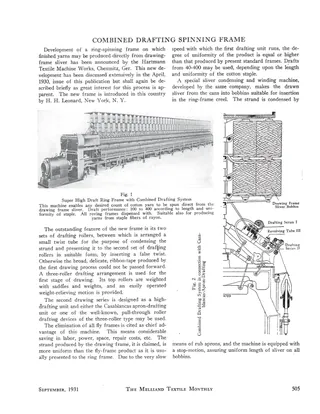
Combined Drafting Spinning Frame
The Melliand, September 1931
Article · 1 page
A short trade article from 1931 describing a ring-spinning frame from the Hartmann Textile Machine Works of Chemnitz, Germany, that spins finished cotton yarn directly from drawing-frame sliver without fly frames. It explains the two sets of drafting rollers with an intermediate false-twist tube, the Casablancas apron drafting option, draft ranges of 40 to 400, and a companion sliver condensing and winding machine. It includes a photograph of the machine and a diagram of the drafting system.
Combined Knitting and Weaving Loom
Article · 2 pages
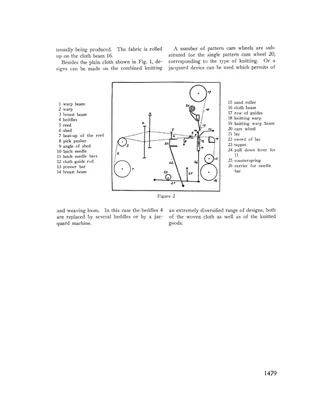
Article describing a combined warp knitting and weaving loom invented by Dr. Edwin Wildt of Leicester (German Patent No. 454,161). The machine alternates weaving and knitting operations to produce a fabric that is less prone to lengthening and excessive stretch than ordinary knitted goods. The text walks through the sequence of weaving a pick, pushing it into the latch needles, and knitting it into a row of loops, with a numbered parts key and a side-section diagram. It also notes that pattern cam wheels, multiple heddles or a jacquard device can be used for patterned fabrics.
Comparative Studies on Cellulose Acetate
Article · 7 pages
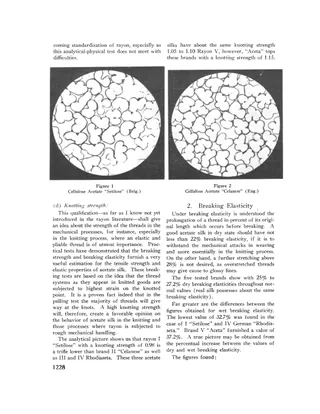
Concluding part of H. Stadlinger's laboratory comparison of five commercial cellulose acetate rayons (Setilose, Celanese, French and German Rhodiaseta, and Aceta). It reports tests of dry, wet, boiled and knotting tensile strength, breaking elasticity, titer, sorting defects, gloss, color, ultraviolet fluorescence, dyeing with Cellit fast dyes, acetic acid content, viscosity and oil content. Micrographs of fiber cross-sections illustrate how ribbon-shaped filaments gave way to multi-lobed round forms and how this affects gloss. The article ends with eleven numbered conclusions on suitability for knitting, weaving and dyeing.
Comparative Studies on Cellulose Acetate, Part 1
Article · 8 pages
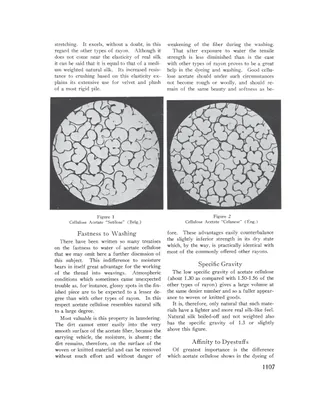
First part of a two-part article by consulting chemist H. Stadlinger comparing cellulose acetate rayon ('acetate silk') from several European makers. It first defends acetate against common criticisms (ironing, alkalies, strength) and lists its advantages: smoothness, luster, elasticity, water resistance, low specific gravity, dye affinity and sanitary properties. It then reports laboratory tests on samples from Belgian, British, French, German and Dutch producers, with tables of denier, twist, breaking strength, elasticity, gloss, fluorescence, dyeing, boiling behavior, acetic acid content, viscosity and oil coating, plus micrographs of fiber cross-sections.
Compensation for Loom Fixers
Article · 3 pages
A 1931 article by textile consultant James Chittick proposing a bonus-based pay system for loom fixers and weave room overseers in textile mills. Fixers would get a flat weekly wage about 10% below the usual rate plus a bonus per 100 yards of cloth produced, and foremen a bonus per thousand yards. The article also covers keeping warps and filling supplied ahead of need, rotating fixers into weaving work during slack periods, and overtime pay. It draws on the author's experience with a 500-loom silk mill.
Constructions for Cotton Work Clothing Fabrics
Article · 3 pages
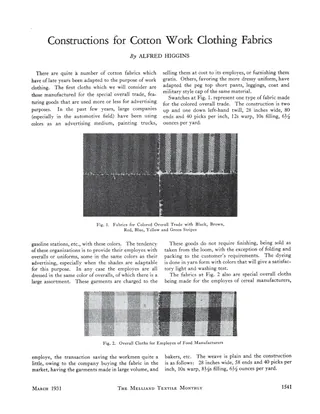
A 1931 trade article from The Melliand Textile Monthly describing cotton fabric constructions for work clothing, including colored overall cloths, uniform twills, Bedford cord, napped suitings, stock-dyed twills, imitation worsted trousering and a 'Frenchback' cloth with an extra warp. For each fabric it gives the weave, width, ends and picks per inch, yarn counts, weight per yard, dyeing and finishing requirements. Photographs of swatches illustrate each type.
Correct Reeding of Weaves, Part 1
Article · 3 pages · weaving drafts
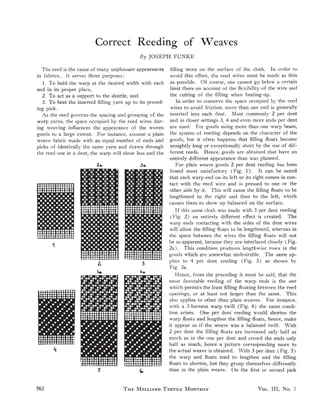
An article from The Melliand Textile Monthly on how the number of warp ends per dent in the reed changes the look of woven cloth. Funke examines plain weave, 3-harness twill, balanced and fancy twills, and satins reeded at 1, 2, 3 and 4 ends per dent. He uses drawdown diagrams to show where filling floats are lengthened or shortened and where diagonals, lengthwise rows or cross ribs appear. He concludes that the reeding should not put more ends per dent than a filling float covers, and that the usual rule of matching ends per dent to the weave repeat holds only relatively. The article is continued in a later part.
Correct Reeding of Weaves, Part 2
Article · 3 pages · weaving drafts
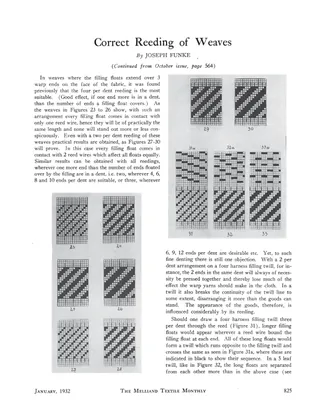
Second part of Joseph Funke's article on how the number of warp ends per dent in the reed affects the appearance of woven cloth. It examines filling twills (4-, 5- and 6-harness) and satin-type weaves, showing how different reeding plans produce uniform, elongated or shortened filling floats and visible lines in the twill. The text is illustrated with drawdown figures (Figures 23-44) and closes with a summary of the most and least suitable reeding rules.
Crompton & Knowles Makes Widest Loom in its History
The Melliand, August 1931
Article · 2 pages
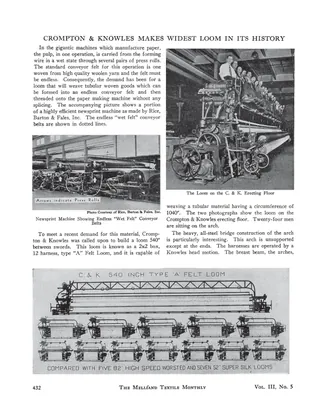
A short trade article from 1931 describing a very large felt loom built by Crompton & Knowles for weaving tubular, endless woolen conveyor felts used on paper-making machines. It gives the loom's specifications (540-inch reed space between swords, 12 harnesses, 2x2 box, Knowles head motion, two motors, 30 picks per minute, about 20 tons) and compares its floor space with that of smaller worsted and silk looms. Illustrated with photographs of a newsprint machine and the loom on the erecting floor.
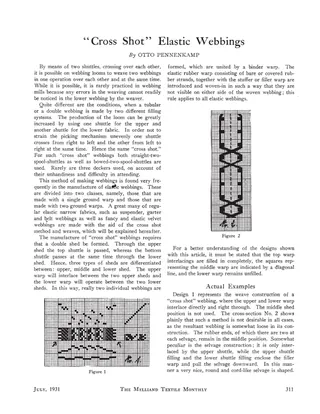
'Cross Shot' Elastic Webbings
Article · 4 pages · weaving drafts
Article from The Melliand Textile Monthly explaining the cross shot method of weaving elastic webbings, in which two shuttles cross in separate upper and lower sheds to weave two fabrics at once on a webbing loom. It describes the three-shed system, warp arrangements with binder, rubber, and stuffer ends, and selvage constructions. It works through numbered designs for single, double, and hollow webbings, with drawdowns and cross-sections, and closes with notes on two-eye heddles and harness arrangements.
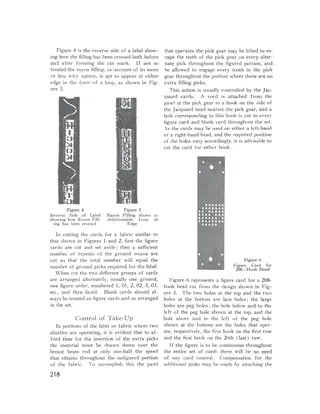
Design and Construction of Narrow Woven Fabrics
Article · 8 pages · weaving drafts
Article from The Melliand (May 1930) by Edwin J. Gibbons on designing and constructing woven name labels made on Jacquard drop-lay looms. It explains laying out designs on point paper, working out ends and picks, spacing letters, and painting figure and ground weaves. It also covers weaving face down and backwards, card cutting and arrangement, take-up control, stitching of extra filling picks, rayon and silk fillings, extra warp for figure, and a 5-harness satin rayon label. Illustrated with label photographs, a Jacquard card, and design grids.
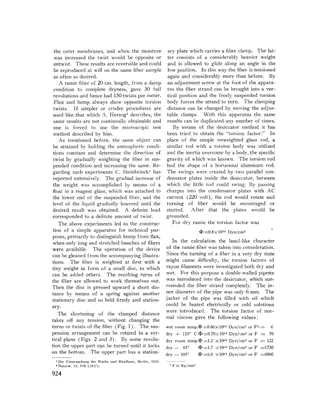
Distortion Phenomena in Bast Fibers
Article · 3 pages
A 1930 technical article from The Melliand on how bast fibers twist and untwist as their moisture content changes. It describes the spiral fibril structure of hemp, ramie and flax, with spiral angles and calculated twists per meter. It also covers desiccator experiments and a simple torsion apparatus for telling hemp from flax. Torsion factors measured for dry ramie and for viscose rayon at various temperatures are given, with photographs of the apparatus.
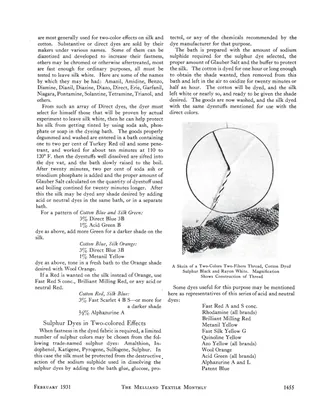
Dyeing Fancy Patterns in Textiles
Article · 4 pages
A 1931 trade article by N. D. White on producing multicolored patterns in finished fabrics by cross-dyeing mixed fibers (silk, cotton, rayon, acetate/celanese, wool) in the piece. It gives dye-bath procedures and sample formulas for two-color effects using direct, acid and sulphur dyes, plus notes on degumming and the risks of saponifying acetate. It also touches on multicolored hosiery and includes one magnified photograph of a two-fiber thread.
An Easy Method of Determining the Fineness of Wool
Article · 4 pages
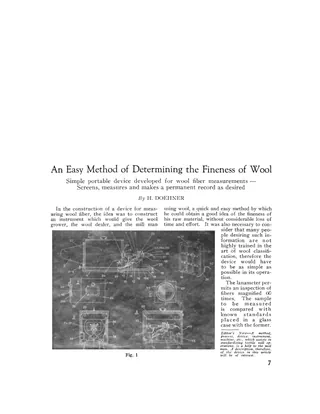
A short article describing the lanameter, a portable device for judging the fineness of wool fibers. A microscope projects the fiber at 60x for comparison with standards, or at 500x for individual measurements on a scaled disc, and the image can also be photographed for a permanent record. The article explains the construction of the apparatus, its wooden carrying case, slides, lighting and objectives, and how wool growers, dealers and mill men can use it. Photographs show the apparatus and its components.
Easy Method of the Determination of Raw and Bleached Cotton in Textiles
Article · 2 pages
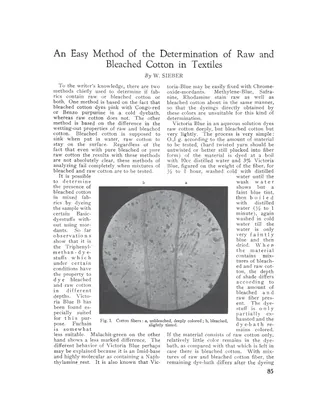
A short technical article describing a dyeing method for telling raw (unbleached) cotton from bleached cotton in textiles, including mixtures of the two. Sieber compares it with the Congo-red and wetting-out tests and recommends Victoria Blue B, a basic triphenylmethane dye applied without mordant, which dyes raw cotton deeply and bleached cotton only lightly. He gives a dyeing procedure, explains how the leftover dyebath can be compared by colorimetry to estimate the percentage of each fiber, and describes microscopic examination. Three micrographs show cotton, ramie and flax fibers, raw and bleached.
Effect of Yarn Twist and Weave on the General Appearance of a Fabric
Article · 7 pages · weaving drafts
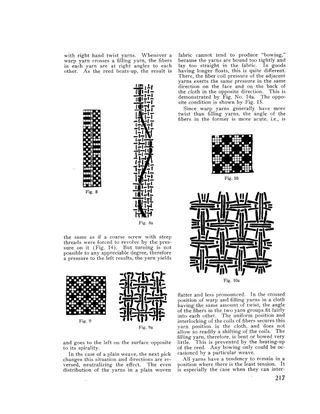
A 1929 article from The Melliand by Josef Funke on how the direction and amount of yarn twist interact with weave structure to affect the look of a woven fabric. It explains how light reflects differently from right- and left-twist yarns, why yarns bow or deviate from straight lines in floats, honeycomb, mock leno and huck weaves, and how warp and filling twist relationships affect beating-up. It ends with how twill and gabardine constructions can control tilting of floats. Illustrated with numbered figures, including twill and other weave drawdowns.
Engraving With the Jacquard Machine
The Melliand, November 1930
Article · 5 pages
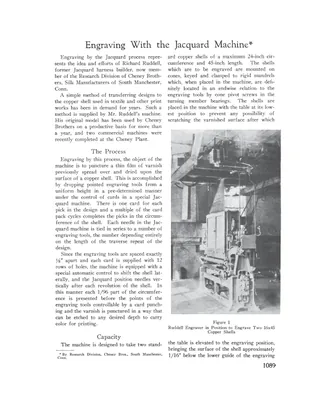
Describes the Ruddell engraver, a machine developed at Cheney Brothers (South Manchester, Conn.) that uses a special Jacquard head to puncture a varnish film on copper print-roller shells so they can be etched for textile printing. It explains the process, shell capacity, traverse and multiplier mechanisms, engraving tools, drive, repeat tie-up changes, re-etch work, and time required. It also covers card preparation and reports a 33% time saving and 40% cost reduction over the previous method. Six photographs show the machine and its parts.
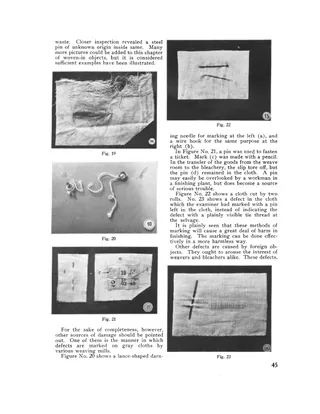
Extraneous Objects in Gray Cotton Goods: A Source of Trouble for Weaver and Finisher Alike
Article · 7 pages
An article by C. Martini, a finishing-plant operator, on foreign objects such as wire, nails, pins, heddle and harness parts, and reed fragments that get woven into gray cotton goods and later damage cloth and finishing machinery. He describes how calender rolls stencil damage into cloth, why mill inspection often misses these objects, and how weaving mills mark defects with pins or hooks. Twenty-four photographic figures illustrate examples, and he urges closer cooperation between weaving mills and finishers.
Faults in Crêpe Fabrics Containing Rayon
Article · 4 pages
A 1932 technical article on the causes of faults in crêpe fabrics made wholly or partly of rayon. It covers weft faults (weft bars, tram lines, lashing-in, box marking), warp faults (slack ends, streaky acetate warps), scouring faults (oil spots, residual silk gum, creasing) and finishing faults (over-tensioning, rain-spotting, slipping, blistering, shrinkage). It concludes that most faults can be avoided with proper care in manufacture. Two photographs illustrate weft bars and a crease effect after dyeing.
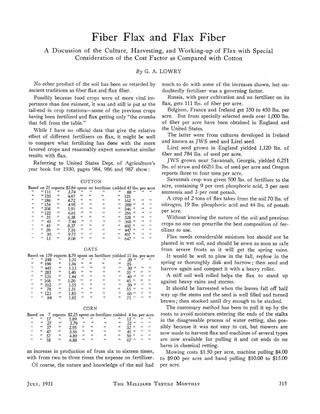
Fiber Flax and Flax Fiber
Article · 5 pages
A 1931 trade-journal article by G. A. Lowry on growing, harvesting, retting, and processing fiber flax, with emphasis on cost compared with cotton. It uses USDA fertilizer-yield tables for cotton, oats and corn to argue that flax would also respond to fertilizing, and compares water, dew and chemical retting (degumming) and several scutching machines, including the Grant or Farmer's machine. It gives test yields and per-acre and per-pound cost figures, and argues that degummed flax spun on cotton machinery could compete with cotton.
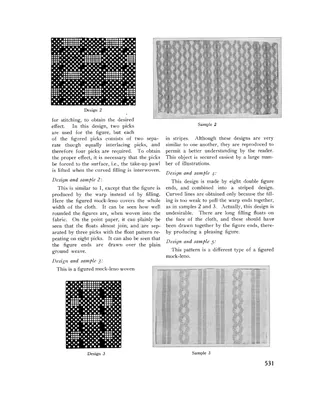
Figured Mock Lenos, Part 1
Article · 8 pages · weaving drafts
Part 1 of an article by M. Loescher of Gera-Reuss, Germany, on figured mock-lenos, which imitate true leno gauze through floating warp or filling figure ends on a plain weave ground and can be woven at normal loom speed. It covers the principles (floats, separate figure beam, slack figure warp, reeding), outlines five groups of mock-leno, and works through the first two: quadrangular floats and pointed floats. Numbered designs (drawdowns), sketches and photographs of woven samples illustrate each type.
Figured Mock Lenos, Part 2
Article · 6 pages · weaving drafts
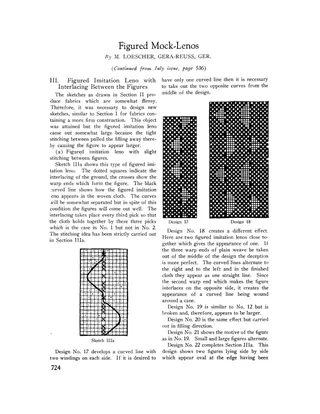
Second installment of M. Loescher's article on figured mock (imitation) lenos, covering Sections III to V. It describes figured imitation lenos with interlacing between the figures, lenos with only one floating warp end, and designs with warp or filling floats on the cloth surface that are not true imitation lenos. Sketches and Designs 17 to 33 are shown as drawdowns, each with notes on how the figure forms, warp and filling tension, and the effect in the cloth.
Flamengo -- A New Parisian Mixture Fabric
Article · 4 pages · weaving drafts
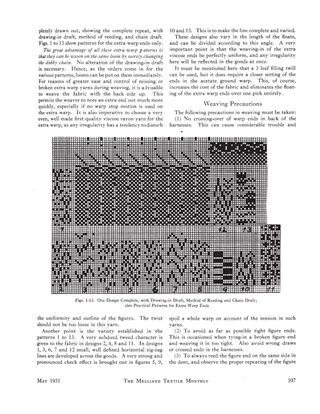
A 1931 trade-journal article describing Flamengo, a Parisian mixture dress fabric with an acetate plain-weave ground warp, an extra viscose figure warp and a worsted crepe filling. It covers dobby loom setup, the 6-end ground to 1-end figure arrangement, reeding, drawing-in on 12 harnesses, float length limits and weaving precautions. Thirteen extra-warp patterns are shown as swatch photographs and as a drawdown, with one design drawn out in full with its draft, reeding and chain draft.
Form of Destruction on Wool and Cotton Fibers
Article · 6 pages
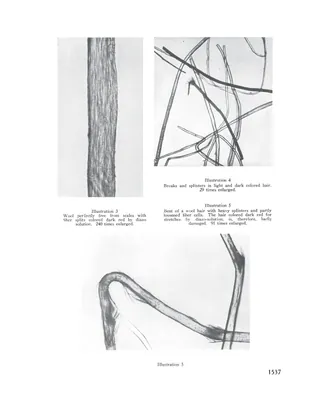
An article by J. Bartsch summarizing results from a German textile testing laboratory on how wool and cotton fibers are damaged. It describes microscopic and chemical methods, including pH measurement of acid concentration in paper-machine drying felts, and diazo and zinc-chloride-iodine staining tests. Twelve micrographs show scale damage, splits, brush ends, moth damage, and acid-parchmented and mercerized cotton fibers. It also covers acid damage to wool, hydrocellulose brittleness in cotton, and acid treatment of Swiss transparent cotton fabrics.
Genuine Persian Rug, Part 1
Article · 4 pages
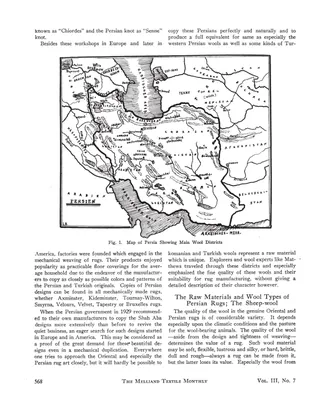
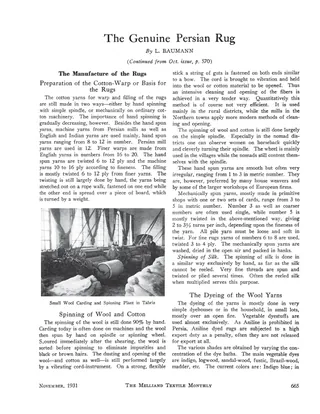
The first part of an article on genuine Persian rugs from a 1931 trade journal. It outlines the history of Oriental rug weaving, from antiquity through the Safavid period to the spread of rugs to Europe and America and their imitation in European and American workshops and power looms. It then begins a survey of the raw materials, covering sheep wool, goat hair (Kurk) and camel hair in each Persian wool district and the effects of pasture and climate on quality. It includes a map of Persian wool districts and photographs of a bridge near Mianeh and of wool-sorters in Tabriz. The article ends with "To be continued".
Genuine Persian Rug, Part 2
Article · 5 pages
Second installment of L. Baumann's series on the Persian rug, covering how the rugs are made. It describes spinning and preparing cotton, wool and silk yarns, vegetable dyeing, the knotted-pile loom and the three knot types used in Persia, shearing and washing, and the colors, motifs and symbolism of Persian rug design. Illustrated with knot diagrams and photographs of Tabriz workshops and rug designs.
Genuine Persian Rug, Part 3
Article · 5 pages
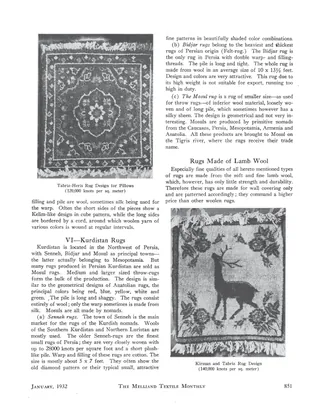
The concluding part of a three-part article from The Melliand Textile Monthly on Persian rugs. It distinguishes nomad, Persian and Turkish/Smyrna rugs, then surveys Persian rug types by region: Azerbaijan (Tabriz, Heris, Karadagh), Turkmenian, Northeast (Chorasan-Meshed), Central (Feraghan, Kashan, Isfahan, Hamadan, Sarabent, Saruk), South (Kirman, Shiras-Kashkai) and Kurdistan (Senneh, Bidjar, Mosul). For each it describes the wool, knot density per square foot, sizes, colors and designs. Illustrations include a map of Persian wool districts and two rug design photographs with knot counts.
Hartmann Differential Wool Spinning Mule
The Melliand, May 1931
Article · 1 page
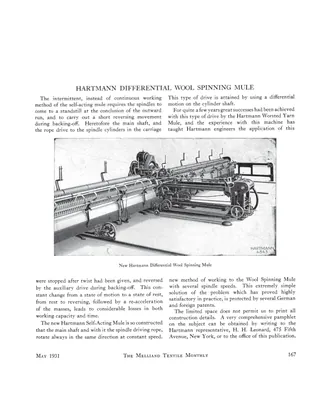
A one-page trade notice from The Melliand describing the new Hartmann Differential Wool Spinning Mule, a self-acting mule. The main shaft and spindle driving rope turn constantly in one direction at constant speed, with a differential motion on the cylinder shaft. This avoids the losses of time and capacity from stopping and reversing the spindles during backing-off. It includes a photograph of the machine, a mention of German and foreign patents, and an address for obtaining a pamphlet from the Hartmann representative in New York.
High Speed Worsted Loom
The Melliand, February 1931
Article · 2 pages
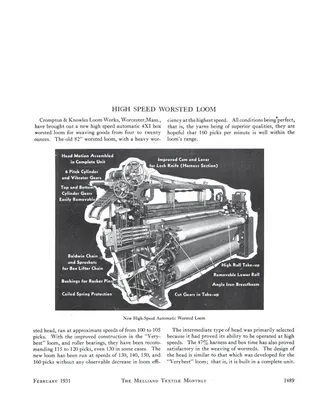
A 1931 trade-journal article describing Crompton & Knowles' new high-speed automatic 4x1 box worsted loom for fabrics of four to twenty ounces. It reports running speeds of 130 to 160 picks per minute, compared with about 100 to 105 on the older worsted loom. It details the head motion unit, gearing, bearings, shipper, take-up, lay and bunter construction. A photograph with labeled parts accompanies the text.
History of Textile Industry -- Spun Silk: Transition from a Home-Industry to Mechanical Spinning
Article · 3 pages
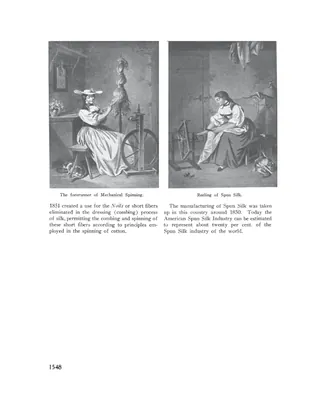
A short historical article on the spun silk industry and its shift from hand spinning to mechanical spinning. It separates reeling (filature) of raw silk from spun silk made from waste and unreelable cocoons, and traces hand combing and spinning in Italy, Switzerland and France. It then covers the adaptation of cotton and wool machinery, the first mechanical plant near Basle in 1824, the mechanical comb of 1851, and the start of American production around 1850. Illustrations show hand combing of silk and a spinning wheel scene.
History of the Sericultural Industry in China
The Melliand, February 1930
Article · 3 pages
A summary of a brief history of China's sericulture industry, originally published by the Shanghai Bureau of Inspection and Testing of Commercial Commodities. It traces silk from its legendary discovery in 2852 B.C. through its spread to Japan, Rome and the rest of Asia and Europe, then covers China's export growth after 1842 and the introduction of steam filatures from 1879. It describes sericultural schools, experimental stations, disease-free egg programs and government testing efforts in Chekiang, Kiangsu, Anhwei, Canton and Shantung, with filature statistics for 1924 and 1929, and closes with six lines of endeavor for future development.
How Rayon is Made
The Melliand, September 1931
Article · 2 pages
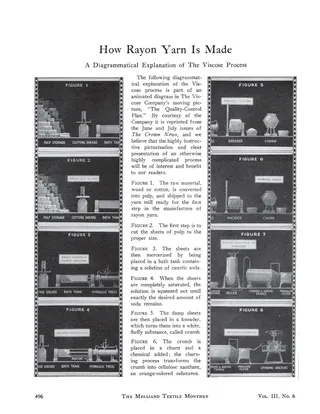
A two-page illustrated explanation of the viscose process for making rayon yarn, reprinted from The Crown News and drawn from The Viscose Company's film "The Quality-Control Plan." Sixteen numbered diagram frames with captions follow the process from wood or cotton pulp through caustic soda steeping, kneading into crumb, xanthation, ageing and filtering of the viscose solution, spinning through a spinnerette into an acid bath, then reeling, washing, bleaching, centrifugal extraction, drying, inspection and packing.
How to Distinguish Quickly Cotton from Linen
Article · 2 pages
A short technical article describing practical tests for telling cotton from linen in fabrics and yarns. It covers microscopic differences between the fibers, water absorption, feel and finish, yarn strength and untwisting, an oil transparency test, and dyeing and chemical tests such as Methylene Blue, fuchsin and ammonia, and copper oxide solution.
Identification of Fibers
Article · 4 pages
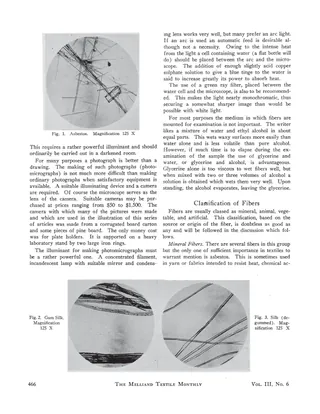
First installment of a series by H. B. Gordon on identifying textile fibers, with emphasis on microscopic appearance and supporting chemical tests. It covers microscope equipment, illumination, mounting media, and photomicrography, then begins the classification of fibers (mineral, animal, vegetable, artificial). It treats asbestos and the silks in detail: cultivated, tussah or wild, spider, and byssus silk, plus tin and organic weighting. Illustrated with nine photomicrographs and closed with references to Chamot and Matthews.
Identification of Fibers: The Hair Fibers, Part 1
Article · 3 pages
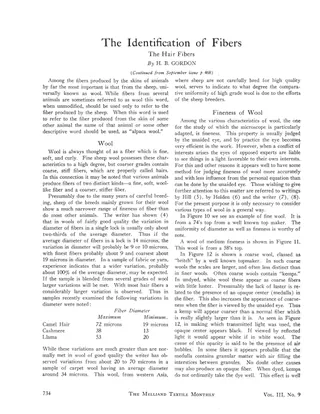
A continuation of H. B. Gordon's series on microscopic identification of textile fibers, covering the hair fibers with a focus on sheep's wool. It discusses variation in fiber diameter in wool compared with camel hair, cashmere and llama, how to judge wool fineness under the microscope, and kemps (opaque medullated fibers). It also explains the limits of identifying re-worked wool (shoddy), illustrated with 125x micrographs of fine, medium, coarse and re-worked wool. Ends with references and a note that the series continues.
Identification of Fibers: The Hair Fibers, Part 2
Article · 3 pages
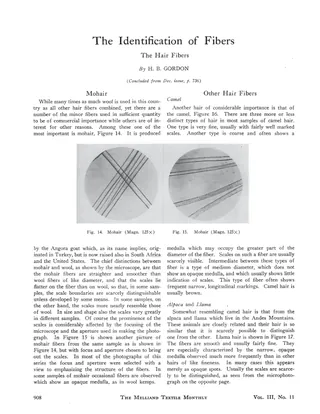
Concluding part of H. B. Gordon's series on identifying fibers by microscope, covering the minor hair fibers. It describes the microscopic appearance of mohair, camel, alpaca and llama, vicuna, cashmere, common goat, white rabbit, cow, horse and human hair, noting scale visibility, medulla and fiber fineness. Illustrated with photomicrographs (Figs. 14-25) at 100x to 125x magnification.
Immunized Cotton
Article · 3 pages
A 1929 article on Immunized Cotton, a chemically treated cotton introduced in Europe in 1924 and in the United States about 1927. It explains the chemistry of esterifying cotton cellulose with sulphonic chlorides (especially p-toluene sulphonic chloride), which makes the fiber resist direct cotton dyes while keeping an affinity for basic dyes. It describes the changes to the fiber, the dyeing and resist-printing possibilities for two-color and white effects, and uses in hosiery, dress goods, menswear and draperies.
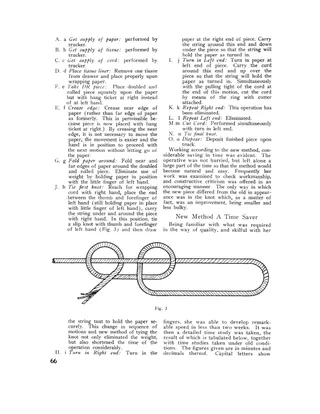
Increasing Production and Decreasing Cost in Putting Up Piece Goods: How One Finishing Plant Has Reorganized for Quality Production and Increased Quantity
Article · 10 pages
First part of a 1929 article describing how a cotton-cloth finishing plant reorganized its put-up (folding, wrapping, ticketing) department to raise output and cut cost. It covers the original congested layout and staffing, the planned reorganization into dispatcher, record clerk, inspector and supervisor roles, and motion-study work on bundling pieces of cloth. Time studies show a cut from 1.21 to 0.76 minutes per piece, along with a Gantt task-and-bonus wage plan and small devices such as a cord-cutting ring and a needle with the eye in the point. It ends with "To be continued".
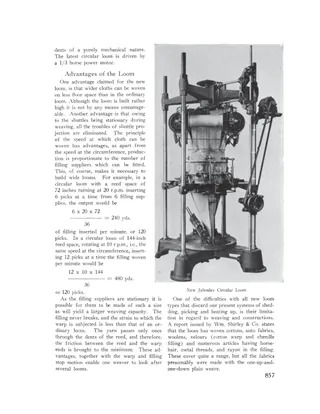
Jabouley Circular Loom
The Melliand, September 1930
Article · 3 pages
A 1930 trade-journal article describing the Jabouley circular loom, shown at the Lyons Fair. The loom forms the warp from four beams into a rotating vertical tube while stationary filling suppliers insert several picks per revolution. It covers the mechanical description, operation, automatic warp and filling stop motions, claimed advantages, and output calculations. The loom is said to have woven cottons, woolens, velours and other fabrics, presumably all in plain weave.
138 documents found