Textile Documents › Authors › Author: Werner von Bergen
9 documents found
Sort: 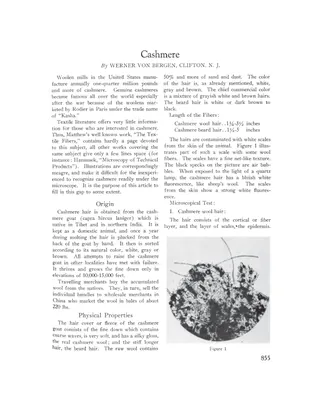
Cashmere
Article · 5 pages
A 1929 article from The Melliand on the microscopic identification of cashmere fiber. It covers the origin of the cashmere goat and how the hair is harvested and traded, then the physical properties of the fleece, including down and beard hair. The author describes scale counts, which separate cashmere from sheep's wool, along with fiber diameter measurements, cross-sections and pigment in brown hairs. Illustrated with photomicrographs, cross-section drawings and charts of scale counts and diameter variation.
Musk-Ox Wool and its Possibilities as a New Textile Fiber, Part 1
Article · 3 pages
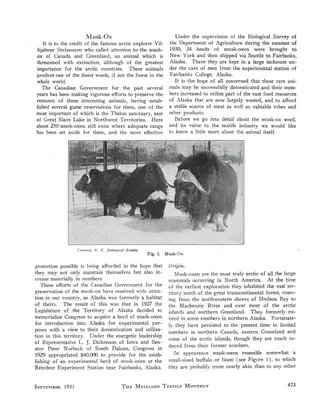
First installment of an article on musk-ox wool as a potential new textile fiber. It opens with the search for new fibers and gives production statistics for mohair and alpaca, then discusses the impracticality of breeding foreign fiber animals in the U.S. It then covers the musk-ox itself: conservation efforts in Canada, the 1930 Alaska experimental herd, the animal's range, appearance, herd behavior and population, and begins measurements of the hair coat (wool and beard hair lengths and percentages) from New York and Alaska samples.
Musk-Ox Wool and its Possibilities as a New Textile Fiber, Part 2
Article · 4 pages
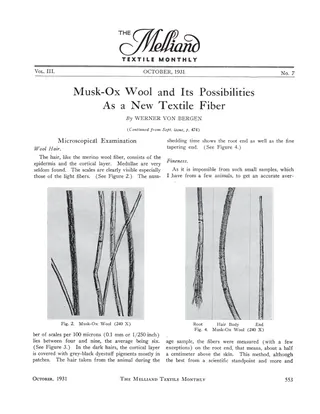
Second installment of a serial article on musk-ox wool as a possible textile fiber, covering its microscopical examination. It describes the structure, scale counts and fineness of the fine underwool and the coarse beard hairs (kemp), with micron measurements for root end and middle of the staple. It compares samples from Alaska and New York animals and against cashmere and Australian merino. Illustrated with micrographs and width-variation graphs.
Musk-Ox Wool and its Possibilities as a New Textile Fiber, Part 3
Article · 3 pages
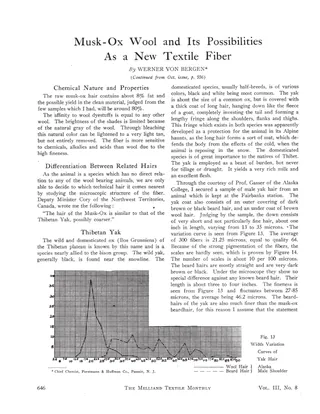
Third installment of Werner von Bergen's serial article on musk-ox wool as a possible commercial textile fiber. It covers the chemical properties of the raw hair (fat content, yield, dye affinity, sensitivity to chemicals) and compares it microscopically with yak, vicuna, cashmere and camel hair. Includes width-variation charts, 240x microphotographs, and a comparison table of color, length, fineness, scales, quality and medullation. The author concludes that musk-ox shoulder wool is closest to cashmere and may be the finest known wool hair.
Musk-Ox Wool and its Possibilities as a New Textile Fiber, Part 4
Article · 3 pages
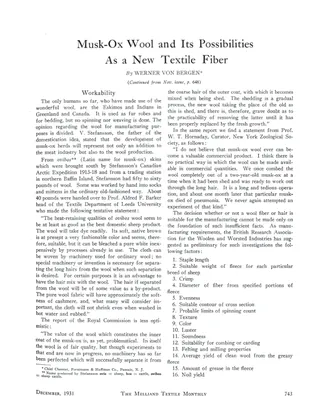
Part of a serial article by Werner von Bergen, chief chemist at Forstmann & Huffman, on the textile potential of musk-ox (ovibos) wool. It reviews opinions on workability from Stefansson, Prof. A. F. Barker of Leeds, the Royal Commission and W. T. Hornaday. It lists the criteria the British Research Association for the Woolen and Worsted Industries proposed for judging a fiber. The author argues that musk-ox wool can be separated from its coarse beard hair as cashmere is, and he describes the 1920s Leeds experiments and the unpublished Atkinson thesis. One figure shows a cashmere goat.
Musk-Ox Wool and its Possibilities as a New Textile Fiber, Part 5
Article · 3 pages
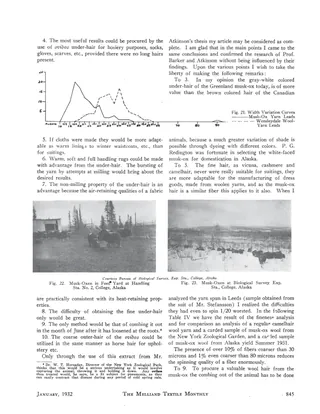
Concluding installment of Werner von Bergen's series on musk-ox wool as a textile fiber. It compares the Greenland white-faced musk-ox with Canadian musk-ox hair spun in Leeds, and summarizes F. H. D. Atkinson's 1922 Leeds thesis conclusions on handle, color, and uses such as hosiery and linings. It includes fineness tables comparing musk-ox, camel hair, and Alaska samples, a width-variation graph, photographs of domesticated musk-oxen in Alaska, remarks on combing the under-hair, and a reference list.
Ostrich Feathers as Effects for Dress Goods
Article · 2 pages
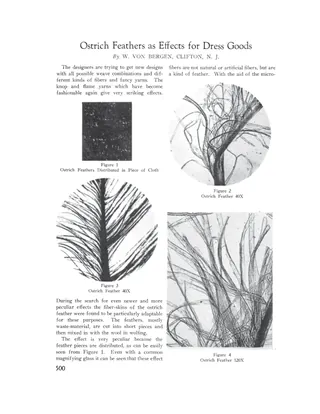
A short article describing the use of cut ostrich feather waste mixed with wool as a novelty effect in dress goods. It explains how the feather pieces appear scattered through the cloth and how to identify them under a magnifying glass or microscope. Six micrograph figures at 40X and 120X show feather barbs and their branching structure.
Root-Ends and Skin Pieces in Woolen Materials, Part 1
Article · 4 pages
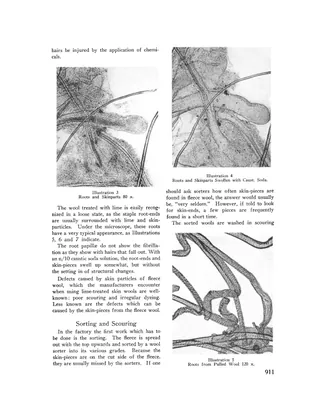
Article by W. von Bergen arguing that root-ends and skin pieces found under the microscope in woolen cloth do not prove that pulled wool is present, since they also occur in the best fleece wool. It covers three sources: shed hairs in fleece (including wool that grows off through undernourishment or illness), skin pieces cut from the sheep during shearing, and pulled or skin wool removed by lime/sodium sulphide or by the sweating method. It then describes how skin pieces behave in sorting, scouring, worsted and woolen spinning, and weaving. Seven micrograph and photograph illustrations show roots and skin parts, including the effect of caustic soda; the article is continued in a later part.
Vicuna
Article · 5 pages
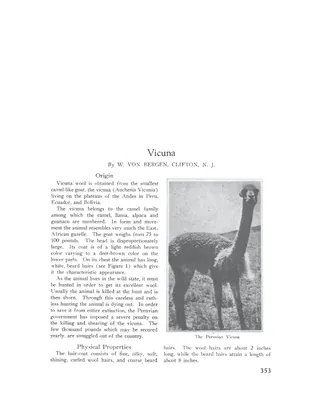
A 1930 article from The Melliand on vicuna wool, covering the animal's Andean habitat, its hunting and near extinction, and the physical properties of its wool and beard hairs. Most of the text is a microscopic study of the fibers, with fineness measurements and diameter-distribution charts that compare vicuna with camel hair and llama. It ends with a short section on the fabrics made from vicuna (blankets, velours, hats).
9 documents found