Textile Documents › Authors › Author: Franz M. Feldhaus
8 documents found
Sort: 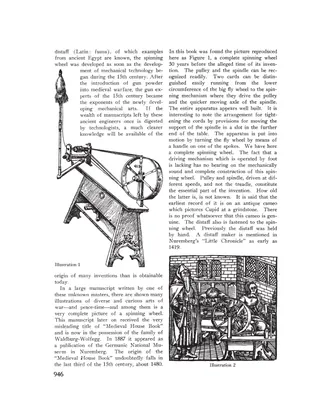
Ancient History of the Spinning Wheel
Article · 3 pages
A short historical article by F. M. Feldhaus examining the claim that a Brunswick wood carver named Juergen invented the spinning wheel in 1530. Feldhaus traces the claim to a 1722 chronicle and argues against it, citing a complete spinning wheel drawn in the c. 1480 "Medieval House Book" and drawings by Leonardo da Vinci. The article is illustrated with five woodcuts and line drawings of early spinning wheels and spinning scenes.
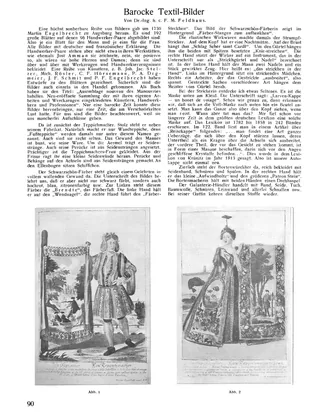
Barocke Textil-Bilder [Baroque Textile Pictures]
Article · 3 pages · German, French
A 1927 German article by F. M. Feldhaus on Baroque engravings from Martin Engelbrecht's Augsburg series of about 1730, in which craftsmen and their wives are shown dressed in the tools and products of their trades. The text discusses the tapestry maker, black-and-fine dyer, stocking knitter, passementier (braid maker) and mercer, describing the tools, materials and costume details shown. It includes a note on a travelling face mask, citing Krünitz's encyclopedia. The plates, with French and German captions, are reproduced on the following pages.
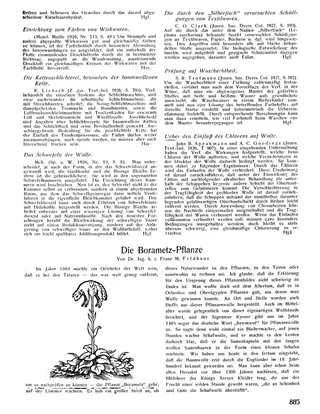
Die Borametz-Pflanze [The Borametz Plant]
Article · 1 page · German
A short German article by Franz M. Feldhaus on the legendary Borametz, the 'vegetable lamb' plant said to grow lambs, reported from Tartary in 1601. Feldhaus argues the image derives from cotton, drawn as a lamb-shaped seed capsule with white fibers, citing knowledge of plant wool since antiquity, Kyeser's 1405 word 'bawmwol', and Herodotus on Xerxes' soldiers wearing garments woven from a wild plant. The page includes an engraving of the plant and also carries the end of several unrelated textile-chemistry abstracts.
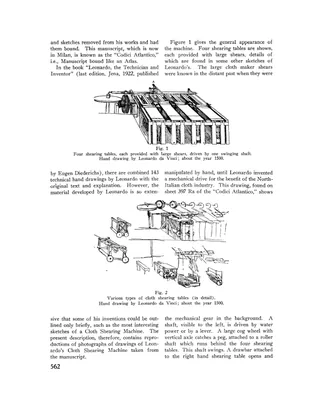
Cloth Shearing Machine of Leonardo Da Vinci
Article · 4 pages
Article by Franz M. Feldhaus describing Leonardo da Vinci's designs, from about 1500, for a mechanically driven cloth shearing machine. It opens with a short biography of Leonardo and the fate of his manuscripts, then goes through six drawings from the Codex Atlanticus. These show four shearing tables driven by a swinging shaft, tension rolls, gearing, spring and springless shear mechanisms, and Leonardo's own notes. It ends by noting that Everett of Wiltshire invented a similar machine in 1758.
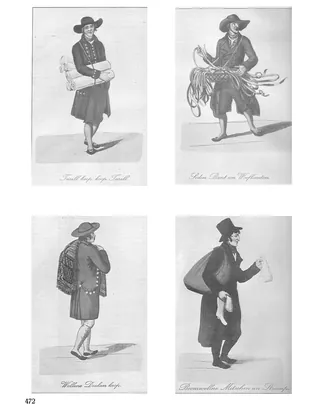
Hamburger Textil-Händler um 1808 [Hamburg Textile Vendors around 1808]
Article · 2 pages · German
A short German-language piece by F. M. Feldhaus on Christoff Suhr's colored pictures of Hamburg street vendors, published as "Der Ausruf in Hamburg" (1808), with commentary by Pastor Hübbe. It focuses on the textile hawkers: a vendor of ticking (Drell) linen, a poor Jewish ribbon seller, a South German seller of woolen blankets, and a seller of cotton caps and stockings. Page 2 reproduces four engraved vendor illustrations with their Low German cries. The first page also carries an unrelated notice of new dye sample cards from I. G. Farbenindustrie.
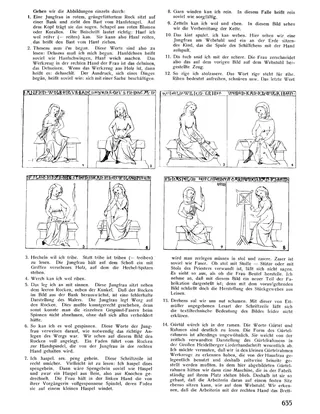
Die Konstanzer Textil-Bilder [The Konstanz Textile Pictures]
Article · 3 pages · German
Article by Franz M. Feldhaus on the Konstanz textile wall paintings, made around 1300 in a burgher's house in Konstanz and showing women at textile work. He reproduces the pictures and their inscription bands from an 1866 publication and explains each of the roughly 18 scenes. The scenes cover hemp processing, hackling, tow spinning with distaff and spindle, reeling, warping, linen weaving at a loom with a child winding the bobbin, cutting cloth, belt weaving on a frame, and silk preparation. Feldhaus discusses the Middle High German wording of the inscriptions and the tools shown, and asks textile specialists for comments.
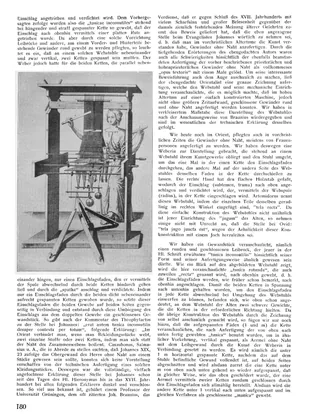
Das Weben antiker nahtloser Gewänder [The Weaving of Ancient Seamless Garments]
Article · 2 pages · German
A 1927 article by Franz M. Feldhaus on how seamless garments such as the biblical tunica inconsutilis were woven in antiquity. Drawing on Franz Bock, Jerome, Josephus, Herodotus, Theophylactus and Johannes Braunius, it explains that a standing weaver worked two warps side by side on a vertical warp-weighted loom, passing a single weft alternately through both and beating it upward with a flat wooden stick (spatha), so that the two cloths joined at the edges into a closed tubular garment. A woodcut-style illustration of the loom and a female weaver accompanies the text, and the sleeves are described as woven the same way.
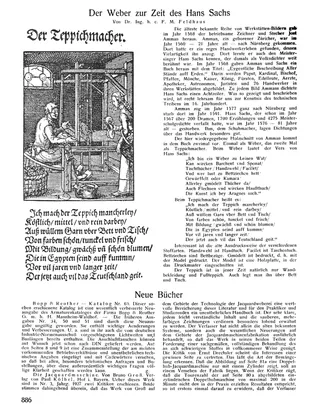
Der Weber zur Zeit des Hans Sachs [The Weaver in the Time of Hans Sachs]
Article · 1 page · German
Short German-language article by F. M. Feldhaus on the weaver and the tapestry maker (Teppichmacher) in the age of Hans Sachs. It centers on a woodcut by Jost Amman from the 1568 book of trades, 'Eygentliche Beschreibung Aller Stände auff Erden', and quotes Hans Sachs's verses for the weaver and the tapestry maker. It explains archaic textile terms such as Handzwehl, Facilet, Bettziechen and gmödelt, and notes that carpets then served as wall hangings, floor coverings and bed and table covers.
8 documents found