Das Weben antiker nahtloser Gewänder [The Weaving of Ancient Seamless Garments]
Sample pages
Page 2, at reduced quality. Open the document to read every page in full.
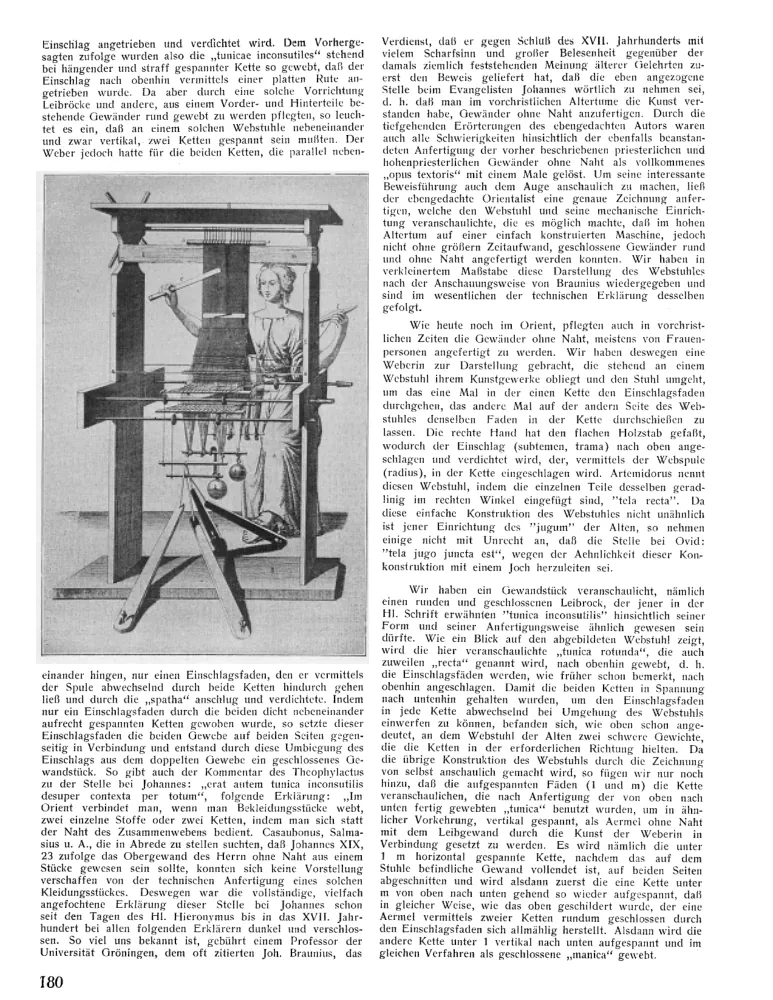
A 1927 article by Franz M. Feldhaus on how seamless garments such as the biblical tunica inconsutilis were woven in antiquity. Drawing on Franz Bock, Jerome, Josephus, Herodotus, Theophylactus and Johannes Braunius, it explains that a standing weaver worked two warps side by side on a vertical warp-weighted loom, passing a single weft alternately through both and beating it upward with a flat wooden stick (spatha), so that the two cloths joined at the edges into a closed tubular garment. A woodcut-style illustration of the loom and a female weaver accompanies the text, and the sleeves are described as woven the same way.
- Type
- Article
- Date
- 1927
- Language
- German
- Pages
- 2
(A free account is all you need)
From Ralph Griswold's Digital Archive, delivered by the University of Arizona.
Have missing pages or a better copy of this document, or another document to share? Contributing documents »