Textile Documents › Topic: Double weave and multiple cloth
414 documents found
Sort: 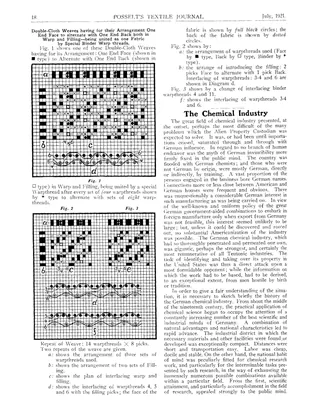
Double-Cloth Weaves having for their Arrangement One End Face to Alternate with One End Back both in Warp and Filling
Article · 1 page · weaving drafts
A single page from Posselt's Textile Journal (July 1921) explaining double-cloth weaves in which one face end alternates with one back end in both warp and filling, with the two cloths joined by special binder warp threads after every set of four warp threads. Figures 1-3 give weaving drafts with warp arrangement, filling order (2 face picks to 1 back pick), interlacing plans, and a variant changing the binder interlacing. The weave repeats on 14 warp threads and 8 picks. The page also carries the start of an unrelated article on the chemical industry and the Alien Property Custodian.
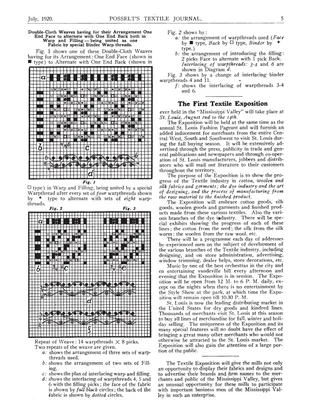
Double-Cloth Weaves Having for their Arrangement One End Face to Alternate with One End Black both in Warp and Filling - being united as one Fabric by Special Binder Warp Threads
Article · 1 page · weaving drafts
A one-page article from Posselt's Textile Journal (July 1920) explaining double-cloth weaves in which one face end alternates with one back end in both warp and filling, with the two cloths joined by special binder warp threads. Three figures give drafts with symbols for face, back and binder threads, plus interlacing diagrams; the repeat is 14 warp threads by 8 picks. The page also carries a short news item announcing the first Textile Exposition in the Mississippi Valley, to be held in St. Louis in August.
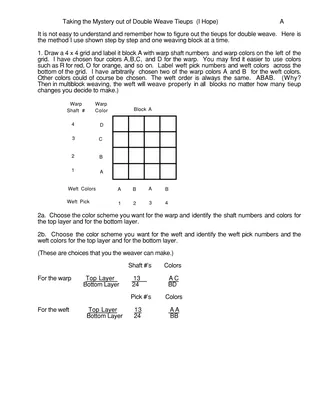
Double Weave Workshop Notes: Taking the Mystery Out of Double Weave Tie-Ups
Web Doc · 8 pages · weaving drafts
A step-by-step workshop handout explaining how to work out tie-ups for double weave, one weaving block at a time. It uses a 4x4 grid method relating warp shafts and colors to weft picks and colors, marking top-layer (T) and bottom-layer (B) intersections and adding dots for raised top-layer shafts. The method is worked for Block A (shafts 1-4) and Block B (shafts 5-8), then combined into 8-shaft tie-ups for a background and a window design. Closing pages cover color notation and the possible warp color pairs for two-color and four-color threadings.
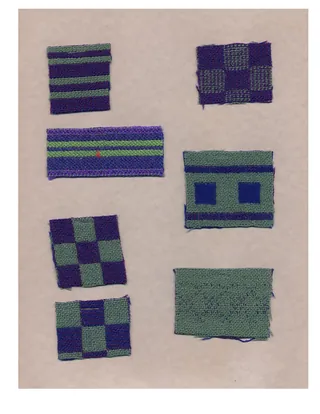
The Double Weave: Plain and Patterned Portfolio
Other · 4 pages
Portfolio supplement to Harriet Tidball's Shuttle Craft Monograph One, The Double Weave: Plain and Patterned (1960). It consists of a cover page, two pages of photographed woven swatches pinned to mounting sheets, and a text page describing each sample, including yarns, sett and tie-ups. The sample notes cover a polychrome sampler, a Pringle of Inverness wool blanket sample, and seven worsted study swatches (two-block double weave, 1/3 twill variations, fringe and quilting). The last page also gives Shuttle Craft Guild subscription plans, prices and ordering addresses.
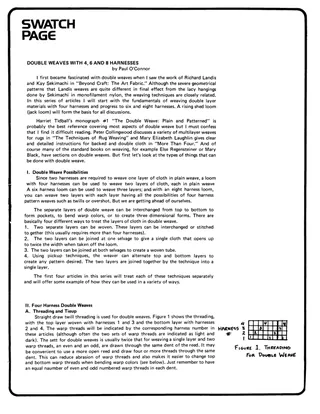
Double Weaves with 4,6 and 8 Harnesses
Article · 2 pages · weaving drafts
The first article in a series by Paul O'Connor introducing double weave on a rising-shed (jack) loom, beginning with four harnesses and leading toward six and eight. It outlines four ways of treating the two layers (separate layers, joined at one selvage, tubes, and pickup), then covers straight-draw threading, sett, tieups and treadling for two separate layers. It closes with interchanging layers for a checkerboard effect and a skeleton tieup for a four-harness loom with six treadles. Figures show the threading, a layer cross section, and tieup diagrams.
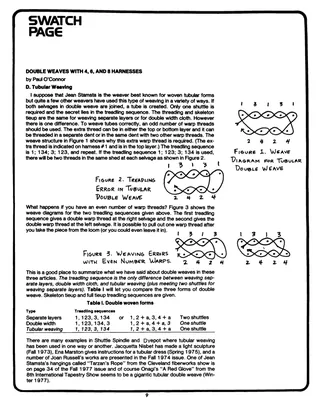
Double Weaves with 4,6 and 8 Harnesses
Article · 2 pages
Section D (Tubular Weaving) of a series on double weaves by Paul O'Connor. It explains how joining both selvages of a double weave makes a tube, why an odd number of warp threads is needed, and which treadling sequences work (1; 134; 3; 123). A table compares treadling for separate layers, double width cloth and tubular weaving. It also gives instructions for pillow covers, small purses or glasses cases, pockets stuffed on the loom, and caps or dolls, and cites examples from Shuttle Spindle and Dyepot.
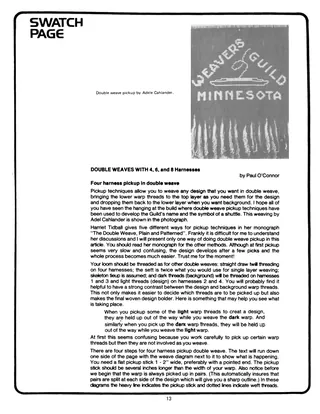
Double Weaves with 4,6 and 8 Harnesses
Article · 2 pages · weaving drafts
An installment in a series by Paul O'Connor on double weave, covering four-harness pickup double weave. It explains threading as a straight draw twill with dark warp on harnesses 1 and 3 and light warp on 2 and 4, the use of a pickup stick, and a four-step weaving procedure, with diagrams of stick positions and weft shots. It also gives a variation alternating light and dark shots, a two-stick option, and advice on charting designs in pairs of warp threads. It mentions that later articles will cover 6- and 8-harness double weaves.
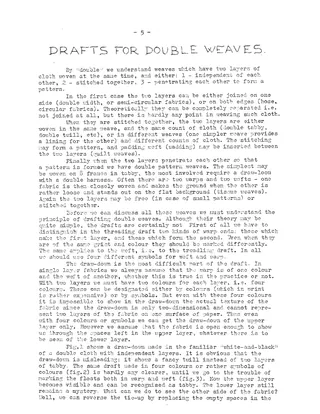
Drafts for Double Weaves
Master Weaver, October 1952
Article · 5 pages · weaving drafts
An introductory article on how to draft double weaves, in which two layers of cloth are woven at once. It explains independent, stitched and pattern-penetrating layers, and why four symbols are needed for warp and weft in threading, treadling and draw-downs. Worked examples cover double tabby and double twill on 4 to 6 frames, treadling for double-width and circular fabrics, and ways to stitch the layers together using tie-up changes, a stitching treadle or an extra heddle frame. Figures 1-19 show the tie-ups, threadings and draw-downs.
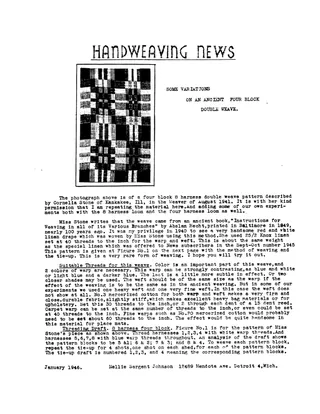
Handweaving News (January 1946): Some Variations on an Ancient Four Block Double Weave
Periodical · 3 pages · weaving drafts
A January 1946 Handweaving News article by Nellie Sargent Johnson on a four-block, eight-harness double weave. It repeats Cornelia Stone's pattern from The Weaver (August 1941), which she traced to Absalom Hecht's 1849 Baltimore weaving instruction book. It gives threading drafts, tie-ups, warp and weft suggestions, and sett information for linen, mercerized cotton and carpet warp, plus four-harness adaptations. The last page lists four weft experiments by Beatrice Carrothers, including rug filler, raffia and heavy doubled weft variations.
Loom for Cylindrical Cloth
Scientific American, 1847
Article · 1 page
A short 1847 news item from Scientific American describing a loom invented by Henry Pease of Clarkson, N.Y., for weaving seamless cylindrical cloth suited to meal bags. Two sets of warps are arranged so the shuttle passes between the halves of the upper warp and returns between the halves of the lower warp, joining the two webs at both edges to form a continuous tube. The note gives no technical drawings or drafts.
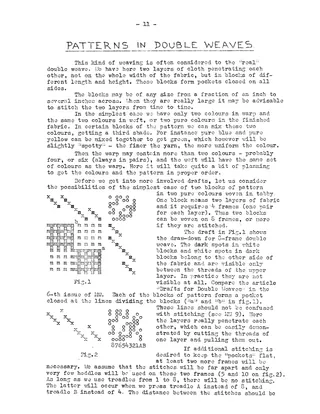
Patterns in Double Weaves
Master Weaver, July 1953
Article · 2 pages · weaving drafts
A two-page article from Master Weaver No. 10 on pocket-type double weaves, where two cloth layers interpenetrate in blocks to form closed pockets. It explains the 8-frame, two-block draft in tabby, adding stitching frames to keep large pockets flat, and several warp and weft colour-exchange schemes that give mixed or gray effects. Five figures show drawdowns and colour-pattern diagrams. A short note on weaving terminology follows, recommending "locked weft" over "clasped wefts".
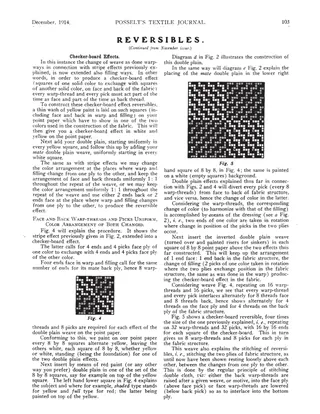
Reversibles
Article · 2 pages · weaving drafts
Continuation of Posselt's series on reversible double-plain fabrics, covering checker-board effects in which every warp thread and pick serves alternately as face and back. It explains how to build the weaves on point paper by painting squares and adding a double plain and its mate. It describes two color/ply arrangements (Figs. 4 and 5, then Fig. 6 with a 24 by 24 repeat) and how the two plies are stitched together. The pages also carry short unrelated items on an embossed fabric patent, spinning mill management and waterproofing fabrics.
Discussion on Double Weave
Monograph · 4 pages · weaving drafts
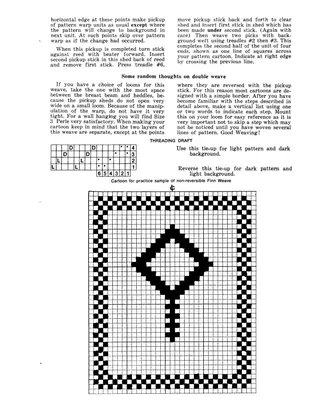
A short instructional booklet by Colonel John S. Fishback, Lily Mills' weaving consultant, based on notes for a Venice Weavers Guild workshop. It briefly surveys what double weave can mean on a four-harness loom (double thickness, double width, tubular cloth), then gives step-by-step directions for the non-reversible Finn Weave pickup technique on a 196-end practice warp. It includes a threading draft, tie-up, and a cartoon for a practice sample, plus closing tips on loom choice, warp tension, and cartoon design.
Double Weave Workshop Notes: Basket Weaves in Double Weave
Web Doc · 6 pages · weaving drafts
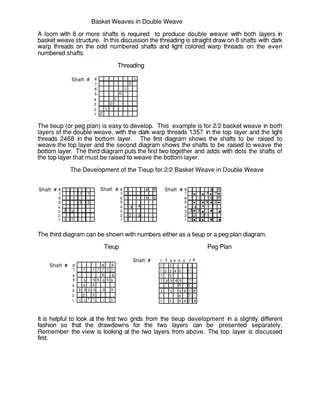
Workshop notes explaining how to weave double weave with both layers in 2/2 basket weave on an 8-shaft loom, using a straight draw threading with alternating dark and light warps. They show how the tieup or peg plan is developed, how the top and bottom layers are separated and drawn down, and how color-and-weave variations arise from different treadling orders and six peg plans. A final section extends the idea to a window (frame) design on 12 shafts, with plain weave and basket weave options, and shows other threadings including one suited to 3/3 basket weave.
Double Weave Workshop Notes: Twill Weaves in Double Weave
Web Doc · 7 pages · weaving drafts
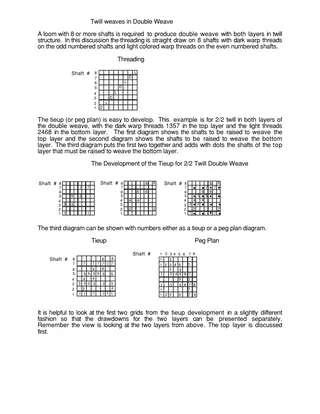
Workshop notes explaining how to develop twill structures in both layers of double weave on 8 or more shafts. They cover the straight-draw threading with dark and light warps, the tieup and peg plan for 2/2 twill, and how the bottom layer is drawn when viewed from below. Further examples change the treadling order or peg plan (including 3/1 and 1/3 twill) to produce color-and-weave effects, and the notes end with a 12-shaft window design with plain weave or twill backgrounds and borders.
Double Weaves with 4,6 and 8 Harnesses
Article · 3 pages · weaving drafts
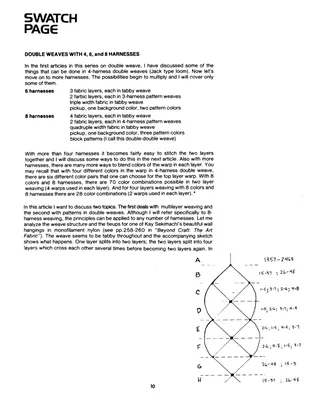
An installment in Paul O'Connor's series on double weave, extending from 4 harnesses to 6 and 8. It lists what 6- and 8-harness double weaves can do (multiple tabby layers, pattern layers, pickup, block patterns) and counts the possible warp color combinations. It analyzes the layer structure and tieups of a Kay Sekimachi monofilament wall hanging woven as four crossing layers. It then covers pattern weaves in double-width cloth, including the reversal of the lower layer's pattern and a corrected treadle sequence for the twill join at the closed selvage.
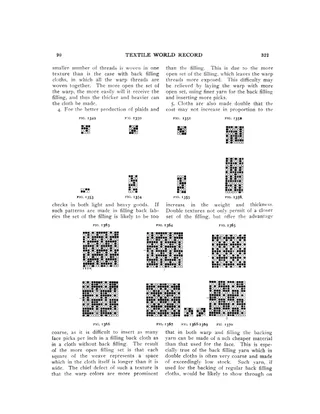
Handbook of Weaves
Article · 5 pages · weaving drafts
One installment of G. H. Oelsner's serial 'A Hand Book of Weaves', translated and revised by Samuel S. Dale, on double cloths. It lists the uses of double cloth, gives common face/back weave combinations and set ratios, and explains how double-cloth weaves are drafted. It covers tubular fabrics (lamp wicking, fire hose, seamless bags, circular felts) and the principles of stitching face and back together. The figures are drawdown grids numbered Figs. 1349-1370.
Network Drafting for Double Weave
Paul R. O'Connor · c. 1996-2000
Web Doc · 86 pages · weaving drafts
A web-published monograph by Paul O'Connor on applying Alice Schlein's network drafting principles to double weave. It moves from a single-layer network drafting background through networked double weave designs (window and checkerboard) using tieups and peg plans on 8, 12 and 16 shafts, to designs built on blocks. It also covers integrated double weave, in which all threads lie in a single cloth layer, and symmetry rules such as extra threads at turning points. Appendices hold catalogs of 4x4 peg plans with their drawdowns (0 to 8 additional pegs) and a discussion of turning points in double weave.
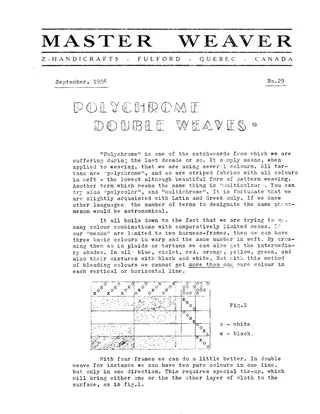
Polychrome Double Weaves
Master Weaver, September 1956
Article · 6 pages · weaving drafts
An article from the Master Weaver (Fulford, Quebec) explaining polychrome double weave on eight shafts, where colour blocks are independent of the structural double-weave layers. It presents a key table of eight threading blocks and eight treadling units in black, white and grey, then gives threading and treadling sequences for six sample patterns (Figs. 4-9) and explains how to extend the method to more colours. It closes with a practical project for place mats in 8/2 cotton, with a threading draft, a 32-sample colour sampler scheme and a suggested treadling.
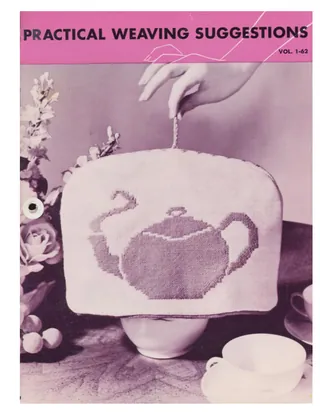
Practical Weaving Suggestions, Vol. 1-62 (1962): Double Woven Cloth
Periodical · 8 pages
A short instructional leaflet by Elsie H. Gubser on weaving double woven cloth on a four-harness loom, issued by Lily Mills. It covers the equipment (pick-up stick, shed stick, round stick), the Finnweave and Mexican methods of picking up patterns, and treadling for jack and counterbalanced looms. It also gives tie-ups for double width cloth and tubing, and a list of general tips on yarn, sett, beating and closing edges. Photographs show a reversible wall hanging, handbag and pillow covers.
Practical Weaving Suggestions, Vol. XVIII: Imprisoned Sequins
Periodical · 4 pages
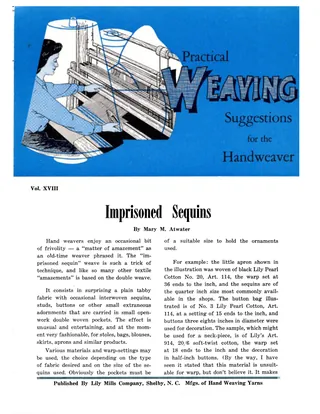
A short article by Mary Meigs Atwater describing the "imprisoned sequin" technique, in which sequins, buttons, shells or rhinestones are enclosed in small open double-woven pockets within a plain tabby fabric. It gives yarn and sett examples (Lily Pearl Cotton and 20/6 filler), and treadling instructions for four-harness rising and sinking shed set-ups and for eight-harness threadings with several tie-ups, including pick-up stick use. It also covers shirring with cords, care and pressing of sequined pieces, and a supplier for sequins. The leaflet was published by Lily Mills and includes a page advertising Lily hand weaving yarns.
Reversibles
Article · 2 pages · weaving drafts
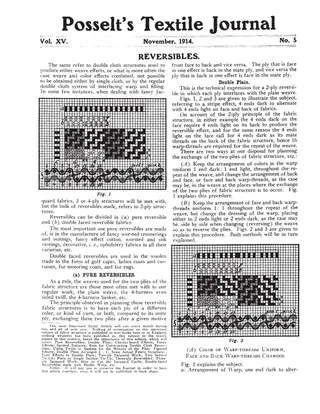
Opening installment of a serial article on reversible double cloth structures from Posselt's Textile Journal. It defines pure and double-faced reversibles and their uses in trouserings, vestings, upholstery, coats and rugs. It then explains the 'double plain' 2-ply reversible with 4 dark and 4 light end stripes, using point-paper drawdowns (Figs. 1-3) and two methods of exchanging the plies: changing face/back thread placement, or changing the color dressing of the warp. Also includes a preview of topics for the series.
Reversibles
Article · 2 pages · weaving drafts
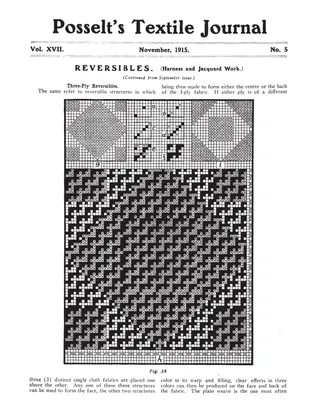
A continuation of E. A. Posselt's series on reversible fabrics for harness and Jacquard weaving, covering three-ply reversibles, in which three single-ply plain-weave cloths are stacked and interlaced. It gives a seven-step rule for constructing the 3-ply weave on point paper, explains how the warp and filling threads can be transposed to change which ply is face, centre or back, and describes how to build a weave plan from a three-color design. Fig. 38 shows the diagrams a through i.
Two Warp Weaves 3
Master Weaver, March 1961
Article · 2 pages · weaving drafts
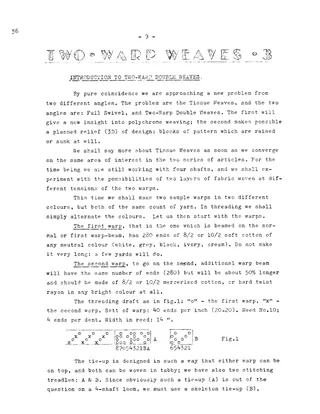
Third installment of a series on two-warp weaves from Master Weaver, introducing two-warp double weaves on four shafts with a second warp beam. It gives warp specifications (280 ends each of 8/2 or 10/2 cotton, sett 40 epi), a threading draft with a full tie-up and a skeleton tie-up, and treadling experiments. The experiments vary the tension of the two warps to produce ribbed, double-weft, loose-layer and pleated effects, as a step toward relief patterns and tissue weaves.
Double Warp Effects
Article · 1 page · weaving drafts
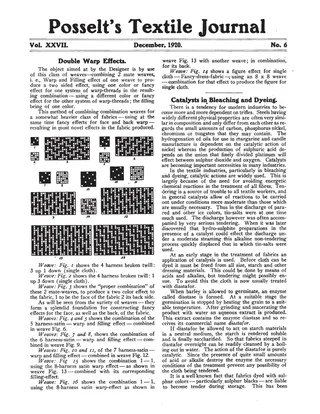
A one-page article from Posselt's Textile Journal on double warp effects, in which two mate weaves (warp-effect and filling-effect) are combined so the cloth has a different color or fancy effect on face and back warp, with a single color of filling. Sixteen drawdown figures show broken twills and 5-, 6-, 7- and 8-harness satins and their combinations, plus a figure effect for single cloth. The page also begins a separate short article on catalysts in bleaching and dyeing, covering diastafor desizing and tendering.
Double Weave Workshop Notes: Double Weave with a Four-Shaft Loom
Web Doc · 17 pages · weaving drafts
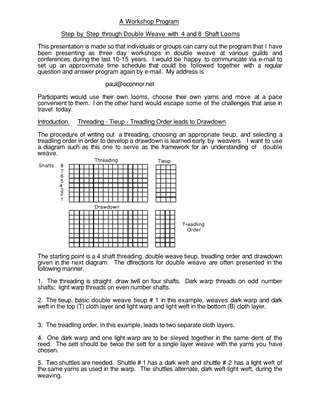
A self-guided workshop program by Paul O'Connor that leads weavers step by step through double weave on a four-shaft loom, adapted from his multi-day guild and conference workshops. It explains how the drawdown and tieup of double weave arise from the weave structure (top and bottom layers, raising the top-layer shafts to weave the bottom layer). It then varies treadling order, tieup (shorthand such as 13/24 and 24/13, and the six tieups of each group), threading, and warp and weft yarn sizes. It closes with practical loom tips and exercises covering two layers, double width, tubular weave, and color effects.
Double Weave; A Retrospective
Paul R. O'Connor · 2006
Book · 128 pages
Illustrated catalog of a retrospective exhibit of double weave work by Paul R. O'Connor, prepared for the Complex Weavers Seminars at Hope College in July 2006. Each piece is shown in front and back photographs with a short note on its design idea and technique, covering 1973 to 2005. Works include window and checkerboard designs in sewing thread, sculptural and interchanged-layer pieces, triple weave, pickup and supplementary warp and weft work, and many bead weavings. The foreword and introduction credit the influence of Richard Landis, Kay Sekimachi and Yaakov Agam.
Double Weaves - Multi-Block Patterns
Master Weaver, September 1953
Article · 4 pages · weaving drafts
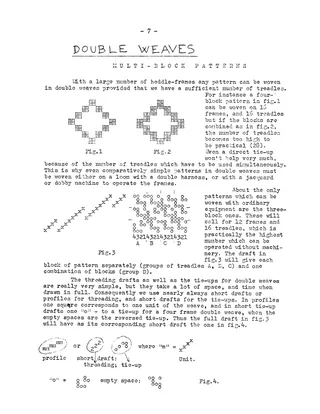
An article from Master Weaver on designing multi-block double weave patterns. It explains the frame and treadle limits (three blocks on 12 frames and 16 treadles), the use of profiles and short drafts, and how to work out warp ends per profile square. It also covers double weaves with twill layers (1:2, 2:1, 2:2) and combinations of tabby with twill or basket in different blocks, illustrated by threading and tie-up drafts on every page.
Double Weaves - Stitched Layers
Master Weaver, May 1953
Article · 3 pages · weaving drafts
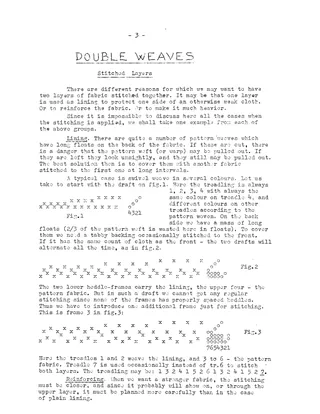
A short article from Master Weaver on stitching together the two layers of double weaves. It covers three uses: lining to cover long floats on the back of pattern weaves such as swivel weave, reinforcing an open basket weave with a tabby ground, and quilt weaves with wadding between the layers. Drafts (Figs. 1-10) and treadling sequences accompany each example. It ends with a practical project for a heavy couch cover, giving yarns, setts, quantities and reed advice.
Double Weaves with 4, 6 and 8 Harnesses
Article · 2 pages · weaving drafts
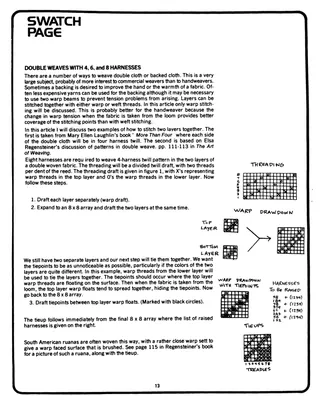
An article from the Minnesota Weaver's Swatch Page on weaving double cloth with warp stitching on 4, 6 and 8 harnesses. It first walks through a divided four-harness twill double cloth on eight harnesses, after Mary Ellen Laughlin's 'More Than Four', drafting each layer, combining them in an 8 x 8 array, and placing tiepoints under top-layer warp floats. It then covers Elsa Regensteiner's pattern-harness approach from The Art of Weaving, with tabby tieups and added tiepoint treadles for a quilted effect, illustrated with a purple and pink tunic. Drafts, tieups and drawdowns are included.
Double Weaves with 4,6 and 8 Harnesses
Article · 2 pages · weaving drafts
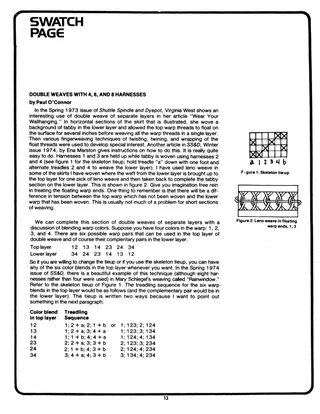
A two-page article from Paul O'Connor's series on double weave, covering double weave of separate layers on four harnesses using a skeleton tie-up. It explains leaving top warp threads floating over a tabby lower layer, using leno, and blending four warp colors in the top and lower layers with treadling sequences for each pair, and how to avoid float errors when changing blends. The second half covers double width weaving, slit placement at the selvage or center, treadling and selvage cross checks, and a ruana project combining double width and separate layers.
Double Weaves with 4,6 and 8 Harnesses
Article · 3 pages · weaving drafts
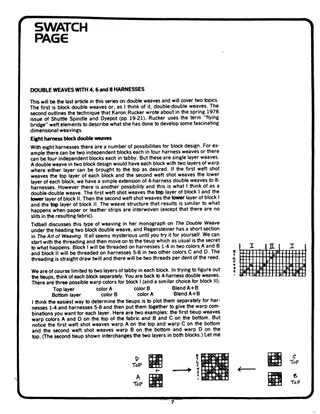
Final article in Paul O'Connor's series on double weaves in the Minnesota Weaver. It explains eight-harness two-block double weaves ("double-double weaves"), covering threading in two colors per block, tieups, color-and-layer planning, and the number of color patterns a single warp can give. It then outlines Karon Rucker's "flying bridge" technique, in which weft floats between layers so the cloth can be folded off the loom into dimensional forms. Includes small drafts, diagrams, photographs of the author's work, and a bibliography.
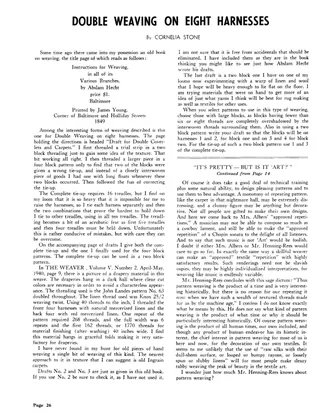
Double Weaving on Eight Harnesses
Article · 2 pages · weaving drafts
Cornelia Stone describes double weaving on eight harnesses, based on directions in an 1849 Baltimore instruction book by Abslam Hecht headed "Draft for Double Coverlets and Carpets." She explains her trial threadings, the 16-treadle complete tie-up and her reduced ten-treadle version, and gives details of a drapery fabric in John Landes pattern No. 63 doubled, woven in natural and red linen. The second page carries the drafts, including complete and short tie-ups and the Hecht drafts. The scan also includes the end of a rebuttal piece, "It's Pretty—But Is It 'Art?'"
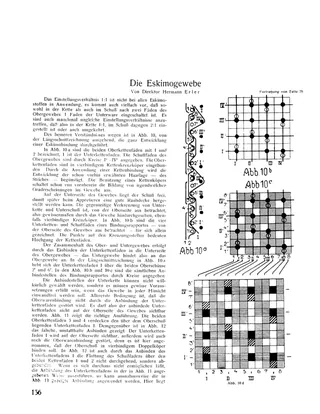
Die Eskimogewebe [The Eskimo Fabrics]
Article · 2 pages · German · weaving drafts
A two-page installment of Hermann Erler's article on Eskimo cloth, a double-cloth fabric with a twill-bound upper face and a napped underside. It explains how the upper warp, the lower warp and the weft are set in ratios such as 1:1 or 2:1, and how a 4-shaft warp-faced cross twill is developed from a longitudinal section drawing. It also covers where the lower warp may be tied into the upper cloth without disturbing the face weave, with correct and incorrect binding diagrams (Abb. 10-13).
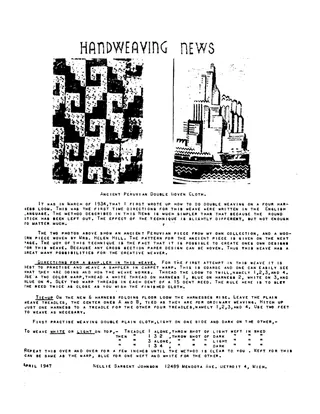
Handweaving News (April 1947): Ancient Peruvian Double Woven Cloth
Periodical · 2 pages · weaving drafts
A two-page April 1947 issue of Handweaving News by Nellie Sargent Johnson on weaving double cloth in the manner of ancient Peruvian pieces, using a four-harness twill threading. It gives directions for a carpet-warp sampler with a two-color warp, treadling for double plain cloth, and a pickup-stick method for weaving a pattern from cross-section paper designs. Page 2 has pattern grids (Figures 1-3) and a side-view diagram of the shed with pickup stick (Figure 4). Photos show an ancient Peruvian piece from the author's collection and a modern piece woven by Mrs. Helen Hill.
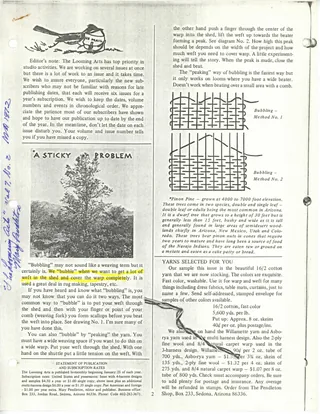
Looming Arts, Vol. 7, No. 2 (March-April 1972)
Looming Arts, March-April 1972
Periodical · 4 pages · weaving drafts
Partial photocopy of a 1972 issue of Looming Arts, published by Mary Pendleton in Sedona, Arizona. It includes a note on two ways of 'bubbling' weft, a three-harness weft-faced fabric from a Mary Atwater sample with counterbalanced and jack tie-ups and treadling directions in three colors, and the first of five articles explaining double weaving on four shafts with tie-up diagrams. It also gives seven two-color treadling variations for the three-harness weave, yarn prices and subscription information.
Minnesota Weaver, Vol. 4, No. 8 (May 1979)
Minnesota Weaver, May 1979
Periodical · 14 pages · weaving drafts
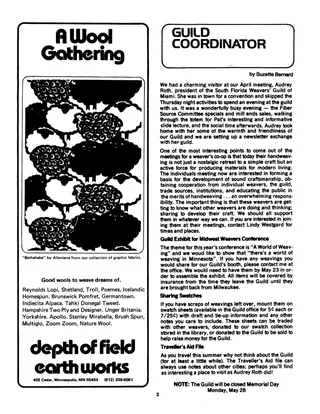
May 1979 issue of the Weavers Guild of Minnesota's monthly newsletter. It announces the May annual meetings, workshops and a guest artist visit (Victoria Rabinowe on double weave), and carries board meeting summaries, library and school news, group orders, and a bulletin board. Technical features include the final article in a series on double weaves for 4, 6 and 8 harnesses (block "double-double" weaves and Karon Rucker's flying bridge technique, with drafts), a column on spindle spinning, a spinning-wheel bobbin tip, a frame-loom jacket made from five rectangles, and a call for woven yarn garlands for a Christmas tree.
Reference Guide for Double Weave
Web Doc · 44 pages · weaving drafts
A short reference manual on loom-controlled double weave for 4 and 8 shaft looms, written by Paul O'Connor for workshop students and others needing a quick refresher. It covers weave structures (double width, tubular, two separate layers), the six 4-shaft tieups, a step-by-step method for deriving tieups and peg plans with T/B notation, and how to separate drawdowns for the top and bottom layers. Later sections treat color-and-weave effects with DLDL and DDLL color orders, 8-shaft units and blocks, profile drafts, windows and checkerboard designs, multi-color warps, and Kathryn Wertenberger's methods for drafting double-width cloth.
Reversibles
Article · 2 pages · weaving drafts
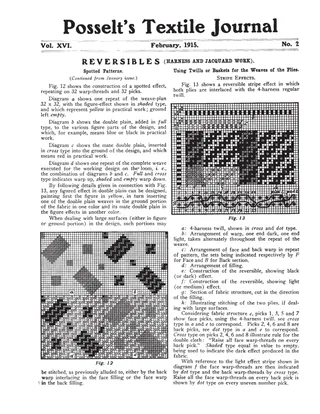
Two pages from the February 1915 issue of Posselt's Textile Journal (Vol. XVI, No. 2), continuing a series on reversible double-plain fabrics for harness and jacquard work. This installment covers spotted patterns and stripe effects with twill or basket plies (Figs. 12-13), then checkerboard effects using broken twill and twill-and-basket combinations (Figs. 14-17), with color arrangements and repeat sizes. Page 2 also begins a section of a separate series on ribbon and trimming manufacture, discussing entering threads for fancy ribbon edges.
Reversibles
Article · 2 pages · weaving drafts
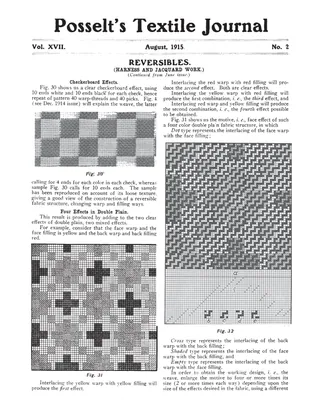
Two pages from Posselt's Textile Journal, August 1915, continuing a series on reversible fabrics for harness and Jacquard work. It explains checkerboard effects and four-color double plain, showing how to build the weave from a motive by enlarging it and inserting the four double plain positions, with a 24-harness draft. The pages also include a continuation of a fabric analysis series on finding warp and filling texture by counting threads per inch, and a short item on a patented waterproofing method for fabrics.
Ribbons, Trimmings, Edgings, Etc.
Article · 1 page · weaving drafts
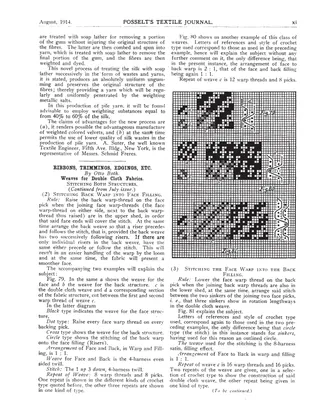
A one-page installment of Otto Both's series on ribbons, trimmings and edgings in Posselt's Textile Journal, continuing the section on weaves for double cloth fabrics. It explains rules for stitching the back warp into the face filling and the face warp into the back filling, with worked examples (Figs. 79-81) using 4-harness twill and 8-harness satin. The diagrams use different symbol types to show face weave, back weave and stitching points. The page begins with the end of an unrelated item on weighting and ungumming silk waste for velvet pile yarn.
Seamless Afghans and Bags
Article · 4 pages · weaving drafts
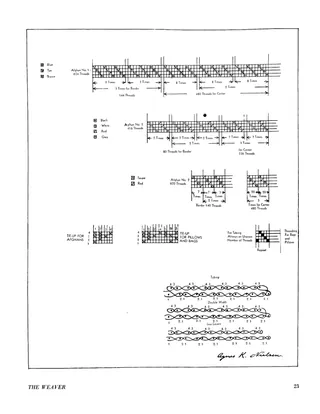
Article by Agnes K. Neilson on weaving double-width cloth and seamless tubing on a four-harness twill threading, with extra notes on eight- and six-harness variations. It gives sleying, treadling and tie-up directions for two pillows, a saddlebag, a zipper bag and a knitting bag. It also covers three checkered afghans (one in log-cabin style), with color sequences, thread counts, sett and finished sizes. Alternate treadling for Structo-Looms is included.
Shuttle-Craft Bulletin (December 1960)
Periodical · 4 pages · weaving drafts
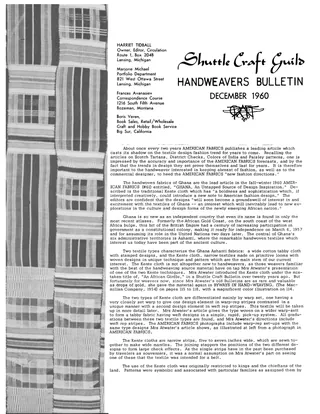
December 1960 issue of the Shuttle Craft Guild Handweavers Bulletin, edited by Harriet Tidball. The lead article discusses Ghanaian Kente cloth as a design trend reported in American Fabrics, and proposes adapting it in double weave. It gives instructions for two Christmas party strips (festremsa): a silk four-harness double weave with warping hints, and a quick pearl cotton version. The issue also has book and periodical news, a list of Shuttle Craft Guild publications, correspondence course news, and guild business such as binders, renewals and a Peru trip.
Studies in Peruvian Textiles: Double-Cloth Weaves
Article · 4 pages
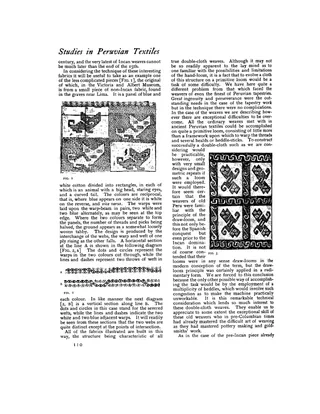
Article by Cyril G. E. Bunt in the series Studies in Peruvian Textiles, examining double-cloth (two-ply) weaving in ancient Peru. Bunt questions the claim by Squier and others that the Peruvians wove true "three-ply" cloth, and doubts Uhle's drafts of such pieces from Pachacamac. He explains double-cloth structure with sectional diagrams of a blue and white cotton panel in the Victoria and Albert Museum, and argues that the weaving implies a rudimentary draw-loom principle. He also discusses and dates several pieces from graves near Lima and from Nasca, and comments on the animal and stepped motifs.
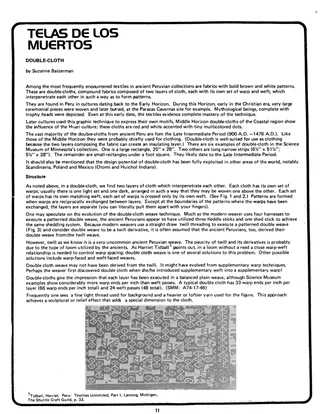
Telas de los Muertos, Double-Cloth
Article · 3 pages · weaving drafts
An article on double-cloth in ancient Peruvian textiles, drawing on six examples in the Science Museum of Minnesota. It describes the structure (two interpenetrating layers with separate warp and weft), materials (mostly brown and white cotton, some wool and alpaca), backstrap-loom process, four-selvage construction, and design. It compares ancient practice with modern four-harness double weave, with cross-section diagrams and threading drafts for patterned double cloth.
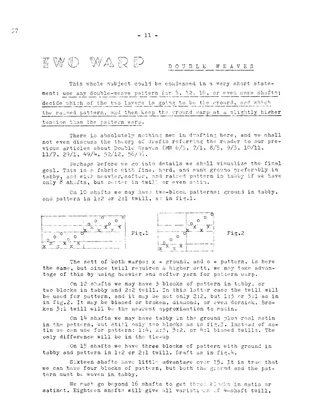
Two Warp Double Weaves
Master Weaver, May 1961
Article · 2 pages · weaving drafts
A two-page article from Master Weaver explaining how to weave double weaves with two separate warps, a tighter ground warp and a slacker pattern warp, on 8 to 21 shafts. It describes what each shaft count allows: tabby ground with tabby, twill or satin pattern, and two to four pattern blocks. Fig. 1-4 give threading drafts; tie-ups are deferred to a later article. It ends with practical advice on weft tension, shuttle handling, edges, warp tensions and sampling.
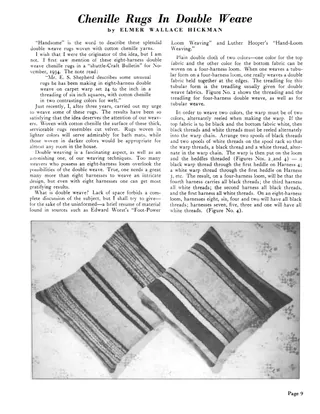
Chenille Rugs in Double Weave
Article · 6 pages · weaving drafts
A 1938 article by Elmer Wallace Hickman describing how to weave thick rugs of cotton chenille weft in eight-harness double weave, whose surface resembles cut velvet. It explains the principle of double cloth on four and eight harnesses, including shed formation, treadling, selvage handling, and a 12-harness arrangement with long-eyed heddles for tabby. It gives practical notes on warp (24 ends per inch, two colors), reed, chenille choice, and color combinations. Four drafts, shed diagrams, and rug photographs are included.
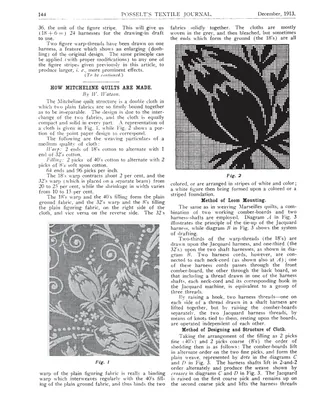
December, 1913
Article · 2 pages · weaving drafts
Two pages from the December 1913 issue of Posselt's Textile Journal. The first part is W. Watson's article on how Mitcheline quilts are made: a Jacquard double cloth of two plain fabrics, with warp and filling counts, loom mounting with two comber-boards and two harness shafts, and design and weave diagrams. The second part begins an article on how diagonals are made by warp-drafting every other thread of regular 45-degree twills. The pages also close a continued article on figure warp stripes.
Designing
Textile Mercury, 1891
Article · 2 pages · weaving drafts
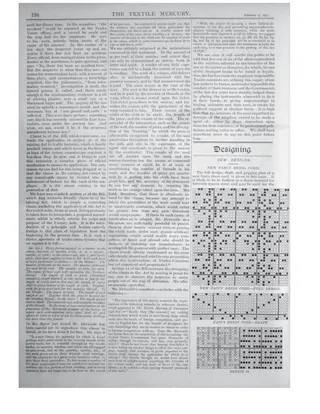
A two-page "Designing" column from The Textile Mercury, 14 February 1891, giving designs for power-loom dress and mantle fabrics. It presents a new fancy dress cord with full design, draft and pegging plan, with sett, yarn and colour suggestions. It also covers double-cloth novelties (Designs 13 and 14) and worsted mantle cloths (Designs 15 and 16, buckskin, double plain and warp rib), with warp and weft particulars and drafts and pegging plans.
Double Weave Workshop Notes: Double Weave with an Eight-Shaft Loom
Web Doc · 13 pages · weaving drafts
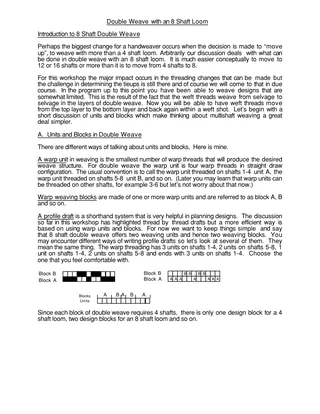
Workshop notes by Paul O'Connor on double weave for an eight-shaft loom, continuing from a four-shaft double weave program. They explain warp units, blocks and profile drafts, then the window and checkerboard designs with threadings, tieups and treadling, followed by color-planning exercises. Further sections cover skeleton tieups for 10- and 12-treadle looms, twill structures (1/3, 3/1 and 2/2) in double-width cloth, and four-layer multilayer weaving, ending with an analysis of a Kay Sekimachi monofilament hanging.
414 documents found