Textile Documents › Authors › Author: Hermann Erler
5 documents found
Sort: 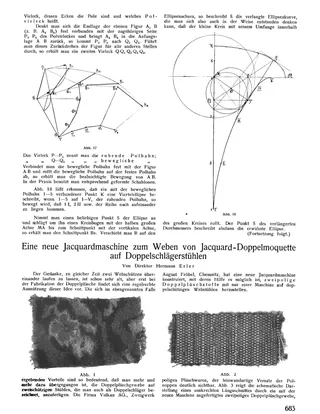
Eine neue Jacquardmaschine zum Weben von Jacquard-Doppelmoquette auf Doppelschlägerstühlen [A New Jacquard Machine for Weaving Jacquard Double Moquette on Double-Shuttle Looms]
Article · 2 pages · German · weaving drafts
Part of a 1927 article by Hermann Erler describing a new Jacquard machine from Vulkan AG (August Fröbel branch, Chemnitz) for weaving two-pole double-faced moquette (double plush) on double-shuttle looms. The text explains how the machine allows two-colour-pole double plush to be made with a single Jacquard, and describes the warp and weft arrangement: ground threads, pole threads, their colour sequence and reversal between warp courses, and upper and lower wefts. The pages also include the end of an unrelated mechanical discussion of pole paths (Polbahn) and a weave diagram of warp and weft paths. The article continues in a later issue.
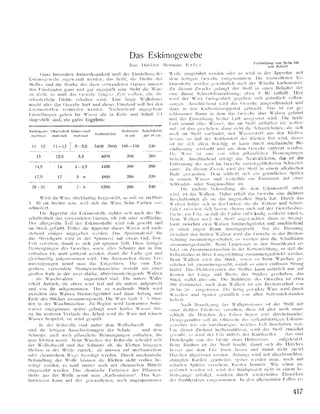
Die Eskimogewebe [Eskimo Fabrics]
Article · 2 pages · German
The concluding part of a German article on Eskimo cloth, a heavy napped and felted woolen fabric. It gives recommended setting tables for warp and weft yarn counts, density and width, then describes the finishing sequence step by step: scouring, carbonizing, fulling, raising with teasels, shearing, pressing, decating, dyeing and final shearing. The text deals with finishing machinery and processes, not weaving drafts.
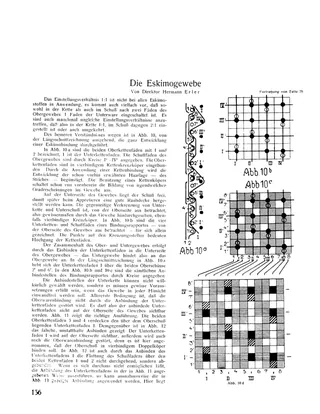
Die Eskimogewebe [The Eskimo Fabrics]
Article · 2 pages · German · weaving drafts
A two-page installment of Hermann Erler's article on Eskimo cloth, a double-cloth fabric with a twill-bound upper face and a napped underside. It explains how the upper warp, the lower warp and the weft are set in ratios such as 1:1 or 2:1, and how a 4-shaft warp-faced cross twill is developed from a longitudinal section drawing. It also covers where the lower warp may be tied into the upper cloth without disturbing the face weave, with correct and incorrect binding diagrams (Abb. 10-13).
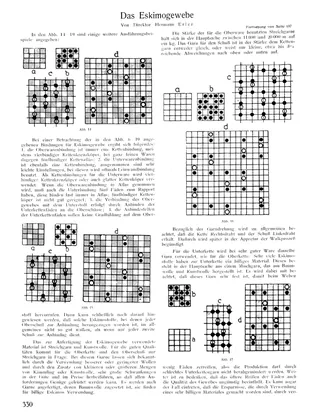
Die Eskimogewebe [The Eskimo Fabrics]
Article · 2 pages · German · weaving drafts
A two-page installment (pp. 330-331) of Hermann Erler's serial article on Eskimo fabrics, a double-cloth wool material with separate face and backing warps and wefts. It gives further weave examples (Abb. 14-19) and summarizes the structures used: four-end warp-faced cross twill or five-end warp satin for the face, and warp-faced twill, satin or plain weave for the backing, with backing warp ends tied to face picks. It also covers yarn materials (carded woolen yarn, shoddy, cotton blends, mohair or silk for chinchilla effects), yarn counts, twist direction, and how these affect fulling. A table lists face weave, backing weave, binding weave and thread settings for each figure.
Die Eskimogewebe [The Eskimo Fabrics]
Article · 2 pages · German · weaving drafts
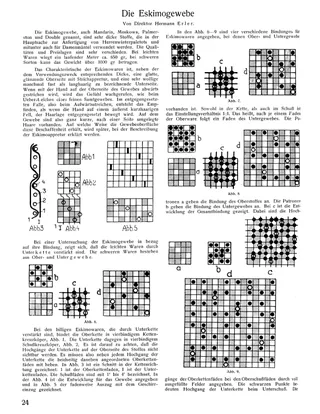
First installment of a German article by Hermann Erler on Eskimo cloths (also called Mandarin, Moskowa, Palmerston and Double), thick woolen coatings used for men's winter overcoats and some women's coats. It describes the characteristic smooth, brushed face and woolly back, then explains the weave structures: lighter qualities use a backed warp with a 4-end warp-faced and weft-faced twill, while heavy qualities use a double cloth with separate face and back weaves. Drafts and a table list four face/back/binding combinations (Abb. 6-9), and two photographs show the cloth after fulling and after finishing. The article ends with 'to be continued', with finishing to be covered later.
5 documents found