Textile Documents › Publications › Publication: Melliand's Textilberichte [Melliand's Textile Reports]
62 documents found
Sort: 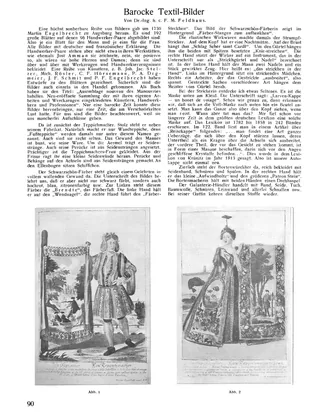
Barocke Textil-Bilder [Baroque Textile Pictures]
Article · 3 pages · German, French
A 1927 German article by F. M. Feldhaus on Baroque engravings from Martin Engelbrecht's Augsburg series of about 1730, in which craftsmen and their wives are shown dressed in the tools and products of their trades. The text discusses the tapestry maker, black-and-fine dyer, stocking knitter, passementier (braid maker) and mercer, describing the tools, materials and costume details shown. It includes a note on a travelling face mask, citing Krünitz's encyclopedia. The plates, with French and German captions, are reproduced on the following pages.
Beitrag zur Kenntnis der Kreppbindungen [Contribution to the Knowledge of Crepe Weaves]
Article · 1 page · German
First installment of a German-language article on crepe fabrics and the crepe weave structures used to make them. It describes three ways to give a fabric a crepe character: finishing with engraved calenders, using hard-twisted yarns (S and Z twist in warp and weft, or yarns that shrink in finishing such as mercerizing), and weaving with crepe bindings whose scattered floats break up reflected light. It announces that later parts will examine how common crepe bindings are derived and how new ones can be constructed. This page contains no drafts, and the article ends with "Fortsetzung folgt".
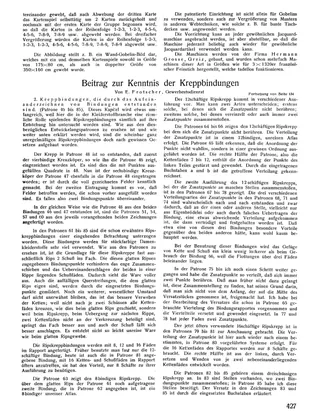
Beitrag zur Kenntnis der Kreppbindungen [Contribution to the Knowledge of Crepe Weaves]
Article · 2 pages · German · weaving drafts
Installment of E. Frotscher's article on crepe weaves (Kreppbindungen), covering crepe weaves produced by superimposing one weave on another (patterns 46 to 85). It explains how the combined weaves are built, with particular attention to rib crepe weaves (Ripskreppbindungen) used for piece-dyed women's dress fabrics. It describes 8-, 12- and 16-end repeats, the placement of added binding points on a plain 2-pick rib base, and the 3-pick rib crepe, and notes the advantages over plain rib. The second page has the drawdown grids numbered 46 to 85. The text begins with the end of an unrelated note on a patented Jacquard enlarging device for tapestry.
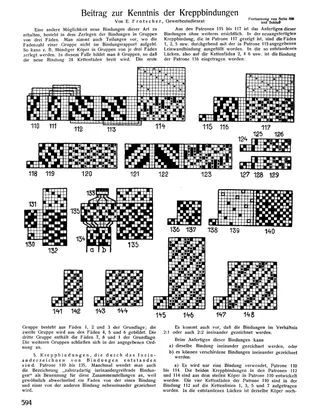
Beitrag zur Kenntnis der Kreppbindungen [Contribution to the Knowledge of Crepe Weaves]
Article · 3 pages · German · weaving drafts
The concluding part of E. Frotscher's German-language study of crepe weaves (Kreppbindungen), continuing from an earlier page 520. It explains methods for constructing crepe weaves: dividing weaves into groups of threads, interdrawing weaves in ratios such as 1:1, 2:1 and 2:2, adding or removing points on base weaves (plain, twill, satin), filling in divided pattern areas, and drawing free "wild" crepe weaves. The pages carry numbered drawdowns (about 110 to 168), with notes on shaft counts, Jacquard use and balancing float lengths. The scan ends with the start of an unrelated technical note on a patented doubling and press-board inserting machine.
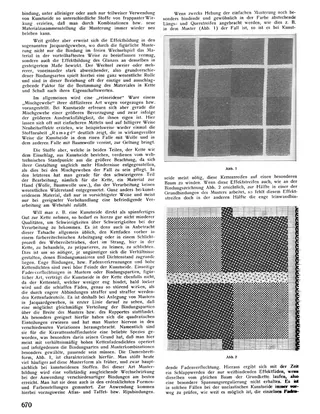
Bindungs- und Materialeffekte in kunstseidenen Stoffen [Weave and Material Effects in Rayon Fabrics]
Article · 3 pages · German
A 1927 article from Melliand's Textilberichte by Franz Müller on how weave structure and material interact in rayon (Kunstseide) fabrics. It covers rayon warp preparation and sizing, the problems of tight weaves and high warp density, and the use of checkerboard (Damenbrett) Jacquard patterns, especially for neckties, with satin, taffeta and rib weaves. It also discusses warp- and weft-direction effect stripes and their crossing points, illustrated by a pattern figure and a weave drawdown. The scan also includes the end of an article on Jacquard card care and the start of Josef Funke's article on plain weave, which covers shedding on hand and power looms.
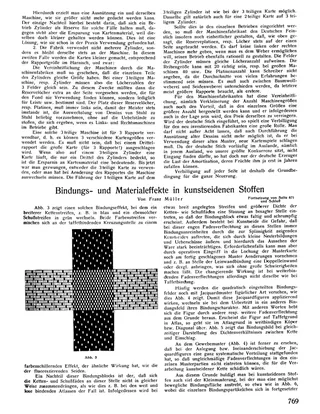
Bindungs- und Materialeffekte in kunstseidenen Stoffen [Weave and Material Effects in Rayon Fabrics]
Article · 2 pages · German · weaving drafts
The concluding part of Franz Müller's article on weave-structure and material effects in rayon (Kunstseide) fabrics. It discusses block-type binding effects where warp and weft color stripes cross in plain weave, and how jacquard figures change binding (e.g., satin figure on plain ground, twill on satin ground). It also covers the fragility of rayon warps, low warp densities, the use of unplied rayon, and rayon's prospects for replacing natural silk. Figures show binding diagrams and fabric samples. The scan begins with the end of an unrelated piece on standardizing jacquard machines, cylinders and punched cards.
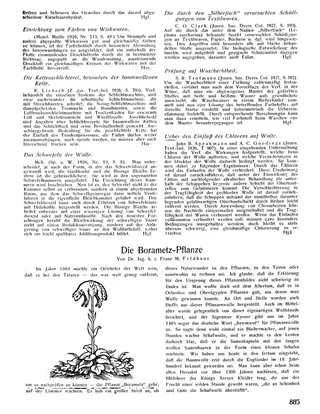
Die Borametz-Pflanze [The Borametz Plant]
Article · 1 page · German
A short German article by Franz M. Feldhaus on the legendary Borametz, the 'vegetable lamb' plant said to grow lambs, reported from Tartary in 1601. Feldhaus argues the image derives from cotton, drawn as a lamb-shaped seed capsule with white fibers, citing knowledge of plant wool since antiquity, Kyeser's 1405 word 'bawmwol', and Herodotus on Xerxes' soldiers wearing garments woven from a wild plant. The page includes an engraving of the plant and also carries the end of several unrelated textile-chemistry abstracts.
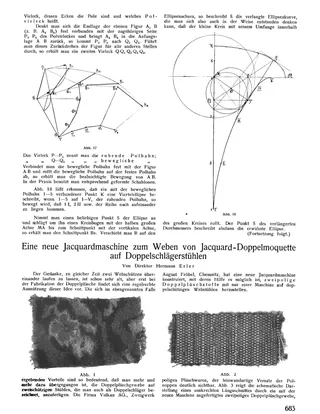
Eine neue Jacquardmaschine zum Weben von Jacquard-Doppelmoquette auf Doppelschlägerstühlen [A New Jacquard Machine for Weaving Jacquard Double Moquette on Double-Shuttle Looms]
Article · 2 pages · German · weaving drafts
Part of a 1927 article by Hermann Erler describing a new Jacquard machine from Vulkan AG (August Fröbel branch, Chemnitz) for weaving two-pole double-faced moquette (double plush) on double-shuttle looms. The text explains how the machine allows two-colour-pole double plush to be made with a single Jacquard, and describes the warp and weft arrangement: ground threads, pole threads, their colour sequence and reversal between warp courses, and upper and lower wefts. The pages also include the end of an unrelated mechanical discussion of pole paths (Polbahn) and a weave diagram of warp and weft paths. The article continues in a later issue.
Entwürfe für Damast-Tischzeug (Gebild-Gewebe) [Designs for Damask Table Linen (Figured Fabric)]
Article · 3 pages · German · weaving drafts
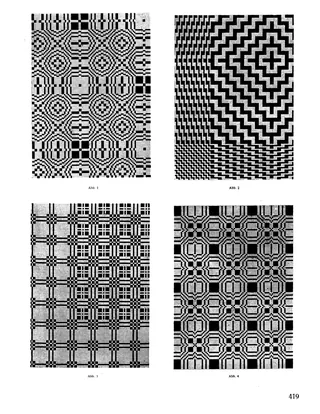
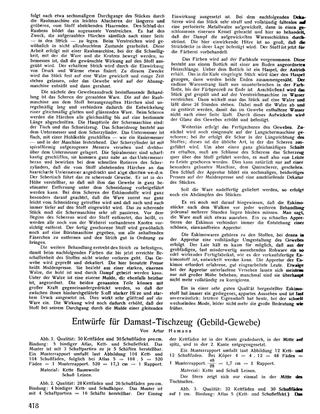
A short German-language technical article by Artur Hamann giving four designs for damask table linen (Gebild-Gewebe). For each design (Abb. 1-4) it states thread counts per cm, the binding (5-end satin, 4-end twill), the number of shaft groups and shafts needed, pattern repeat size in threads and cm, and materials (cotton warp with linen weft, or all linen). A page of drawdown figures illustrates the four patterns.
Entwürfe für Damast-Tischzeug (Gebild-Gewebe) [Designs for Damask Table Linen (Figured Fabrics)]
Article · 3 pages · German · weaving drafts
A short German-language piece from Melliand's Textilberichte by Artur Hamann presenting four designs for damask table linen (Gebild-Gewebe). For each design (Abb. 1-4) it gives thread counts per cm, the binding (5-end satin or 4-end twill), the number of shaft groups and shafts needed, pattern repeat calculations and materials (cotton warp with linen weft, or all linen). The scan also includes the end of G. Lehmann's article on the technique of figured weaving, covering a Schleicher damask jacquard attachment and a half-damask machine.
Erzielung von Wollcharakter auf Baumwollgeweben [Achieving a Wool Character on Cotton Fabrics]
Article · 1 page · German
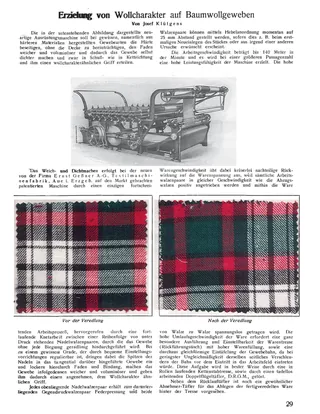
A short 1927 German trade article describing a new patented finishing machine from Ernst Geßner A.-G. (Aue, Saxony) that gives cotton fabrics a wool-like hand. The machine kneads the cloth between pairs of spring-loaded needle rollers and counter-pressure rollers, loosening threads and weave so the fabric becomes softer, fuller and denser in warp and weft. The article covers roller adjustment, running speed up to 140 m/min, tension-free fabric transport and the folding devices. A photo of the machine and before/after swatch photos accompany the text.
Die Eskimogewebe [Eskimo Fabrics]
Article · 2 pages · German
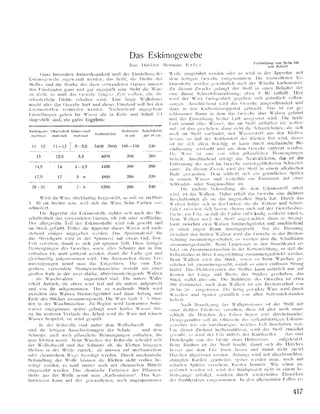
The concluding part of a German article on Eskimo cloth, a heavy napped and felted woolen fabric. It gives recommended setting tables for warp and weft yarn counts, density and width, then describes the finishing sequence step by step: scouring, carbonizing, fulling, raising with teasels, shearing, pressing, decating, dyeing and final shearing. The text deals with finishing machinery and processes, not weaving drafts.
Die Eskimogewebe [The Eskimo Fabrics]
Article · 2 pages · German · weaving drafts
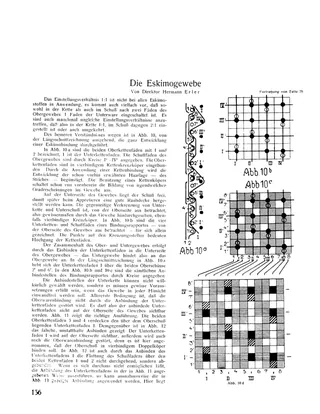
A two-page installment of Hermann Erler's article on Eskimo cloth, a double-cloth fabric with a twill-bound upper face and a napped underside. It explains how the upper warp, the lower warp and the weft are set in ratios such as 1:1 or 2:1, and how a 4-shaft warp-faced cross twill is developed from a longitudinal section drawing. It also covers where the lower warp may be tied into the upper cloth without disturbing the face weave, with correct and incorrect binding diagrams (Abb. 10-13).
Die Eskimogewebe [The Eskimo Fabrics]
Article · 2 pages · German · weaving drafts
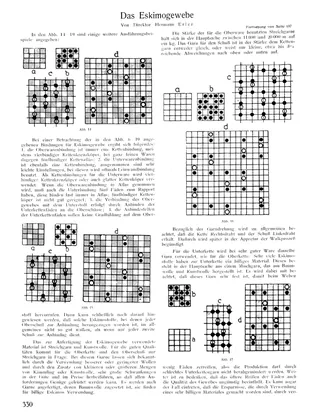
A two-page installment (pp. 330-331) of Hermann Erler's serial article on Eskimo fabrics, a double-cloth wool material with separate face and backing warps and wefts. It gives further weave examples (Abb. 14-19) and summarizes the structures used: four-end warp-faced cross twill or five-end warp satin for the face, and warp-faced twill, satin or plain weave for the backing, with backing warp ends tied to face picks. It also covers yarn materials (carded woolen yarn, shoddy, cotton blends, mohair or silk for chinchilla effects), yarn counts, twist direction, and how these affect fulling. A table lists face weave, backing weave, binding weave and thread settings for each figure.
Die Eskimogewebe [The Eskimo Fabrics]
Article · 2 pages · German · weaving drafts
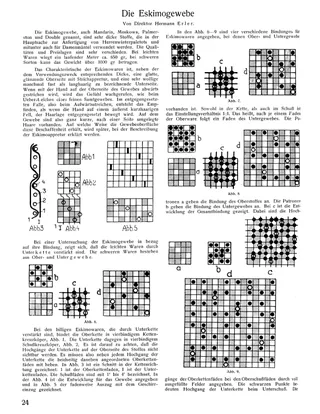
First installment of a German article by Hermann Erler on Eskimo cloths (also called Mandarin, Moskowa, Palmerston and Double), thick woolen coatings used for men's winter overcoats and some women's coats. It describes the characteristic smooth, brushed face and woolly back, then explains the weave structures: lighter qualities use a backed warp with a 4-end warp-faced and weft-faced twill, while heavy qualities use a double cloth with separate face and back weaves. Drafts and a table list four face/back/binding combinations (Abb. 6-9), and two photographs show the cloth after fulling and after finishing. The article ends with 'to be continued', with finishing to be covered later.
Gebildweberei in Seidendamastdecken des Rokoko [Pictorial Weaving in Silk Damask Covers of the Rococo]
Article · 1 page · German
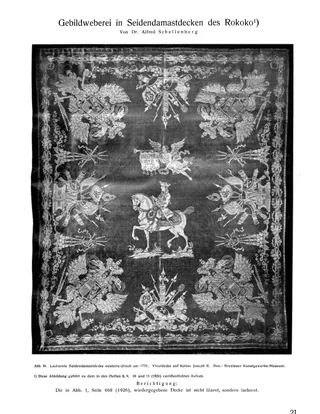
A single page from Melliand's Textilberichte with Alfred Schellenberg's illustration (Abb. 10) of a salmon-red Austrian silk damask cover (Vivatdecke) of about 1779 made for Emperor Joseph II, held by the Breslau Kunstgewerbe-Museum. The figure shows a central equestrian figure surrounded by floral and foliate motifs. A footnote says the figure belongs to Schellenberg's article on pictorial weaving in Rococo silk damask covers, published in issues 8-11 of 1926. A correction states that the cover shown in Abb. 1 on page 668 (1926) is salmon-red, not lilac-red.
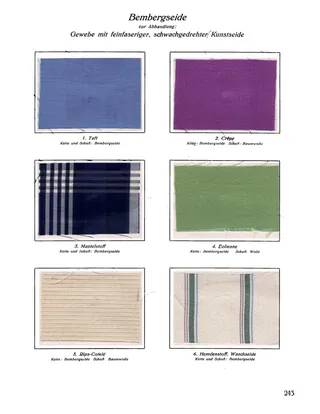
Gewebe aus feinfaseriger, schwachgedrehter Kunstseide [Fabrics from Fine-Filament, Low-Twist Rayon]
Article · 4 pages · German
A 1927 German article from Melliand's Textilberichte on weaving fine-filament, low-twist rayon (Bemberg cupro silk). It describes six sample fabrics (taffeta, crepe, coat fabric, eolienne, rips-cotelé, shirting) with warp and weft yarns, twist and thread counts. It then gives detailed operating rules for rayon weaving: sizing, winding, warping, loom setup, reed, shuttle, humidity control and finishing. A second article by Justin Hausner on processing rayon with Aktivin begins on the last page.
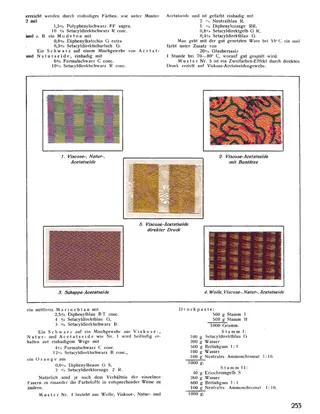
Gewebe und Effekte mit Acetatseide [Fabrics and Effects with Acetate Rayon]
Article · 3 pages · German
A 1927 German-language trade article on dyeing and printing acetate rayon (Acetatseide, e.g. Celanese) and its use for effect threads in mixed fabrics. It explains why acetate resists traditional dyes, describes direct acetate dyes, and gives dye recipes and print pastes for five sample fabrics combining viscose, natural silk, schappe and wool. The scan also includes two short pieces on vat (Indanthren) dyeing of schappe effect threads and on dyeing acetate rayon, the latter breaking off after its introduction.
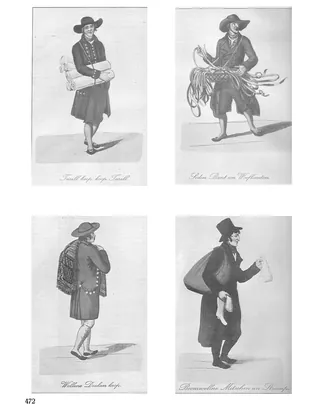
Hamburger Textil-Händler um 1808 [Hamburg Textile Vendors around 1808]
Article · 2 pages · German
A short German-language piece by F. M. Feldhaus on Christoff Suhr's colored pictures of Hamburg street vendors, published as "Der Ausruf in Hamburg" (1808), with commentary by Pastor Hübbe. It focuses on the textile hawkers: a vendor of ticking (Drell) linen, a poor Jewish ribbon seller, a South German seller of woolen blankets, and a seller of cotton caps and stockings. Page 2 reproduces four engraved vendor illustrations with their Low German cries. The first page also carries an unrelated notice of new dye sample cards from I. G. Farbenindustrie.
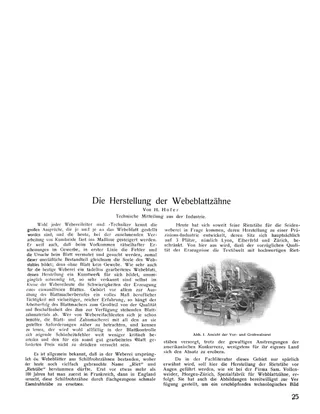
Die Herstellung der Webeblattzähne [The Production of Weaving Reed Dents]
Article · 2 pages · German
A 1927 technical article in German on how reed dents (the wires of a weaving reed) are manufactured, drawing on the Swiss firm Sam. Vollenweider of Horgen-Zürich. It covers the history of reeds, from cane (Schilfrohr) to flat iron wire, and the centers of fine reed-wire production (Lyon, Elberfeld, Zürich). It then covers the choice of round wire and the precision rolling process, with photographs of the rough-rolling and fine-rolling shops. The article ends with "Fortsetzung folgt" (to be continued).
Hochverzug-Streckwerk System Ferrand [High-Draft Drafting System, Ferrand System]
Article · 2 pages · German
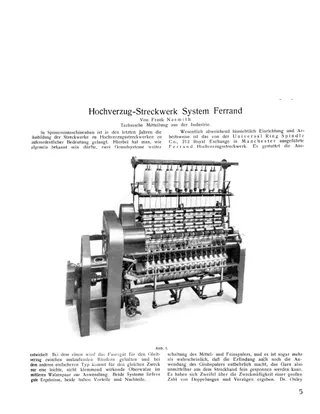
A short German-language technical report from 1927 on the Ferrand high-draft drafting system for spinning machinery, made by the Universal Ring Spindle Co. of Manchester. It explains how three vertically arranged roller pairs let the roving go straight into the ring frame's drafting unit, which removes the intermediate and fine roving frames. It covers claimed savings in labor, power and waste, and use with cotton, wool, asbestos and cotton-wool blends. Photographs and a line drawing illustrate the machine.
Höchstleistung durch Schnelläufermaschinen in der Wirkerei und Strickerei [Maximum Output through High-Speed Machines in Knitting and Hosiery Manufacture]
Article · 2 pages · German
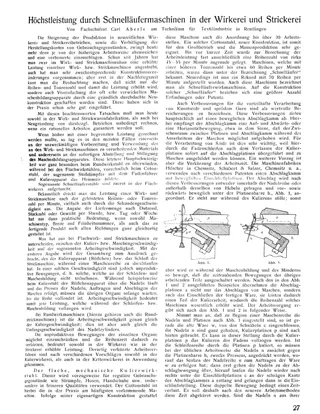
A 1927 German-language article by Carl Aberle of the Reutlingen textile technical school on raising output in knitting and hosiery manufacture with high-speed machines. It explains the difference between knitting speed and working speed, then describes improvements to flat Cotton frames, notably a movable knock-over comb with enclosing sinkers. It also covers high-speed circular knitting machines, including the Terrot system and the Haaga loop-wheel frame. Three cross-section diagrams of needle and sinker mechanisms illustrate the text, and the article ends with "Fortsetzung folgt" (to be continued).
Jacquardkarten-Spareinrichtung für Gobelin-Bildweberei [Jacquard Card-Saving Device for Gobelin Picture Weaving]
Article · 2 pages · German
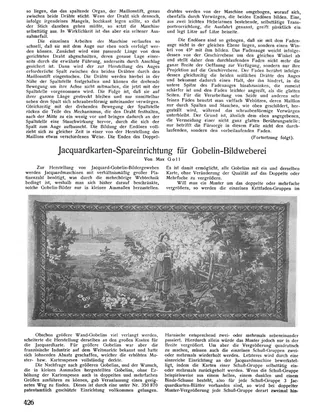
Two-page scan from Melliand's Textilberichte (1927) with Max Goll's article on a patented device (German patent no. 350 870) that saves Jacquard cards in Gobelin-style picture weaving. By repeating warp groups across the harness and automatically stepping the card set back to repeat weft groups, one card set can weave a pattern at double or multiple size, as in a wall tapestry woven at 175x80 cm and 350x160 cm. The scan also includes the continuation of E. Frotscher's article on crepe weaves, covering rib crepe (Ripskrepp) bindings built by superimposing weaves, with 8, 12 and 16-thread repeats and draft diagrams (Patronen 46-85). The page before Goll's article ends the text of an unrelated piece on wire heddles.
Kleinspinnerei-Maschinen und -Anlagen [Small Spinning Machines and Plants]
Article · 2 pages · German
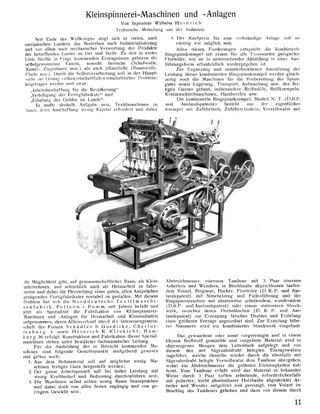
A 1927 technical report by engineer Wilhelm Heinrich on small-scale spinning machinery and plant layouts for cottage industry, cooperatives and small enterprises. It describes the combined ring-spinning carding machine (Model N.T.) made by the Norddeutsche Textilmaschinenfabrik of Pollnow, covering its carding, web-dividing, drafting and ring-spinning stages, plus output figures, drive options and a larger version. One illustration shows the machine.
Die Konstanzer Textil-Bilder [The Konstanz Textile Pictures]
Article · 3 pages · German
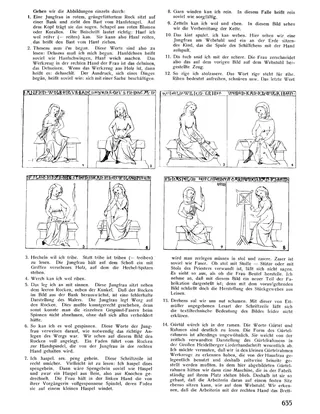
Article by Franz M. Feldhaus on the Konstanz textile wall paintings, made around 1300 in a burgher's house in Konstanz and showing women at textile work. He reproduces the pictures and their inscription bands from an 1866 publication and explains each of the roughly 18 scenes. The scenes cover hemp processing, hackling, tow spinning with distaff and spindle, reeling, warping, linen weaving at a loom with a child winding the bobbin, cutting cloth, belt weaving on a frame, and silk preparation. Feldhaus discusses the Middle High German wording of the inscriptions and the tools shown, and asks textile specialists for comments.
Die Kunstseide [Artificial Silk]
Article · 2 pages · German
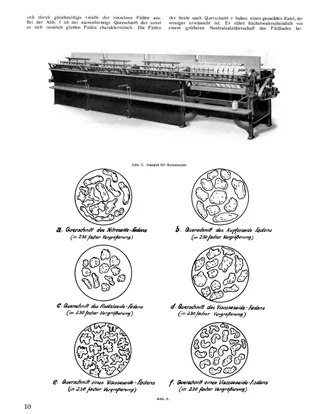
Concluding installment of a German article on artificial silk (rayon) manufacture. It describes reeling machines (Haspel) used to wind silk from spinning cakes into skeins, including a Carl Zangs A.-G. (Crefeld) reel with a patented counter, followed by washing, drying, chlorine bleaching, softening with paraffin or glycerin, and skein dyeing. It also compares magnified cross-sections of nitro, copper, acetate and viscose silk filaments at 230x, and notes how the shapes reflect the process used.
Leinwandbindung [Plain Weave]
Article · 2 pages · German
A 1927 German-language technical article on plain weave (Leinwandbindung) by a textile school teacher, focused on how it is woven on hand looms and power looms. It covers shed formation with a roller (Geschirrwelle), eccentric cams, shaft lift, multiple shafts with skip drafting (Sprungeinzug), and the problem of streaky cloth and how a closing shed and a movable whip roll (Walkwelle) address it. It ends with the properties, uses and names of plain-weave fabrics. The scan opens with the end of another article on stripe effects in satin weaves, and closes with the start of a second article on patterning pullover fabrics.
Das Mischen der Baumwolle für die Spinnerei [The Blending of Cotton for the Spinning Mill]
Article · 3 pages · German
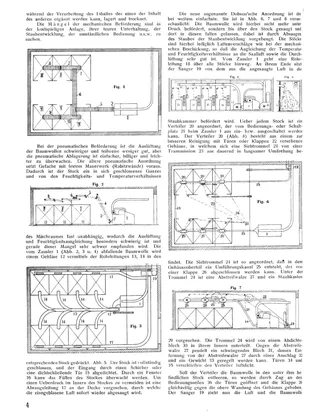
A German-language technical article from 1927 on blending raw cotton before spinning. It explains the purposes and rules of mixing, the opening of bales, the bale breaker (Ballenzausler), and how long mixing bins (Stöcke) are stored. It compares mechanical conveying with slat conveyor belts against pneumatic filling, including the Dobson suction arrangement with a sieve-drum distributor. Fiber mixes for different yarn counts are listed, and several diagrams of mixing-room installations are included. The text ends with "Fortsetzung folgt" (to be continued).
Muster für Textilzwecke [Designs for Textile Purposes]
Article · 2 pages · German
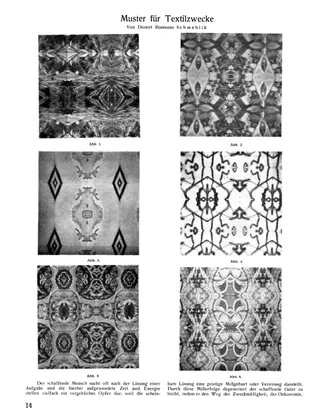
A short German-language article by Romanus Schmehlik on how artists can generate textile patterns by drawing on nature and everyday objects and transforming them with physical-optical aids such as repetition and reflection. It argues that this saves an artist's creative capacity and yields designs for carpets, damask, curtains, embroidery and printing. Six halftone figures show example patterns (bands, lattices, medallions); the author does not describe the methods in detail for lack of space.
Die Musterung von Pulloverstoffen [The Patterning of Pullover Fabrics]
Article · 3 pages · German · weaving drafts
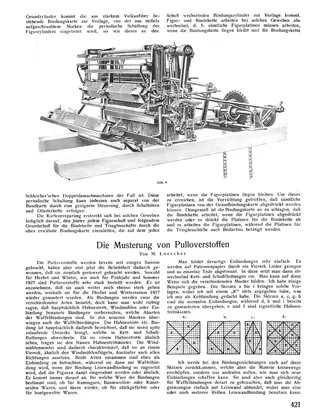
Part one of a German trade-journal article by M. Loescher on designing pullover fabrics in 1927. It explains that Hahnentritt (houndstooth-like), windmill and ice weaves, which are variants of waffle weave, dominated the season. It shows how to build them on point paper by alternating warp and weft floats, and how different warp and weft color arrangements produce checks and stripes from one weave. A 12-shaft example in black and white is described, with sketches a-i and pattern drawings I-IV. The scan also includes parts of two other articles: the end of a piece on a Jacquard card-saving device for Gobelin picture weaving (Max Goll) and a piece on machine-made wire heddles.
Die Musterung von Pulloverstoffen [The Patterning of Pullover Fabrics]
Article · 3 pages · German · weaving drafts
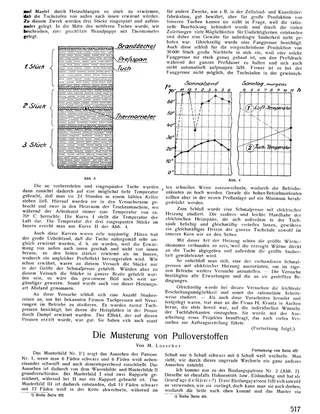
Part of a serialized German-language article from Melliand's Textilberichte on patterning pullover fabrics. Loescher describes houndstooth/ice-weave (Eisbindung) weave designs, numbered 1 to 7, several requiring 16 shafts, and explains how colour arrangement in warp and weft changes their appearance, and how designs can be turned or used for stripes. The drafts are illustrated as black-and-white pattern grids. The scan begins with the end of an unrelated article on cloth presses with electric heating and ends with the start of a section of E. Frotscher's article on crepe weaves.
Die Musterung von Pulloverstoffen [The Patterning of Pullover Fabrics]
Article · 2 pages · German · weaving drafts
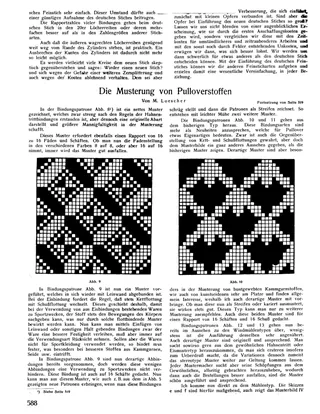
A two-page continuation of M. Loescher's article on designing patterns for pullover fabrics, published in Melliand's Textilberichte in 1927. It discusses weave diagrams (Bindungspatronen, Abb. 8-15) on 16 shafts, including houndstooth variants, ice weaves that alternate warp and weft floats, and the windmill (Mühlen) pattern achieved with 8 or 16 thread colour arrangements and plain-weave tie-downs. The page also opens with the end of a separate piece advocating a German fine gauge (deutscher Feinstich) for knitting cylinders.
Die Musterung von Pulloverstoffen [The Patterning of Pullover Fabrics]
Article · 3 pages · German · weaving drafts
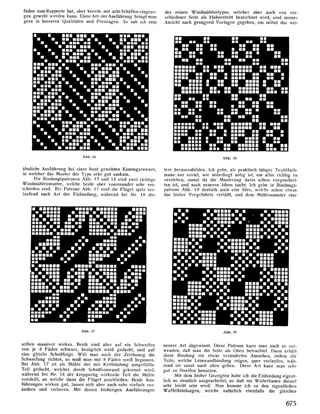
A 1927 installment of M. Loescher's series on patterning pullover fabrics, published in Melliand's Textilberichte. It presents weave patterns (Abb. 16-23) of the windmill (Mühlen), cock's-tread and ice-weave (Eisbindung) types, followed by waffle weaves (Waffelbindungen) with diagonal plain-weave lines. The text gives harness counts and repeat sizes (such as 8 shafts for a 24-thread repeat, and 16 shafts and picks) and suggests colour arrangements, stripes, and turning the draft to get a second pattern. The first page also carries the end of a separate text on plain weave, covering loom behaviour with a shed closed early, the movable whip roll, and typical plain-weave fabrics.
Die Musterung von Pulloverstoffen [The Patterning of Pullover Fabrics]
Article · 3 pages · German · weaving drafts
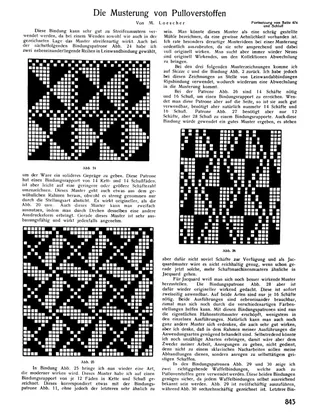
The concluding part of M. Loescher's article on designing patterns for pullover fabrics, from Melliand's Textilberichte, 1927. It discusses weave diagrams Abb. 24-30 (houndstooth-type, rib and waffle weaves), shaft and pick counts for repeats, and the use of Jacquard versus dobby looms. It also covers colour arrangements in warp and weft, the use of rayon in the weft, cotton warps, fabric widths, prices and finishing. The scan ends with the start of a separate article by Richard Hünlich on reinforcing or thickening fabrics with extra warps or wefts and on analysing them.
Seidenraupenzucht und Seidenverarbeitung [Silkworm Rearing and Silk Processing]
Article · 4 pages · German
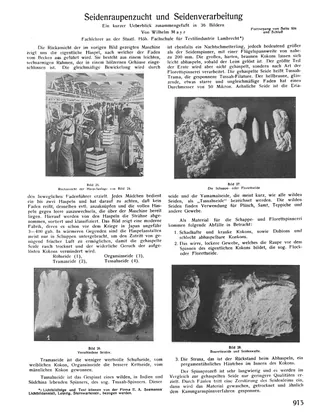
Concluding installment of an illustrated overview of silk culture and silk processing, written for a lantern-slide series (Bilder 25-36). It covers silk reeling, the types of silk (raw, organzine, tram, tussah, schappe/floret, bourette), conditioning, degumming, weighting and throwing. It also describes Japanese silk weaving mills, handweaving workshops at Kiryu and in the countryside, and silk embroidery in Kyoto. The scan also includes the end of an unrelated article on cop formation and faults on the self-acting mule.
Spinndüsen für die Kunstseidenspinnerei [Spinnerets for Rayon Spinning]
Article · 3 pages · German
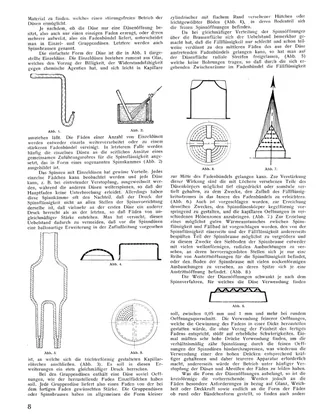
A 1927 German-language technical article by Robert Glafey on spinnerets (Spinndüsen) used in rayon (artificial silk) spinning. It distinguishes single nozzles from group nozzles (spinning showers), describes designs meant to improve coagulation and heat exchange, orifice sizes and shapes, and the materials used (glass, platinum, nickel, porcelain, gemstones). It also covers how orifices are made and how nozzle plates are mounted in nozzle heads, with twelve figures; the text ends with "to be continued".
Der Streifentüll [Striped Tulle]
Article · 2 pages · German
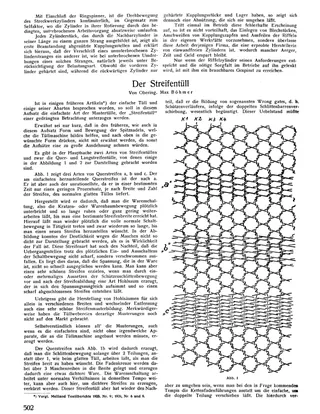
German-language technical article by Max Böhmer on striped tulle (Streifentüll), the simplest kind of patterned tulle made on tulle (bobbinet) machines. It describes three ways of making cross stripes (by interrupting take-up, by shifting the carriage over two divisions, and by continuous carriage-bar shifting) and longitudinal stripes made with an additional guide bar. It also covers zigzag and wave stripes, rectangles, and the use of many guide bars with a Jacquard device for small floral motifs, with a note on uses for curtains and stores. Illustrated with two diagrams of the mesh structures.
Studien in der Lumpensortierung [Studies in Rag Sorting]
Article · 2 pages · German
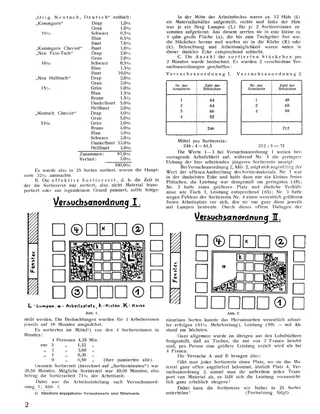
A 1927 German article by Dipl. Ing. Roßmann on the sorting of rags as raw material for shoddy (Kunstwolle) production. It reports time-and-motion studies in the rag-sorting rooms of large cloth factories, covering the sorting table layout, worker fatigue, dust and extraction, and the 25 sorts of 'Neutuch' clippings with their percentages. Two experimental workspace arrangements are compared by effective sorting time and pieces sorted per two minutes, concluding that open, individual work places and less material transport raise output. The article ends with 'Fortsetzung folgt' (to be continued).
Die Technik der Gebildweberei einst und jetzt [The Technique of Figured Weaving Then and Now]
Article · 2 pages · German · weaving drafts
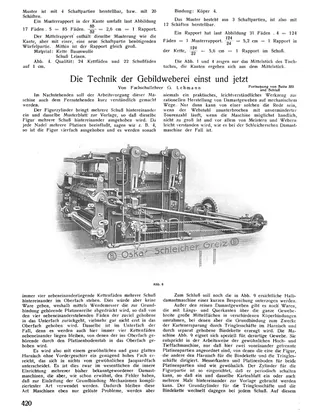
Concluding part of G. Lehmann's article on the technique of figured (damask) weaving, past and present. It describes how the Oskar Schleicher Greiz damask machine works, using a figure cylinder, turning knives and a plain harness to form the ground weave, and then a half-damask machine for fabrics with twill-bound borders and central fields. It opens with the end of a preceding passage on twill-bound tablecloth patterns, with repeat and shaft calculations. A second, unrelated article by M. Loescher on patterning pullover fabrics follows, covering ice, cock's-tread (houndstooth), windmill and waffle weaves, with small drawdown sketches.
Die Technik der Gebildweberei einst und jetzt [The Technique of Pictorial Weaving Then and Now]
Article · 2 pages · German
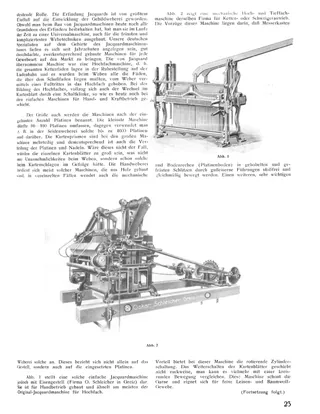
A German-language article from Melliand's Textilberichte tracing the history of shed-forming mechanisms for pictorial and figured weaving, from ancient frame looms to the Jacquard machine. It covers the Kegelstuhl and Zampelstuhl, the inventions of Bouchon, Falcon, Reynier, Vaucanson and Waldhör, and Jacquard's punched-card machine. The second page describes modern hand-operated and mechanical high- and low-shed Jacquard machines by the firm O. Schleicher of Greiz, illustrated with two line drawings. The article ends with "Fortsetzung folgt" (to be continued).
Technische Auskünfte [Technical Inquiries]
Article · 4 pages · German · weaving drafts
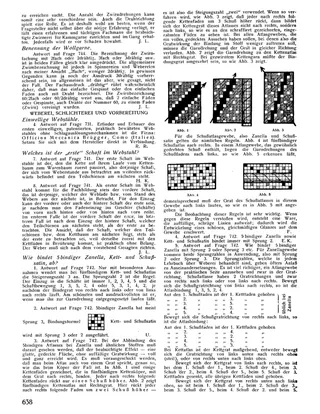
A four-page installment of the 'Technische Auskünfte' (technical inquiries) column from Melliand's Textilberichte, 1927, listing reader questions Nos. 759-772 and published answers to earlier questions. Questions cover mercerizing, dyeing, fire-sprinkler systems, silk degumming, and weaving acetate rayon. The longest section is a set of seven answers on how to set up five-end satin, atlas and zanella weaves, discussing the step (Steigungszahl/Sprungzahl), twill-line direction relative to yarn twist, and a table of binding sequences for 5 to 17 shafts, with small weave diagrams. Other answers deal with the first shaft of a loom, rayon weft in underpick shuttles, velvet and cord weaving, and warp stress. The issue ends with a finishing recipe for blue mollino and a list of sources sought.
Ueber das Einrollen der Leisten beim Walken [On the Curling of Selvedges During Fulling]
Article · 1 page · German
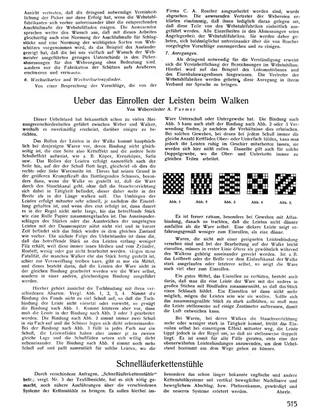
A short 1927 German trade-journal article by weaving manager A. Farmer on why selvedges curl or roll inward during fulling of woolen cloth, especially in twills, cross twills and satins with uneven face and back effects. He recommends weaving the selvedges in a balanced binding (plain weave and its variants, shown in five small diagrams, Abb. 1-5) instead of the ground weave. He also gives practical tips: keep selvedges as thick as the cloth, stretch the cloth during fulling, and sew the two selvedges together into a tube. The page also carries the end of a meeting report on loom standardization (pickers, pattern chain cylinders) and the start of a note on high-speed warp knitting machines by Aberle.
Ueber die Fehler in Lunten und Vorgarn und ihre Ermittlung [On the Faults in Slubbing and Roving and Their Detection]
Article · 2 pages · German
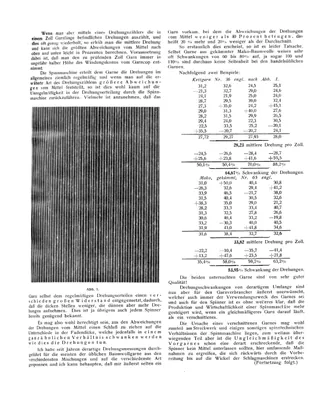
German-language article from 1927 by engineer Paul Laetsch on irregularities (thick and thin places) in cotton roving and yarn and how to detect them. It proposes counting twists per inch with a twist counter as a practical way to infer variation in yarn thickness, and gives two worked examples (a No. 36 warp yarn and a combed Mako cotton No. 65) showing twist variations of about 54 to 65 percent. The text breaks off with "to be continued"; the figure is a black-board winding of yarn used for visual inspection.
Ueber Litzen und Litzenfabrikation [On Heddles and Heddle Manufacture]
Article · 2 pages · German
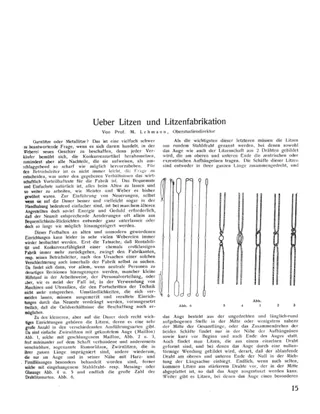
A German-language technical article from 1927 on heddles (Litzen) for power looms, comparing thread (twine) heddles with wire and metal types. It describes knotted, looped, glass-, steel- and brass-eyed heddles, round and flat steel wire heddles, and movable "Rumor" heddles. It weighs durability, cost, warp density and suitability for fine yarns, silk and damask weaving. The text ends with "to be continued", so it is the first part of a series.
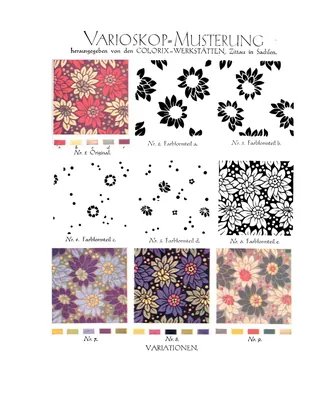
Varioskop Musterung [Varioskop Patterning]
Article · 2 pages · German
A two-page illustrated item on the Varioskop pattern system published by the Colorix-Werkstätten in Zittau, Saxony. Page 1 shows an original floral pattern, five separated color-form parts (a–e), and variations produced from them. Page 2 shows a projection dianegative and the projected image without filters. Text is limited to figure captions.
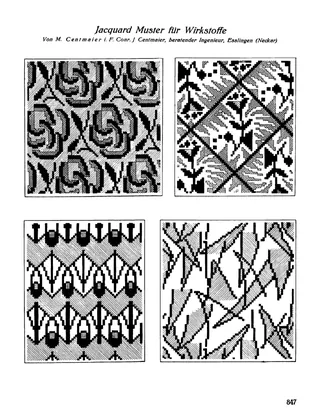
Das Verstärken oder Verdichten von Geweben und deren Untersuchung [Reinforcing or Thickening Fabrics and Their Analysis]
Article · 3 pages · German
A 1927 German-language article by Richard Hünlich on reinforcing or thickening fabrics by layering thread systems, and on how to analyze such fabrics. It describes three types: warp doubles (extra backing warp), weft doubles (extra backing weft), and double cloths, with guidance on choosing ratios of face to backing threads and on stitching the layers together invisibly. It also explains how to design the weaves on point paper and how to dissect a sample to determine the weave. The scan opens with the end of an earlier piece on ice-pattern (Eisbindung) fabrics with color-and-weave striping and check effects, and closes with a page of jacquard pattern designs.
Das Weben antiker nahtloser Gewänder [The Weaving of Ancient Seamless Garments]
Article · 2 pages · German
A 1927 article by Franz M. Feldhaus on how seamless garments such as the biblical tunica inconsutilis were woven in antiquity. Drawing on Franz Bock, Jerome, Josephus, Herodotus, Theophylactus and Johannes Braunius, it explains that a standing weaver worked two warps side by side on a vertical warp-weighted loom, passing a single weft alternately through both and beating it upward with a flat wooden stick (spatha), so that the two cloths joined at the edges into a closed tubular garment. A woodcut-style illustration of the loom and a female weaver accompanies the text, and the sleeves are described as woven the same way.
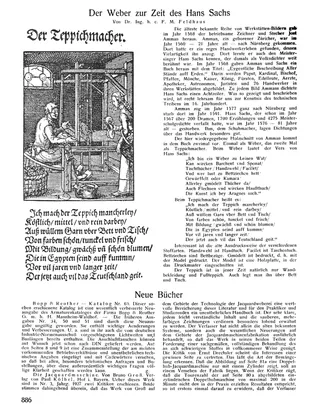
Der Weber zur Zeit des Hans Sachs [The Weaver in the Time of Hans Sachs]
Article · 1 page · German
Short German-language article by F. M. Feldhaus on the weaver and the tapestry maker (Teppichmacher) in the age of Hans Sachs. It centers on a woodcut by Jost Amman from the 1568 book of trades, 'Eygentliche Beschreibung Aller Stände auff Erden', and quotes Hans Sachs's verses for the weaver and the tapestry maker. It explains archaic textile terms such as Handzwehl, Facilet, Bettziechen and gmödelt, and notes that carpets then served as wall hangings, floor coverings and bed and table covers.
Webereisünden [Weaving Sins]
Article · 1 page · German
A one-page German trade article by R. Büken, written as a response to an earlier piece on weaving faults in cotton finishing. It recounts cases where small holes appeared in finished cotton quilting satin and half-silk umbrella fabric, and traces them to damaged warp threads from weaving-room practices (scissors tapped on the breast beam, pirns pressed against it) and to a grain of sand from a sand roller. The scan also carries the end of an unrelated article by Carl Aberle on high-speed knitting and warp-knitting machines.
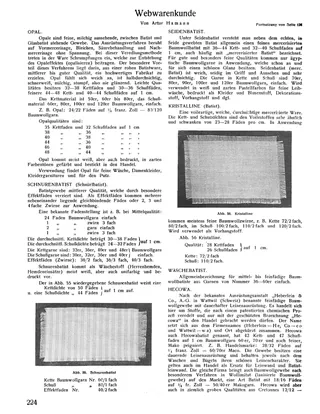
Webwarenkunde [Fabric Knowledge]
Article · 4 pages · German
A 1927 installment of Artur Hamann's serial "Webwarenkunde" (textile fabric knowledge) in Melliand's Textilberichte, written in German. It is an alphabetical glossary of cotton and linen fabrics, covering Opal, Schnurenbatist, Seidenbatist, Kristalline, Hecowa, Philana, Hecolan, Chiffon, Creas, Cretonne, Dowlas, Duck, Linon, Mako, Madapolam, Nanking and others. Entries give origin of the name, finishing processes, thread counts per cm or per quarter French inch, yarn numbers and uses. Fabric swatch photographs (Abb. 55-59) illustrate several entries.
62 documents found