Textile Documents › Authors › Author: M. Loescher
8 documents found
Sort: 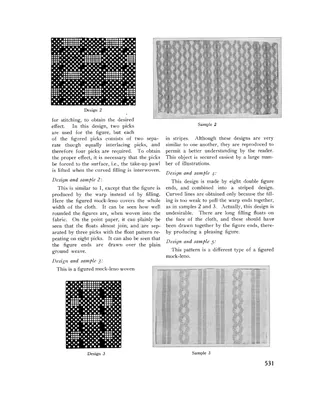
Figured Mock Lenos, Part 1
Article · 8 pages · weaving drafts
Part 1 of an article by M. Loescher of Gera-Reuss, Germany, on figured mock-lenos, which imitate true leno gauze through floating warp or filling figure ends on a plain weave ground and can be woven at normal loom speed. It covers the principles (floats, separate figure beam, slack figure warp, reeding), outlines five groups of mock-leno, and works through the first two: quadrangular floats and pointed floats. Numbered designs (drawdowns), sketches and photographs of woven samples illustrate each type.
Figured Mock Lenos, Part 2
Article · 6 pages · weaving drafts
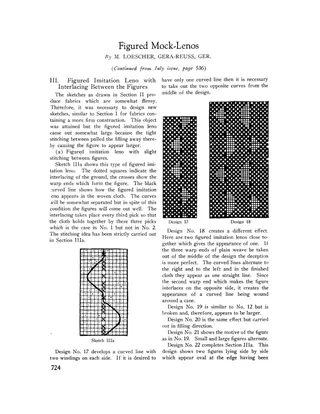
Second installment of M. Loescher's article on figured mock (imitation) lenos, covering Sections III to V. It describes figured imitation lenos with interlacing between the figures, lenos with only one floating warp end, and designs with warp or filling floats on the cloth surface that are not true imitation lenos. Sketches and Designs 17 to 33 are shown as drawdowns, each with notes on how the figure forms, warp and filling tension, and the effect in the cloth.
Die Musterung von Pulloverstoffen [The Patterning of Pullover Fabrics]
Article · 3 pages · German · weaving drafts
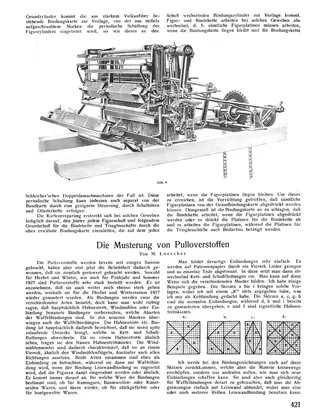
Part one of a German trade-journal article by M. Loescher on designing pullover fabrics in 1927. It explains that Hahnentritt (houndstooth-like), windmill and ice weaves, which are variants of waffle weave, dominated the season. It shows how to build them on point paper by alternating warp and weft floats, and how different warp and weft color arrangements produce checks and stripes from one weave. A 12-shaft example in black and white is described, with sketches a-i and pattern drawings I-IV. The scan also includes parts of two other articles: the end of a piece on a Jacquard card-saving device for Gobelin picture weaving (Max Goll) and a piece on machine-made wire heddles.
Die Musterung von Pulloverstoffen [The Patterning of Pullover Fabrics]
Article · 3 pages · German · weaving drafts
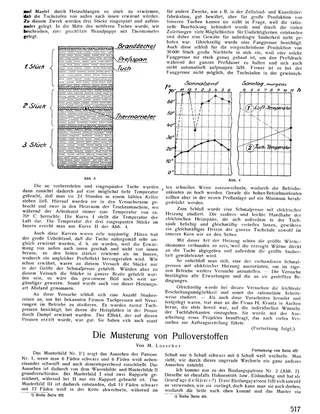
Part of a serialized German-language article from Melliand's Textilberichte on patterning pullover fabrics. Loescher describes houndstooth/ice-weave (Eisbindung) weave designs, numbered 1 to 7, several requiring 16 shafts, and explains how colour arrangement in warp and weft changes their appearance, and how designs can be turned or used for stripes. The drafts are illustrated as black-and-white pattern grids. The scan begins with the end of an unrelated article on cloth presses with electric heating and ends with the start of a section of E. Frotscher's article on crepe weaves.
Die Musterung von Pulloverstoffen [The Patterning of Pullover Fabrics]
Article · 2 pages · German · weaving drafts
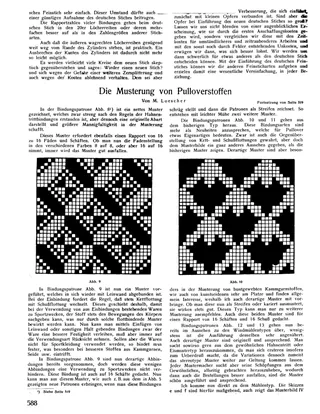
A two-page continuation of M. Loescher's article on designing patterns for pullover fabrics, published in Melliand's Textilberichte in 1927. It discusses weave diagrams (Bindungspatronen, Abb. 8-15) on 16 shafts, including houndstooth variants, ice weaves that alternate warp and weft floats, and the windmill (Mühlen) pattern achieved with 8 or 16 thread colour arrangements and plain-weave tie-downs. The page also opens with the end of a separate piece advocating a German fine gauge (deutscher Feinstich) for knitting cylinders.
Die Musterung von Pulloverstoffen [The Patterning of Pullover Fabrics]
Article · 3 pages · German · weaving drafts
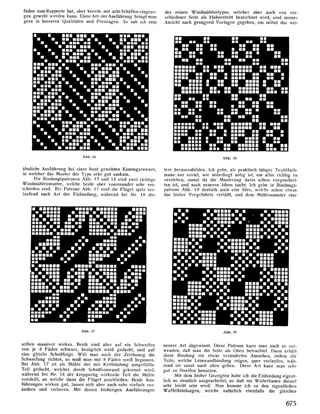
A 1927 installment of M. Loescher's series on patterning pullover fabrics, published in Melliand's Textilberichte. It presents weave patterns (Abb. 16-23) of the windmill (Mühlen), cock's-tread and ice-weave (Eisbindung) types, followed by waffle weaves (Waffelbindungen) with diagonal plain-weave lines. The text gives harness counts and repeat sizes (such as 8 shafts for a 24-thread repeat, and 16 shafts and picks) and suggests colour arrangements, stripes, and turning the draft to get a second pattern. The first page also carries the end of a separate text on plain weave, covering loom behaviour with a shed closed early, the movable whip roll, and typical plain-weave fabrics.
Die Musterung von Pulloverstoffen [The Patterning of Pullover Fabrics]
Article · 3 pages · German · weaving drafts
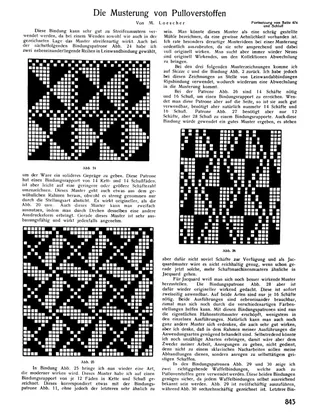
The concluding part of M. Loescher's article on designing patterns for pullover fabrics, from Melliand's Textilberichte, 1927. It discusses weave diagrams Abb. 24-30 (houndstooth-type, rib and waffle weaves), shaft and pick counts for repeats, and the use of Jacquard versus dobby looms. It also covers colour arrangements in warp and weft, the use of rayon in the weft, cotton warps, fabric widths, prices and finishing. The scan ends with the start of a separate article by Richard Hünlich on reinforcing or thickening fabrics with extra warps or wefts and on analysing them.
Weaving of Lengthwise Pleats
Article · 3 pages · weaving drafts
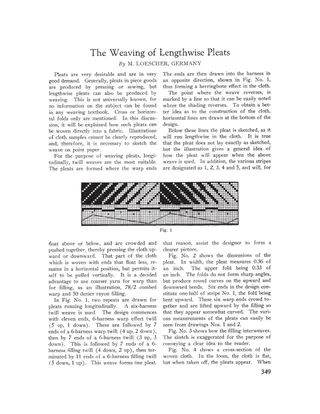
An article by M. Loescher of Germany explaining how lengthwise pleats can be woven directly into cloth using twill weaves, rather than pressed or sewn afterward. It gives step-by-step twill-group sequences on 6- and 8-harness threadings for several pleat designs (Figs. 1-8), with pleat dimensions, reed spacing and shrinkage allowances, yarn choices (coarser warp than filling), and notes on satin weaves, color effects and finishing. Most designs have repeats that need a Jacquard loom or many harnesses.
8 documents found