Textile Documents › Authors › Author: Josef Funke
4 documents found
Sort: 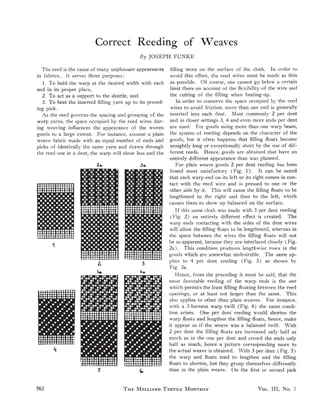
Correct Reeding of Weaves, Part 1
Article · 3 pages · weaving drafts
An article from The Melliand Textile Monthly on how the number of warp ends per dent in the reed changes the look of woven cloth. Funke examines plain weave, 3-harness twill, balanced and fancy twills, and satins reeded at 1, 2, 3 and 4 ends per dent. He uses drawdown diagrams to show where filling floats are lengthened or shortened and where diagonals, lengthwise rows or cross ribs appear. He concludes that the reeding should not put more ends per dent than a filling float covers, and that the usual rule of matching ends per dent to the weave repeat holds only relatively. The article is continued in a later part.
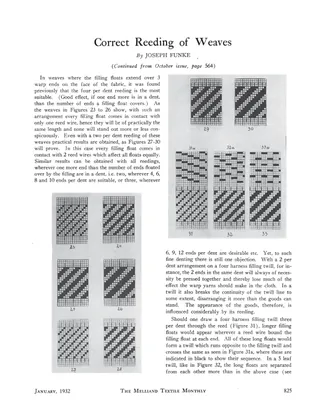
Correct Reeding of Weaves, Part 2
Article · 3 pages · weaving drafts
Second part of Joseph Funke's article on how the number of warp ends per dent in the reed affects the appearance of woven cloth. It examines filling twills (4-, 5- and 6-harness) and satin-type weaves, showing how different reeding plans produce uniform, elongated or shortened filling floats and visible lines in the twill. The text is illustrated with drawdown figures (Figures 23-44) and closes with a summary of the most and least suitable reeding rules.
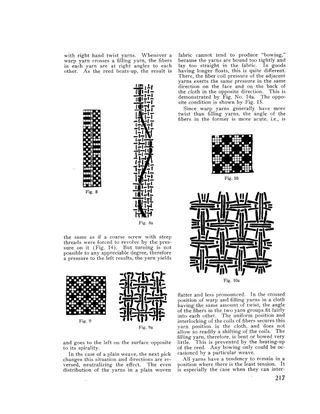
Effect of Yarn Twist and Weave on the General Appearance of a Fabric
Article · 7 pages · weaving drafts
A 1929 article from The Melliand by Josef Funke on how the direction and amount of yarn twist interact with weave structure to affect the look of a woven fabric. It explains how light reflects differently from right- and left-twist yarns, why yarns bow or deviate from straight lines in floats, honeycomb, mock leno and huck weaves, and how warp and filling twist relationships affect beating-up. It ends with how twill and gabardine constructions can control tilting of floats. Illustrated with numbered figures, including twill and other weave drawdowns.
Leinwandbindung [Plain Weave]
Article · 2 pages · German
A 1927 German-language technical article on plain weave (Leinwandbindung) by a textile school teacher, focused on how it is woven on hand looms and power looms. It covers shed formation with a roller (Geschirrwelle), eccentric cams, shaft lift, multiple shafts with skip drafting (Sprungeinzug), and the problem of streaky cloth and how a closing shed and a movable whip roll (Walkwelle) address it. It ends with the properties, uses and names of plain-weave fabrics. The scan opens with the end of another article on stripe effects in satin weaves, and closes with the start of a second article on patterning pullover fabrics.
4 documents found