Textile Documents › Authors › Author: E. Ullrich
5 documents found
Sort: 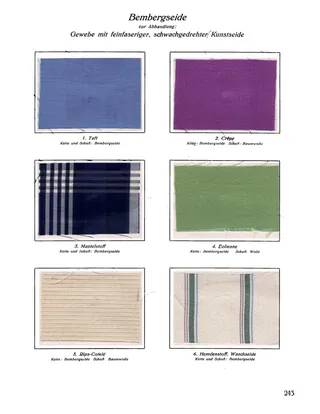
Gewebe aus feinfaseriger, schwachgedrehter Kunstseide [Fabrics from Fine-Filament, Low-Twist Rayon]
Article · 4 pages · German
A 1927 German article from Melliand's Textilberichte on weaving fine-filament, low-twist rayon (Bemberg cupro silk). It describes six sample fabrics (taffeta, crepe, coat fabric, eolienne, rips-cotelé, shirting) with warp and weft yarns, twist and thread counts. It then gives detailed operating rules for rayon weaving: sizing, winding, warping, loom setup, reed, shuttle, humidity control and finishing. A second article by Justin Hausner on processing rayon with Aktivin begins on the last page.
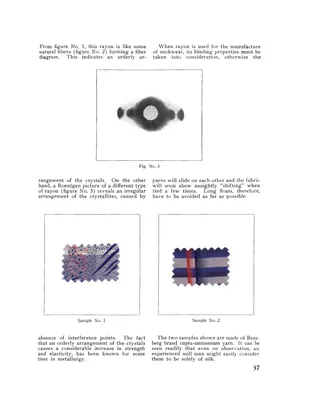
Rayon Necktie Fabrics
Article · 2 pages
A short 1929 trade article on the use of rayon in necktie fabrics. It explains that cuprammonium rayon has improved enough in strength, elasticity and fineness to be used as warp as well as filling, and compares its filament diameter and denier with weighted silk. It discusses the molecular structure shown by X-ray diffraction patterns, the need to avoid long floats so yarns do not shift, and two sample fabrics woven from Bemberg cupra-ammonium yarn.
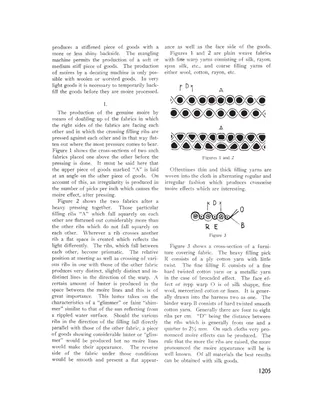
Various Types of Moire Effects and Their Production, Part 1
Article · 3 pages
A 1929 trade-journal article by E. Ullrich of Krefeld on the types of moire effects in fabrics and how they are produced. It distinguishes genuine moire from pressed, impregnated or imitated moire. It explains that genuine moire needs plain-weave rib fabrics with fine, closely set warp and heavy filling, and describes how two fabrics are doubled face to face and pressed, with cross-section diagrams. It also covers calenders, mangling machines, plate presses and decating machines, and tips for keeping picks parallel. Part 1 of a series, ending "To Be Continued".
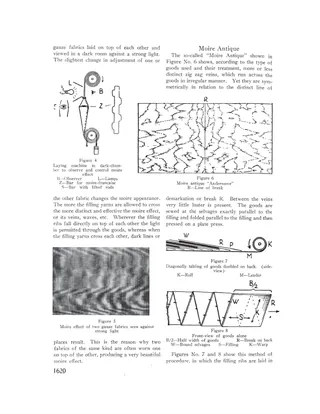
Various Types of Moire Effects and Their Production, Part 2
Article · 8 pages
Second installment of E. Ullrich's serial on moire effects in fabrics, covering how doubled cloths are laid and checked and how different moire types are produced by finishing. It describes moire antique, moire renaissance (mirror moire), moire velours (cloudy moire) and moire francaise (striped moire), with the mangles, hydraulic and plate presses, calenders, toothed bars and friction-disc and patterned rolls used for each. The final section covers weaving moire effects with wavy, ombre and gravure reeds, citing Krefeld patents of 1888 and 1898. Illustrated with 30 figures of machines, diagrams and fabric swatches.
Various Types of Moiré Effects and Their Production, Part 3
Article · 8 pages
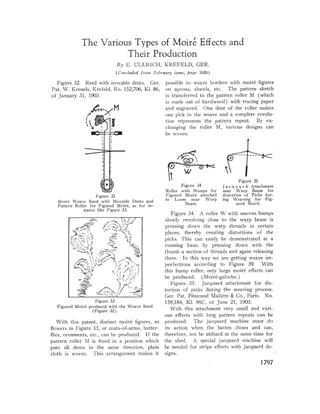
Concluding part of E. Ullrich's series on moiré effects in silk and rayon cloth. It describes loom attachments that distort the picks during weaving (movable-dent reeds, hump rollers, Jacquard attachments, whirling brushes, lamella and ring rollers, needle levers) and calender methods for genuine moiré on single cloth, ribbons and striped goods. It also covers non-genuine pressed (gauffrage) moiré, half-genuine moiré on repp weaves, and printed moiré, and ends with a short conclusion. Illustrated with numbered figures (32-55) of machinery and sample cloths; no weaving drafts.
5 documents found