Textile Documents › Authors › Author: Karl Aberle
3 documents found
Sort: 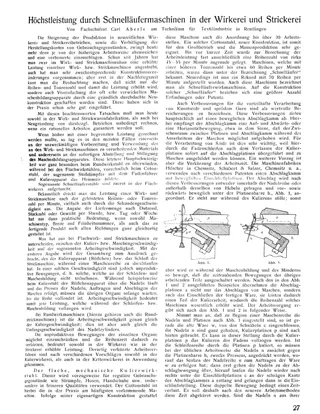
Höchstleistung durch Schnelläufermaschinen in der Wirkerei und Strickerei [Maximum Output through High-Speed Machines in Knitting and Hosiery Manufacture]
Article · 2 pages · German
A 1927 German-language article by Carl Aberle of the Reutlingen textile technical school on raising output in knitting and hosiery manufacture with high-speed machines. It explains the difference between knitting speed and working speed, then describes improvements to flat Cotton frames, notably a movable knock-over comb with enclosing sinkers. It also covers high-speed circular knitting machines, including the Terrot system and the Haaga loop-wheel frame. Three cross-section diagrams of needle and sinker mechanisms illustrate the text, and the article ends with "Fortsetzung folgt" (to be continued).
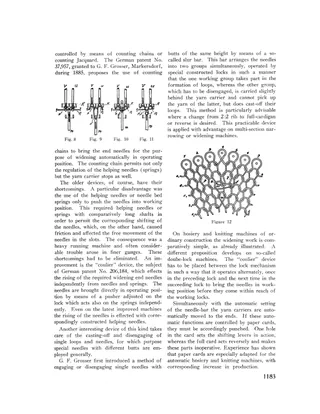
Manufacture of Fashioned Knit Goods
Article · 3 pages
Concluding installment of Karl Aberle's article on making fashioned (shaped) knit goods on flat and tubular knitting machines. It covers widening of double-sided rib and cardigan fabrics, the special difficulty of widening tubular work, and Grosser's patented method of widening tubular fabric without holes. It also describes automatic widening devices (counting chains, counting Jacquard, the "coulier" device, slur bar, punched paper cards), illustrated with needle-bed, lock, and loop diagrams in Figures 6-12.
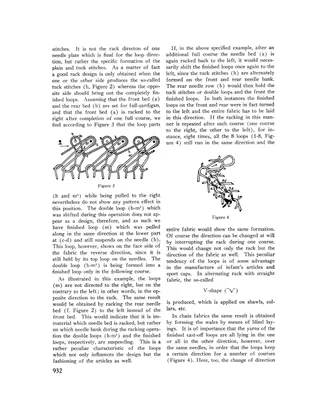
Manufacture of Fashioned Knit Goods, Part 1
Article · 6 pages
First part of an article on how fashioned (shaped-on-the-machine) knitted goods are manufactured, by Karl Aberle of Reutlingen. It compares fashioned articles with garments cut from piece goods and lists the main shaping methods: changing loop form, loose and tight loops, changing loop direction by racking, widening, narrowing and gussets. It covers stitch changes for connected sleeve parts, needle selection on flat and circular machines, rib dial adjustment on hosiery machines, rack stitch and tuck stitches, and widening by adding needles. Five diagrams illustrate sleeve sections, loop structures, racking and carrier-limited widening. The article ends with "To be continued".