Textile Documents › Publications › Publication: Textile World Record
26 documents found
Sort: 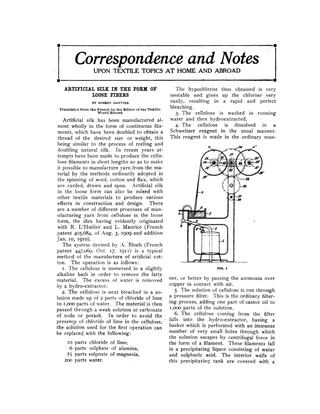
Artificial Silk in the Form of Loose Fibers
Article · 3 pages
A 1913 article, translated from the French, on making artificial silk (rayon) as short loose fibers rather than continuous filaments, so it can be carded and spun like wool, cotton or flax or blended with other fibers. It describes several patented processes: Bloch's cuprammonium (Schweitzer reagent) method, Girard's winding of viscose filaments on bobbins and cutting them into staple, Girard and Buffard's metal-plate spinnerets, and Cahen's collodion-based filaments formed without pressure. Line drawings show the machinery and spinneret details. The scan ends with a short unrelated note on depression in the Scotch tweed industry.
Efficiency, its Use and Abuse
Article · 4 pages
An address by Melville W. Mix, president of the Dodge Manufacturing Company, delivered before the Chicago Executive Club and printed in Textile World Record in 1913. It argues that industrial efficiency and operative standardization must take account of workers' goodwill and morale rather than treating people as machines. Mix uses golf handicaps as an analogy for standards and describes a departmental accident-prevention score board at his company, along with the National Association of Corporation Schools. It is a general management essay with no weaving or textile technical content.
Foreign Novelties
Textile World Record, November 1903
Article · 4 pages
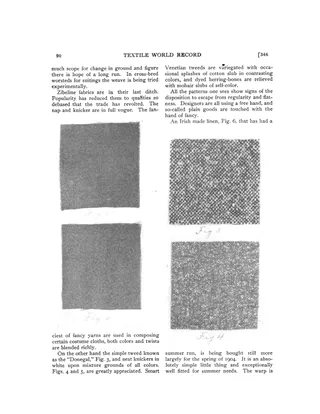
A 1903 trade-journal report from a special correspondent on novelty dress goods and suitings in the Bradford, England, market. It covers the 12-shaft Roxana weave in black goods, canvas/hopsack, Donegal tweeds, knickerbocker effects, Irish linen, mercerized crepon-type figured cloths, French seal ripple cloth, and silk-striped men's tweeds. It ends with notes on Cravenette and other rainproof finishing processes. Halftone swatch photographs illustrate several of the fabrics; no weaving drafts are shown.
Fostering the Growing of Cotton
Textile World Record, November 1913
Article · 2 pages
A two-page editorial from Textile World Record on U.S. government support for cotton growing, prompted by Carl S. Schofield's paper on Egyptian-type cotton in the Southwest. It lists the Bureau of Plant Industry's experiments, farmer seed distribution, and record-keeping from 1902 to 1912. It argues that cotton growing is more directly protected than cotton manufacturing. It also criticizes the Southern Cotton Corporation's 1912 proposals to Lancashire spinners, which it sees as a step toward a cotton trust.
Handbook of Weaves
Article · 5 pages · weaving drafts
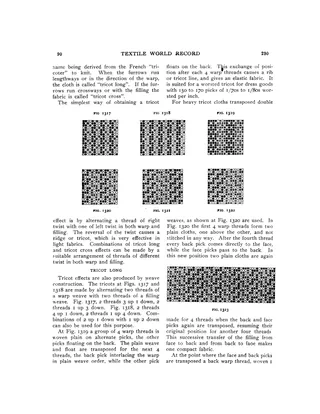
An installment of G. H. Oelsner's serialized "A Hand Book of Weaves," translated and revised by Samuel S. Dale, covering felt-cloth weaves, tricot weaves (long and cross), and cloths with an extra inner fabric. The text explains how tricot ridges are produced by alternating twills, transposed double plain weaves, and back-warp or back-filling constructions, with advice on yarn size and set. It includes drawdowns Figs. 1311-1348 and step-by-step rules for drafting outer and inner weaves.
Handbook of Weaves
Article · 5 pages · weaving drafts
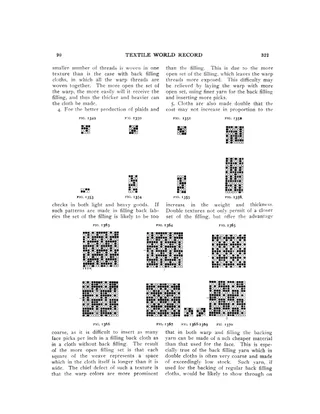
One installment of G. H. Oelsner's serial 'A Hand Book of Weaves', translated and revised by Samuel S. Dale, on double cloths. It lists the uses of double cloth, gives common face/back weave combinations and set ratios, and explains how double-cloth weaves are drafted. It covers tubular fabrics (lamp wicking, fire hose, seamless bags, circular felts) and the principles of stitching face and back together. The figures are drawdown grids numbered Figs. 1349-1370.
Leno Cloths, Part 1
Article · 3 pages · weaving drafts
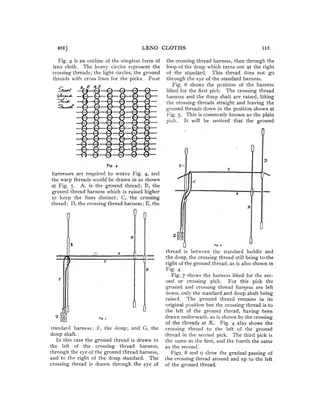
The first part of a 1903 trade-journal article on the construction of leno cloths, written for textile designers. It explains the doup heddle, the doup shaft, and the ground and crossing threads, and defines the related terms. It then walks through the harness lifts for the plain pick and the crossing pick in the simplest leno, and describes the hemstitch leno, with two picks per shed. Figures 1-10 include doup diagrams and interlacement grids, and the article ends "to be continued."
Manufacture of Elastic Fabrics
Article · 3 pages · weaving drafts
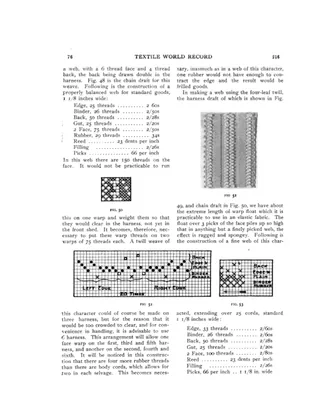
Part of a serialized article by Samuel Brown on weaving narrow elastic webbing, continued from the October issue. It covers satin-face (3-leaf twill) and 4-leaf twill webs for suspenders and corset trimming, with harness and chain drafts, and heavier webs for police and fireman braces and farmers' web. Warp constructions are given as tables of thread counts, yarn sizes, reed, filling and picks per inch, with notes on rubber threads, binder and back warps, picot edges and raised cords.
Manufacture of Fancy Yarn, Part 1
Article · 5 pages
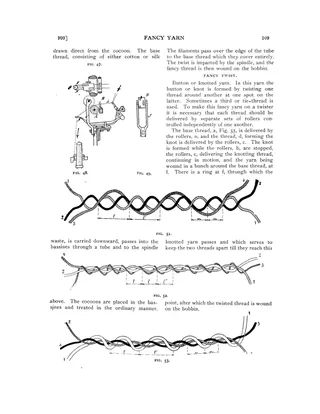
A continuing 1906 trade-journal article on making fancy (novelty) yarns on twisting machines. This installment covers twisted gut yarn, barred twist, mouline twist, silk-covered threads, and button or knotted yarn. It explains the roller, gear, ratchet and cam arrangements that start and stop delivery rolls to form knots. It is illustrated with numbered line figures of yarn structures and machine parts.
Manufacture of Fancy Yarn, Part 2
Article · 7 pages
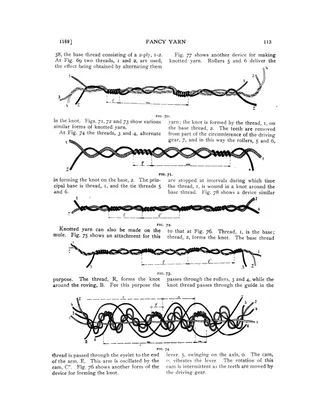
Second installment of a serial article on fancy yarn manufacture, published in Textile World Record in February 1906. It describes the machinery and mechanisms for making knotted (boutonné) yarns: cams and clutch-driven roller sets that stop and start to form knots, mule attachments, and a frame with hollow spindles, bobbins and a ratchet-driven reel. It also covers how knot size, spacing and elongation are controlled by changing cams, gears and vibrating guide eyes or spindle rails. Figures 60-84 show the apparatus and the resulting yarn structures.
New Styles in Braids
Article · 2 pages
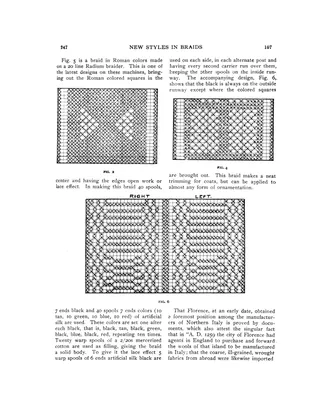
A 1913 trade article by Montcalm on new styles of machine-made braid trimmings, especially those in Bulgarian, Balkan and Roman color combinations. It describes the spool counts, colors and materials (artificial silk, mercerized cotton, gimp) used on lace braiding machines, including a 24 line lace braider and a 20 line Radium braider. Photographs show braid samples, and grid charts show the jacquard-controlled spool and color placement for each braid. The braids were used as trimmings for hats and coats.
Novel Piano Card Stamping Machine
Textile World Record, November 1903
Article · 3 pages
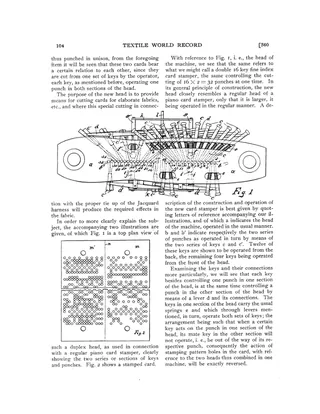
Describes a duplex head for a piano card stamper that combines two standard heads side by side, with paired keys linked by levers so that when a key punches a hole in one card, its mate leaves the corresponding position unpunched in the other. The pair of cards cut together has reversed hole patterns, intended for elaborate Jacquard fabrics with a suitable harness tie-up. The article explains the 16-key double head (32 punches), the key pairing schemes, peg-hole punches, and a worked comparison of hole positions on two cards, with two figures.
Novelties from Foreign Sources, Part 1
Textile World Record, October 1903
Article · 3 pages · weaving drafts
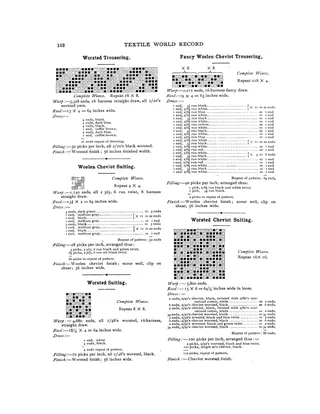
Three pages of mill specifications for men's woolen and worsted cloths, from the 1903 Textile World Record column on foreign novelties. Each entry gives a complete weave drawdown with its repeat size, plus warp count, harness draw, reed, color dressing, filling picks and finishing instructions. Fabrics include woolen cheviot suitings, worsted trousering and suiting, fancy cassimere and a fancy woolen overcoating.
Novelties from Foreign Sources, Part 2
Textile World Record, November 1903
Article · 4 pages · weaving drafts
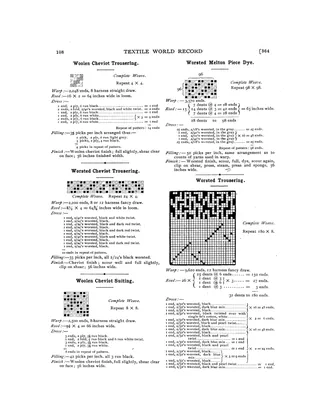
Four pages of mill specifications for men's wool and worsted suiting, trousering, cheviot and melton fabrics, taken from foreign sources. Each entry gives a drawdown of the complete weave with its repeat size, warp count and harness draw, reed and width in the loom, a detailed warp dress and filling arrangement with yarn counts and colors, and finishing instructions. Fabrics include worsted melton suiting, worsted trousering, fancy worsted trousering, woolen and worsted cheviots, and a piece-dyed worsted melton.
Novelties from Foreign Sources, Part 4
Textile World Record, February 1906
Article · 2 pages · weaving drafts
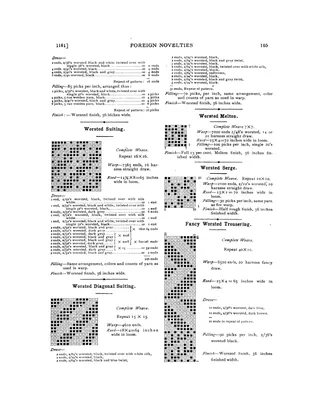
A two-page installment of a series in Textile World Record giving specifications for foreign woolen and worsted dress and suiting fabrics. Each entry gives a weave drawdown (repeat sizes from 7x7 to 40x10), warp ends and harness draw, reed, color dressing, filling picks per inch, and finishing instructions. Fabrics include piece-dye coating, melton suitings, diagonal suiting, serge, and fancy trousering.
Our Textile Design School: Lesson 17 -- Diagonals Obtained by Means of Filling Drafting
Textile World Record, January 1906
Article · 6 pages · weaving drafts
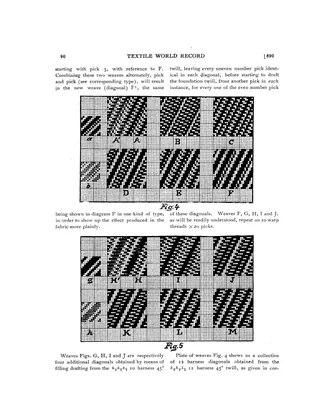
Lesson XVII of a serial textile design course in Textile World Record, explaining how to design diagonal weaves by "filling drafting", alternating picks of a regular 45-degree twill with picks of the same twill started on a different pick. Worked examples use 8, 9, 10, 12 and 16 harness twills, with plates of drawdowns showing the foundation twills, the resulting diagonals and the pick-by-pick drafting sequences. Repeat sizes are given (e.g. 8 harness x 16 picks, 12 x 24, 16 x 32), and the method is presented as useful for woolen and worsted fabrics.
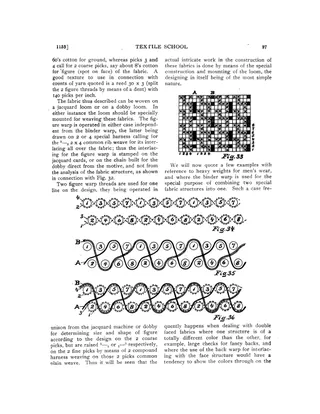
Our Textile Design School: Lesson 18 -- Binder Warps
Textile World Record, February 1906
Article · 11 pages · weaving drafts
Lesson XVIII of the Textile World Record's textile design school series, on binder warps: extra warps, usually cotton, that stiffen or bind fabric structures. It covers binder warps in single cloth (silk dress goods built on 5- and 8-leaf satin and 2x4, 2x6 and 2x8 warp rib weaves, each combined with a plain binder at ratios from 2:1 to 4:1), and in cotton pique and figured dress goods. It also covers double cloth for men's wear, where binder warps join two plain or twill fabrics, and pile fabrics such as tapestry and Brussels carpets. Most pages carry weave drawdowns (Figs. 1-47) and thread-interlacing diagrams, with text on repeats, ratios, take-up and the need for separate warp beams.
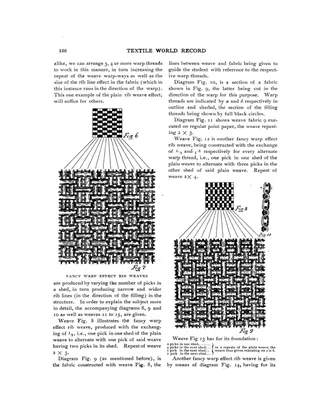
Our Textile Design School: Lesson 2 -- Rib and Basket Weaves
Textile World Record, October 1903
Article · 7 pages · weaving drafts
Lesson 2 of a serialized textile design course from Textile World Record, covering rib and basket weaves derived from the plain weave. It explains warp-effect and filling-effect ribs (plain and fancy), plain and fancy basket weaves, and rib weaves with interwoven backs, stitched warp threads, and strengthening warps. It also covers figured rib weaves, warp and filling combinations, and corded effects with binder and figure warps. Numbered figures show drawdowns and fabric diagrams, and the lesson ends with exercises for students.
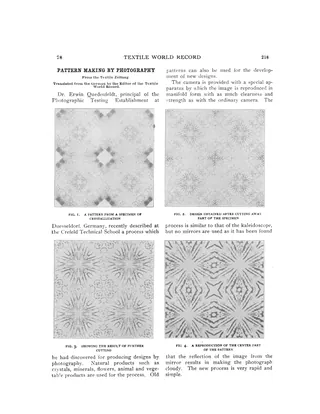
Pattern Making by Photography
Textile World Record, November 1913
Article · 2 pages
A short 1913 trade-journal article, translated from the German Textile Zeitung, describing Dr. Erwin Quedenfeldt's photographic method for generating textile designs. A camera fitted with a special apparatus reproduces an image in multiple, kaleidoscope-like repeats without mirrors. Source objects include crystals, minerals, agate, marble, butterfly wings and flowers. Eight halftone figures show the resulting patterns, and the text notes that cutting the specimen produces many variations. The article does not cover weaving drafts.
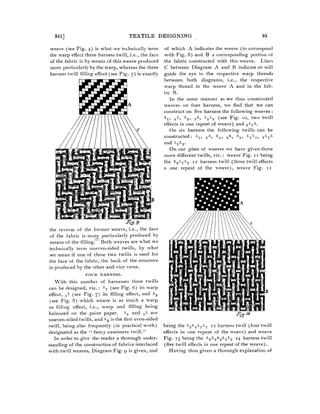
Plain Twills and Satins; The Foundation of Textile Designing
Textile World Record, November 1903
Article · 5 pages · weaving drafts
A 1903 instructional article from Textile World Record explaining the three foundation weaves of textile design: plain weave, twills and satins. It describes how each is constructed on point paper, with diagrams linking weave notation to fabric cross-sections, covers 3-, 4-, 5- and 6-harness twills plus larger twills up to 24 harness, and gives a rule for building satin weaves using counters. It closes with a set of study questions and a recommendation of E. A. Posselt's Technology of Textile Design.
Recent Textile Patents
Textile World Record, October 1903
Article · 2 pages
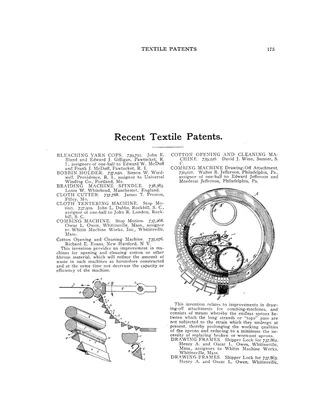
A two-page list of recent U.S. textile machinery patents from Textile World Record, October 1903, arranged alphabetically by subject with patent numbers, inventors, and assignees. Most entries are for looms and loom parts, with others for spinning, combing, drawing, flax, mercerizing, and knitting machinery. A few entries have short descriptions and line drawings: a cotton opening and cleaning machine, a combing machine drawing-off attachment, and a vertical wool washing machine.
Recent Textile Patents
Textile World Record, November 1903
Article · 2 pages
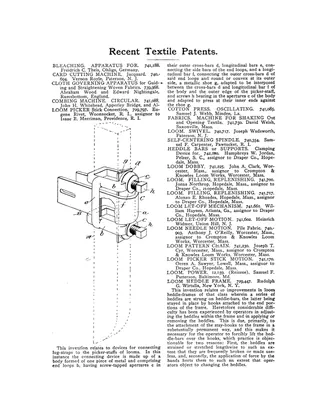
A two-page listing of recent U.S. textile machinery patents from Textile World Record, November 1903, arranged alphabetically by subject with patent number, inventor, location and assignee. Most entries concern looms (pickers, heddle frames, dobbies, let-off motions, filling replenishing, pattern chains), plus spinning, twisting, combing, bleaching and Jacquard card-cutting apparatus. A few entries include the patent's descriptive text and drawings, such as a loom picker-stick connection, a loom heddle frame, a spinning machine guide board, and a wool combing machine.
Recent Textile Patents
Textile World Record, January 1906
Article · 2 pages
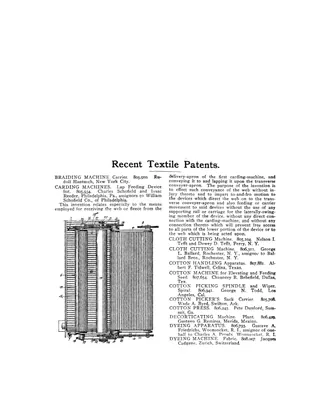
A two-page list of U.S. textile-related patents issued around late 1905 and early 1906, arranged alphabetically by subject with patent numbers, inventors, locations, and assignees. Only the carding machine lap-feeding device (805,934) is described in any detail. Most entries cover looms and loom attachments (warp stop motions, let-off, take-up, lappet, narrow ware, pile fabric), spinning machinery, cotton handling, and dyeing apparatus. One entry is for a weaving diagram and method of making it (805,244, Jan Szczepanik).
Recent Textile Patents
Textile World Record, November 1913
Article · 1 page
A one-page listing of recent US textile patents and trademarks from Textile World Record, November 1913. Patents are listed alphabetically by subject with patent number, inventor and location, covering looms, shuttles, spinning machinery, dyeing and bleaching apparatus, hosiery, knitting, and Jacquard connections. A short list of recently registered textile trade-marks follows, giving the mark, goods and owner.
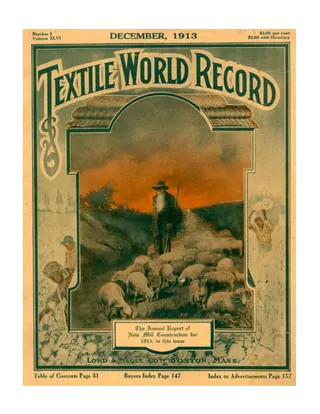
Textile World Record, Vol. 43, No. 3 (December 1913)
Textile World Record, December 1913
Periodical · 266 pages · weaving drafts
December 1913 issue of Textile World Record, an American trade journal for the cotton, woolen, worsted, silk and knitting industries. It contains monthly comment, association news, the annual report of new mill construction for 1913, correspondence and technical notes (filling leno weaving, a new process for weaving warp pile fabrics, artificial silk fibers, a hand book of weaves with drafts), questions and answers, dye recipes, knitting and hosiery articles, mill news and a large amount of machinery and supply advertising.
The Weaving of Filling Leno
Article · 4 pages
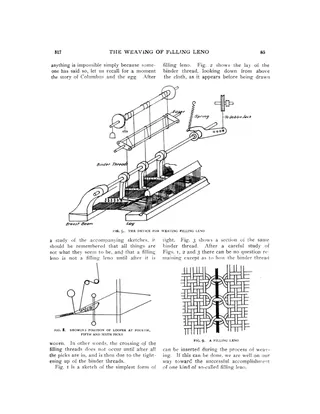
A 1913 article from Textile World Record explaining how filling leno effects, in which weft threads cross one another, can be woven on a power loom. It describes a binder thread inserted by spring-steel loopers mounted over the breast beam and operated from an open shed dobby. The loopers take three positions (out, half in, all in), and the crossing of the filling picks occurs only when the binder threads are tightened after the picks are in. Seventeen figures show the loom attachment, looper positions at successive picks, and filling leno stripe, block and net effects.
26 documents found