Textile Documents › Authors › Author: Paul R. O'Connor
21 documents found
Sort: 
Double Weave Workshop Notes: Basket Weaves in Double Weave
Web Doc · 6 pages · weaving drafts
Workshop notes explaining how to weave double weave with both layers in 2/2 basket weave on an 8-shaft loom, using a straight draw threading with alternating dark and light warps. They show how the tieup or peg plan is developed, how the top and bottom layers are separated and drawn down, and how color-and-weave variations arise from different treadling orders and six peg plans. A final section extends the idea to a window (frame) design on 12 shafts, with plain weave and basket weave options, and shows other threadings including one suited to 3/3 basket weave.
Double Weave Workshop Notes: Double Weave with a Four-Shaft Loom
Web Doc · 17 pages · weaving drafts
A self-guided workshop program by Paul O'Connor that leads weavers step by step through double weave on a four-shaft loom, adapted from his multi-day guild and conference workshops. It explains how the drawdown and tieup of double weave arise from the weave structure (top and bottom layers, raising the top-layer shafts to weave the bottom layer). It then varies treadling order, tieup (shorthand such as 13/24 and 24/13, and the six tieups of each group), threading, and warp and weft yarn sizes. It closes with practical loom tips and exercises covering two layers, double width, tubular weave, and color effects.
Double Weave Workshop Notes: Double Weave with an Eight-Shaft Loom
Web Doc · 13 pages · weaving drafts
Workshop notes by Paul O'Connor on double weave for an eight-shaft loom, continuing from a four-shaft double weave program. They explain warp units, blocks and profile drafts, then the window and checkerboard designs with threadings, tieups and treadling, followed by color-planning exercises. Further sections cover skeleton tieups for 10- and 12-treadle looms, twill structures (1/3, 3/1 and 2/2) in double-width cloth, and four-layer multilayer weaving, ending with an analysis of a Kay Sekimachi monofilament hanging.
Double Weave Workshop Notes: Taking the Mystery Out of Double Weave Tie-Ups
Web Doc · 8 pages · weaving drafts
A step-by-step workshop handout explaining how to work out tie-ups for double weave, one weaving block at a time. It uses a 4x4 grid method relating warp shafts and colors to weft picks and colors, marking top-layer (T) and bottom-layer (B) intersections and adding dots for raised top-layer shafts. The method is worked for Block A (shafts 1-4) and Block B (shafts 5-8), then combined into 8-shaft tie-ups for a background and a window design. Closing pages cover color notation and the possible warp color pairs for two-color and four-color threadings.
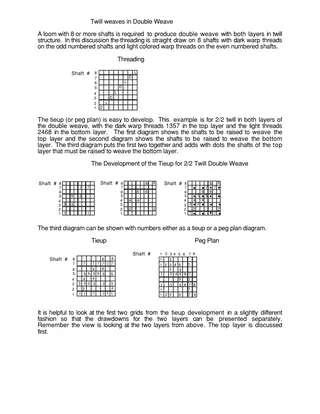
Double Weave Workshop Notes: Twill Weaves in Double Weave
Web Doc · 7 pages · weaving drafts
Workshop notes explaining how to develop twill structures in both layers of double weave on 8 or more shafts. They cover the straight-draw threading with dark and light warps, the tieup and peg plan for 2/2 twill, and how the bottom layer is drawn when viewed from below. Further examples change the treadling order or peg plan (including 3/1 and 1/3 twill) to produce color-and-weave effects, and the notes end with a 12-shaft window design with plain weave or twill backgrounds and borders.
Double Weave; A Retrospective
Paul R. O'Connor · 2006
Book · 128 pages
Illustrated catalog of a retrospective exhibit of double weave work by Paul R. O'Connor, prepared for the Complex Weavers Seminars at Hope College in July 2006. Each piece is shown in front and back photographs with a short note on its design idea and technique, covering 1973 to 2005. Works include window and checkerboard designs in sewing thread, sculptural and interchanged-layer pieces, triple weave, pickup and supplementary warp and weft work, and many bead weavings. The foreword and introduction credit the influence of Richard Landis, Kay Sekimachi and Yaakov Agam.
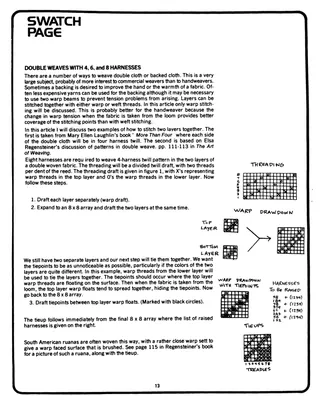
Double Weaves with 4, 6 and 8 Harnesses
Article · 2 pages · weaving drafts
An article from the Minnesota Weaver's Swatch Page on weaving double cloth with warp stitching on 4, 6 and 8 harnesses. It first walks through a divided four-harness twill double cloth on eight harnesses, after Mary Ellen Laughlin's 'More Than Four', drafting each layer, combining them in an 8 x 8 array, and placing tiepoints under top-layer warp floats. It then covers Elsa Regensteiner's pattern-harness approach from The Art of Weaving, with tabby tieups and added tiepoint treadles for a quilted effect, illustrated with a purple and pink tunic. Drafts, tieups and drawdowns are included.
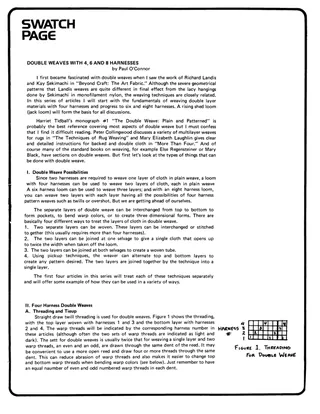
Double Weaves with 4,6 and 8 Harnesses
Article · 2 pages · weaving drafts
The first article in a series by Paul O'Connor introducing double weave on a rising-shed (jack) loom, beginning with four harnesses and leading toward six and eight. It outlines four ways of treating the two layers (separate layers, joined at one selvage, tubes, and pickup), then covers straight-draw threading, sett, tieups and treadling for two separate layers. It closes with interchanging layers for a checkerboard effect and a skeleton tieup for a four-harness loom with six treadles. Figures show the threading, a layer cross section, and tieup diagrams.
Double Weaves with 4,6 and 8 Harnesses
Article · 2 pages · weaving drafts
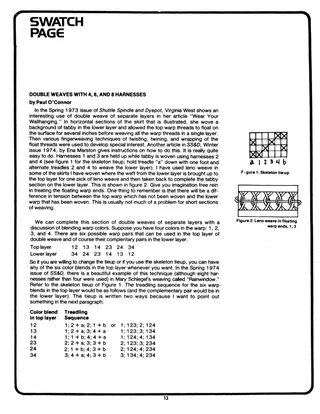
A two-page article from Paul O'Connor's series on double weave, covering double weave of separate layers on four harnesses using a skeleton tie-up. It explains leaving top warp threads floating over a tabby lower layer, using leno, and blending four warp colors in the top and lower layers with treadling sequences for each pair, and how to avoid float errors when changing blends. The second half covers double width weaving, slit placement at the selvage or center, treadling and selvage cross checks, and a ruana project combining double width and separate layers.
Double Weaves with 4,6 and 8 Harnesses
Article · 2 pages
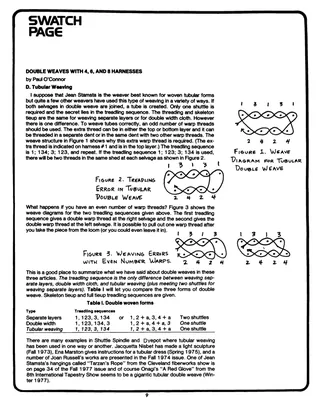
Section D (Tubular Weaving) of a series on double weaves by Paul O'Connor. It explains how joining both selvages of a double weave makes a tube, why an odd number of warp threads is needed, and which treadling sequences work (1; 134; 3; 123). A table compares treadling for separate layers, double width cloth and tubular weaving. It also gives instructions for pillow covers, small purses or glasses cases, pockets stuffed on the loom, and caps or dolls, and cites examples from Shuttle Spindle and Dyepot.
Double Weaves with 4,6 and 8 Harnesses
Article · 2 pages · weaving drafts
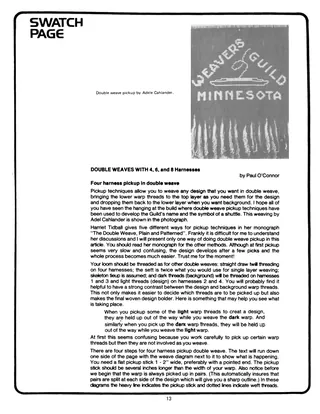
An installment in a series by Paul O'Connor on double weave, covering four-harness pickup double weave. It explains threading as a straight draw twill with dark warp on harnesses 1 and 3 and light warp on 2 and 4, the use of a pickup stick, and a four-step weaving procedure, with diagrams of stick positions and weft shots. It also gives a variation alternating light and dark shots, a two-stick option, and advice on charting designs in pairs of warp threads. It mentions that later articles will cover 6- and 8-harness double weaves.
Double Weaves with 4,6 and 8 Harnesses
Article · 3 pages · weaving drafts
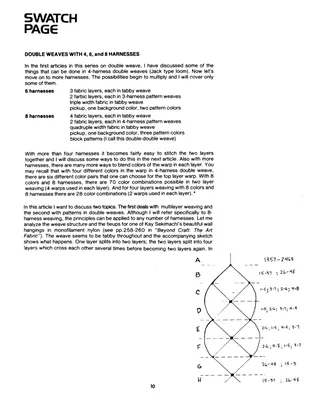
An installment in Paul O'Connor's series on double weave, extending from 4 harnesses to 6 and 8. It lists what 6- and 8-harness double weaves can do (multiple tabby layers, pattern layers, pickup, block patterns) and counts the possible warp color combinations. It analyzes the layer structure and tieups of a Kay Sekimachi monofilament wall hanging woven as four crossing layers. It then covers pattern weaves in double-width cloth, including the reversal of the lower layer's pattern and a corrected treadle sequence for the twill join at the closed selvage.
Double Weaves with 4,6 and 8 Harnesses
Article · 3 pages · weaving drafts
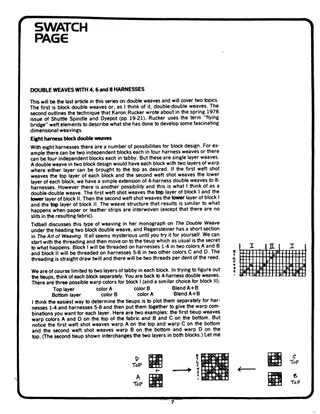
Final article in Paul O'Connor's series on double weaves in the Minnesota Weaver. It explains eight-harness two-block double weaves ("double-double weaves"), covering threading in two colors per block, tieups, color-and-layer planning, and the number of color patterns a single warp can give. It then outlines Karon Rucker's "flying bridge" technique, in which weft floats between layers so the cloth can be folded off the loom into dimensional forms. Includes small drafts, diagrams, photographs of the author's work, and a bibliography.
Drafting for Weft-Faced Weaving
Article · 4 pages · weaving drafts
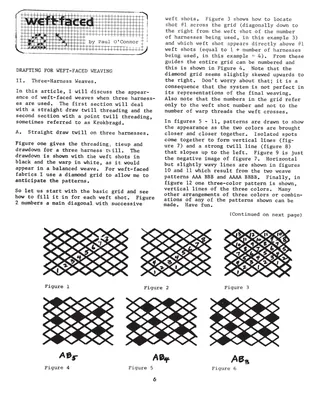
Part II of Paul O'Connor's series on drafting for weft-faced weaving, covering three-harness weaves. It explains a diamond-grid method for anticipating patterns in straight-draw twill and shows how two- and three-color weft arrangements (AB, A2B, A3B3, ABC and others) change the look of the fabric. A second section treats point twill threading, or Krokbragd, with its three-treadle sequence, color rotations, and the different design on the back of the fabric. Illustrated with drawdowns, a draft, and photographs of the front and back of a sample.
Drafting Weft-Faced Patterns: Four Harness Twills
Article · 2 pages · weaving drafts
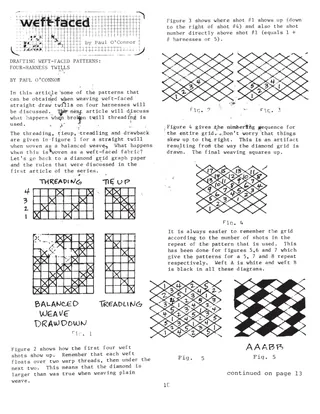
Article in a series on drafting weft-faced patterns, covering straight-draw 2/2 twill threaded on four harnesses. It uses diamond grid graph paper to work out how weft shots appear, numbering the shots across the grid and showing 5-, 7- and 8-shot repeat patterns in two colors (white and black). It ends with a 12-shot sequence on a 12-shaft diagram, which is also shown as Plate 52 in Collingwood's book.
Network Drafting for Double Weave
Paul R. O'Connor · c. 1996-2000
Web Doc · 86 pages · weaving drafts
A web-published monograph by Paul O'Connor on applying Alice Schlein's network drafting principles to double weave. It moves from a single-layer network drafting background through networked double weave designs (window and checkerboard) using tieups and peg plans on 8, 12 and 16 shafts, to designs built on blocks. It also covers integrated double weave, in which all threads lie in a single cloth layer, and symmetry rules such as extra threads at turning points. Appendices hold catalogs of 4x4 peg plans with their drawdowns (0 to 8 additional pegs) and a discussion of turning points in double weave.
Peter Collingwood's Shaft Switching Technique, Part 1
Article · 2 pages · weaving drafts
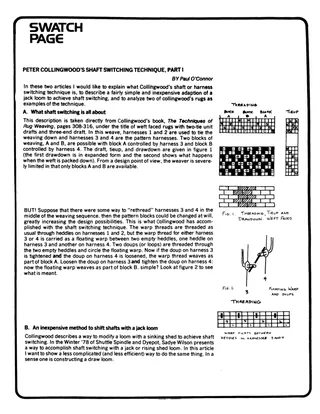
Part 1 of a two-part article by Paul O'Connor explaining Peter Collingwood's shaft (harness) switching technique for weft-faced rugs. It describes how floating warp threads held by doups between empty heddles on shafts 3 and 4 can be switched between pattern blocks A and B. It also gives a low-cost way to adapt a jack loom with a raised bridge, cup hooks and nylon seine twine doups, with practical sett and weft advice, and refers to Collingwood's Plate 98 rug as an example.
Peter Collingwood's Shaft Switching Technique, Part 2
Article · 2 pages · weaving drafts
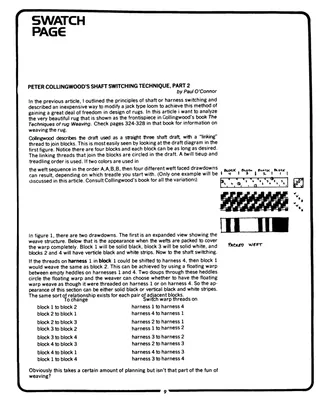
Second of two articles by Paul O'Connor explaining Peter Collingwood's shaft switching technique for weaving rugs. It analyzes the rug shown as the frontispiece of Collingwood's The Techniques of Rug Weaving, using a three-shaft threading with linking threads to join four blocks and a twill tieup. It explains how floating warp threads running through doups between empty heddles can be switched between shafts to change blocks, with a table of the switches needed. Figures include a block draft with drawdowns, a drawing of the rug and a threading draft for the switching section.
Reference Guide for Double Weave
Web Doc · 44 pages · weaving drafts
A short reference manual on loom-controlled double weave for 4 and 8 shaft looms, written by Paul O'Connor for workshop students and others needing a quick refresher. It covers weave structures (double width, tubular, two separate layers), the six 4-shaft tieups, a step-by-step method for deriving tieups and peg plans with T/B notation, and how to separate drawdowns for the top and bottom layers. Later sections treat color-and-weave effects with DLDL and DDLL color orders, 8-shaft units and blocks, profile drafts, windows and checkerboard designs, multi-color warps, and Kathryn Wertenberger's methods for drafting double-width cloth.
A Twill of Your Choice
Book · 172 pages · weaving drafts
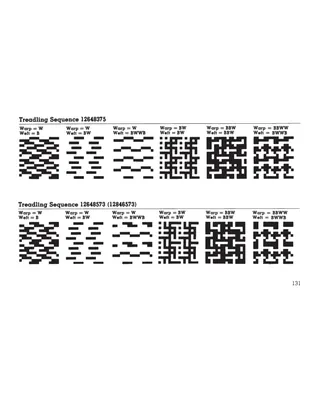
A reference collection of color-and-weave twill patterns for straight draw threadings on 2 to 8 harnesses, with over 1800 computer-generated drawdowns. The introduction explains how the number of distinct twills is counted (1 for 3 shafts, 2 for 4, 4 for 5, 14 for 6, 52 for 7, 320 for 8). Each treadling sequence is shown with several warp and weft color arrangements in black and white (W, B, BW, BWWB, BBWW and others). A closing section of photographs of woven samples refers back to the drawdown pages.
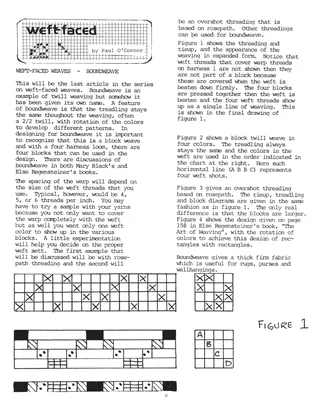
Weft-Faced Weaves - Boundweave
Article · 2 pages · weaving drafts
Final article in a series on weft-faced weaves, explaining boundweave as a block weave based on twill in which the treadling stays constant (often 2/2 twill) while weft colors are rotated to form patterns. On a four-harness loom it gives four blocks. It covers sett (4 to 6 threads per inch), a rosepath threading and an overshot threading based on rosepath, and a four-color block rotation chart. The figures include drafts, block diagrams and drawdowns, with a design adapted from Else Regensteiner's The Art of Weaving. Boundweave is recommended for rugs, purses and wall hangings.
21 documents found