Textile Documents › Publications › Publication: Minnesota Weaver
216 documents found
Sort: 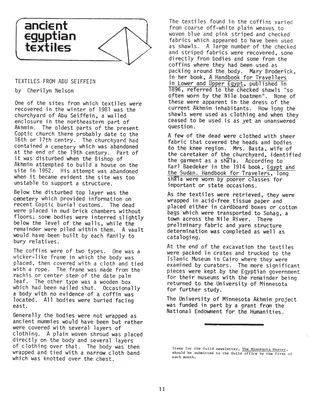
Ancient Egyptian Textiles - Abu Seiffein
Article · 1 page
A one-page article by Cherilyn Nelson on textiles recovered in the winter of 1981 from the churchyard of Abu Seiffein, a Coptic cemetery in Akhmim, Egypt. It describes the site, burial customs, coffin types, and how bodies were clothed, along with the plain, striped and checked fabrics and a sheer garment called a shala. It also outlines how the textiles were handled, catalogued and divided between Egyptian museums and the University of Minnesota, whose Akhmim project made the excavation.
Artists Equity
Minnesota Weaver, February 1980
Article · 1 page
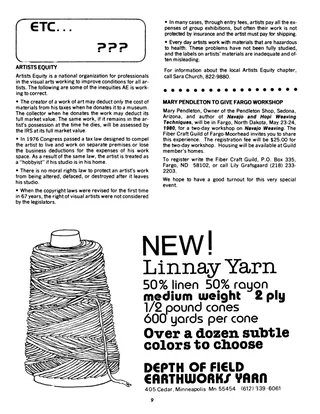
A one-page item from the Minnesota Weaver (February 1980) describing Artists Equity, a national organization for visual artists, and the tax, copyright, moral rights, exhibition and health-hazard issues it works to change. The page also announces a May 1980 two-day Navajo weaving workshop in Fargo given by Mary Pendleton, and carries an advertisement for Linnay linen/rayon yarn from Depth of Field Earthworks Yarn in Minneapolis.
As the Wheel Turns
Article · 1 page
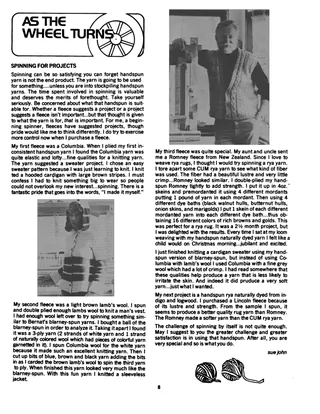
A first-person column from the Minnesota Weaver spinning series in which a beginning spinner describes choosing fleeces and spinning yarn to suit specific projects. She covers a Columbia fleece spun for a knitted cardigan, lamb's wool spun to imitate a commercial blarney-spun yarn, and a Romney fleece spun, mordanted and dyed for a rya rug. She also mentions a planned rya from Lincoln wool dyed with indigo and logwood, and urges spinners to plan what the handspun will be used for.
As the Wheel Turns
Article · 1 page
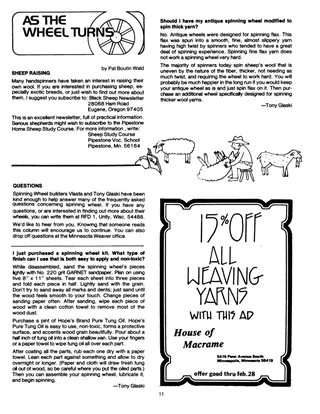
A one-page spinning column from Minnesota Weaver. It lists sources for people interested in raising sheep, including the Black Sheep Newsletter and the Pipestone Home Sheep Study Course. It then gives two answers from wheel builder Tony Glaski: why an antique flax wheel should not be modified to spin thick wool yarn, and how to sand and finish a spinning wheel kit with Hope's pure tung oil.
As the Wheel Turns
Article · 1 page
A one-page spinning column from Minnesota Weaver that opens with short reviews of sheep-themed and knitting books, including titles on sheep breeds, the textile industry and Elizabeth Zimmermann's knitting books. It lists where to buy them and announces knitting classes and clinics at local Minnesota yarn shops. It closes with a Q&A section on lubricating spinning wheels and on measuring orifice size, signed Tony Glaski.
As the Wheel Turns
Article · 2 pages
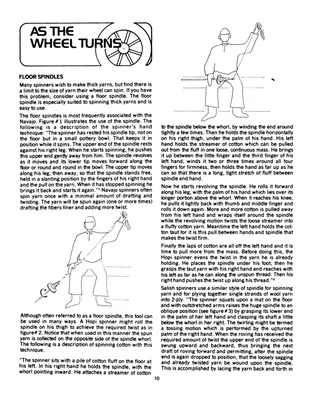
A column from the Minnesota Weaver on floor spindles for spinning thick yarns. It describes how Navajo, Hopi and Salish spinners use the spindle, quoting accounts of hand technique for spinning wool and cotton and for plying. A short Q&A follows, covering spinning wheel choice for beginners (band drive, orifice size, pulley ratios) and how to judge overtwist. The piece ends with a Glimakra loom lessons advertisement.
As the Wheel Turns
Article · 2 pages
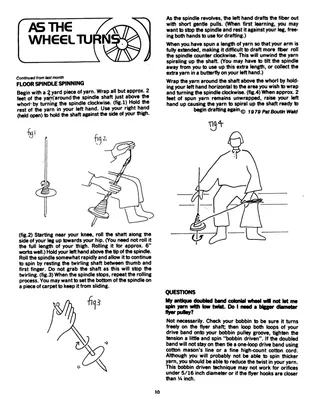
Two pages from the Minnesota Weaver (May 1979) with Pat Boutin Wald's spinning column, continuing instructions for floor spindle spinning: winding on, rolling the shaft along the thigh, drafting, and unwinding. Reader Q&A on spinning wheels follows, covering low-twist spinning with a doubled drive band and freeing a binding bobbin by reaming it with a threaded rod. Page 2 also carries Connie Magoffin's 'From Woods & Fields' dyeing column, reporting wool dyed with avocado pits and peels, artichokes, tangelo and tangerine peels, and brass, plus an offer of Fred Gerber's book on cochineal.
As the Wheel Turns
Article · 1 page
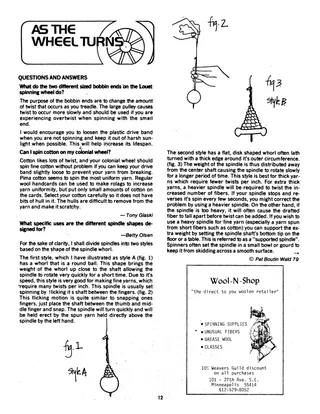
A one-page question-and-answer column on spinning from Minnesota Weaver. It covers the two bobbin pulley sizes on a Louet wheel and care of the drive band, spinning cotton on a colonial wheel, and how spindle whorl shape (round ball versus flat disk) suits fine or thick yarns. Three small figures illustrate the spindle styles and the flicking motion used to start a spindle.
As the Wheel Turns
Article · 1 page
A short column from Minnesota Weaver in which Pat Boutin Wald presents a guest piece by Wausau, Wisconsin spinner Sue John about her fear of new equipment ("neomechanophobia"), including her spinning wheel and a contramarche loom that takes months to warp. The page also announces a study manual on color and spinning for the Range fiber guild, and closes with a question-and-answer section by Tony Glaski on the best woods for spinning wheels and looms (black cherry, red oak, walnut).
As the Wheel Turns - Color palette
Article · 1 page
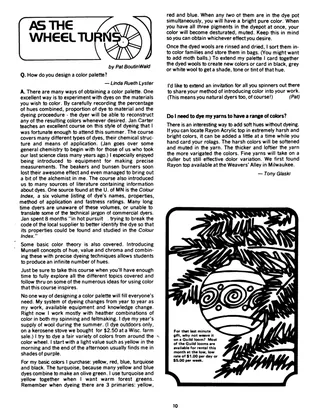
A one-page spinning and dyeing column from the Minnesota Weaver that answers reader questions about building a color palette. Pat Boutin Wald describes a dyeing course taught by Jan Carter that covers dye chemistry, precise measuring, the Colour Index and Munsell color theory. She also explains her own summer dyeing routine with yellow, red, blue, turquoise and black, and how she blends carded wools for heathers. A second reader tip suggests carding bright rayon/acrylic top into rolags to soften and mute colors without dyeing.
Billedvaer
Minnesota Weaver, March 1977
Article · 1 page
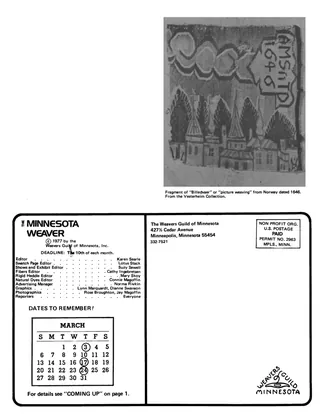
A single page from The Minnesota Weaver (March 1977) showing a photograph caption for a fragment of Norwegian "Billedvaer" (picture weaving) dated 1646, from the Vesterheim Collection. The image itself is not legible in the scan. The page also carries the newsletter masthead listing editors, a March calendar, and the Weavers Guild of Minnesota mailing panel.
Bushings
Article · 1 page
A single-page "As the Wheel Turns" spinning column from the Minnesota Weaver. It answers a reader's question about spinning wheel bushings: what they are, where they sit on the wheel (drive wheel axle, flyer shaft, treadle bar pins), and what they are made of (leather, rawhide, bone, hard woods, nylon, teflon). It also includes a correction to the previous month's answer on bulk and Swiss wheels, a tip on cotton Mason's Line for drive bands, and a report on a Wausau, Wisconsin spin-in.
Card Weaving
Article · 2 pages · weaving drafts
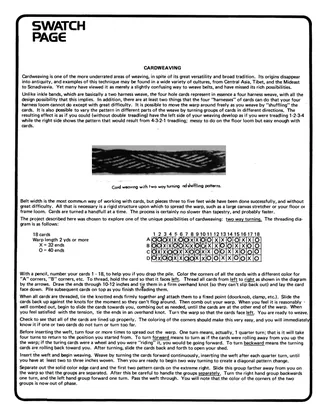
A short instructional article on card (tablet) weaving by Charlotte Miller, from the Swatch Page of Minnesota Weaver. It introduces the technique, compares four-hole cards to a four-harness weave, and explains shuffling and two-way turning of card groups. It gives a threading diagram for an 18-card project (X = 32 ends, O = 40 ends) with step-by-step instructions for threading, warping, turning, and making diagonal pattern changes. It ends with tips on yarn choice, correcting mistakes, and calculating warp length.
Chilkat loom and dyes
Article · 2 pages
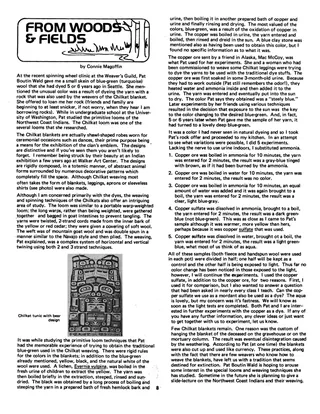
Connie Magoffin's column describes the Chilkat blanket and its loom, a warp-weighted style loom using twining with cedar bark and mountain goat wool. It focuses on the traditional dyes: yellow from lichen, black from hemlock bark and copper, and blue-green from copper oxidized in urine. She reports five kitchen experiments with copper ore and copper sulfate in ammonia or water, and ends with a bibliography. The second page carries travel notes: a visit to a silk importer in Myrtle Creek, Oregon, and announcements of weaving tours and workshops in Norway and Sweden.
Cochineal
Article · 1 page
A one-page review from the 'From Woods & Fields' column in Minnesota Weaver of Fred Gerber's 70-page book on cochineal and other insect dyes. The reviewer describes its coverage of dye and mordant history, kermes, St. John's Blood, lac and cochineal, its 34 mounted cochineal-dyed yarn samples, Bancroft's study, carmine preparation, and use of the ISCC-NBS color name charts. Ordering information and prices are given; the page also carries a Glimåkra loom advertisement.
Color Fastness
Article · 1 page
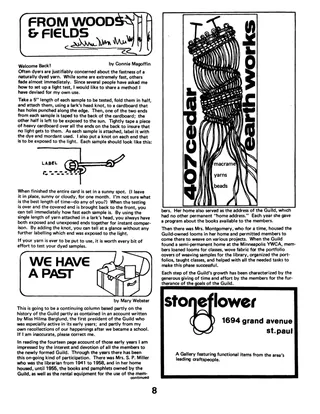
A single page from the first issue of Minnesota Weaver. Connie Magoffin describes a home method for light-testing naturally dyed yarns: folded samples are attached with lark's head knots to a cardboard card, half of each is covered, and the card is left in the sun for about a month to compare exposed and unexposed ends. The page also carries the start of Mary Webster's history column "We Have A Past" on the early years of the Minnesota weavers' guild, and a small advertisement.
Correspondent Report-Raising Sheep
Article · 1 page
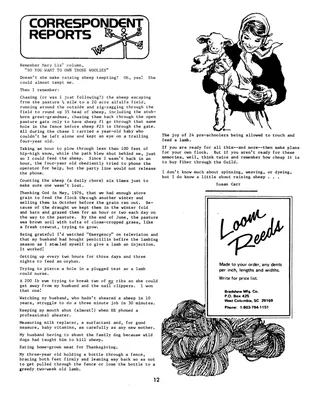
A one-page personal essay by Susan Carr in a guild newsletter's Correspondent Reports column, recalling the hardships and rewards of raising sheep. It responds to an earlier column by Mary Lis on owning sheep and covers chasing escaped flocks, winter feeding, lambing, bottle-feeding orphans, shearing, and drought. The page also carries a Bradshaw Mfg. Co. loom reed advertisement.
Design Considerations
Minnesota Weaver, December - January 1978-79
Article · 1 page
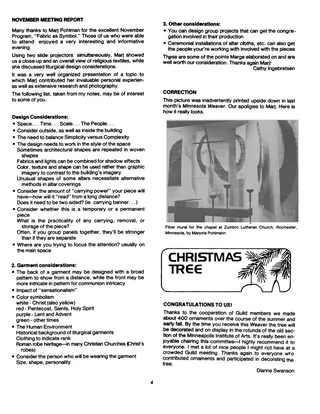
A single page from the Minnesota Weaver guild newsletter. It reports on Marj Pohlman's November program "Fabric as Symbol," with notes on designing liturgical textiles and garments, including scale, visibility, permanence, and liturgical color symbolism. It also carries a correction reprinting a photograph of her fiber mural for the chapel at Zumbro Lutheran Church, Rochester, Minnesota, and a note on about 400 ornaments the guild made for a Christmas tree at the Minneapolis Institute of Arts.
Detail of Guatemalan Brocaded (photo)
Minnesota Weaver, February 1980
Article · 1 page
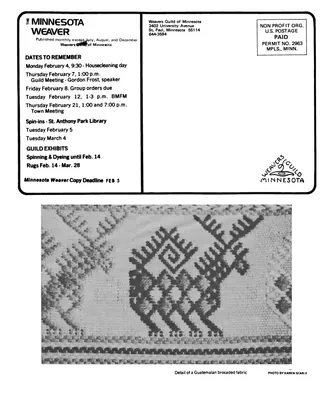
A single black-and-white photograph of a Guatemalan brocaded fabric, credited to Karen Searle, printed on the back cover of an issue of The Minnesota Weaver. The detail shows geometric brocade motifs in a diamond or stepped pattern. The page also carries the Weavers Guild of Minnesota's February calendar of meetings, exhibits and deadlines, along with mailing information.
Double Corduroy
Article · 1 page · weaving drafts
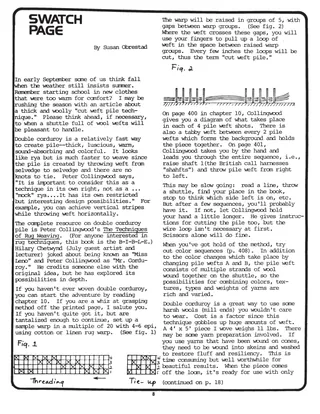
A one-page article from the Swatch Page column introducing double corduroy, a cut weft pile technique for rugs that resembles rya but is woven faster because the pile is thrown selvedge to selvedge with no knots. It directs readers to Peter Collingwood's The Techniques of Rug Weaving (chapter 10) and suggests a sample warp in multiples of 20 at 4-6 epi in cotton or linen rug warp. It also covers yarn choice, color sequences, and the heavy weft consumption. Figures show a 4-shaft threading and tie-up and a diagram of raised warp groups of 5.
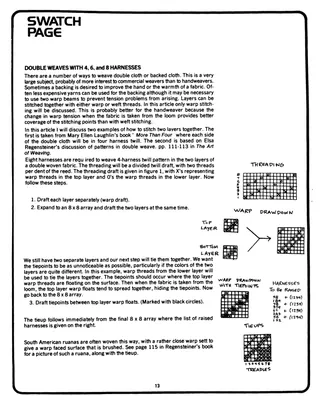
Double Weaves with 4, 6 and 8 Harnesses
Article · 2 pages · weaving drafts
An article from the Minnesota Weaver's Swatch Page on weaving double cloth with warp stitching on 4, 6 and 8 harnesses. It first walks through a divided four-harness twill double cloth on eight harnesses, after Mary Ellen Laughlin's 'More Than Four', drafting each layer, combining them in an 8 x 8 array, and placing tiepoints under top-layer warp floats. It then covers Elsa Regensteiner's pattern-harness approach from The Art of Weaving, with tabby tieups and added tiepoint treadles for a quilted effect, illustrated with a purple and pink tunic. Drafts, tieups and drawdowns are included.
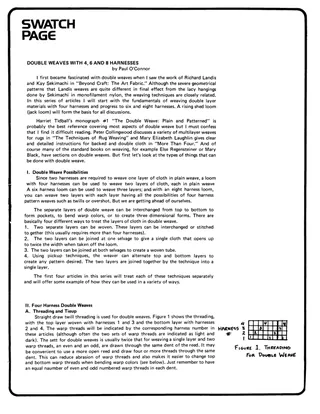
Double Weaves with 4,6 and 8 Harnesses
Article · 2 pages · weaving drafts
The first article in a series by Paul O'Connor introducing double weave on a rising-shed (jack) loom, beginning with four harnesses and leading toward six and eight. It outlines four ways of treating the two layers (separate layers, joined at one selvage, tubes, and pickup), then covers straight-draw threading, sett, tieups and treadling for two separate layers. It closes with interchanging layers for a checkerboard effect and a skeleton tieup for a four-harness loom with six treadles. Figures show the threading, a layer cross section, and tieup diagrams.
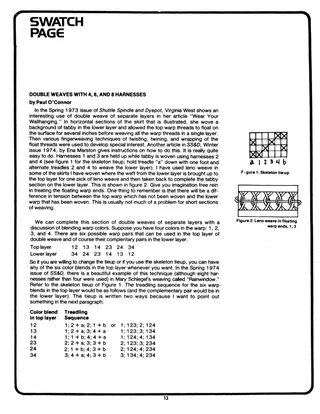
Double Weaves with 4,6 and 8 Harnesses
Article · 2 pages · weaving drafts
A two-page article from Paul O'Connor's series on double weave, covering double weave of separate layers on four harnesses using a skeleton tie-up. It explains leaving top warp threads floating over a tabby lower layer, using leno, and blending four warp colors in the top and lower layers with treadling sequences for each pair, and how to avoid float errors when changing blends. The second half covers double width weaving, slit placement at the selvage or center, treadling and selvage cross checks, and a ruana project combining double width and separate layers.
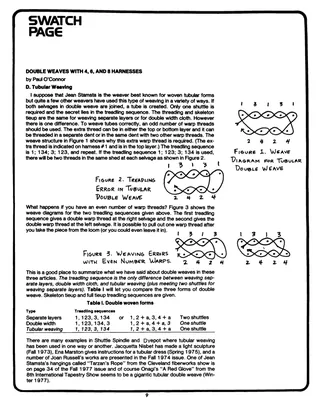
Double Weaves with 4,6 and 8 Harnesses
Article · 2 pages
Section D (Tubular Weaving) of a series on double weaves by Paul O'Connor. It explains how joining both selvages of a double weave makes a tube, why an odd number of warp threads is needed, and which treadling sequences work (1; 134; 3; 123). A table compares treadling for separate layers, double width cloth and tubular weaving. It also gives instructions for pillow covers, small purses or glasses cases, pockets stuffed on the loom, and caps or dolls, and cites examples from Shuttle Spindle and Dyepot.
Double Weaves with 4,6 and 8 Harnesses
Article · 2 pages · weaving drafts
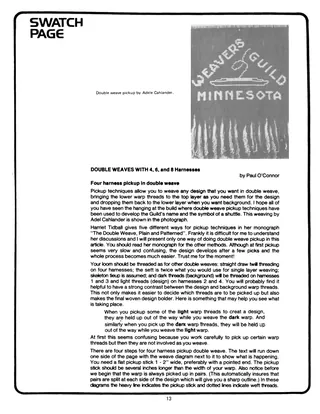
An installment in a series by Paul O'Connor on double weave, covering four-harness pickup double weave. It explains threading as a straight draw twill with dark warp on harnesses 1 and 3 and light warp on 2 and 4, the use of a pickup stick, and a four-step weaving procedure, with diagrams of stick positions and weft shots. It also gives a variation alternating light and dark shots, a two-stick option, and advice on charting designs in pairs of warp threads. It mentions that later articles will cover 6- and 8-harness double weaves.
Double Weaves with 4,6 and 8 Harnesses
Article · 3 pages · weaving drafts
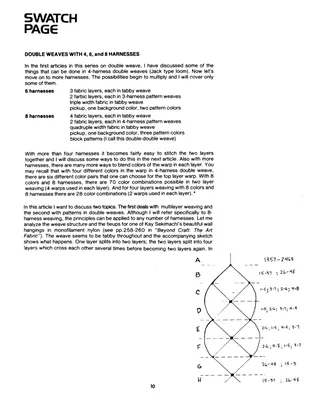
An installment in Paul O'Connor's series on double weave, extending from 4 harnesses to 6 and 8. It lists what 6- and 8-harness double weaves can do (multiple tabby layers, pattern layers, pickup, block patterns) and counts the possible warp color combinations. It analyzes the layer structure and tieups of a Kay Sekimachi monofilament wall hanging woven as four crossing layers. It then covers pattern weaves in double-width cloth, including the reversal of the lower layer's pattern and a corrected treadle sequence for the twill join at the closed selvage.
Double Weaves with 4,6 and 8 Harnesses
Article · 3 pages · weaving drafts
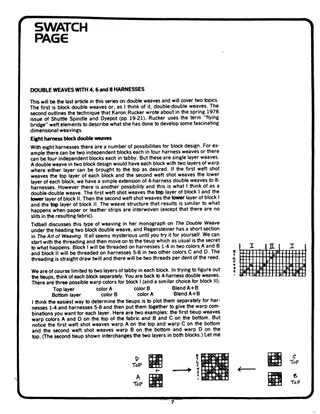
Final article in Paul O'Connor's series on double weaves in the Minnesota Weaver. It explains eight-harness two-block double weaves ("double-double weaves"), covering threading in two colors per block, tieups, color-and-layer planning, and the number of color patterns a single warp can give. It then outlines Karon Rucker's "flying bridge" technique, in which weft floats between layers so the cloth can be folded off the loom into dimensional forms. Includes small drafts, diagrams, photographs of the author's work, and a bibliography.
Drafting for Weft-Faced Weaving
Article · 4 pages · weaving drafts
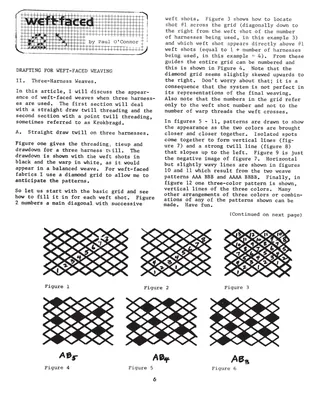
Part II of Paul O'Connor's series on drafting for weft-faced weaving, covering three-harness weaves. It explains a diamond-grid method for anticipating patterns in straight-draw twill and shows how two- and three-color weft arrangements (AB, A2B, A3B3, ABC and others) change the look of the fabric. A second section treats point twill threading, or Krokbragd, with its three-treadle sequence, color rotations, and the different design on the back of the fabric. Illustrated with drawdowns, a draft, and photographs of the front and back of a sample.
Drafting Weft-Faced Patterns: Four Harness Twills
Article · 2 pages · weaving drafts
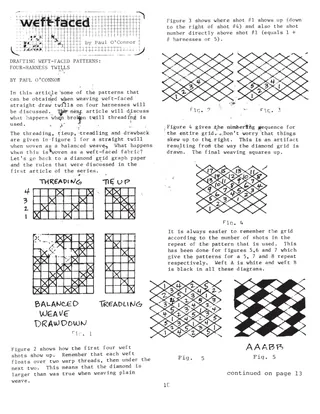
Article in a series on drafting weft-faced patterns, covering straight-draw 2/2 twill threaded on four harnesses. It uses diamond grid graph paper to work out how weft shots appear, numbering the shots across the grid and showing 5-, 7- and 8-shot repeat patterns in two colors (white and black). It ends with a 12-shot sequence on a 12-shaft diagram, which is also shown as Plate 52 in Collingwood's book.
Draw Mechanisms, Part 1
Article · 1 page
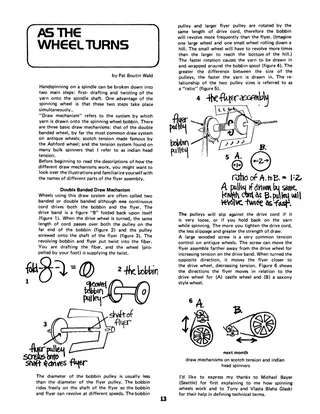
A one-page article on how spinning wheels draw yarn onto the bobbin, the first of a series. It names three basic draw mechanisms (double band, Scotch tension, and "Indian head" tension) and explains the double-banded system in detail: the figure-8 drive band, bobbin and flyer pulleys, pulley size ratio, drive cord tension and the screw tension control on antique wheels. Diagrams show the drive band, pulleys, flyer assembly and the direction of flyer movement on castle and saxony wheels. Scotch tension and Indian head systems are left for the next installment.
Draw Mechanisms, Part 2
Article · 1 page
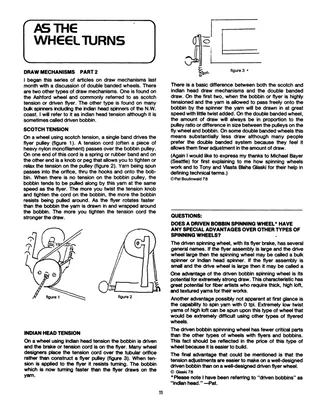
Second part of a series on spinning wheel draw mechanisms from the column 'As the Wheel Turns.' It explains scotch tension (driven flyer, as on the Ashford wheel) and indian head tension (driven bobbin, used on bulk spinners), and contrasts both with the double-banded draw. A short question-and-answer section by Glaski lists the advantages of driven bobbin wheels, including strong draw, very low twist yarns, fewer critical parts and easier tension adjustment.
Dye chart
Article · 1 page
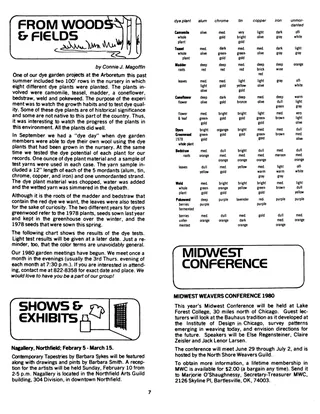
A single page from Minnesota Weaver (February 1980) in which Connie J. Magoffin reports on a dye garden project at the Arboretum. Eight dye plants were grown in the nursery and tested with five mordants and an unmordanted sample. A chart lists the resulting colors for camomile, teasel, madder, coneflower, dyers greenwood, bedstraw, weld and pokeweed. The page also carries a notice for the 1980 Midwest Weavers Conference at Lake Forest College and a short gallery exhibit listing.
Dye Experiments
Article · 2 pages
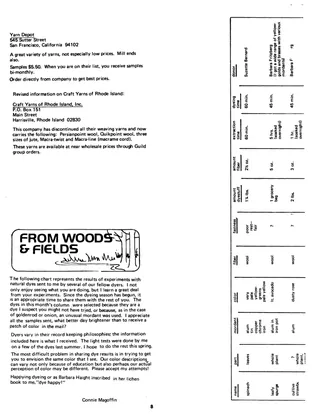
A column from the Minnesota Weaver in which Connie Magoffin shares natural dye experiment results sent in by fellow dyers. A chart records dye plant, part used, mordant, resulting color, fiber, fastness, amounts, extraction and dyeing times, and donor for dyes such as spinach, leafy spurge, strawberry, tea, coffee, cranberries, goldenrod, purple iris, onion skin, pine and rhubarb. The first page also carries short notes on yarn suppliers, including the Yarn Depot in San Francisco and revised product information for Craft Yarns of Rhode Island.
Dye Garden
Article · 1 page
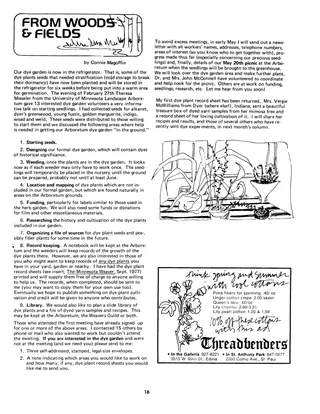
A column from The Minnesota Weaver reporting on a volunteer dye garden being established at the University of Minnesota Landscape Arboretum. It describes starting dye plant seeds that need cold stratification, a talk on seedlings, and nine areas where volunteers are needed, including seed starting, garden design, weeding, mapping wild dye plants, funding, research, record keeping and a slide and yarn sample library. It also announces a May picnic and mentions a reader's dye results from a mimosa tree. The page includes an advertisement for Threadbenders.
Dye Plant Sources
Article · 1 page
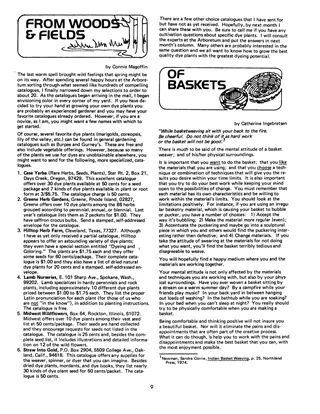
A single page from Minnesota Weaver (April 1976) with two short columns. Connie Magoffin's 'From Woods & Fields' lists six mail-order sources for dye plant seeds and plants, with addresses, prices and notes on what each catalogue offers. Catherine Ingebretsen's 'Of Baskets' opens a piece on the mental attitude and working conditions suited to basket weaving.
Dyeing Easter Eggs
Article · 2 pages
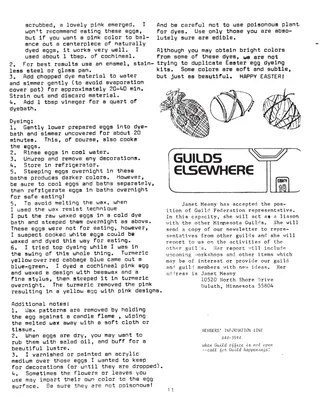
A column from the 'From Woods & Fields' series in Minnesota Weaver giving instructions for coloring Easter eggs with natural dyes. It covers egg preparation, resist and wrapping methods (leaves, rubber bands, netting, onion skins, beeswax), dye baths from onion skins, red cabbage, coffee, turmeric and cochineal, and dyeing, overdyeing and finishing steps, with safety notes about eating the eggs and poisonous plants.
Dyeing with grapeskins
Article · 1 page
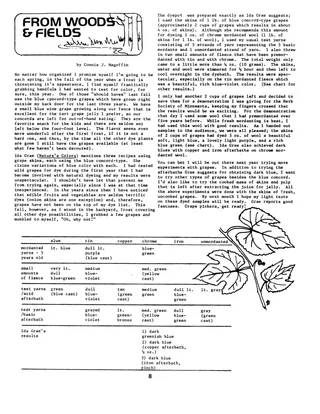
A short column from the Minnesota Weaver series "From Woods & Fields" in which Connie Magoffin reports her experiments dyeing wool with the skins of blue concord-type grapes, following recipes from Ida Grae's Nature's Colors. She describes the dyepot, the mordants tested (alum, tin, copper, chrome, iron, and unmordanted), and the resulting blues, violets and greens. A results chart compares her samples with Grae's, and she outlines further experiments she plans.
Dyeing with pomegranates, testing
Article · 1 page
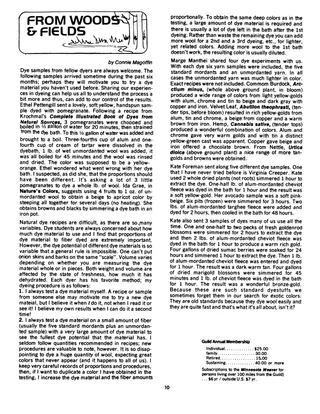
A column from the Minnesota Weaver's "From Woods & Fields" series in which Connie Magoffin reports on dye samples sent by fellow dyers. It describes an unsuccessful pomegranate dyebath on wool and compares recipes from Krochmal and Ida Grae. It also covers Magoffin's method of testing a dyestuff on small fiber samples with the five standard mordants and an unmordanted sample, using a large amount of dye material. Results are given for burdock, velvet leaf, hemp, nettle, Virginia creeper, avocado pits, goldenrod, sumac and marigold.
Dyeing with purple corn
Article · 2 pages
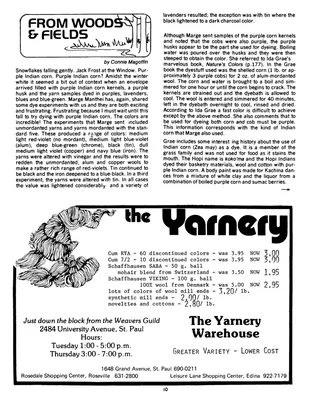
A dyeing column from the Minnesota Weaver reporting Marge Manthei's experiments dyeing wool with purple Indian corn husks. It lists the colors obtained with no mordant and with alum, chrome, tin, copper and iron, plus the effects of vinegar and tin afterbaths. It summarizes Ida Grae's recipe and the Hopi use of purple corn, cites a few other references (Krochmal, Brooklyn Botanic Garden), and announces plans to grow purple corn in the guild dye garden. Page 2 ends with guild bulletin board notices.
Dyeing with walnuts
Article · 1 page
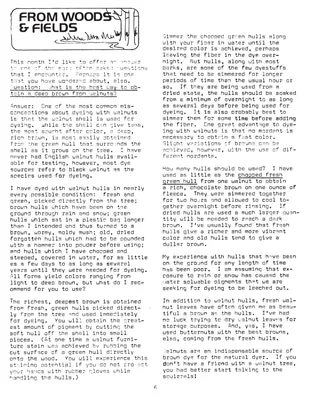
A one-page column from the Minnesota Weaver's "From Woods & Fields" series answering how to get a deep brown from walnuts. The author explains that the green hull, not the shell, is the best dye source, and compares fresh, dried, and ground-weathered hulls. She gives advice on chopping, soaking, and simmering times, notes that no mordant is needed, and mentions walnut leaves and butternuts as alternative sources.
Early Minnesota Weavers - Florence Titus
Article · 2 pages
A biographical profile by Kate Foreman of Florence Titus, a Minnesota rug weaver who began weaving rag rugs in 1916 at age 15 on a $32 two-harness Montgomery Ward loom. It covers her materials, pricing, trademark inlaid end borders, weft choices, knotting, wide carpets and stair runners, and her later years. The second page carries the article's end plus unrelated guild newsletter items: a report on the Midwest Weavers Conference and the end of a studio tour notice.
Experiments: Willow, Plantain, Milkweed, Chokecherries, Dandelions
Article · 1 page
A one-page column from the Minnesota Weaver in which Connie Magoffin reports natural dye experiments sent in by readers, using willow shoots, plantain, milkweed, chokecherries and dandelion blossoms. It gives amounts, simmering times, mordants (alum, tin, copper, chrome) and resulting colors on wool. The page also begins Peggy Dokka's series 'Metrics for Weavers', which offers tips for visualizing metric linear measurements.
February Program- Textile Preservation
Article · 1 page
Report on a February 1979 guild program in which Lotus Stack, textile coordinator at the Minneapolis Institute of Arts, spoke on textile preservation for contemporary weavers. It covers destructive factors (fiber stress, temperature and humidity, light and heat, chemical contamination), choice of warp and materials, mounting methods for rugs and tapestries, and packing, shipping and storage. The page also has a short report on a guild yarn workshop with Joy Rosner and Charlotte Haglund, plus a wool-n-shop advertisement.
Felt
Article · 1 page
A one-page article on the history and contemporary use of felt in fiber arts. It traces felt from legend and early skin clothing through Roman accounts and the felt hat industry to its adoption by textile artists such as Robert Morris. It also notes related techniques, the Art Protis needle process and handmade paper pressing. The page includes an advertisement for the Yarnery in St. Paul.
Figuring a Metric Warp
Article · 1 page
A one-page column from the Minnesota Weaver on figuring a warp in metric units. It works through an example of two sets of place mats (8 mats per set) with a 9 meter warp, a 40 dent reed double sleyed, and 240 ends, and argues that metric units in tens make warp calculation easier than inches and yards. It also mentions a slide-rule style "Metric Converter" sold by mail order. The page includes advertisements for two St. Paul needlework shops.
Fine Adjustments on the Ashford Wheel; Steps and Tools for Hand-spinning
Article · 1 page
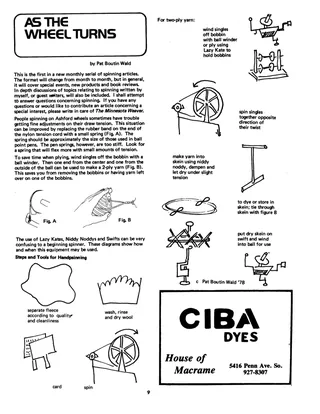
First installment of a monthly spinning column in The Minnesota Weaver. It gives a tip for getting finer draw-tension adjustments on an Ashford wheel by replacing the rubber band on the nylon tension cord with a small spring, and a time-saving method for plying singles from a ball wound on a ball winder. It also includes diagrams and a step list of hand-spinning, from sorting and washing fleece through carding, spinning, plying, skeining, and winding into a ball, showing the use of lazy kates, niddy noddys, and swifts.
Fleece prep
Article · 1 page
A one-page column from the spinning series "As the Wheel Turns" in Minnesota Weaver, on realistic expectations when preparing and buying fleece. Kate Foreman reports advice from St. Peter Woolen Mill on sending wool for custom carding: be explicit in instructions, keep lots separate, remove chaff and burrs beforehand, and scour on the dry side. It also covers buying skirted versus unskirted fleeces and how price affects the choice.
Frame Loominations
Article · 1 page
A column from the Minnesota Weaver on creative possibilities for the two-harness rigid heddle frame loom. Mary Temple lists categories of techniques, including open work weaves, pile weaves, weft-faced rep, pick-up weaves, texture patterns, inlay, tapestry, non-loom techniques, added materials, warp effects, and finishes. She closes with double weave using two rigid heddles and announces her class on the subject at the Weavers Guild. A small advertisement for a St. Paul needle art shop appears on the page.
Frame Loominations
Article · 1 page
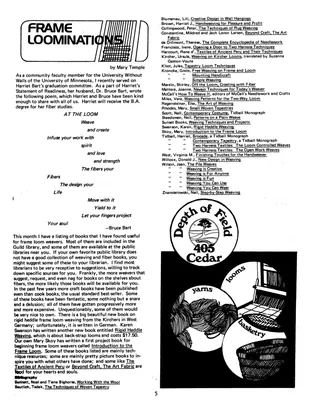
A column from the Minnesota Weaver by Mary Temple on frame loom weaving. It opens with a poem, "At the Loom," by Bruce Bart, written for his wife Harriet Bart's University of Minnesota fiber studies degree. Temple then comments on weaving books available through the Guild library and public libraries, mentioning new titles on rigid heddle and frame loom weaving. The column ends with a bibliography of about 40 titles on frame loom weaving, tapestry, rugs, two-harness weaving and fiber art.
Frame Loominations - Texture
Article · 1 page
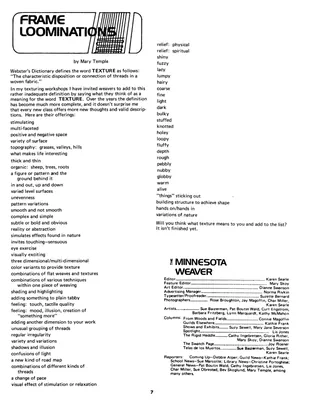
A one-page column by Mary Temple in the 'Frame Loominations' series that considers what the word 'texture' means in weaving. She quotes Webster's definition and then lists words and phrases offered by weavers in her texturing workshops, such as tactile, nubby, lumpy, and 'regular irregularity', and invites readers to add their own. The page also carries the Minnesota Weaver staff list.
216 documents found