Textile Documents › Authors › Author: Pat Boutin Wald
11 documents found
Sort: 
As the Wheel Turns
Article · 1 page
A one-page spinning column from Minnesota Weaver. It lists sources for people interested in raising sheep, including the Black Sheep Newsletter and the Pipestone Home Sheep Study Course. It then gives two answers from wheel builder Tony Glaski: why an antique flax wheel should not be modified to spin thick wool yarn, and how to sand and finish a spinning wheel kit with Hope's pure tung oil.
As the Wheel Turns
Article · 1 page
A one-page spinning column from Minnesota Weaver that opens with short reviews of sheep-themed and knitting books, including titles on sheep breeds, the textile industry and Elizabeth Zimmermann's knitting books. It lists where to buy them and announces knitting classes and clinics at local Minnesota yarn shops. It closes with a Q&A section on lubricating spinning wheels and on measuring orifice size, signed Tony Glaski.
As the Wheel Turns
Article · 2 pages
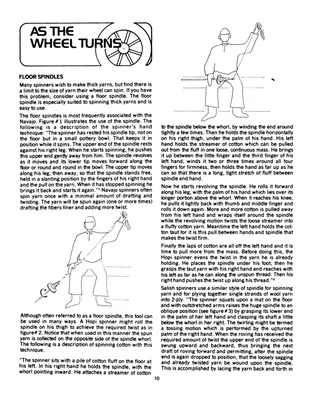
A column from the Minnesota Weaver on floor spindles for spinning thick yarns. It describes how Navajo, Hopi and Salish spinners use the spindle, quoting accounts of hand technique for spinning wool and cotton and for plying. A short Q&A follows, covering spinning wheel choice for beginners (band drive, orifice size, pulley ratios) and how to judge overtwist. The piece ends with a Glimakra loom lessons advertisement.
As the Wheel Turns
Article · 2 pages
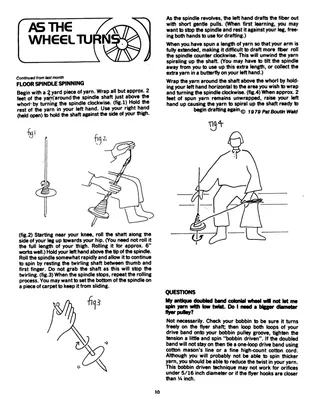
Two pages from the Minnesota Weaver (May 1979) with Pat Boutin Wald's spinning column, continuing instructions for floor spindle spinning: winding on, rolling the shaft along the thigh, drafting, and unwinding. Reader Q&A on spinning wheels follows, covering low-twist spinning with a doubled drive band and freeing a binding bobbin by reaming it with a threaded rod. Page 2 also carries Connie Magoffin's 'From Woods & Fields' dyeing column, reporting wool dyed with avocado pits and peels, artichokes, tangelo and tangerine peels, and brass, plus an offer of Fred Gerber's book on cochineal.
As the Wheel Turns
Article · 1 page
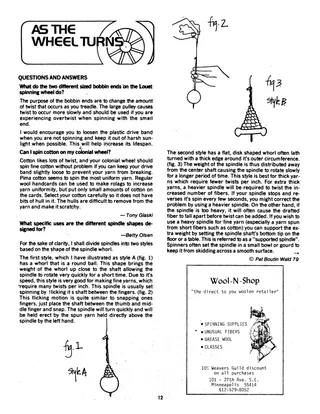
A one-page question-and-answer column on spinning from Minnesota Weaver. It covers the two bobbin pulley sizes on a Louet wheel and care of the drive band, spinning cotton on a colonial wheel, and how spindle whorl shape (round ball versus flat disk) suits fine or thick yarns. Three small figures illustrate the spindle styles and the flicking motion used to start a spindle.
As the Wheel Turns
Article · 1 page
A short column from Minnesota Weaver in which Pat Boutin Wald presents a guest piece by Wausau, Wisconsin spinner Sue John about her fear of new equipment ("neomechanophobia"), including her spinning wheel and a contramarche loom that takes months to warp. The page also announces a study manual on color and spinning for the Range fiber guild, and closes with a question-and-answer section by Tony Glaski on the best woods for spinning wheels and looms (black cherry, red oak, walnut).
As the Wheel Turns - Color palette
Article · 1 page
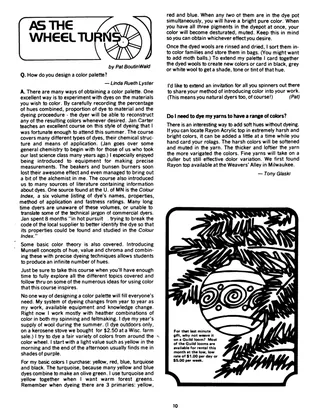
A one-page spinning and dyeing column from the Minnesota Weaver that answers reader questions about building a color palette. Pat Boutin Wald describes a dyeing course taught by Jan Carter that covers dye chemistry, precise measuring, the Colour Index and Munsell color theory. She also explains her own summer dyeing routine with yellow, red, blue, turquoise and black, and how she blends carded wools for heathers. A second reader tip suggests carding bright rayon/acrylic top into rolags to soften and mute colors without dyeing.
Bushings
Article · 1 page
A single-page "As the Wheel Turns" spinning column from the Minnesota Weaver. It answers a reader's question about spinning wheel bushings: what they are, where they sit on the wheel (drive wheel axle, flyer shaft, treadle bar pins), and what they are made of (leather, rawhide, bone, hard woods, nylon, teflon). It also includes a correction to the previous month's answer on bulk and Swiss wheels, a tip on cotton Mason's Line for drive bands, and a report on a Wausau, Wisconsin spin-in.
Draw Mechanisms, Part 1
Article · 1 page
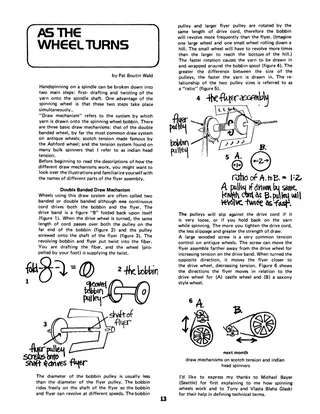
A one-page article on how spinning wheels draw yarn onto the bobbin, the first of a series. It names three basic draw mechanisms (double band, Scotch tension, and "Indian head" tension) and explains the double-banded system in detail: the figure-8 drive band, bobbin and flyer pulleys, pulley size ratio, drive cord tension and the screw tension control on antique wheels. Diagrams show the drive band, pulleys, flyer assembly and the direction of flyer movement on castle and saxony wheels. Scotch tension and Indian head systems are left for the next installment.
Draw Mechanisms, Part 2
Article · 1 page
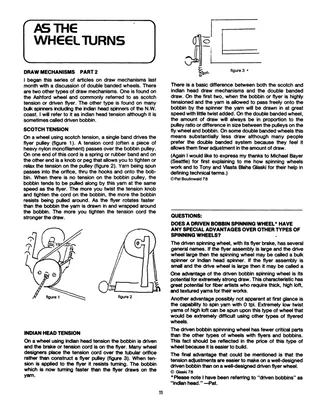
Second part of a series on spinning wheel draw mechanisms from the column 'As the Wheel Turns.' It explains scotch tension (driven flyer, as on the Ashford wheel) and indian head tension (driven bobbin, used on bulk spinners), and contrasts both with the double-banded draw. A short question-and-answer section by Glaski lists the advantages of driven bobbin wheels, including strong draw, very low twist yarns, fewer critical parts and easier tension adjustment.
Fine Adjustments on the Ashford Wheel; Steps and Tools for Hand-spinning
Article · 1 page
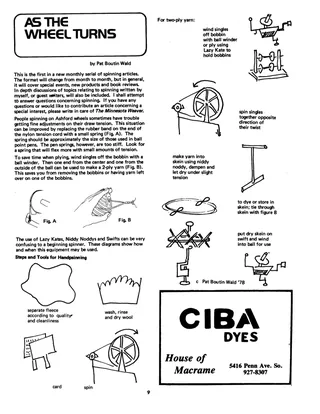
First installment of a monthly spinning column in The Minnesota Weaver. It gives a tip for getting finer draw-tension adjustments on an Ashford wheel by replacing the rubber band on the nylon tension cord with a small spring, and a time-saving method for plying singles from a ball wound on a ball winder. It also includes diagrams and a step list of hand-spinning, from sorting and washing fleece through carding, spinning, plying, skeining, and winding into a ball, showing the use of lazy kates, niddy noddys, and swifts.
11 documents found