Textile Documents › Authors › Author: Connie Magoffin
30 documents found
Sort: 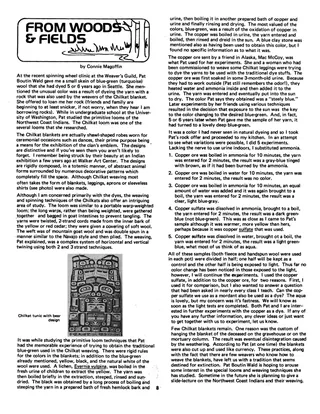
Chilkat loom and dyes
Article · 2 pages
Connie Magoffin's column describes the Chilkat blanket and its loom, a warp-weighted style loom using twining with cedar bark and mountain goat wool. It focuses on the traditional dyes: yellow from lichen, black from hemlock bark and copper, and blue-green from copper oxidized in urine. She reports five kitchen experiments with copper ore and copper sulfate in ammonia or water, and ends with a bibliography. The second page carries travel notes: a visit to a silk importer in Myrtle Creek, Oregon, and announcements of weaving tours and workshops in Norway and Sweden.
Cochineal
Article · 1 page
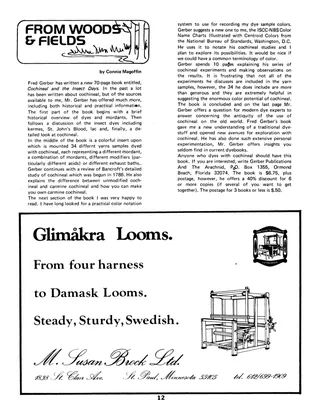
A one-page review from the 'From Woods & Fields' column in Minnesota Weaver of Fred Gerber's 70-page book on cochineal and other insect dyes. The reviewer describes its coverage of dye and mordant history, kermes, St. John's Blood, lac and cochineal, its 34 mounted cochineal-dyed yarn samples, Bancroft's study, carmine preparation, and use of the ISCC-NBS color name charts. Ordering information and prices are given; the page also carries a Glimåkra loom advertisement.
Color Fastness
Article · 1 page
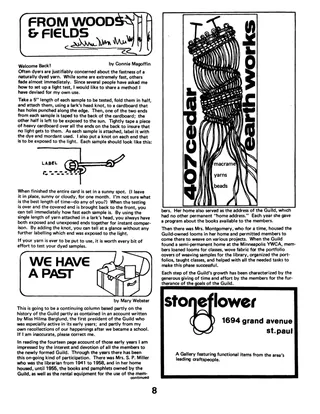
A single page from the first issue of Minnesota Weaver. Connie Magoffin describes a home method for light-testing naturally dyed yarns: folded samples are attached with lark's head knots to a cardboard card, half of each is covered, and the card is left in the sun for about a month to compare exposed and unexposed ends. The page also carries the start of Mary Webster's history column "We Have A Past" on the early years of the Minnesota weavers' guild, and a small advertisement.
Dye chart
Article · 1 page
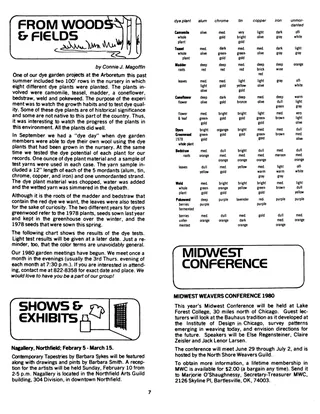
A single page from Minnesota Weaver (February 1980) in which Connie J. Magoffin reports on a dye garden project at the Arboretum. Eight dye plants were grown in the nursery and tested with five mordants and an unmordanted sample. A chart lists the resulting colors for camomile, teasel, madder, coneflower, dyers greenwood, bedstraw, weld and pokeweed. The page also carries a notice for the 1980 Midwest Weavers Conference at Lake Forest College and a short gallery exhibit listing.
Dye Experiments
Article · 2 pages
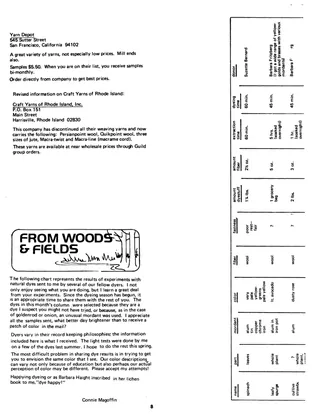
A column from the Minnesota Weaver in which Connie Magoffin shares natural dye experiment results sent in by fellow dyers. A chart records dye plant, part used, mordant, resulting color, fiber, fastness, amounts, extraction and dyeing times, and donor for dyes such as spinach, leafy spurge, strawberry, tea, coffee, cranberries, goldenrod, purple iris, onion skin, pine and rhubarb. The first page also carries short notes on yarn suppliers, including the Yarn Depot in San Francisco and revised product information for Craft Yarns of Rhode Island.
Dye Garden
Article · 1 page
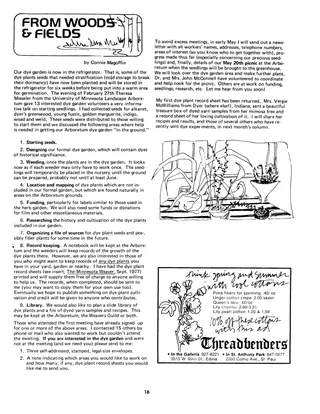
A column from The Minnesota Weaver reporting on a volunteer dye garden being established at the University of Minnesota Landscape Arboretum. It describes starting dye plant seeds that need cold stratification, a talk on seedlings, and nine areas where volunteers are needed, including seed starting, garden design, weeding, mapping wild dye plants, funding, research, record keeping and a slide and yarn sample library. It also announces a May picnic and mentions a reader's dye results from a mimosa tree. The page includes an advertisement for Threadbenders.
Dye Plant Sources
Article · 1 page
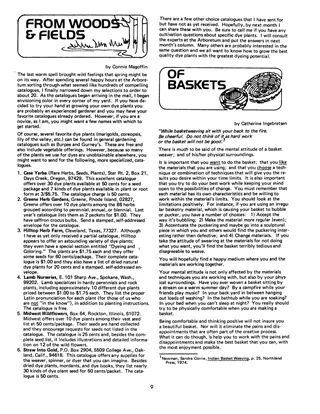
A single page from Minnesota Weaver (April 1976) with two short columns. Connie Magoffin's 'From Woods & Fields' lists six mail-order sources for dye plant seeds and plants, with addresses, prices and notes on what each catalogue offers. Catherine Ingebretsen's 'Of Baskets' opens a piece on the mental attitude and working conditions suited to basket weaving.
Dyeing Easter Eggs
Article · 2 pages
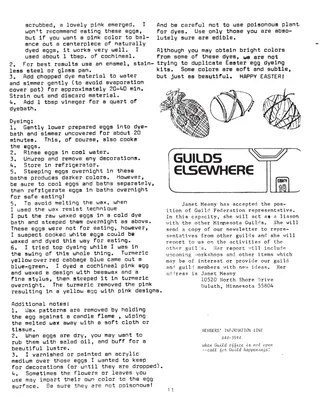
A column from the 'From Woods & Fields' series in Minnesota Weaver giving instructions for coloring Easter eggs with natural dyes. It covers egg preparation, resist and wrapping methods (leaves, rubber bands, netting, onion skins, beeswax), dye baths from onion skins, red cabbage, coffee, turmeric and cochineal, and dyeing, overdyeing and finishing steps, with safety notes about eating the eggs and poisonous plants.
Dyeing with grapeskins
Article · 1 page
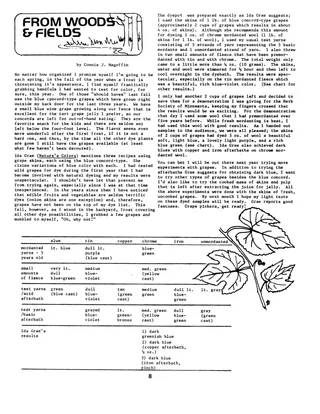
A short column from the Minnesota Weaver series "From Woods & Fields" in which Connie Magoffin reports her experiments dyeing wool with the skins of blue concord-type grapes, following recipes from Ida Grae's Nature's Colors. She describes the dyepot, the mordants tested (alum, tin, copper, chrome, iron, and unmordanted), and the resulting blues, violets and greens. A results chart compares her samples with Grae's, and she outlines further experiments she plans.
Dyeing with pomegranates, testing
Article · 1 page
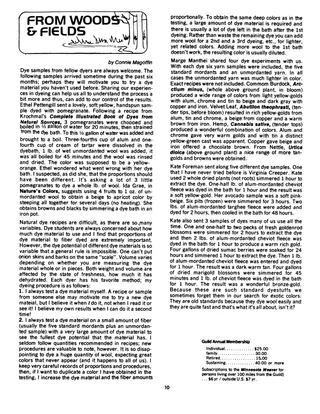
A column from the Minnesota Weaver's "From Woods & Fields" series in which Connie Magoffin reports on dye samples sent by fellow dyers. It describes an unsuccessful pomegranate dyebath on wool and compares recipes from Krochmal and Ida Grae. It also covers Magoffin's method of testing a dyestuff on small fiber samples with the five standard mordants and an unmordanted sample, using a large amount of dye material. Results are given for burdock, velvet leaf, hemp, nettle, Virginia creeper, avocado pits, goldenrod, sumac and marigold.
Dyeing with purple corn
Article · 2 pages
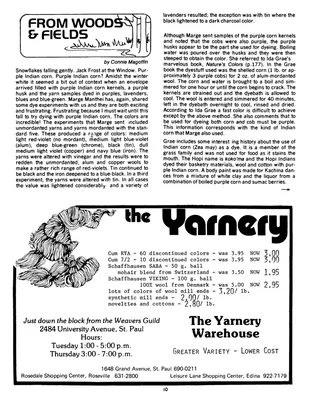
A dyeing column from the Minnesota Weaver reporting Marge Manthei's experiments dyeing wool with purple Indian corn husks. It lists the colors obtained with no mordant and with alum, chrome, tin, copper and iron, plus the effects of vinegar and tin afterbaths. It summarizes Ida Grae's recipe and the Hopi use of purple corn, cites a few other references (Krochmal, Brooklyn Botanic Garden), and announces plans to grow purple corn in the guild dye garden. Page 2 ends with guild bulletin board notices.
Dyeing with walnuts
Article · 1 page
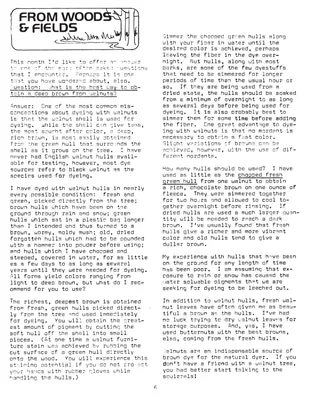
A one-page column from the Minnesota Weaver's "From Woods & Fields" series answering how to get a deep brown from walnuts. The author explains that the green hull, not the shell, is the best dye source, and compares fresh, dried, and ground-weathered hulls. She gives advice on chopping, soaking, and simmering times, notes that no mordant is needed, and mentions walnut leaves and butternuts as alternative sources.
Experiments: Willow, Plantain, Milkweed, Chokecherries, Dandelions
Article · 1 page
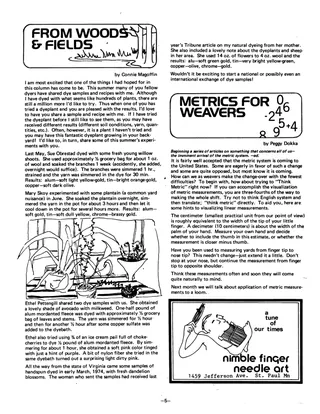
A one-page column from the Minnesota Weaver in which Connie Magoffin reports natural dye experiments sent in by readers, using willow shoots, plantain, milkweed, chokecherries and dandelion blossoms. It gives amounts, simmering times, mordants (alum, tin, copper, chrome) and resulting colors on wool. The page also begins Peggy Dokka's series 'Metrics for Weavers', which offers tips for visualizing metric linear measurements.
From Woods & Fields
Article · 1 page
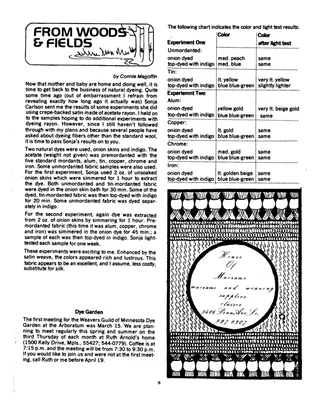
A one-page column from the Minnesota Weaver on natural dyeing of acetate rayon crepe-backed satin. It reports Sonja Carlson's experiments with onion skins and indigo on unmordanted fabric and fabric premordanted with alum, tin, copper, chrome and iron, including a chart of colors before and after a one-week light test. It also announces meetings of the Weavers Guild of Minnesota Dye Garden.
From Woods & Fields-Dye Garden
Article · 1 page
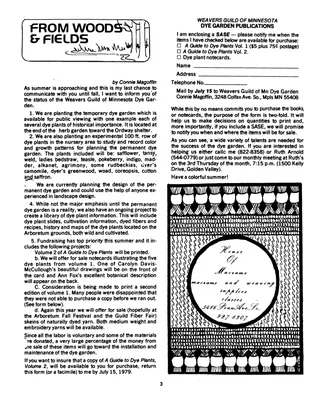
A one-page column from the Minnesota Weaver reporting on the Weavers Guild of Minnesota Dye Garden at the Minnesota Landscape Arboretum. It describes a temporary public dye garden, an experimental row of dye plants, plans for a permanent garden, and a dye plant information library. It also covers fundraising: Volume 2 of A Guide to Dye Plants, notecards, a possible second edition of Volume 1, and sales of naturally dyed yarn. A pre-order form is included.
From Woods and Fields
Article · 1 page
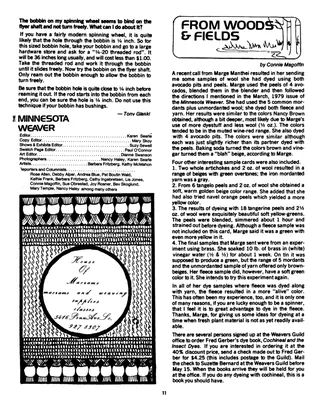
A one-page column from The Minnesota Weaver in which Connie Magoffin reports natural dyeing experiments sent in by Marge Manthei. Wool fleece and yarn were dyed with avocado peels and pits, artichokes, tangelo, orange and tangerine peels, and soaked brass, using five common mordants plus unmordanted samples. Colors range from muted wine-reds to beiges and yellow-greens. The page also carries a spinning wheel tip on reaming a ¼-inch bobbin hole with a threaded rod, and a notice on ordering Fred Gerber's book Cochineal and the Insect Dyes at a discount.
Garden Dye Plants
Article · 1 page
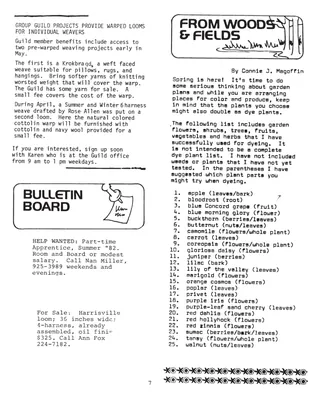
A one-page column from the Minnesota Weaver, "From Woods & Fields" by Connie J. Magoffin, listing 25 garden and woodland plants she has successfully used for natural dyeing, with suggested plant parts to use for each (such as leaves, bark, flowers or berries). The list is not exhaustive and omits weeds and untested plants. The page also carries guild news about pre-warped group projects (a krokbragd and a Summer and Winter project) and bulletin board notices.
Indigo
Article · 1 page
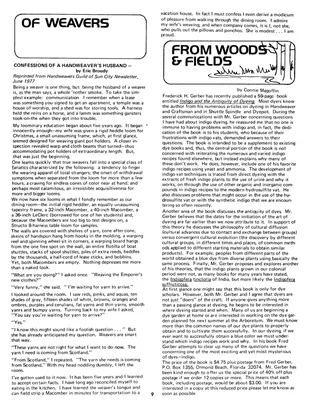
A single page from Minnesota Weaver containing two items. The part relevant to the catalog title is Connie Magoffin's review in the 'From Woods & Fields' column of Frederick H. Gerber's 59-page book Indigo and the Antiquity of Dyeing, covering indigo vat chemistry, the history of vat techniques, theories on the antiquity of dyeing, and the identity of colonial indigo plants. It gives ordering information and a group discount. The page also has a humorous piece by Eric Broudy, 'Confessions of a Handweaver's Husband,' about living with a weaver's looms and yarn.
Indigo Dyeing
Article · 1 page
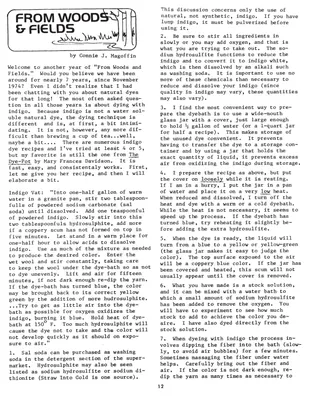
A column from the "From Woods & Fields" series on natural dyes in Minnesota Weaver, in which Connie Magoffin explains how to dye wool with natural indigo. She gives Mary Frances Davidson's indigo vat recipe from The Dye-Pot (sodium carbonate, powdered indigo, hydrosulphite). Numbered notes follow on sourcing chemicals, preparing and storing the vat in a glass jar, judging when the vat is ready, making a stock solution, and dipping and airing the fiber.
Lichen Workshop
Article · 1 page
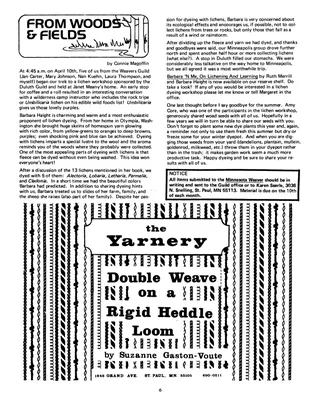
A short column from the Minnesota Weavers Guild newsletter reporting on a lichen dyeing workshop held in Duluth, led by Barbara Haight of Olympia, Washington. It describes the lichens used (Alectoria, Lobaria, Letharia, Parmelia, Cladonia), the colors obtained, dyeing fleece without washing, and concerns about ecologically responsible collecting. It closes with notes on a library book, woad seeds, and encouragement to use garden plants and weeds in the dyepot.
Light Testing
Article · 1 page
A one-page column from the 'From Woods & Fields' series in the Minnesota Weaver on testing natural-dyed yarn for lightfastness. Connie Magoffin reports on a rating system from J. Merritt Matthews' 'Application of Dyestuffs' (1920), as cited in Ida Grae's 'Nature's Colors'. Samples are exposed in a south-facing window and rated from very fast to not fast over one to four weeks. She also notes that fastness covers washing, rubbing and perspiration as well as light, and announces natural dye classes and the use of Umbilicaria lichen for violet dyes.
Misc.
Article · 1 page
A one-page piece from the Minnesota Weaver containing Connie Magoffin's natural dyeing column "From Woods & Fields" and a short news item on the new Surface Design Association. The column covers the Guild's supply of mordants (alum, sodium hydrosulfite for indigo), a note on dye safety, donations of dye plants and dyed yarn samples, warp-painting experiments, and a search for a natural dyer, with a preview of a Navajo dye trip. The news item describes the 1976 national surface design conference at the University of Kansas, the founding of the association, its membership fee and its 1978 conference at Purdue. A Yarn Shed advertisement appears at the bottom.
Natural Dyes for Easter Eggs
Article · 2 pages
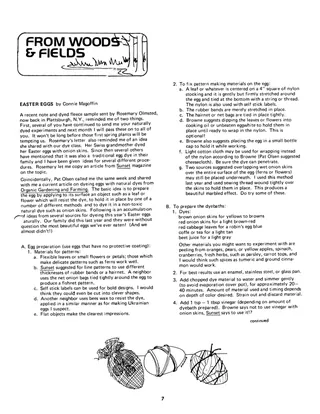
A short article from the Minnesota Weaver's "From Woods & Fields" column giving instructions for dyeing Easter eggs with natural dyes. It covers resist materials (leaves, flowers, rubber bands, nets, labels, wax, onion skins), ways to fix them on the egg, dyebath recipes (onion skins, red cabbage, coffee, tea, beet juice), the dyeing and finishing steps, and safety notes, with sources cited. Page 2 also carries the start of a separate item, "The Rigid Heddle: Large Projects - part 2", with tips on finishing large handwoven pieces and a list of fringe and non-fringe finishes.
Natural dyes in yarn, fleece, cloth, wool, cotton etc.
Article · 1 page
A one-page column from the Minnesota Weaver's 'From Woods & Fields' series, in which Connie Magoffin surveys the range of materials and forms that can be dyed with natural dyes. She covers dyeing fleece, yarn and cloth, other fibers and materials such as raffia, paper, feathers, animal hair and some nylon, and techniques like ikat, tie-dye, batik, warp painting and top-dyeing. She also mentions non-dye uses of natural pigments such as wood stain, tapa cloth, inks and cosmetics. The page also carries an advertisement for The Yarnery in St. Paul with fall workshops.
New Dye Books
Article · 1 page
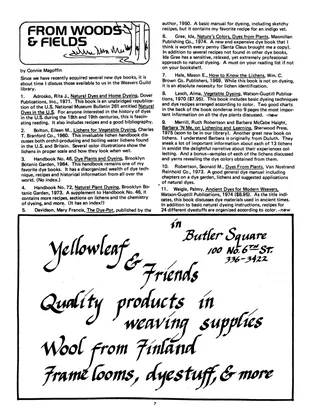
A short column from the Minnesota Weaver's 'From Woods & Fields' series reviewing eleven natural dye books held in the Weavers Guild library. Each entry gives author, title, publisher and year with a brief comment on content, covering general dye manuals, lichen dyeing and identification, and ancient dye materials. A small advertisement for Yellowleaf & Friends appears on the page.
Parmelia (lichen), Brazilwood, Mimosa, solar dyeing
Article · 1 page
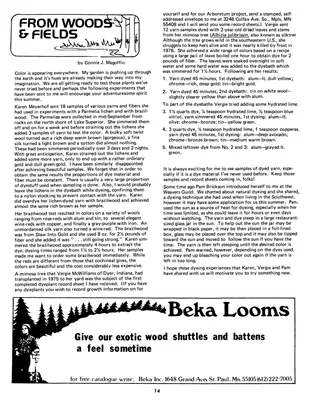
A one-page natural dyeing column from the Minnesota Weaver in which Connie Magoffin reports on readers' dye experiments. It covers Karen Meyerhof's tests with Parmelia lichen and brazilwood on wool, silk and cotton, and Vergie McWilliams's mimosa (Albizia julibrissin) dyebaths with alum, chrome, tin and other additions, listing the colors obtained. It also describes Pam Brickson's solar dyeing method using a large glass jar left in the sun.
Personal Thoughts on Natural Dyeing
Article · 2 pages
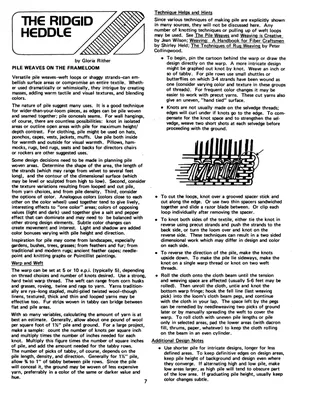
Two pages from the Minnesota Weaver (November 1976), containing Gloria Rither's "The Ridgid Heddle" column on pile weaves on the frame loom, followed by Weavers' Guild "School News". The column covers design planning, warp and weft choices, yarn estimates, and techniques for cutting loops, knotting both sides, reversing pile direction, and rolling cloth with pile. The school news lists November classes, an open house exhibit, and the January interim program. Nothing in the text matches the catalogued title, Connie Magoffin's article on natural dyeing.
Sampling new plants
Article · 2 pages
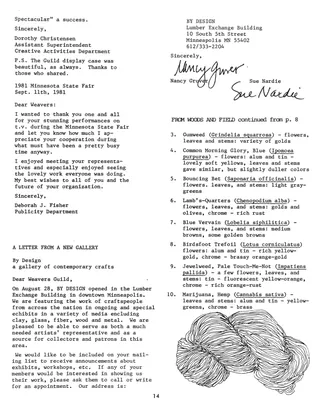
A column from the Minnesota Weaver in which Connie J. Magoffin describes her method for sampling unfamiliar dye plants: chopped plant material simmered with six wool strands mordanted with alum, tin, copper, chrome, iron, or left unmordanted, then recorded on index cards for light testing. She then lists ten plants she tried for the first time, such as Queen Anne's Lace, Gumweed, Jewelweed and Birdsfoot Trefoil, with general color results for each. The second page continues the list and carries unrelated guild letters, including thanks for the Minnesota State Fair demonstrations and a note from a new Minneapolis crafts gallery.
Southwest Trip
Article · 1 page
A first-person travel account from the "From Woods & Fields" column by Connie Magoffin about a Southwest trip to research natural dyes. She visits the Hubbell Trading Post at Ganado, the Grand Canyon, the Museum of Northern Arizona in Flagstaff (with its Navajo weaving displays), and UNLV, where she finds L. Paul Mercer's scrapbook of dye recipes. It closes with her dried rabbitbrush and mormon tea yielding yellows, orange-golds and greens.
Summer Dyeing
Article · 1 page
A one-page column by Connie Magoffin from the Minnesota Weaver (June 1977) offering natural dyers ideas for summer. It covers the advantages of lichen dyeing, tips for experimenting with unidentified dye plants, and references to earlier columns with dye recipes and light-test instructions. It also proposes group dyeplant collecting trips and one-day dyeing get-togethers for Guild members.
30 documents found