Textile Documents › Authors › Author: Karen Searle
9 documents found
Sort: 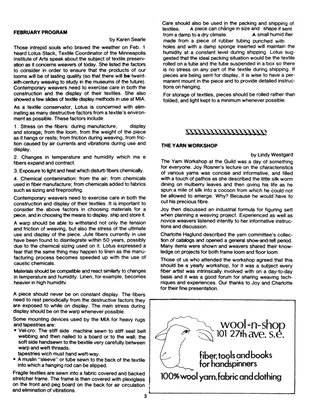
February Program- Textile Preservation
Article · 1 page
Report on a February 1979 guild program in which Lotus Stack, textile coordinator at the Minneapolis Institute of Arts, spoke on textile preservation for contemporary weavers. It covers destructive factors (fiber stress, temperature and humidity, light and heat, chemical contamination), choice of warp and materials, mounting methods for rugs and tapestries, and packing, shipping and storage. The page also has a short report on a guild yarn workshop with Joy Rosner and Charlotte Haglund, plus a wool-n-shop advertisement.
Garments - Bog Jackets Part 2
Article · 1 page
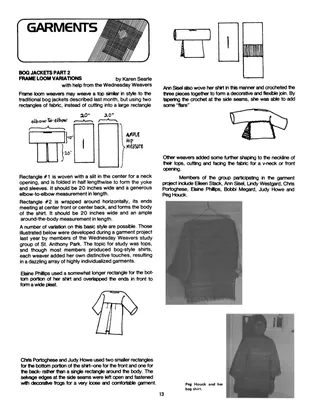
A one-page article from Minnesota Weaver, the second part of a series on bog jackets, covering frame loom variations. It explains how to make a top from two woven rectangles: one with a neck slit folded to form yoke and sleeves, and one wrapped around the body. It illustrates variations by members of the Wednesday Weavers study group of St. Anthony Park, including a front pleat, separate front and back panels joined with frogs, and panels crocheted together with flare. Line drawings and a photograph accompany the text; there are no weaving drafts.
Moorman Inlay Technique for Rigid Heddle Frame Looms
Monograph · 7 pages
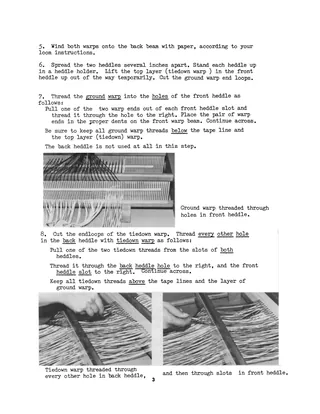
A short instruction booklet by Karen Searle adapting Theo Moorman's inlay technique to rigid heddle frame looms, published by Dos Tejedoras in St. Paul, Minnesota. It explains how to dress the loom with separate ground and tiedown warps using two heddles and masking-tape guides, and sets out the sheds for the ground tabby and the two inlay sheds. A sampler section covers sparse and dense inlay, overlapping motifs, a solid tapestry effect, and variations such as changing the tiedown ratio or spacing the warp. It is illustrated with photographs of the threading steps and woven samples.
The Rigid Heddle - Inlaid Weaves
Article · 2 pages
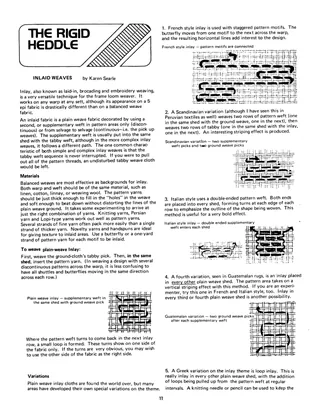
A two-page article from Minnesota Weaver on inlay (laid-in, brocading) techniques for the rigid heddle loom and other frame looms. It explains inlay as a supplementary weft worked on a plain weave ground, recommends materials and yarns, and describes plain weave inlay plus French, Scandinavian, Italian, Guatemalan and Greek loop variations, each illustrated with small diagrams. It also covers charting designs on graph paper, making cartoons, and ends with a short reference list.
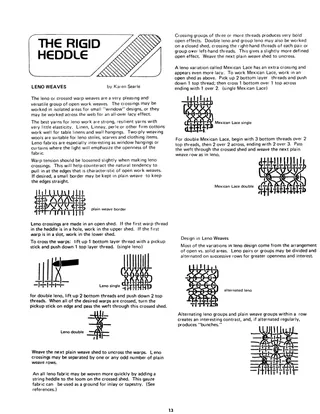
The Rigid Heddle - Leno Weaves
Article · 2 pages · weaving drafts
A two-page article by Karen Searle in the Rigid Heddle column of Minnesota Weaver explaining how to make leno (crossed-warp) lace on a rigid heddle loom with a pickup stick. It covers suitable yarns, tension, single and double leno, Mexican Lace variations, and design ideas such as alternating leno and plain weave groups, with small diagrams and a reference list. The second page also carries notices of regional fiber exhibits and yarn shop advertisements.
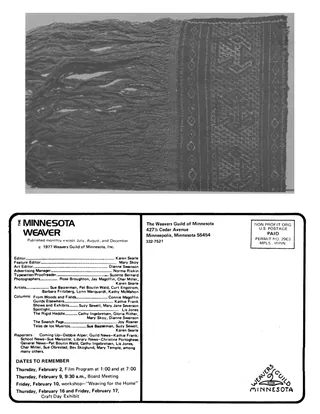
Telas de los Muertos - Supplementary Weft Techniques
Article · 4 pages
An article in the Telas de los Muertos series on supplementary weft patterning in ancient Peruvian textiles from the Science Museum of Minnesota collection. It explains how supplementary wefts differ from embroidery and describes the main structures with diagrams: brick alignments with short and long floats, paired floats, rib, free weft float patterning, and columns (Dukagang). It also covers the materials (cotton ground, cameloid wool supplementary wefts), thread counts, and design motifs, with photographs of five museum fragments.
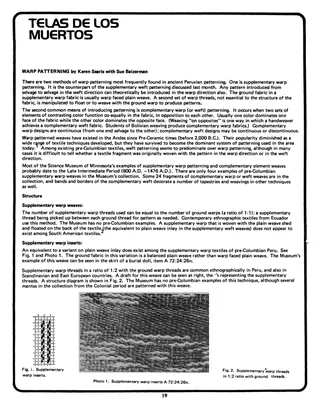
Telas de los Muertos - Warp Patterning
Article · 4 pages · weaving drafts
Part of the Minnesota Weaver series "Telas de los Muertos," this article surveys warp patterning in ancient Peruvian textiles, using examples from the Science Museum of Minnesota's collection. It covers supplementary warp weaves (inserts, 1:1 and 1:2 ratios), plain-weave-derived float weaves, complementary warp/weft weaves including two-color and multicolor pebble weave, turned weave, and warp/weft substitution. Entries give sett, thread counts, fibers, spin direction and approximate dates, with structure diagrams, drafts, photographs and a reference list (Rowe, Emery, Cason and Cahlander, Atwater).
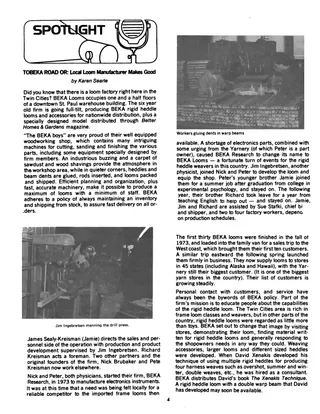
Tobeka Road: Local Loom Manufacturer
Article · 2 pages
A profile of BEKA Looms, a St. Paul, Minnesota firm that manufactures rigid heddle looms and accessories for nationwide distribution. It covers the company's origins in 1973 as BEKA Research, its partners, its shop and production methods, and its customer education efforts, including a travelling workshop van and a planned Rigid Heddle Weaving Conference. It also mentions the Better Homes & Gardens loom, David Xenakis's multiple-heddle technique, and plans for a floor loom.
Weaving Myth and Magic-Cotton
Article · 1 page
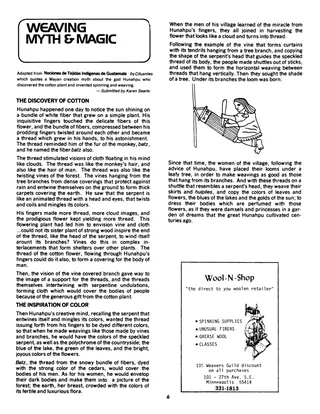
A short article adapted by Karen Searle from Cifuentes's Nociones de Tejidas Indígenas de Guatemala, retelling a Mayan creation myth in which the god Hunahpu discovers the cotton plant, invents spinning, dyeing and weaving, and inspires the first loom under a tree. It explains the origin of the backstrap loom, the shuttle and the colors of Guatemalan women's clothing such as skirts and huipiles. A line drawing of a woman at a backstrap loom accompanies the text, and a Wool-N-Shop advertisement shares the page.
9 documents found