Textile Documents › Authors › Author: Mary Meigs Atwater
105 documents found
Sort: 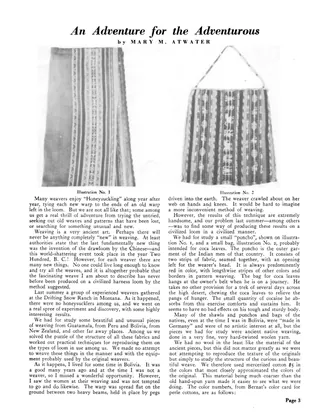
An Adventure for the Adventurous
Article · 3 pages · weaving drafts
Mary Atwater describes a warp-face pattern weave studied from a Bolivian poncho and coca-leaf bag, which she and a group of weavers reproduced on a harness loom at a Montana summer gathering. She gives the warp color plan and sett (48 ends per inch, 4 per dent in a 12-dent reed), treadling for the dark and light square figures, and pick-up stick directions for an X-figure. She also covers a technique for beating up the dense fabric, possible uses, and the needle-woven braid edging on the originals. The last page has the draft with tie-ups and 6- and 4-harness threadings.
Again the Twill Weave
Article · 4 pages · weaving drafts
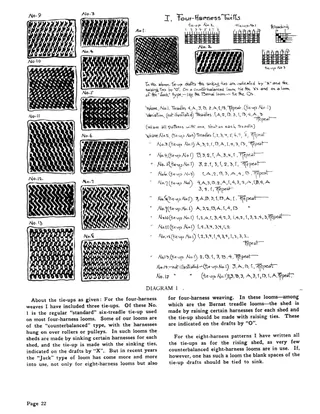
Mary M. Atwater's second Weaver article on twills presents a selection of fancy twill patterns for four and eight harnesses. It gives threading and tie-up drafts with treadling sequences for 15 four-harness and 23 eight-harness patterns, with drawdown swatches and a few woven samples. The text comments on the suitability of individual patterns for suitings, coats, blankets and afghans, how they look on the wrong side, and how to tie up counterbalanced versus jack looms.
Borders
Article · 5 pages · weaving drafts
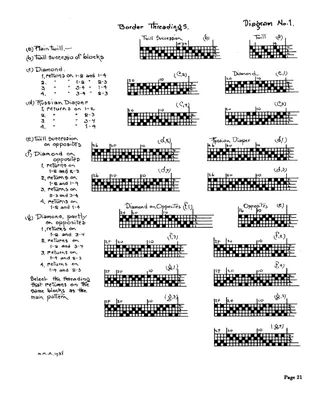
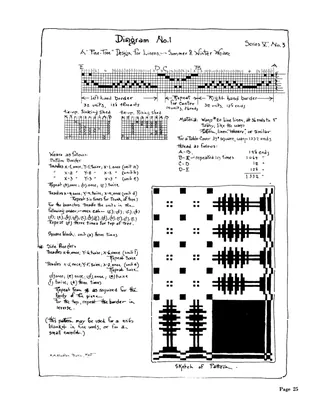
Mary Meigs Atwater discusses how to choose and design borders for coverlets, table pieces, rugs, runners and hangings. She covers twill, twill-succession, diamond and Russian diaper border threadings for overshot, including forms written on opposites, and how to join border and main pattern. She also explains how to produce a simulated Pine-Tree border in four-harness crackle weave and a true Pine-Tree border in summer and winter, with threading diagrams, tie-ups and treadling directions.
Borders
Article · 5 pages · weaving drafts
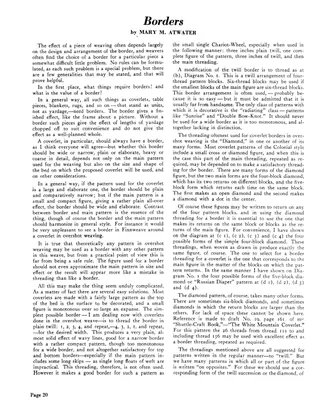
Mary Meis Atwater discusses the choice and design of borders for coverlets and other woven pieces, mainly in overshot. She covers plain twill borders, twill successions of blocks, and four-block diamond and five-block Russian Diaper threadings, including versions on opposites. She explains how to join border and main pattern and how border width relates to bed size. She also gives a simulated Pine Tree border for four-harness crackle weave and Pine Tree borders for summer and winter, with threading and treadling directions and drafts on three diagrams.
Borders - Continued
Article · 5 pages · weaving drafts
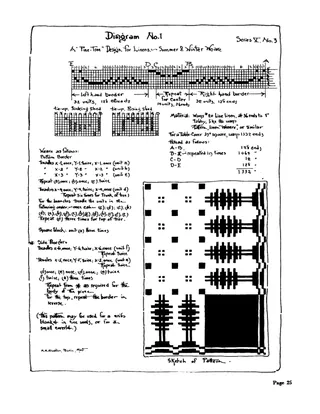
Mary Atwater's article on weaving pattern borders on all four sides of a plain center, for lunch cloths, place mats, curtains, shawls and baby blankets. It explains multi-harness solutions and two four-harness methods: weaving in three strips that are sewn together, and carrying the pattern weft across the border sections only. Five diagrams give drafts and treadling directions: a summer and winter 'Pine-Tree' pattern, a crackle-weave 'Whirling Spindle' lunch cloth, a lunch cloth and mats draft, a spot weave border, and a Finnweave Scandinavian-type border.
Borders -- Continued
Article · 5 pages · weaving drafts
Mary Meigs Atwater's continuation of her article on weaving pattern borders on all four sides of a plain center, from The Weaver. She describes methods for four-harness looms, including weaving in three strips that are sewn together and carrying a pattern shuttle across only the border section, and gives drafts for a summer and winter 'Pine-Tree' design and a double-weave 'Whirling Spindle' pattern. A separate Shuttle-Craft recipe covers a lunch cloth and mats in lace weave, followed by spot-weave borders and a Finnweave Scandinavian-type border.
The Bronson Weave - Four Ways
Article · 9 pages · weaving drafts
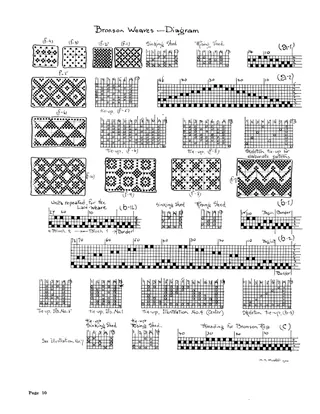
Mary Atwater explains the so-called Bronson weave (spot weave), how it got its name from the 1817 Bronson 'Domestic Manufacturer's Assistant', and its two threading forms, (a) and (b). She describes four uses: fine linens, an openwork lace-weave, a weft-effect upholstery and bag fabric, and a warp-face rep for furniture covering. The article gives treadling sequences, sett and yarn recommendations, and seven illustrations of woven samples, plus a page of diagrams with threadings, tie-ups and drawdowns.
Card Weaving
Monograph · 17 pages · weaving drafts
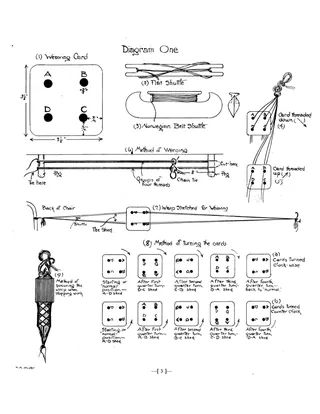
A pamphlet by Mary Meigs Atwater introducing card (tablet) weaving in the simple ancient Egyptian four-hole technique. It covers equipment, materials, reading drafts, warping, threading the cards, stretching the warp, the turning sequences for weaving, and variations such as braided bands. Nine patterns are given with warp color schedules, including the Girdle of Ptahhotep, and photographs of the woven samples. It closes with finishing advice, a short reading list, and pages advertising Lily and Tulip cotton yarns.
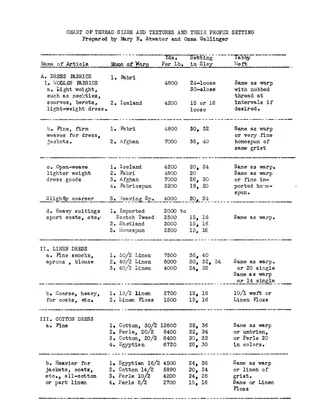
Chart of Thread Sizes and Textures and Their Proper Setting
Monograph · 10 pages
A tabular chart giving recommended warp yarns, yardage per pound, sley (reed) settings, tabby weft and suitable pattern wefts and threadings for hand-woven articles. It covers dress fabrics (wool, linen, cotton), belts, handbags, bed coverings, blankets, upholstery, draperies, rugs and table linens. Facing pages list the recommended weave structures for each use, and a closing note explains how to read the chart and why settings vary with yarn twist.
The Commercial Weaver vs. the Amateur Weaver
Article · 2 pages
A short essay by Mary Meigs Atwater contrasting weaving for profit with weaving for pleasure. She argues that commercial weavers must sometimes compromise beauty for saleability, while amateurs risk being too easily satisfied and should adopt an artist's attitude toward criticism and workmanship. She concludes that amateur weavers carry responsibility for setting standards of beauty and craftsmanship that commercial weavers follow.
Cotton Towelling
Article · 5 pages · weaving drafts
Mary Atwater describes a four-harness towelling weave in soft unmercerized cotton, based on Italian and Swedish pieces, in which small overshot threadings are treadled as plain twill with colored borders and tufted bands. She discusses suitable cottons (Bernat's Perugian and Vittoria Strand), warp setting, and gives detailed treadlings for sections (a) through (j) of two illustrated towels. Three threading drafts with sinking and rising shed tie-ups are included (Sweet-Briar Beauty, Dog Tracks, Queen's Delight), along with suggestions for other overshot patterns. The last page carries a notice for the 1941 National Conference of American Handweavers.
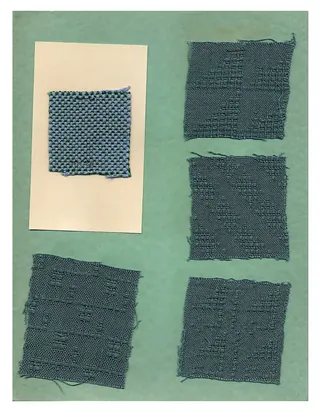
Design and the Handweaver Portfolio
Other · 3 pages
Cover and sample pages from the Portfolio Edition of Mary Meigs Atwater's Shuttle Craft Monograph Three, 'Design and the Handweaver' (1961). The scan has a title page and two pages of mounted handwoven fabric samples in assorted colors and textures. It has no running text or weaving drafts.
Dornik and Some Fancy Twills
Article · 3 pages · weaving drafts
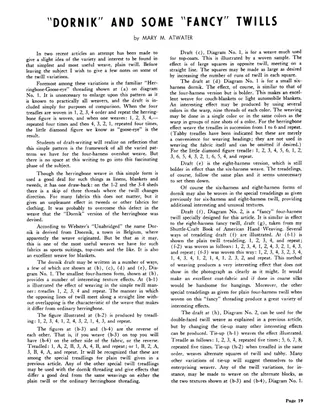
Mary Atwater's article on dornik, a herringbone-type twill variation that avoids the three-thread skip where ordinary herringbone changes direction. It gives four-, six- and eight-harness dornik drafts with treadling sequences, and notes uses for suitings, top-coats and blankets. It also presents a four-harness fancy twill and an eight-harness double twill with alternative tie-ups. Two diagram pages give the drafts, tie-ups and woven samples.
Double Weaving on Four Harnesses - the Finnweave
Article · 5 pages · weaving drafts
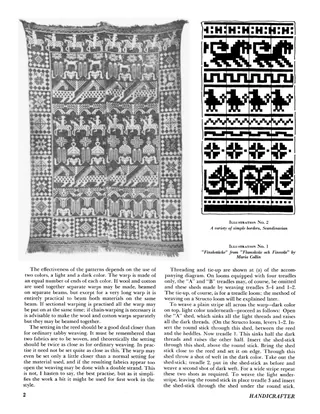
Mary Meigs Atwater introduces the Finnweave, a method of weaving pattern-figured double plain cloth on an ordinary four-harness loom, to American weavers. She explains the equipment (round stick, pattern stick, shed-stick), yarn choice and sett, and step-by-step instructions for weaving plain stripes and pattern rows on treadle and Structo looms. The article includes a threading and tie-up diagram, a worked bag pattern, borders, a coverlet pattern, and two figure motifs (a trumpeter and a peasant woman) adapted from an old Finnish piece.
An Experiment
Article · 6 pages
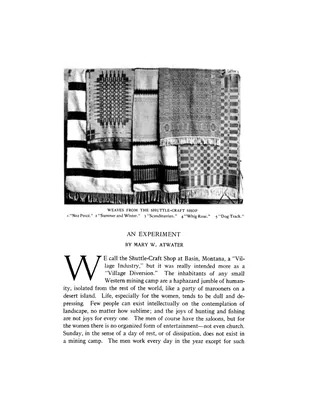
Mary Meigs Atwater describes the Shuttle-Craft Shop, a small weaving enterprise she founded in the mining camp of Basin, Montana, as a diversion for isolated local women. She discusses which groups of women took to weaving and how the shop moved from four-harness overshot to Summer and Winter weave. She describes the pieces shown in the illustrations (rugs, knitting bags, pillow top, card-woven girdle), mentions blue-print drafts of old patterns including John Landes patterns, and appeals to club members to share old drafts. It contains no weaving drafts.
A Few Simple Braids
Article · 6 pages
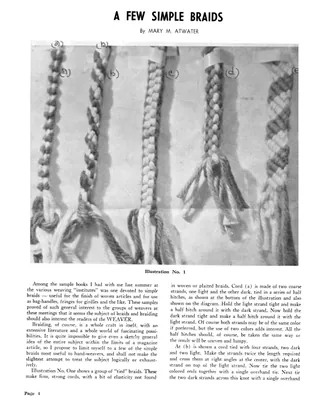
Mary Atwater introduces a selection of simple braids and knotted cords that handweavers can use for finishing woven pieces, bag handles, drawcords and girdle fringes. She gives step-by-step directions for tied braids (half-hitch and crowning knot), Solomon knot cords, looped or bight braids (twin-bight, Antique Sennit), multi-strand Indian, combing and Girdle of Rameses braids, and sailors' sennits. Photographs of sample cords and hand-drawn diagrams accompany the text, and she recommends a further reference on knots and rope work.
A Few Twills
Article · 8 pages · weaving drafts
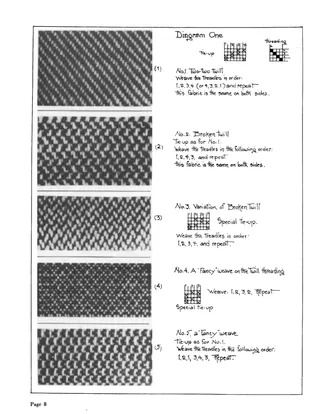
Mary M. Atwater's article surveys a selection of twill weaves for handweavers, with 28 numbered sample drawdowns across seven diagrams. It covers the three-harness jeans twill, four-harness two-two and broken twills, double three-one twill, corkscrew twills, six- and eight-harness twills, double-face twills in blocks, a fancy twill with two weft weights, and twills using two-color warps and wefts. The text discusses suitable uses (dress and coat fabrics, blankets, linens), warp setting, and handling selvages in twill weaving. Each diagram gives tie-ups, threadings and treadling sequences.
The Finish of Edges
Article · 4 pages
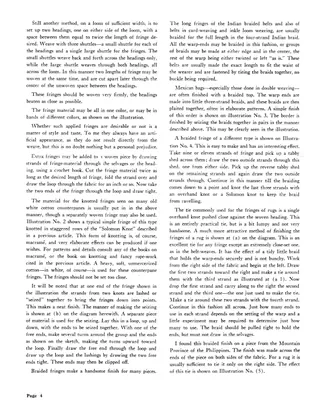
Mary Atwater's article on finishing the edges of woven pieces, mostly with fringes. It covers deciding whether to fringe, finishing in the loom with Spanish open-work weaving, and weaving separate applied fringes on an inkle or harness loom. It also describes knotted macramé (Solomon knot) fringes, seizing, braided fringes and tops, a braided rug-fringe tie from the Philippines, and three Maori twined finishes. Diagrams and five photographs illustrate the methods.
Guatemala Visited Portfolio
Other · 6 pages
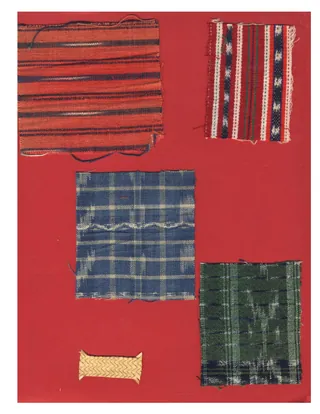
A portfolio of mounted fabric samples that accompanies Mary Meigs Atwater's Shuttle Craft Guild Monograph 15, Guatemala Visited (1965). Four pages of photographs show the swatches, and a final page lists and describes each sample. The samples include ikat skirt cloths, a man's trouser, huipiles, a stiff belt (faja), an apron, a tapestry head-band, a terminal selvage, palm braid and a draw-loom fabric. The notes give dimensions, looms (counter-balanced treadle, back-strap, draw-loom), regions and cross-references to pages in the monograph.
Guide to Hand Weaving Arranged for Use on the Looms of Reed Loom Company
Monograph · 19 pages · weaving drafts
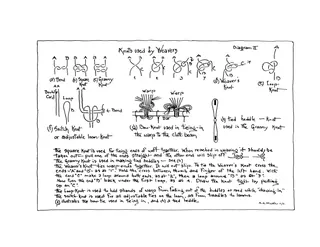
A 1931 beginner's handbook by Mary Meigs Atwater, written for owners of Reed Loom Company looms (Weavers' Friend, Ideal, Little Dandy and the four-harness Cambridge). It covers loom parts, warping on a sectional beam, drawing in, sleying, tying in, knots, tie-ups and weaving technique, then gives rag-rug and fine-fabric directions for two harnesses. Four-harness drafts follow with treadling directions: twill, bird-eye, herringbone and goose-eye, overshot patterns (Honeysuckle, Diamond, Dog Tracks, Pine Bloom, Wreath Rose), Monk's belt, baby blankets, Ms and Os, and a mock-leno openwork weave. Diagrams of the loom and knots and hand-drawn drafts are included.
Hand Weaving
Monograph · 26 pages · weaving drafts
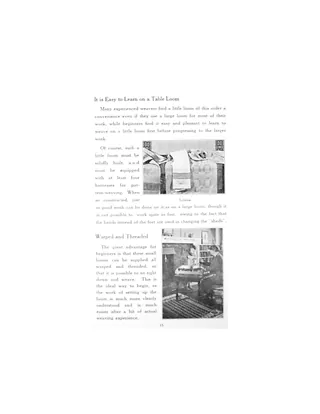
A promotional booklet from the Shuttle-Craft Company in which Mary Meigs Atwater presents hand weaving as a revived American craft, a source of income, and a teaching and occupational-therapy field. It describes household textiles, rugs, coverlets and dress fabrics made on the loom, and gives advice on choosing floor looms and table looms. It outlines the Shuttle-Craft correspondence courses, which cover overshot, draft writing, Summer and Winter and double weaves. It also includes Atwater's autobiographical account of becoming a weaver, a list of Shuttle-Craft special drafts for Colonial coverlet patterns, and a few sample drafts.
[Hand Weaving for the Structo Loom]
Monograph · 21 pages · weaving drafts
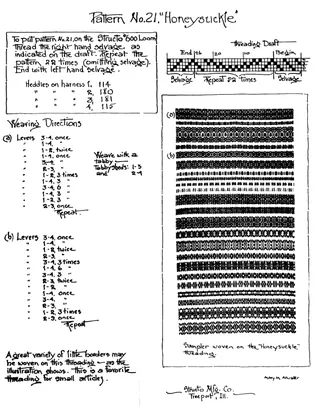
A collection of pattern leaflets by Mary Meigs Atwater for the Structo Mfg. Co. of Freeport, Illinois, giving threading drafts and lever-by-lever weaving directions for the Structo 600 four-harness loom. It opens with a group of small threadings (twill, dornick, bird-eye, goose-eye, Bronson, Ms and Os, huck), then covers numbered coverlet-style patterns such as Honeysuckle, The Diamond (with Holland Chain and Rose in the Wilderness treadlings), Monk's Belt, Lovers' Knot and White Rose, a Summer and Winter arrangement, Double Chariot-Wheels, Double Bow-Knot, Nine Snow-Balls, Governor's Garden, Queen's Delight and Solomon's Delight. Each gives heddle counts per harness, thread counts, tabby sheds, and notes on colors and uses.
Hand-Weaving: An Old Art for Modern Craftsmen
Other · 4 pages
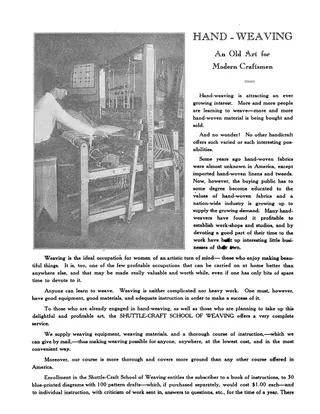
Promotional brochure for Mary Meigs Atwater's Shuttle-Craft School of Hand Weaving in Cambridge, Massachusetts. It opens with a form letter inviting readers to join a "Christmas Club" and the Shuttle-Craft Guild, then describes the mail-order weaving course, which includes instruction, blueprinted diagrams and pattern drafts. It also describes the three looms the school supplied: the Structo 4-harness table loom and the Practical 4- and 8-harness floor looms. Photographs show looms and hand-woven textiles.
Handwoven Rugs
Monograph · 33 pages · weaving drafts
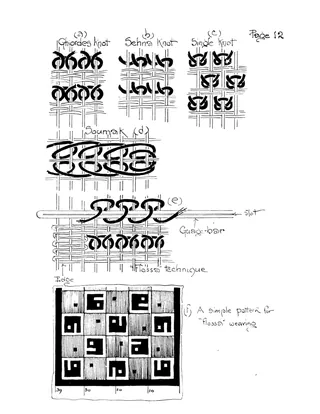
A 1948 monograph by Mary Meigs Atwater, reissued by HTH Publishers, giving concise directions for weaving rugs by hand. It covers equipment and materials, plain-weave rag and chenille rugs, Swedish twice-woven and matta techniques, picked-up tufting, knotted pile (Ghiordes, Sehna, flossa, rya), soumak, overshot, no-tabby and Indian saddle-blanket weaves, crackle, summer-and-winter, and the two-warp technique with pick-up patterns. It ends with fringe ties and closing advice. Pages are hand-lettered and illustrated with many diagrams, drafts, and pattern grids.
How to Weave on the Inkle Loom
Monograph · 12 pages · weaving drafts
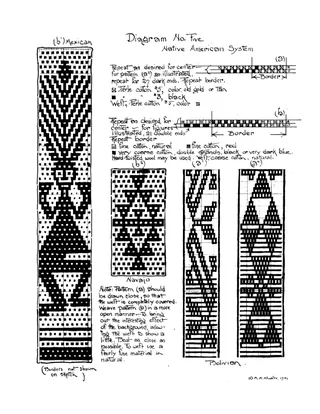
A 1941 instruction pamphlet by Mary Meigs Atwater of the Shuttle-Craft Guild on weaving narrow bands on the inkle loom. It describes the Old English and the table-model New American looms, how to warp them, and how to open the two sheds. It then covers plain-weave warp-faced patterns, pick-up patterns by the Scandinavian/European threading, and the native American system (Navajo, Mexican, Bolivian, Philippine). Six numbered diagrams give color-order drafts, threadings and pattern figures, with photographs of sample bands.
A Hundred and One Things to Weave for Christmas
Mary Meigs Atwater · 1927
Monograph · 9 pages
A short Christmas-season leaflet by Mary Meigs Atwater suggesting hand-woven gifts and how to make them, including linens, scarves, bags, pillow-tops, chair-seats and rugs. It gives warp and weft choices, setts, and sizes for each item. Treadling directions accompany patterns A through F (Honeysuckle, Goose-Eye, Ms and Os, Summer and Winter, and a seamless/double-width tube weave), with table-loom lever transpositions for the Structo loom. It ends with a Yarn News price list for cotton, perle, and linen yarns.
It's Pretty - But is it Art?
Article · 3 pages
Mary M. Atwater responds to Anni Albers' article "Handweaving Today" and the Henning-Rees article from the January-February 1941 Weaver. She rejects the ideas that handweaving exists to make models for industry, that it should be "free-formed" and not meant for use, and that durability does not matter. She also disputes the claim that texture and color alone are real design elements and that pattern weaving is outdated, and she defends pattern, usefulness and "approved repetition." The scan also includes Cornelia Stone's article on double weaving on eight harnesses, based on an 1849 Baltimore weaving manual by Abslam Hecht.
Jaspé
Article · 3 pages
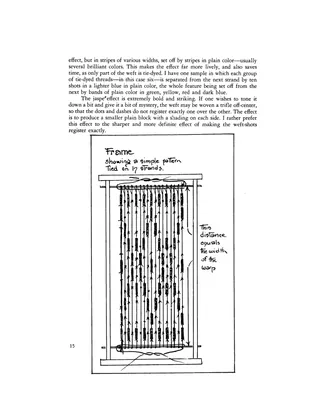
Mary Meigs Atwater describes her experiments with jaspé, a tie-dyed warp or weft effect seen in ancient Peruvian and Guatemalan weaving. She explains stretching the weft on a frame (a spool-rack), wrapping and tying dots and dashes to resist the dye, then dyeing, unwrapping and weaving the weft. She recommends weft-dyeing for standard looms, mentions materials that worked well or poorly, and suggests using the jaspé in stripes and offsetting the weft slightly for a softer look. Illustrations show the wrapping method and a tying frame.
Knotted Pile Rugs
Article · 3 pages · weaving drafts
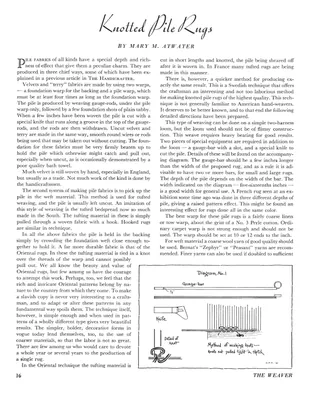
Mary M. Atwater's article from the first issue of The Weaver explains how to make knotted pile rugs using a Swedish technique on a simple two-harness loom. It briefly compares other pile methods (velvet and terry, tufted weft pile, hooked rugs) with Oriental-style knotting. It gives step-by-step directions for tying knots over pairs of warp threads with a slotted gauge-bar and pile-cutting knife, and recommends warp and weft yarns, sett, and quantities. It includes illustrations of rugs and four grid-based pattern designs with warp counts for two rug widths.
Linen
Article · 3 pages
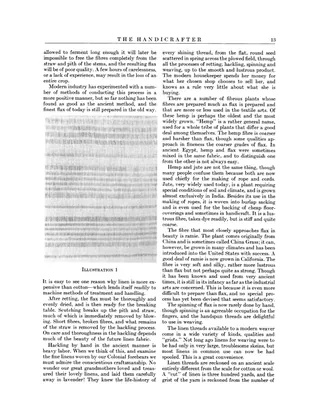
A 1929 magazine article by Mary Meigs Atwater on linen, covering the history of flax, its cultivation, retting, scutching and hackling, and related fibers such as hemp, jute and ramie. It then turns to practical advice for handweavers: how linen yarn is graded (cuts per pound), line versus round linen, warp versus weft linen, the cost of dyed linen, and which weaves suit linen. It touches on overshot, which tends to look stringy in linen, and damask, which it calls the best weave for linen. Illustrations include a flax-processing photograph and a draft-like grid.
New Curtains for Spring
Article · 5 pages · weaving drafts
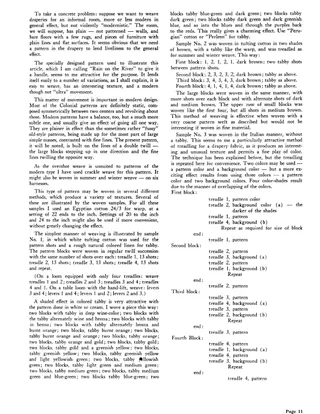
Mary Atwater discusses planning handwoven draperies for a room, covering room size, style, use, pattern versus stripes versus texture weaves, color and material choice. She then presents an original crackle-weave draft, "Rain on the River," for a modern informal room, with a six-treadle tie-up and drawdown. She describes three treadlings, each illustrated by a woven sample: a twill-order block treadling with colored tabby, a summer-and-winter style treadling with coarse brown weft, and an Italian-manner treadling without tabby. She also gives threading variations, color-shading suggestions, warp setting and suitable materials.
New Techniques in Summer and Winter Weave
Article · 4 pages · weaving drafts
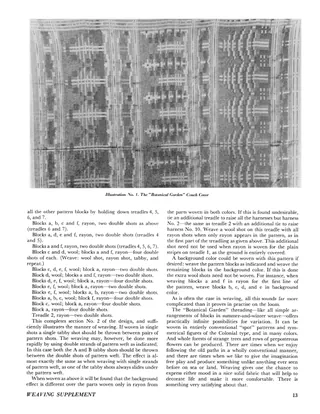
Mary Meigs Atwater describes new ways of using summer and winter weave that old-time weavers did not practice. These include weaving a threading "on opposites" with pattern and background wefts and no tabby, which gives a heavy double-face fabric with reversed colors, and weaving several blocks independently in different colors for tapestry-like effects. She also explains a special tie-up that lets a jack loom produce many sheds through the foot treadles. The "Botanical Garden" couch cover, woven in black silk warp with rayon and wool wefts, serves as the worked example, with treadling directions for one section, a photograph, and a short draft with tie-up.
An Open-Work Weave
Article · 4 pages · weaving drafts
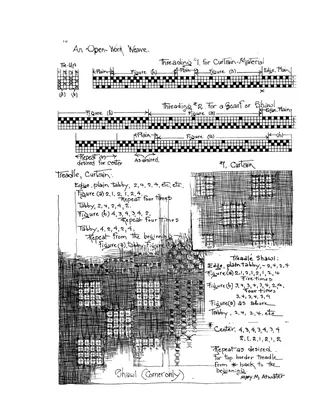
A 1928 Handicrafter article by Mary Meigs Atwater introducing an open-work (lace-work) weave of Scandinavian origin on four shafts. It gives threading and treadling drafts for a linen curtain and for a scarf or shawl, with sett, yarn choices, border arrangements, and loom tie-up transpositions for treadle and table looms. It also suggests variations such as dress fabrics, baby blankets, drapery with grouped warp threads, and six-treadle tie-ups.
The Osage Braid
Article · 5 pages
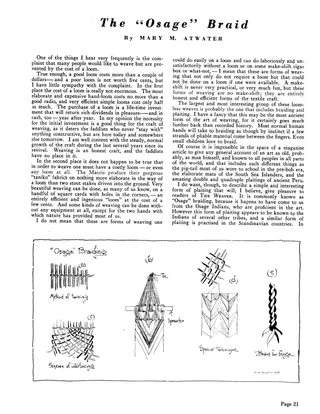
Mary M. Atwater describes the loomless Osage braid (also called "Swedish weaving"), a finger-plaiting technique used for belts and girdles with chevron and diamond patterns. She gives instructions for a three-inch girdle in five colors of Bernat's Peasant yarn: warping, the twining tie, the spreader, picking up the shed and drawing threads through, and finishing with braided fringes, including a four-strand Indian braid. She also covers variations such as arrowhead and lightning figures made by looping the weft threads. Diagrams and photographs of finished girdles, including pieces made at Bacone Indian College, illustrate the article.
The Overshot Weave On Six Harnesses
Article · 5 pages · weaving drafts
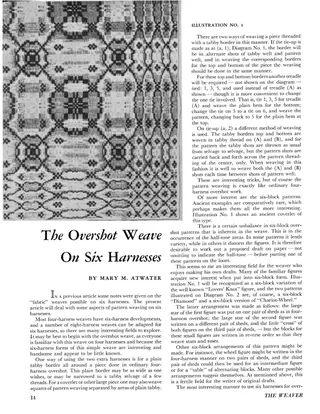
Mary M. Atwater's 1937 article on pattern weaving in overshot on six harnesses. She covers using the two extra harnesses for tabby borders around four-harness overshot, six-block patterns (a six-block Lovers' Knot, Diamond and Chariot-Wheel), and overshot woven "on opposites" written for six harnesses, which gives a reversible fabric with stars on one side and roses on the other. Drafts and tie-ups are given, including the 'John Landes' pattern with warp arrangements for a coverlet strip and a pillow top, plus a Monk's Belt stripe arrangement. The scan also includes the end of a different article and a Questions and Answers column.
Patterns for Six-Harness Weavers
Article · 4 pages · weaving drafts
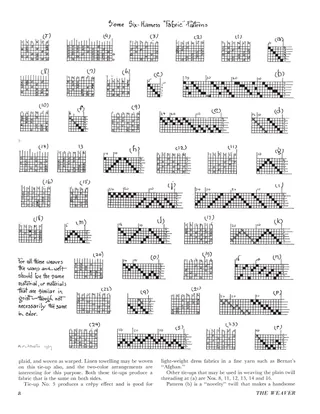
Mary Atwater surveys the possibilities of the six-harness loom, including overshot, Bronson, mock leno, summer and winter and other weaves, then concentrates on small "fabric" threadings for texture rather than pattern. Page 2 has a diagram of 24 tie-ups and threadings (a)-(s), and the text gives tie-up and treadling directions for each, such as plain twill, corkscrew twill, double-faced twill, shepherd's check, bird's-eye, herringbone, waffle and basket weave. She advises on tie-up conventions for jack looms, choice of materials, warp setting, sampling and washing for yardage weaving.
Pink or Blue!
Article · 5 pages · weaving drafts
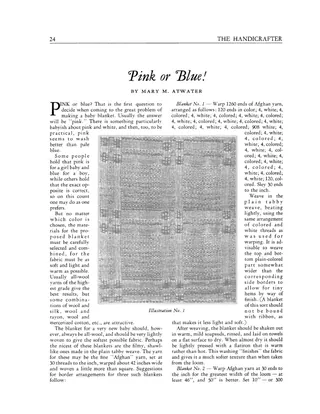
A 1929 article by Mary Meigs Atwater with instructions for weaving baby blankets on a handloom. It covers fifteen blanket designs, from light plain-tabby Afghan-yarn blankets with colored borders to heavier Saxony and Germantown wool blankets. The heavier ones use linen-weave threadings, overshot, basket weave, an eight-harness pattern and quilted (double) weaving. It gives warp counts, sley rates, color arrangements, treadlings and finishing advice, and closes with notes on handling wool warps. A threading-draft sheet with tie-ups (a)-(g) and several photographed or drawn illustrations accompany the text.
Practical Weaving Suggestions, Vol. 1-61 (1961): No-Tabby Weave and Tufted Rugs
Periodical · 8 pages · weaving drafts
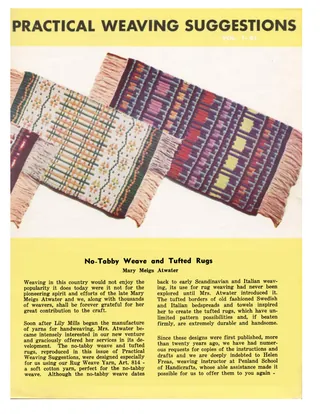
An issue of Lily Mills' Practical Weaving Suggestions reprinting Mary Meigs Atwater's designs for no-tabby weave rugs and tufted rugs, woven with Lily Rug Weave Yarn on a beige carpet warp. It gives materials, sett, threading and tie-up drafts, and pass-by-pass color directions for three 19 x 36 inch rugs (Boy and Girl Figures, Vine and Trellis, Tulip Bed). A final section explains the pick-up tufted rug method on two or four harnesses, with a tuft-making diagram and a bath mat example. The last page is a Lily Mills yarn advertisement.
Practical Weaving Suggestions, Vol. V, No. 2: Notes on 'Crackle Weave'
Periodical · 8 pages · weaving drafts
Mary Meigs Atwater's leaflet explains the crackle weave, a four-block, four-harness weave she named after a Swedish Jamtlandsvaev structure. It covers the weave's origin, block structure, drafting rules, materials and sett, treadle and table-loom tie-up conversions, and three treadling methods (normal, summer-and-winter style, Italian no-tabby). Drafts include 'Three Flowers', 'Cottage Windows', a modern arrangement, 'Rain on the River' with color-shading instructions, and two rug patterns. The last page advertises Lily Mills hand weaving yarns.
Practical Weaving Suggestions, Vol. XVIII: Imprisoned Sequins
Periodical · 4 pages
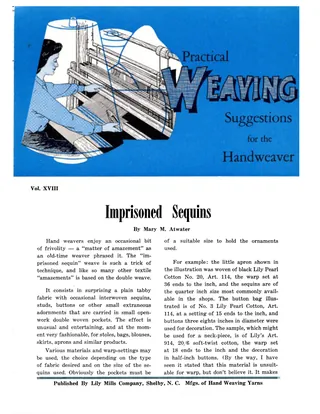
A short article by Mary Meigs Atwater describing the "imprisoned sequin" technique, in which sequins, buttons, shells or rhinestones are enclosed in small open double-woven pockets within a plain tabby fabric. It gives yarn and sett examples (Lily Pearl Cotton and 20/6 filler), and treadling instructions for four-harness rising and sinking shed set-ups and for eight-harness threadings with several tie-ups, including pick-up stick use. It also covers shirring with cords, care and pressing of sequined pieces, and a supplier for sequins. The leaflet was published by Lily Mills and includes a page advertising Lily hand weaving yarns.
A Primitive Weave
Article · 7 pages · weaving drafts
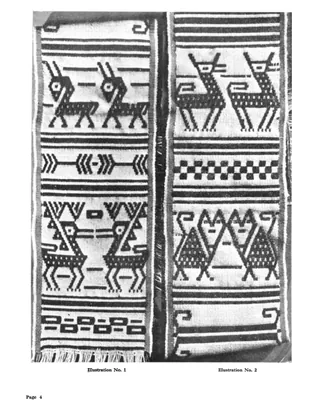
Mary Atwater describes a warp-face pick-up technique inspired by ancient Peruvian girdles with stylized animal figures, adapted for modern four-harness looms using three harnesses. She gives warp plans, yarns, sleying, treadling and pick-up stick instructions for a Peruvian piece and a Mexican piece, with figure charts and photographs of finished work. She suggests uses such as bags, runners, pillow tops and wall panels, and notes the fabric is decorative rather than hard-wearing.
Questions and Answers
Article · 1 page · weaving drafts
A one-page question-and-answer column by Mary M. Atwater from The Weaver, 1936. It covers four reader questions: the selling price of old coverlets, transposing six-treadle tie-up directions to a four-treadle loom (with a conversion table for treadle and rising-shed looms), whether Bronson (spot) weave toweling needs weft identical to the linen warp, and yarn quantities per square yard of plain tabby fabric for several Bernat yarns.
Questions and Answers
Article · 1 page
A question-and-answer column by Mary M. Atwater from The Weaver, July 1936. It explains how to calculate yarn quantities from yarn counts (linen cut of 300 yards, cotton and wool hank of 840 yards), with worked examples for warp yardage and advice on estimating weft and allowing for waste. Shorter answers cover applying warp dressing and where to get gauge-bars and knives for knotted pile rugs. The page also carries the concluding paragraphs of an article on a wall hanging woven in a tapestry-like technique on a rosepath threading with a binder.
Questions and Answers
Article · 1 page
A one-page question-and-answer column by Mary M. Atwater from The Weaver. It explains what warp-dressing is and how to make a flaxseed version for linen and wool warps, suggests weaves and yarns for an afghan or light couch blanket, and describes two ways to mend a broken warp thread during weaving.
Questions and Answers
Article · 1 page
A single-page Questions and Answers column by Mary M. Atwater from The Weaver, 1937. It answers how to cover the warp completely with weft (weft-face weaving) and how to make a warp-face fabric, covering warp setting, tension, beating, use of a template, and suitable pattern weaves such as Summer and Winter and crackle woven on opposites. It also describes a Scandinavian covered-warp twill or Bird-Eye/Rosengang weave and mentions card weaving. The page ends with the concluding paragraph of an article on laid-in technique, continued from page 7.
Questions and Answers
Article · 1 page
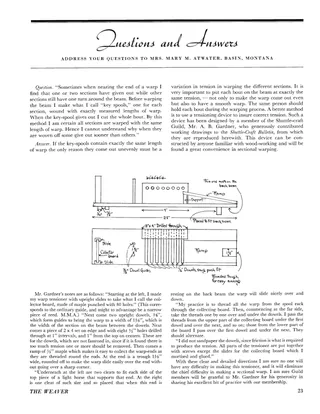
A one-page question-and-answer column by Mary M. Atwater from The Weaver, 1937. A reader asks why sections of a sectionally warped beam run out unevenly even though measured key spools were used. Atwater attributes this to uneven tension and presents a wooden warp tensioning device designed by Guild member A. B. Gardner, with a diagram and Gardner's construction and use notes.
Questions and Answers
Article · 1 page
A single page from The Weaver (October 1937) with Mary Meigs Atwater's Questions and Answers column. She discusses the difference between 'hand-woven' and 'hand-loomed' fabrics (the latter a trade name for machine imitations), and explains how to produce weft-face and warp-face fabrics by choosing warp spacing, sett and weft size, with rug examples and threading double or triple. The page also opens with closing advice on yarns and twills for garments, and ends with the conclusion of an article on the overshot weave on six harnesses.
Questions and Answers
Article · 1 page
A one-page Questions and Answers column by Mary M. Atwater on calculating yarn quantities for weaving. It works through an overshot coverlet in two strips, figuring warp yardage from the cotton count (24/3 at 6,720 yards per pound) and weft weights for Shetland pattern yarn and cotton tabby. It also gives a tweed example and the base yardage figures for cotton, wool (840) and linen (300).
Questions and Answers
Article · 1 page
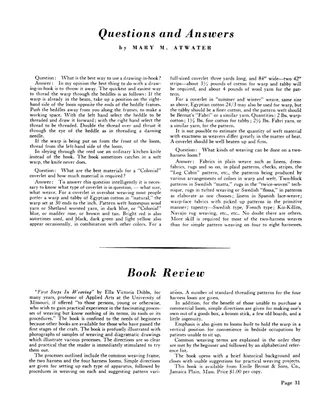
A one-page Questions and Answers column by Mary M. Atwater from The Weaver, July 1938. It covers threading heddles and sleying without a drawing-in hook, materials and yardage for a Colonial overshot or summer and winter coverlet, and the kinds of weaving possible on a two-harness loom. It ends with a short review of Ella Victoria Dobbs's beginners' book "First Steps in Weaving."
Questions and Answers
Article · 1 page
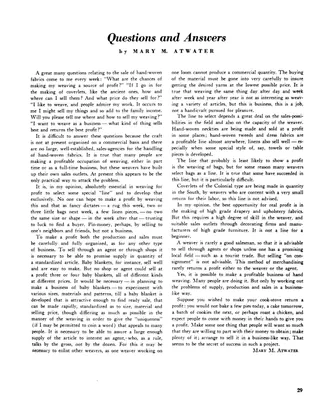
Mary M. Atwater answers readers' recurring questions about selling hand-woven fabrics for profit. She argues that a weaver must choose one standardized line, organize production, materials purchasing and sales like any business, and sell through agents or shops rather than on consignment. She comments on which lines tend to pay (tweeds, dress fabrics, linens, neckties, high-grade drapery and upholstery fabrics) and which to avoid (bags, Colonial-type coverlets).
105 documents found