Textile Documents › Publications › Publication: Weaver
237 documents found
Sort: 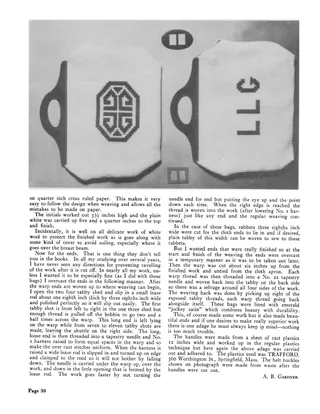
Adaptation of Dukagang to a Modern Work Bag
Article · 2 pages
A.B. Gardner describes adapting the Scandinavian Dukagang technique, as presented by Elmer Wallace Hickman in an earlier issue of The Weaver, to make a white wool work bag with an octagonal green medallion and initials. She explains her departures from Hickman's method: weaving right side up with a bobbin bin clamped to the cloth beam, weaving in pattern ends instead of knotting them, and carrying the pattern to the selvedges. She also covers warp and yarn choices, a twill threading, overcast and woven-back finishing of the ends, and plastic handles. A photograph shows the finished handles and belt buckles.
Adaptations of a Simple Danish Stitch
Article · 2 pages
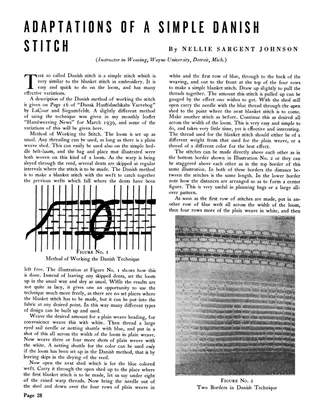
A short 1939 article by Nellie Sargent Johnson explaining how to work the Danish stitch, a blanket-stitch-like technique, on the loom over a plain weave ground. It describes sleying with skipped dents versus freely placed stitches, and spacing and staggering the stitches to form borders. Instructions are given for a place mat in carpet warp and candlewick cotton and for a raw silk bag woven on a 12-inch heddle loom. Four photographs and diagrams illustrate the method and the finished pieces.
Adaptations of Commercial Weaves
Article · 2 pages · weaving drafts
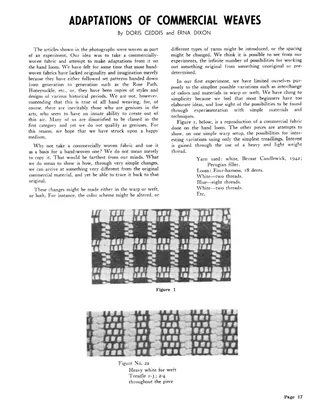
A short article describing an experiment in adapting a commercially woven checked fabric on a four-harness hand loom. The authors argue that hand weavers can create original work by making simple changes in color, yarn type, and spacing rather than copying traditional patterns. They give the warp setup (white and blue stripes, 18 dents) and weft and treadling variations for a series of sample swatches, including plain-weave stripes and twill.
An Adventure for the Adventurous
Article · 3 pages · weaving drafts
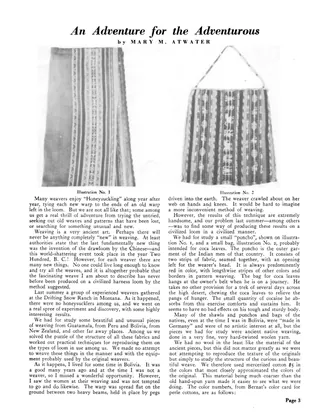
Mary Atwater describes a warp-face pattern weave studied from a Bolivian poncho and coca-leaf bag, which she and a group of weavers reproduced on a harness loom at a Montana summer gathering. She gives the warp color plan and sett (48 ends per inch, 4 per dent in a 12-dent reed), treadling for the dark and light square figures, and pick-up stick directions for an X-figure. She also covers a technique for beating up the dense fabric, possible uses, and the needle-woven braid edging on the originals. The last page has the draft with tie-ups and 6- and 4-harness threadings.
Afghans in Dukagang Effect
Article · 2 pages · weaving drafts
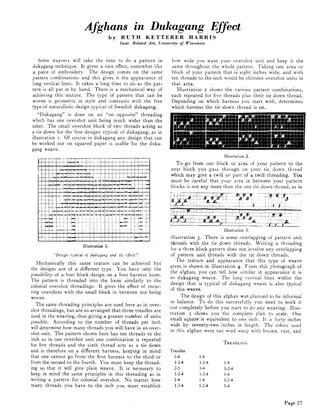
A 1938 Weaver article by Ruth Ketterer Harris explaining how to weave afghans with a texture resembling dukagang, using an overshot-type threading on four harnesses with a tie-down thread after each overshot unit. It covers the threading principles, pattern combinations, treadling with three treadles at once, and the plain-weave tabby system. It also describes a 40 by 72 inch afghan in tan wool with brown, rust and green pattern wefts, with threading drafts, treadling and layout diagrams.
Again the Twill Weave
Article · 4 pages · weaving drafts
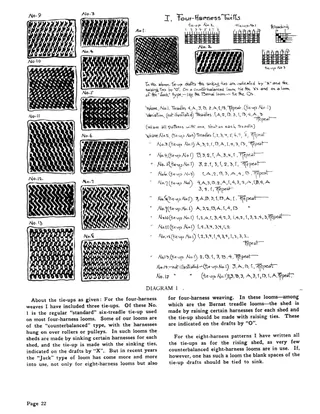
Mary M. Atwater's second Weaver article on twills presents a selection of fancy twill patterns for four and eight harnesses. It gives threading and tie-up drafts with treadling sequences for 15 four-harness and 23 eight-harness patterns, with drawdown swatches and a few woven samples. The text comments on the suitability of individual patterns for suitings, coats, blankets and afghans, how they look on the wrong side, and how to tie up counterbalanced versus jack looms.
American YarnsAn Inspiration for Weavers
Article · 7 pages
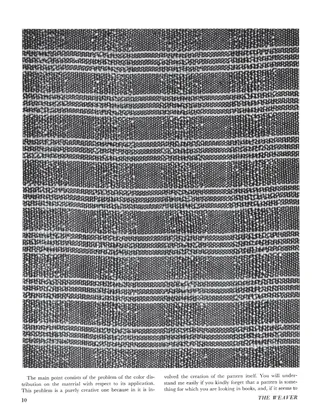
Part Two of Maria Steinhoff's essay in the first issue of The Weaver, discussing creative inspiration in weaving. She argues that yarn texture and color, not copied pattern-book drafts, should drive design, and she applies this to dress fabrics suited to the wearer's figure, coloring and personal versus collective taste, and to designing handwoven cloth that will sell. It closes with captions for five illustrations of her fabrics, giving the Bernat yarns used for warp and filler.
Attractive Luncheon Sets
Article · 2 pages
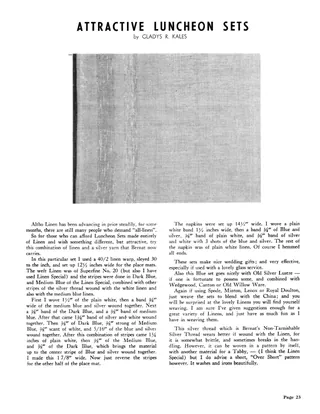
A short 1940 article from Weaver describing how to weave linen luncheon sets (place mats and napkins) with a 40/2 linen warp and weft stripes in blue linen and Bernat's non-tarnishable silver thread. It gives warp sett and widths, the stripe sequence for the place mats and napkin borders, and tips on winding the brittle silver thread with linen. It also suggests matching the colors to china patterns. The first page has a draft or drawdown grid; the second page is an illegible image.
Author's Index of The Weaver
Article · 2 pages
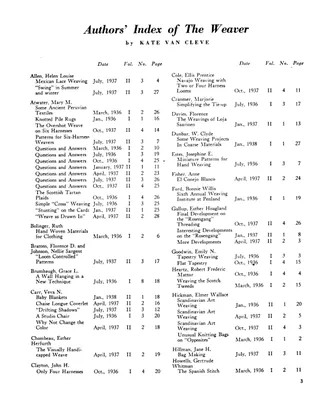
An author index to the first two volumes of The Weaver (1936-1937), compiled by Kate Van Cleve. Page 1 lists authors alphabetically from Allen to Howells, with article titles, issue dates, volume, number and page. Page 2 continues with authors from Johnson to Walters, followed by a title-based listing of selected articles with their authors. Contributors include Mary M. Atwater, Veva N. Carr, Emily N. Goodwin, Elmer Hickman and Esther Gallup.
Baby Blankets
Article · 3 pages · weaving drafts
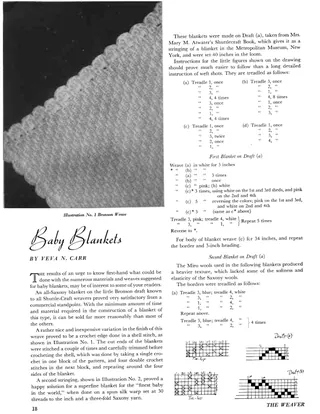
Veva N. Carr describes her experiments weaving baby blankets, a carriage robe and a lap pad in wool, mainly on the Bronson weave and a basket-weave draft from Mary M. Atwater's Shuttle-Craft Book. She gives threadings, tie-ups, treadling sequences, color borders, sett (30 and 15 threads per inch), yarns (Saxony, Miro, Bernat Laurel) and finishing methods such as crochet shell edges and ribbon binding. The scan also includes continuation fragments of other articles in the same issue: a Rosengang treadling and pieces on Loja Saarinen and Scandinavian art weaving.
Bag in Featherstitch Technique
Article · 3 pages · weaving drafts
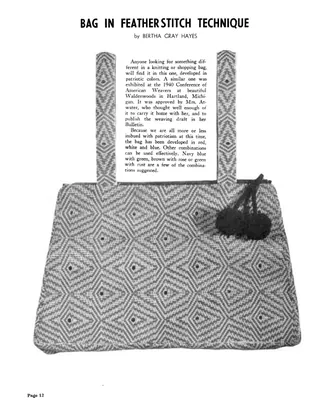
Instructions for weaving and assembling a knitting or shopping bag in red, white and blue using a "featherstitch" technique on a four-shaft loom. The article lists materials (carpet warp, Perle cotton tabby, Saxony wool pattern weft, canvas interlining, silk lining, zipper), the threading, and treadling tables for the front and back, connecting band and handles. It explains how to introduce the red "eye" accent, how to cut the canvas pieces, and how to sew and line the bag, with alternate directions for Structo looms.
Bag Making
Article · 1 page
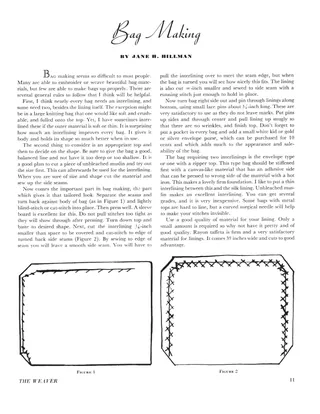
A short 1937 how-to article on making up handwoven or embroidered fabric into handbags. It gives general rules on interlinings, choosing shape and top, turning back and cat-stitching side seams, fitting the lining, and using pins and a pocket. It also covers stiffening envelope and zipper-top bags and choosing lining fabrics such as rayon taffeta. Two line drawings illustrate the seam finishing.
Bags for the Woman Who Reads
Article · 2 pages · weaving drafts
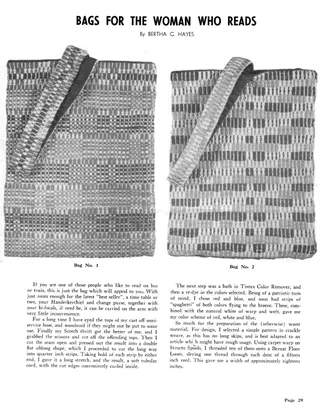
A short 1942 article in Weaver describing two handwoven shoulder bags for carrying reading material, woven in crackle weave with carpet warp. The weft strips are cut from the tops of discarded hosiery, which are stretched into tubular cords and re-dyed red and blue. The article gives the construction method, treadling sequences for both bags, threading notes for Structo Spools on a 15-inch reed, and a draft with tie-up.
Blended Drafts and Weaves, Something New in Honeysuckle and other Patterns
Article · 2 pages · weaving drafts
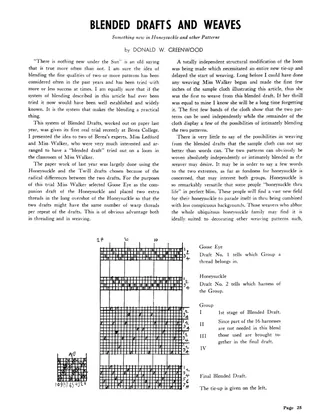
Donald W. Greenwood describes a system of "blended drafts" that combines two four-harness threadings into one draft. The first draft decides which group of harnesses each warp thread goes in, and the second decides which harness within that group. The system was first tried at Berea College, where Miss Walker wove a sample blending Honeysuckle and Goose Eye. The article gives draft diagrams, a worked thread-by-thread example, tie-up notes for ten treadles, and an illustration of the sample cloth.
Bon Voyage Gift
Article · 1 page · weaving drafts
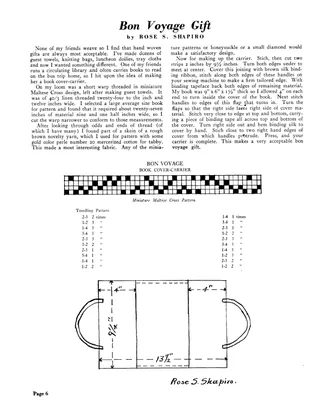
A short article by Rose S. Shapiro describing a book cover-carrier made as a gift from a leftover warp of 40/3 linen threaded in a miniature Maltese Cross pattern. It gives the materials used (brown novelty yarn for pattern, gold perle 20 cotton for tabby), sewing instructions with dimensions, a threading draft and treadling sequence, and a diagram of the carrier.
Book Marks and Hair Bands on Card Weaving
Article · 1 page · weaving drafts
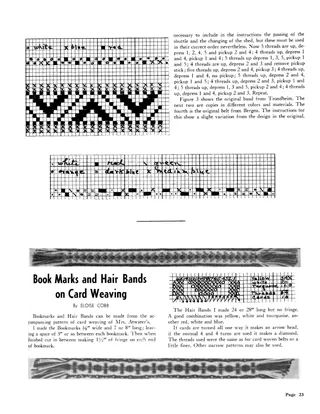
A short article by Eloise Cobb describing how to make bookmarks and hair bands using card (tablet) weaving, based on a pattern by Mrs. Atwater. It gives sizes, fringe and length suggestions, color combinations, and notes on turning the cards to produce arrowhead or diamond motifs. The page includes pattern charts with color keys; it opens with the end of a preceding article's pick-up instructions for Norwegian belts from Trondheim and Bergen.
Borders
Article · 5 pages · weaving drafts
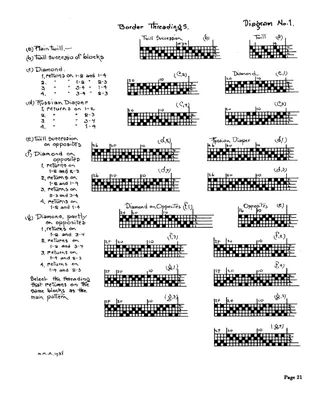
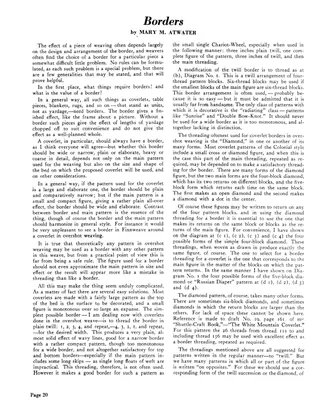
Mary Meigs Atwater discusses how to choose and design borders for coverlets, table pieces, rugs, runners and hangings. She covers twill, twill-succession, diamond and Russian diaper border threadings for overshot, including forms written on opposites, and how to join border and main pattern. She also explains how to produce a simulated Pine-Tree border in four-harness crackle weave and a true Pine-Tree border in summer and winter, with threading diagrams, tie-ups and treadling directions.
Borders
Article · 5 pages · weaving drafts
Mary Meis Atwater discusses the choice and design of borders for coverlets and other woven pieces, mainly in overshot. She covers plain twill borders, twill successions of blocks, and four-block diamond and five-block Russian Diaper threadings, including versions on opposites. She explains how to join border and main pattern and how border width relates to bed size. She also gives a simulated Pine Tree border for four-harness crackle weave and Pine Tree borders for summer and winter, with threading and treadling directions and drafts on three diagrams.
Borders - Continued
Article · 5 pages · weaving drafts
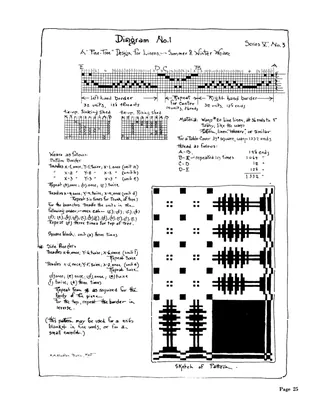
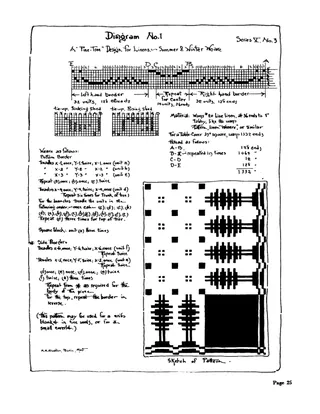
Mary Atwater's article on weaving pattern borders on all four sides of a plain center, for lunch cloths, place mats, curtains, shawls and baby blankets. It explains multi-harness solutions and two four-harness methods: weaving in three strips that are sewn together, and carrying the pattern weft across the border sections only. Five diagrams give drafts and treadling directions: a summer and winter 'Pine-Tree' pattern, a crackle-weave 'Whirling Spindle' lunch cloth, a lunch cloth and mats draft, a spot weave border, and a Finnweave Scandinavian-type border.
Borders -- Continued
Article · 5 pages · weaving drafts
Mary Meigs Atwater's continuation of her article on weaving pattern borders on all four sides of a plain center, from The Weaver. She describes methods for four-harness looms, including weaving in three strips that are sewn together and carrying a pattern shuttle across only the border section, and gives drafts for a summer and winter 'Pine-Tree' design and a double-weave 'Whirling Spindle' pattern. A separate Shuttle-Craft recipe covers a lunch cloth and mats in lace weave, followed by spot-weave borders and a Finnweave Scandinavian-type border.
The Bronson Weave - Four Ways
Article · 9 pages · weaving drafts
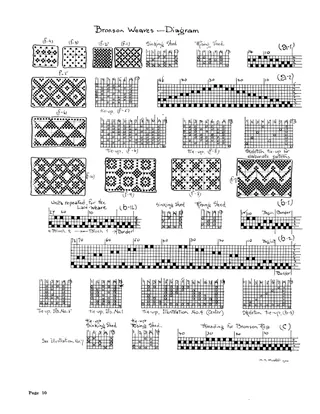
Mary Atwater explains the so-called Bronson weave (spot weave), how it got its name from the 1817 Bronson 'Domestic Manufacturer's Assistant', and its two threading forms, (a) and (b). She describes four uses: fine linens, an openwork lace-weave, a weft-effect upholstery and bag fabric, and a warp-face rep for furniture covering. The article gives treadling sequences, sett and yarn recommendations, and seven illustrations of woven samples, plus a page of diagrams with threadings, tie-ups and drawdowns.
The Business of Weaving
Article · 2 pages
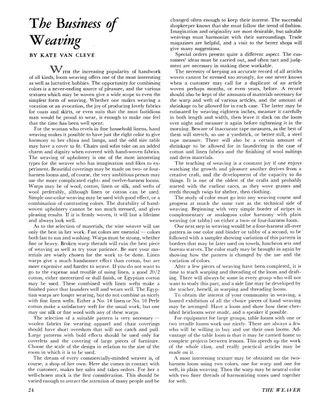
A two-page article from The Weaver by Kate Van Cleve on weaving as a business and hobby. It covers choice of warp and weft materials, pattern selection, running a shop, special orders, record keeping and shrinkage allowances, and teaching weaving classes. The page also carries a Questions and Answers column by Mary M. Atwater on hand-woven versus hand-loomed fabric and on weft-face and warp-face fabrics, plus the end of an article on the overshot weave on six harnesses.
Card Weaving Technique
Article · 5 pages
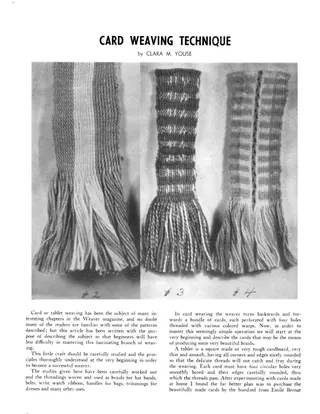
A beginner's instruction article on card (tablet) weaving by Clara M. Youse. It describes the cards, suitable warp and weft yarns, warping, and the method of turning the pack of cards, then gives seven progressive braid studies with tablet-by-tablet specification tables for direction and color. The studies produce plain, striped, horizontal band, checker, chevron, diagonal and wavy (river) patterns. A short book review of 'Weaving at the Little Loomhouse' follows the article.
Casual Table Mats
Article · 2 pages
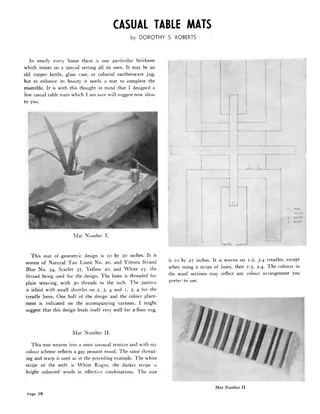
A short article from The Weaver describing four casual table mats designed by Dorothy S. Roberts, each about 10 inches wide and 12 to 27 inches long. All are woven on plain-weave threadings. Mat I has an inlaid geometric design in linen and Vittora Strand, with a cartoon for the colour placement. Mats II to IV are striped, using wool and linen wefts, with a weft-faced technique said to resemble Navaho rug texture. The article gives yarns, colours, sizes, reed and treadling details, and the stripe sequence for Mat IV.
Chair Covers
Article · 3 pages · weaving drafts
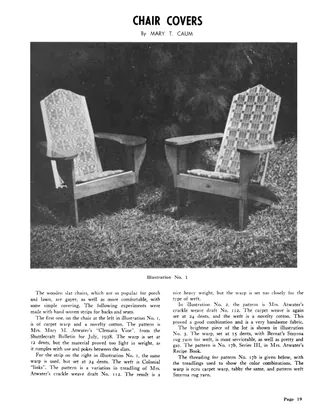
Mary T. Caum describes experiments weaving strips for the backs and seats of wooden slat porch and lawn chairs, using carpet warp with novelty cotton, Colonial "links", or Bernat's Smyrna rug yarn. She compares sett (12, 15 and 24 dents) and weft choices, citing Mary M. Atwater's "Clematis Vine" and crackle weave draft No. 112 and pattern 17b from the Recipe Book. The article gives treadling sequences with color numbers, an overshot-style draft, finished dimensions, and a sketch of how the strip is folded into a stuffed pocket and flap that holds it on the chair back.
Chairs 'N Things
Article · 2 pages · weaving drafts
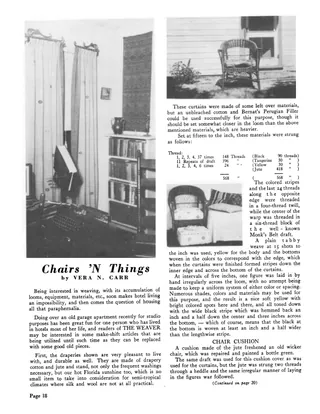
A short article from The Weaver in which Vera N. Carr describes furnishing a converted garage studio in Florida with handwoven items. She gives the warp setup (15 ends per inch, 568 threads in black, tangerine, yellow and jute) for draperies woven in a Monk's Belt block draft with four-thread twill stripes, woven as tabby with hand-laid-in figures. She also describes a jute cushion for a wicker chair and a padded box stool. The scan includes a multilingual glossary of weaving terms (English, Swedish, Norwegian, Danish, French, German, Dutch) and Monk's Belt tie-up and threading drafts.
Chaise Longue Coverlet
Article · 2 pages · weaving drafts
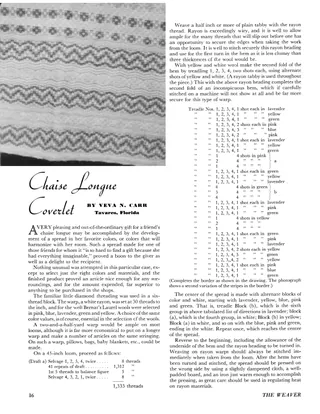
An article from The Weaver (April 1937) by Veva N. Carr of Tavares, Florida, describing a chaise longue coverlet woven as a gift. It uses a small diamond threading in six-thread blocks on a white rayon warp set at 30 ends per inch, with Bernat's Laurel wools in pink, blue, lavender, green and yellow. The text gives the warp count for a 45-inch loom, a full treadling and color sequence for the border, directions for the center blocks, and hem and finishing advice for rayon warps. A photograph of the coverlet and a full-page draft accompany it.
Chenille Rugs in Double Weave
Article · 6 pages · weaving drafts
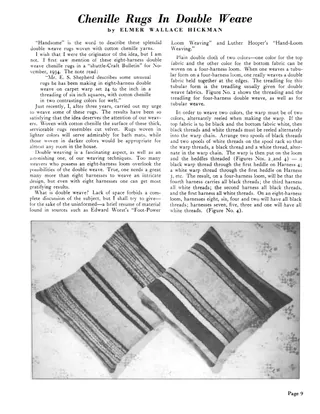
A 1938 article by Elmer Wallace Hickman describing how to weave thick rugs of cotton chenille weft in eight-harness double weave, whose surface resembles cut velvet. It explains the principle of double cloth on four and eight harnesses, including shed formation, treadling, selvage handling, and a 12-harness arrangement with long-eyed heddles for tabby. It gives practical notes on warp (24 ends per inch, two colors), reed, chenille choice, and color combinations. Four drafts, shed diagrams, and rug photographs are included.
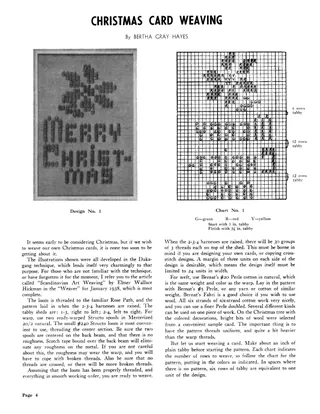
Christmas Card Weaving
Article · 4 pages · weaving drafts
An article from The Weaver explaining how to weave small Christmas and birthday cards in the Dukagang technique on a Rose Path threading, using a small Structo loom with fine cotton warp. It gives warp and weft materials, shed sequences, step-by-step instructions for laying in the pattern, and tips on beating, finishing and hemstitching. Six designs with color charts are included, plus advice on designing your own cards and mounting the finished weaving in photo folders.
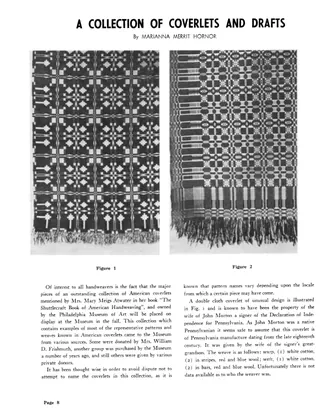
A Collection of Coverlets and Drafts
Article · 3 pages
A short announcement of an exhibition of American coverlets from the Philadelphia Museum of Art, including pieces mentioned in Mary Meigs Atwater's Shuttlecraft Book. The article describes six illustrated coverlets: two Pennsylvania double cloth pieces, a New York compound cloth coverlet, two geometric compound cloth coverlets, and an eighteenth-century fancy twill. For each it gives the provenance where known and the warp and weft materials and colors. It closes by listing photostat copies of early weaving draft books to be shown, including those of John Landes, Johann Ludwig Speck, William Hutchison and Conrad Schleelein.
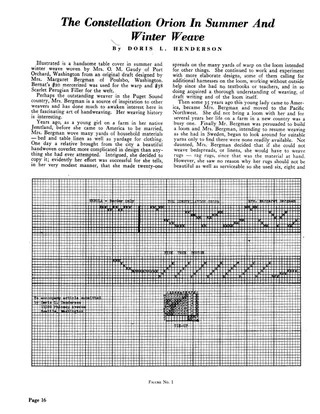
The Constellation Orion in Summer and Winter Weave
Article · 2 pages · weaving drafts
Article profiling Mrs. Margaret Bergman of Poulsbo, Washington, a Swedish-born weaver and teacher in the Puget Sound region, and presenting her summer and winter draft "The Constellation Orion." It recounts her weaving history from Jemtland, Sweden, her rag rugs, her discovery of summer and winter through Mrs. Atwater's book, her folding loom, and her teaching. A table cover woven by her pupil Mrs. Gaudy illustrates the pattern, and the draft includes a Nebula border and a Tree border with tie-up.
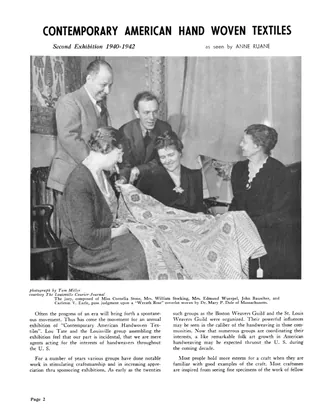
Contemporary American Hand Woven Textiles, Second Exhibition 1940-1942
Article · 25 pages
Anne Ruane's illustrated report on the second national exhibition of Contemporary American Handwoven Textiles, organized by Lou Tate and the Louisville group at the J. B. Speed Memorial Museum, 1940-1942. It describes how the show was organized, juried and awarded, then goes through the five divisions (clothing, linens, household fabrics, runners and wallhangings, tapestries) with photographs and captions naming each weaver. It discusses overshot, summer-and-winter, geometric double weave, doukagang, laid-in tapestry, Khilim, and Norwegian and Coptic techniques, and comments on design, yarns, simple looms and guild activities. It contains no weaving drafts.
Cotton Towelling
Article · 5 pages · weaving drafts
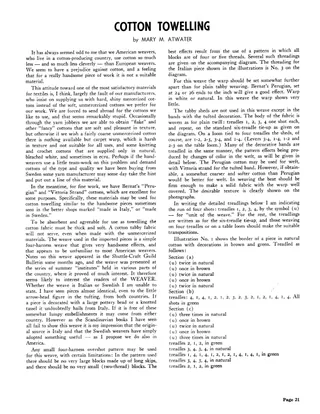
Mary Atwater describes a four-harness towelling weave in soft unmercerized cotton, based on Italian and Swedish pieces, in which small overshot threadings are treadled as plain twill with colored borders and tufted bands. She discusses suitable cottons (Bernat's Perugian and Vittoria Strand), warp setting, and gives detailed treadlings for sections (a) through (j) of two illustrated towels. Three threading drafts with sinking and rising shed tie-ups are included (Sweet-Briar Beauty, Dog Tracks, Queen's Delight), along with suggestions for other overshot patterns. The last page carries a notice for the 1941 National Conference of American Handweavers.
Coverlet Samplers
Article · 3 pages
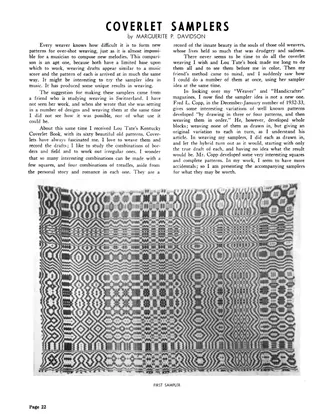
A 1940 article in which Marguerite P. Davidson describes weaving coverlet samplers, threading six overshot coverlet patterns side by side on one warp and treadling each pattern's draft in turn so the other patterns take on hybrid variations. She describes the patterns chosen from Lou Tate's Kentucky Coverlet Book, her own collected drafts, and Philadelphia Museum of Art coverlets, plus the color choices and what she learned. Three pages include photographs of the first, second and third samplers; no drafts are printed.
Creation of Smart Fabrics, Part One
Article · 7 pages
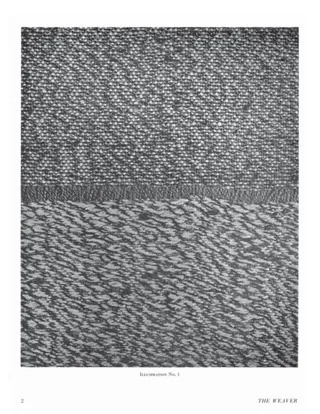
Part one of a two-part article by Maria Steinhoff arguing for the practical and economic value of hand-weaving fashion fabrics. She compares the cost of handwoven yardage with expensive designer and imported cloth, the speed of weaving versus knitting, and the mixing of different fibers. She then describes five illustrated sample fabrics for suits, dresses and coats, naming the Bernat yarns used for warp and filler and the colors. No threading drafts are given.
Crib Coverlets
Article · 1 page
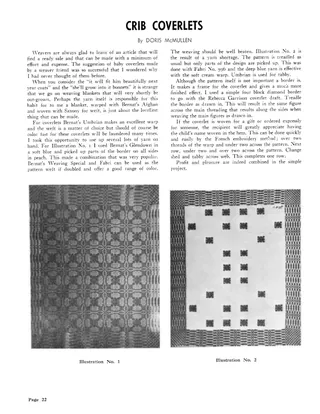
A short article by Doris McMullen proposing woven baby crib coverlets as a quick, inexpensive item for weavers to make and sell. She recommends Bernat yarns (Umbrian for warp, Glendown, Weaving Special and Fabri for weft), describes a coverlet with a picked-up peach border and one with partial pattern pick-up in deep blue, and suggests a four-block diamond border used with the Rebecca Garrison coverlet draft. She also explains weaving the child's name into the hem using the French embroidery method. Two photographs illustrate the coverlets; no drafts are printed.
Curtains
Article · 1 page
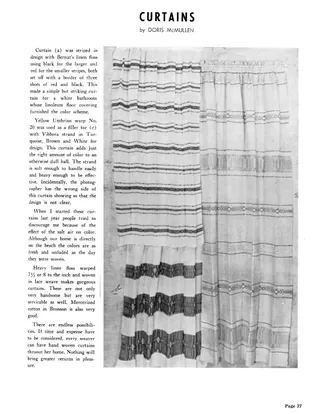
A short 1940 article by Doris McMullen on hand-woven curtains for a seaside home. She describes a striped bathroom curtain woven with linen floss in black and red, and a hall curtain using yellow Umbrian warp as filler with Vibbora strand in turquoise, brown and white. She reports that the colors did not fade in salt air and recommends heavy linen floss in lace weave or mercerized cotton in Bronson weave. A photograph shows the finished curtains; no drafts are given.
D is for Damask
Article · 2 pages
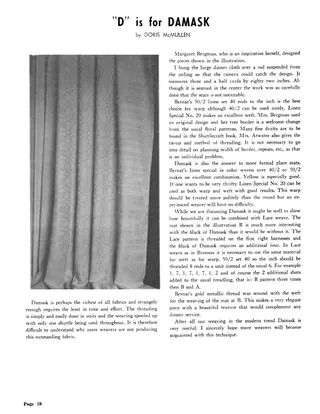
A short 1941 magazine article encouraging handweavers to try damask, which the author describes as rich yet quick to weave because threading is done in units and only one shuttle is used. It describes a tree-bordered linen dinner cloth designed by Margaret Bergman, recommends linen warps and wefts and sett, and suggests place mats. It also explains how to combine damask with Lace weave on eight ends per unit, with gold metallic thread in the weft. No drafts are given, but the author refers readers to the Atwater Shuttle-Craft book for drafts and tie-ups.
Designing Four Harness Loom Patterns
Article · 4 pages · weaving drafts
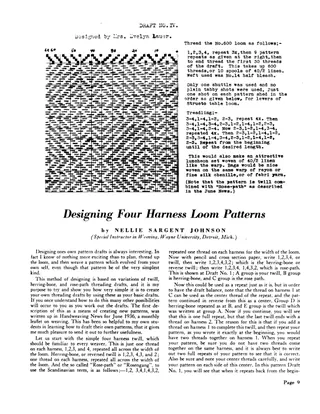
Nellie Sargent Johnson explains a method for designing four-harness threading drafts by combining and varying three basic threadings: twill, herringbone (reversed twill) and rose-path. She covers balancing a draft around center threads, avoiding doubled threads on one harness when repeating, and building pattern blocks of different sizes, with odd-numbered blocks at the reversal point. Draft examples designed by her students Evelyn Lauer and Marie Copland (Hearts and Flowers, Snow-Flake, Electric Light/Copland's Fancy) are given with threading, lever/treadling directions for a Structo loom, and suggested uses and yarns.
Did Your Wife Really Weave It?
Article · 1 page
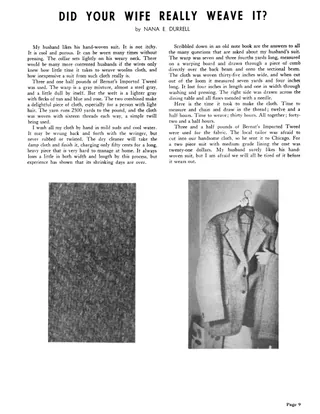
A short first-person article in which Nana Durrell describes weaving wool tweed cloth for her husband's suit. She gives the yarn (Bernat's Imported Tweed, 3.5 pounds), a simple twill at sixteen threads per inch, warp length, finished width, and shrinkage after hand washing. She also reports the time spent (about 42.5 hours) and the tailoring cost.
Dornik and Some Fancy Twills
Article · 3 pages · weaving drafts
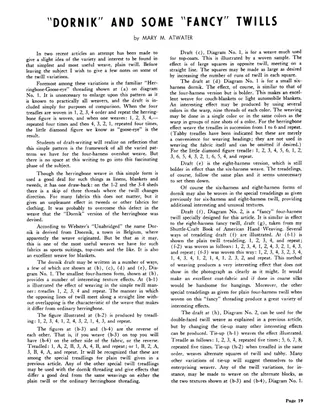
Mary Atwater's article on dornik, a herringbone-type twill variation that avoids the three-thread skip where ordinary herringbone changes direction. It gives four-, six- and eight-harness dornik drafts with treadling sequences, and notes uses for suitings, top-coats and blankets. It also presents a four-harness fancy twill and an eight-harness double twill with alternative tie-ups. Two diagram pages give the drafts, tie-ups and woven samples.
Double Weaving on Eight Harnesses
Article · 2 pages · weaving drafts
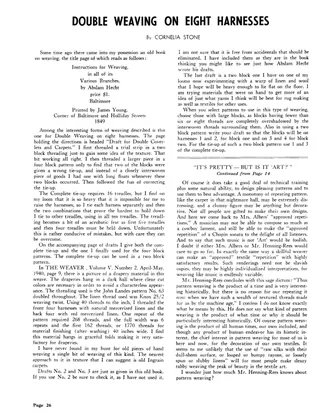
Cornelia Stone describes double weaving on eight harnesses, based on directions in an 1849 Baltimore instruction book by Abslam Hecht headed "Draft for Double Coverlets and Carpets." She explains her trial threadings, the 16-treadle complete tie-up and her reduced ten-treadle version, and gives details of a drapery fabric in John Landes pattern No. 63 doubled, woven in natural and red linen. The second page carries the drafts, including complete and short tie-ups and the Hecht drafts. The scan also includes the end of a rebuttal piece, "It's Pretty—But Is It 'Art?'"
Draperies Woven on a Loom
Article · 2 pages
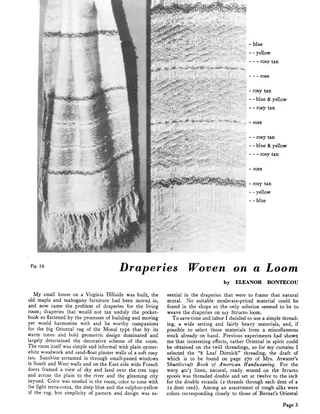
A first-person account by Eleanor Bontecou of weaving living-room draperies on a Structo loom for her Virginia home, colored to match a large Mosul-type Oriental rug. She used the 8-leaf Dornick twill threading from Mrs. Atwater's Shuttlecraft Book, with 40/3 linen warp and rough silk weft in blended shades, woven in Dornick bands on a modified tabby ground. It gives warp setting, color choices, and Structo lever treadling directions, and mentions a matching off-white silk fabric for a study.
Drawing Down Card Weaving Drafts
Article · 1 page · weaving drafts
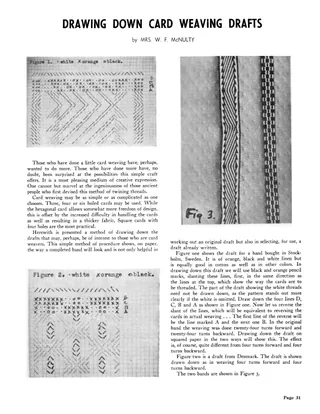
A one-page article explaining how to draw down card (tablet) weaving drafts on squared paper to preview how a finished band will look. The author works through two examples: a Swedish band in orange, black and white linen, and a Danish draft. She shows the effect of weaving twenty-four turns forward and backward versus four and four. The page includes the drafts, a drawn-down pattern, and photographs of the two woven bands.
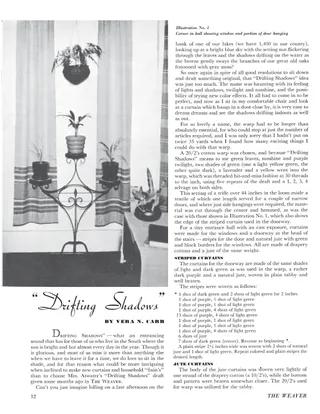
Drifting Shadows
Article · 5 pages · weaving drafts
Article from The Weaver in which Veva (Vera) N. Carr describes household pieces woven on a long warp using Mrs. Atwater's "Drifting Shadows" draft. A 20/2 cotton warp in greens, lavender and yellow was threaded hit-and-miss at 30 epi. It gives treadling and color instructions for striped door curtains, jute curtains, portieres, a table runner, a couch blanket, sofa pillows, and bags with carved wooden handles. The final page has the tie-up and threading draft.
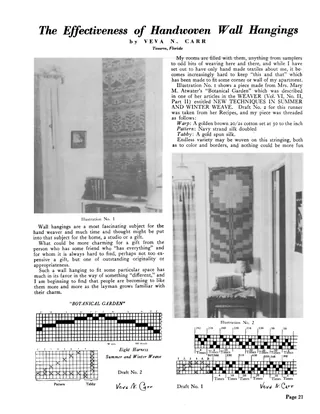
The Effectiveness of Handwoven Wall Hangings
Article · 2 pages · weaving drafts
A short article in which Veva N. Carr describes handwoven wall hangings she made, mostly following Mary Meigs Atwater's designs, and argues they make distinctive decor and gifts. She gives warp and weft materials for each piece, with drafts for an eight-harness Summer and Winter 'Botanical Garden', a second Summer and Winter piece, and a Shuttle Craft Recipe for church weaving with a treadling sequence. She also discusses a Finn Weave wall hanging and the use of samplers as wall decoration.
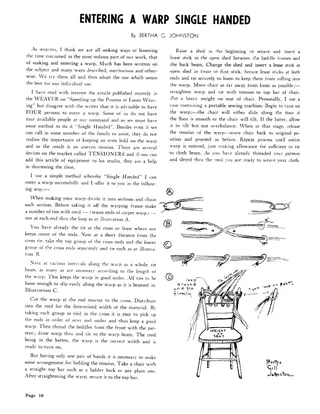
Entering a Warp Single Handed
Article · 1 page
A short 1941 article in which Bertha C. Johnston describes how one weaver can beam a warp alone. She ties the chained warp sections with cord at the ends, the cross and intervals along the length, then threads the heddles and sleys the reed before beaming. To hold tension while turning the warp beam, she ties the warp to the top bar of a weighted chair. Four line illustrations (A-D) show the ties and the chair arrangement.
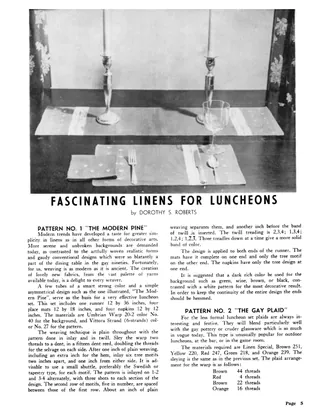
Fascinating Linens for Luncheons
Article · 4 pages
An article from The Weaver (1940) giving instructions for three linen luncheon sets: a runner, place mats and napkins. Pattern No. 1, "The Modern Pine", uses plain weave with inlay tree motifs and a twill band. The other two are a warp-and-weft plaid and a striped set woven from odds and ends of linen. The article lists yarns, colors, sleying and warp color sequences, and weft stripe sequences, and has photographs of the finished sets. It has no weaving drafts.
A Few Simple Braids
Article · 6 pages
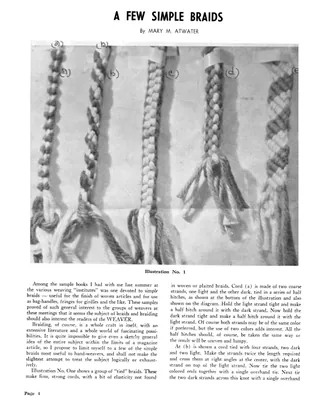
Mary Atwater introduces a selection of simple braids and knotted cords that handweavers can use for finishing woven pieces, bag handles, drawcords and girdle fringes. She gives step-by-step directions for tied braids (half-hitch and crowning knot), Solomon knot cords, looped or bight braids (twin-bight, Antique Sennit), multi-strand Indian, combing and Girdle of Rameses braids, and sailors' sennits. Photographs of sample cords and hand-drawn diagrams accompany the text, and she recommends a further reference on knots and rope work.
A Few Twills
Article · 8 pages · weaving drafts
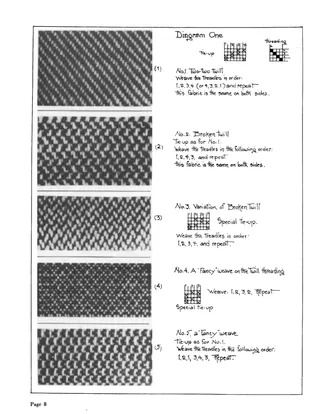
Mary M. Atwater's article surveys a selection of twill weaves for handweavers, with 28 numbered sample drawdowns across seven diagrams. It covers the three-harness jeans twill, four-harness two-two and broken twills, double three-one twill, corkscrew twills, six- and eight-harness twills, double-face twills in blocks, a fancy twill with two weft weights, and twills using two-color warps and wefts. The text discusses suitable uses (dress and coat fabrics, blankets, linens), warp setting, and handling selvages in twill weaving. Each diagram gives tie-ups, threadings and treadling sequences.
237 documents found