Textile Documents › Authors › Author: John S. Fishback
9 documents found
Sort: 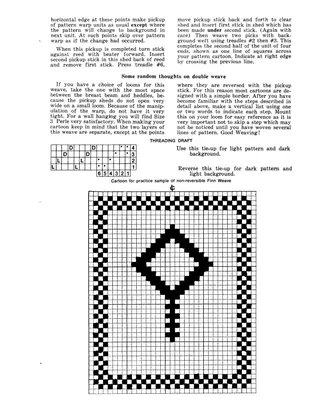
Discussion on Double Weave
Monograph · 4 pages · weaving drafts
A short instructional booklet by Colonel John S. Fishback, Lily Mills' weaving consultant, based on notes for a Venice Weavers Guild workshop. It briefly surveys what double weave can mean on a four-harness loom (double thickness, double width, tubular cloth), then gives step-by-step directions for the non-reversible Finn Weave pickup technique on a 196-end practice warp. It includes a threading draft, tie-up, and a cartoon for a practice sample, plus closing tips on loom choice, warp tension, and cartoon design.
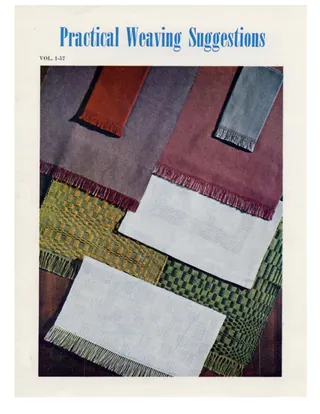
Practical Weaving Suggestions, Vol. 1-57 (1957): Place Mats and Napkins
Periodical · 8 pages · weaving drafts
An issue of Lily Mills' Practical Weaving Suggestions devoted to place mats and napkins, written by Colonel John S. Fishback. It presents four place settings woven by Penland weavers: plain-weave brown and gray perle cotton mats with solid-color napkins, an eight-harness Bronson Lace mat and napkin in linen, a Finnish lace two-block linen mat and napkin, and heavy jute mats on opposites. Warp counts, setts, yarns, threading, tie-up and treadling are given, with drafts for the lace and jute patterns. It closes with advice on trimming fringe to an even length.
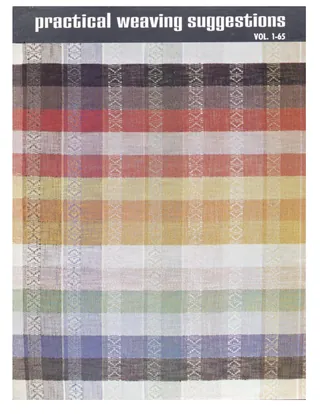
Practical Weaving Suggestions, Vol. 1-65 (1965): Experimenting with Color
Periodical · 6 pages · weaving drafts
An issue of Lily Mills' "Practical Weaving Suggestions" bulletin in which Col. John S. Fishback describes a color blanket or sampler woven with Lily Art. 3343 rayon-jute novelty yarn, crossing each color with every other in plain weave and a Maltese Cross variant. He also discusses how warp and weft crimp and tension affect blended color. The issue also gives drafts, materials and sett for four sets of place mats by Geraldine Wood, using the novelty yarn with Lily linen warp and weft in twill, tabby, huck and summer and winter.
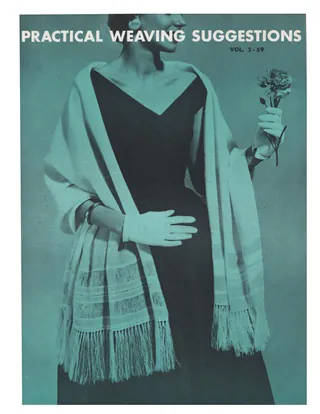
Practical Weaving Suggestions, Vol. 2-59 (1959): Stoles
Periodical · 8 pages · weaving drafts
A Lily Mills pamphlet by Colonel John Fishback giving directions for weaving four lightweight wool stoles and a quexquemetl on plain twill threadings. Each project lists warp width, sett, yarn amounts, sleying plans and weaving directions with treadling, open spaces, pick-up lace and metallic accents. A closing section covers general weaving notes, hemstitching on the loom and finishing worsted pieces.
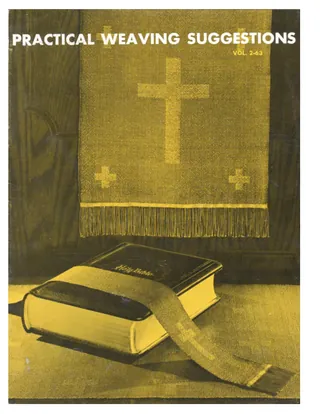
Practical Weaving Suggestions, Vol. 2-63 (1963): Ecclesiastical Weaving
Periodical · 8 pages · weaving drafts
An issue of Lily Mills' Practical Weaving Suggestions devoted to ecclesiastical weaving. Colonel John Fishback describes designing and weaving a 12-foot dossal curtain in 16-thread Summer & Winter units on a 16-harness loom for St. Mark's Episcopal Church, Venice, Florida. Lela Gordon discusses making altar, pulpit and lectern hangings, including fitting them to different churches. Drafts and materials lists follow for a 3-piece altar, pulpit and lectern set (Bergman technique), a 7-step graded cross and a 4-harness cross in crackle weave, and a graded cross in Summer and Winter, with Lily yarn numbers and a source for bullion fringe.
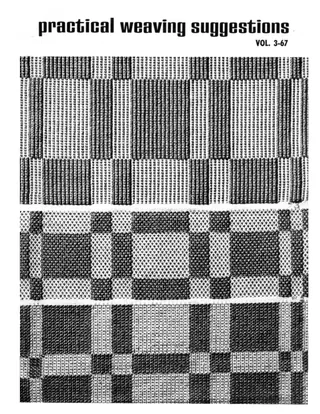
Practical Weaving Suggestions, Vol. 3-67 (1967): Summer and Winter
Periodical · 6 pages · weaving drafts
A short instructional leaflet by John S. Fishback on weaving Summer and Winter, issued by Lily Mills as part of Practical Weaving Suggestions. It gives a brief history of the technique and explains the four-thread unit, with a sample warp worked out and three weft methods (singles, pairs, and Dukagang-style repeated treadle). It then covers the sixteen-thread unit with diamond background, with a four-frame chair seat cover and an eight-harness chair seat cover with a central pattern. Yarn specifications, sleying, tie-ups, and treadling orders are included.
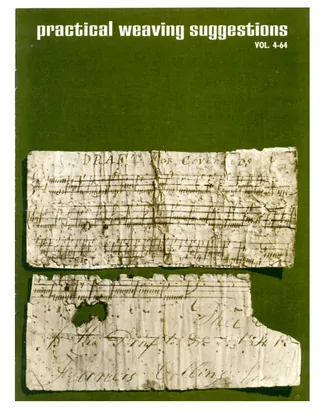
Practical Weaving Suggestions, Vol. 4-64 (1964): From Yesterday's Drafts Tomorrow's Heirlooms
Periodical · 8 pages · weaving drafts
Article by Colonel John S. Fishback on locating, interpreting and reweaving old handwritten coverlet drafts found in the mountain area where he spent summers. It includes a project for a four-shaft coverlet woven from an 1841 draft, with Lily yarn specifications, sley, threading unit divisions, tie-up notes and treadling advice ("tromp as writ"). It also reports sample lengths woven with various Lily yarns as pattern weft. Illustrations include photographs of the faded old drafts, a modern draft translation, an enlargement of the coverlet design and a photograph of the finished coverlet.
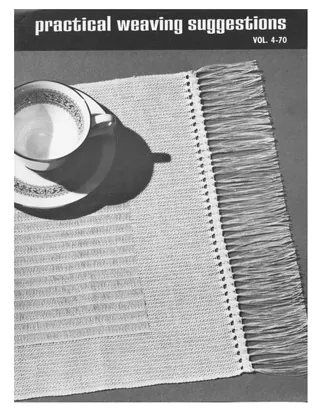
Practical Weaving Suggestions, Vol. 4-70 (1970): Table Runners
Periodical · 4 pages · weaving drafts
An issue of Practical Weaving Suggestions by John S. Fishback giving instructions for linen table runners and place mats woven on a threading adapted from a Finnish piece. It covers sizing for oval and rectangular tables, warp calculation, yarns (Lily linen and cotton), sleying, tie-up and treadling, and controlling length given draw-up after weaving. It also gives alternate yarn combinations and a section on hemstitching on the loom. A threading draft appears on page 3.
Practical Weaving Suggestions, Vol. XXV (1953): A Visit to Scandinavian Weaving Centers
Periodical · 4 pages · weaving drafts
A four-page issue of Lily Mills' Practical Weaving Suggestions in which Colonel John S. Fishback reports on a Penland Craft Tour of weaving schools, studios and craft shops in Denmark, Finland, Sweden and Norway. He describes the long training in Scandinavian weaving schools, a graduate's detailed sample notebooks, and the cooperation between craftsmen, architects and merchants. The issue ends with a draft for a four-shaft lace and plain stripe fabric sleyed unevenly for glass curtains or place mats, with threading, sleying, treadling and tie-up instructions using Lily 20/3 cotton.
9 documents found