Textile Documents › Publications › Publication: Burlington Magazine
12 documents found
Sort: 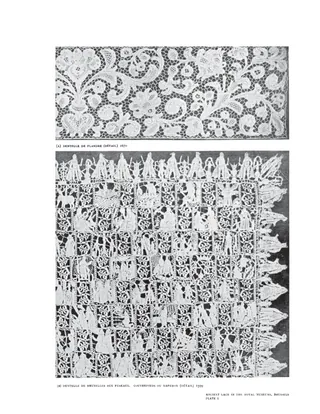
Ancient Lace in the Royal Museums, Brussels
Article · 5 pages
A review article from the Burlington Magazine (1912) of E. Van Overloop's plate book on the lace collection of the Royal Museums of Decorative and Industrial Arts in Brussels. It surveys the Brabant, Flanders, Mechlin, Binche, Valenciennes and Brussels laces illustrated, and notes filet, whitework embroidery and plaited edgings. It singles out the 1599 Ommeganck coverlet and the 1708 bobbin lace commemorating Charles VI's marriage. Two plates show details of Flanders lace (1670), Brussels bobbin lace (1599) and Brussels bobbin lace (1708).
Early Design in Lace
Article · 5 pages
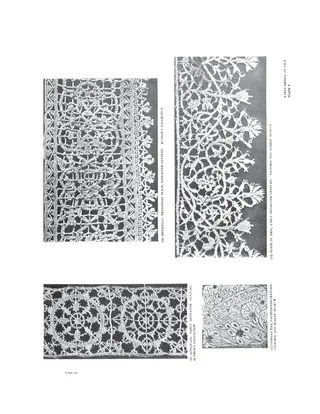
A 1911 Burlington Magazine article arguing that early sixteenth-century Venetian punto in aria needle lace is among the finest periods of lace design, and that its designs derive from Persian sources such as fourteenth-century tiles. It traces lace from knotted thread, lacis and reticello (linen-based) to needle-made punto in aria. It also laments how pointed lace was mangled in repair, with plates showing injured and restored pieces, and appeals to owners to preserve fragments rather than restore them.
Ecclesiastical Lace Ancient and Modern: A Comparison
Article · 6 pages
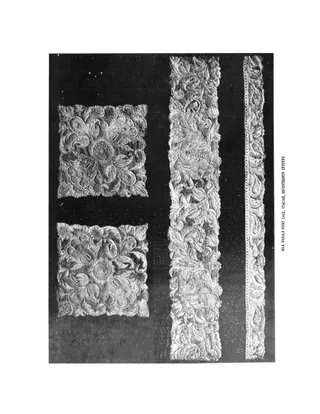
Part I of an article by Mrs. F. Nevill Jackson comparing seventeenth-century church lace with nineteenth-century work. It discusses what counts as ecclesiastical lace, lace made for church use versus lay lace later given to the church, and the role of convents in lace-making. It criticizes the weak design of modern lace, using the 1887 Youghal (Co. Cork) convent set made for Pope Leo XIII as its main example. Plates show Italian and Venetian needle-point lace, including an alb and a stole, and modern Irish needle-point.
Lace as Worn in England Until the Accession of James I
Article · 5 pages
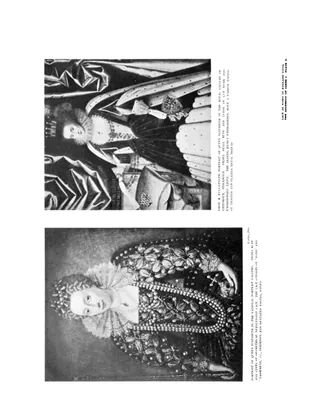
An article by M. Jourdain tracing the meaning of the word 'lace' and the kinds of lace worn in England from the late 15th century to the end of Elizabeth I's reign. It draws on royal wardrobe inventories, New Year's gift rolls and privy purse accounts to define passement, purle, bone-lace, billament, crown, cheyne, compas, parchment and byas laces, plus cut-work, drawn-work and Coventry blue bride laces. Two plates reproduce portraits of Elizabethan and Jacobean women, including Queen Elizabeth and the Countess of Pembroke, showing geometrical bobbin and needlepoint lace on ruffs, cuffs and caps.
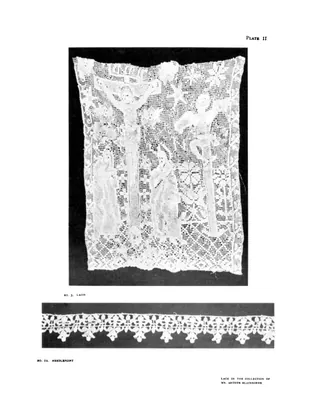
Lace Collection of Mr. Arthur Blackborne: Part 1
Article · 9 pages
Part I of M. Jourdain's article describes the lace collection of Mr. Arthur Blackborne, some six hundred specimens begun in 1850. It discusses lacis (darned net), its terminology, pattern books such as Vinciolo and Parasole, and the symbolism of motifs like peacocks at a fountain. It then covers cutwork and punto in aria and gives numbered catalogue entries (Nos. 1-21) for lacis, cutwork, needlepoint, and Italian and English pillow laces. Four plate pages show photographs of selected specimens.
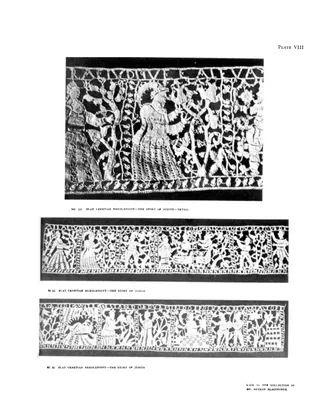
Lace Collection of Mr. Arthur Blackborne: Part 2 -- Later Punto in Aria
Article · 5 pages
Second part of M. Jourdain's catalogue of Arthur Blackborne's lace collection, covering later punto in aria, the flat needlepoint that moved from geometric designs to scrolls, flowers and human figures. It describes specimens 22 to 30 by size and design, including a long Venetian panel with the story of Judith and Holofernes (with a Portuguese inscription), a figured strip with mediaeval costumed figures, and pieces with a Persian sun motif. The author discusses Persian influence on Venetian lace design. Two pages of photographic plates show the Judith panel and Nos. 25, 28 and 29.
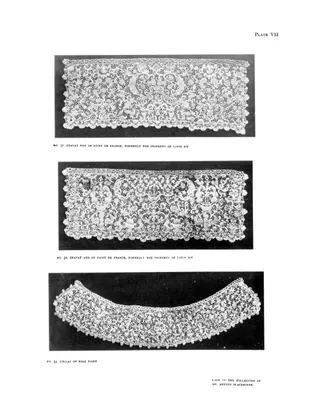
Lace Collection of Mr. Arthur Blackborne: Part III-- Rose Point
Article · 9 pages
Part III of M. Jourdain's series on Arthur Blackborne's lace collection, devoted to rose point (raised Venetian needlepoint lace). The text first explains how rose point differs from later punto in aria in its conventional scroll design, raised relief, and elaborate brides (bar grounds). It then gives numbered catalogue entries (Nos. 31-47) for cravat ends once owned by Louis XIV, collars, cuffs, lappets, and borders, describing their designs, meshes, picots, and provenance. Four plates (VII-X) reproduce many of the pieces in black and white.
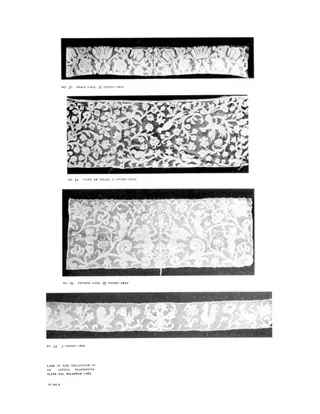
Lace Collection of Mr. Arthur Blackborne: Part IV -- Milanese Laces
Article · 7 pages
Concluding part of M. Jourdain's series on the lace collection of Mr. Arthur Blackborne, devoted to Milanese laces. It begins with a short history of Milanese passements and pillow lace, covering the flat toilé, réseau grounds and the hunting and heraldic designs. It then gives a numbered catalogue (Nos. 48-60) of specimens with dimensions and motif descriptions, including boar-hunt and animal scroll designs, armorial lace, braid lace, point de Milan and church laces. Four plates of halftone photographs illustrate the pieces.
Lace in the Collection of Mrs. Alfred Morrison at Fonthill
Article · 6 pages
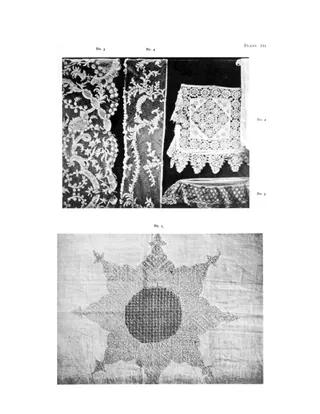
A 1903 Burlington Magazine article by M. Jourdain describing specimens of lace from Mrs. Alfred Morrison's collection at Fonthill House, illustrated on three photographic plates. Entries cover Venetian needle-point (gros point, rose point, point de Venise), Alen\u00e7on and Brussels lace, Honiton, Reticella and punto in aria, Turkish drawn-thread work, Russian lace, and modern Irish needle-point and crochet made to Mrs. Morrison's designs. Each specimen is given a short description of design, technique, and period.
Milanese Bobbin Lace with Hunting Scenes
Article · 3 pages
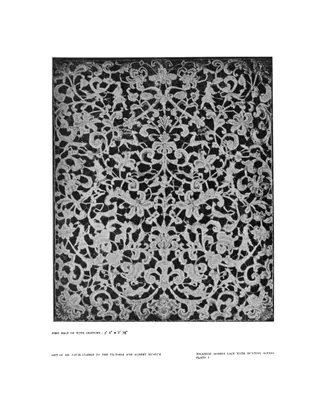
A short museum-acquisition article by P. G. Trendell on two Milanese bobbin-lace panels with hunting scenes, given to the Victoria and Albert Museum by Louis Clarke. It compares them with the Brussels bobbin-lace coverlet of 1599 and discusses the figural motifs (Cupid, huntsmen, hounds, stags, lions, double-headed eagles). It also notes the diamond-shaped plaited mesh ground introduced in the late 17th century and differences between Italian and Flemish technique. Two photographic plates illustrate the panels.
Point de Venise à Réseau; Old Burano Point
Article · 4 pages
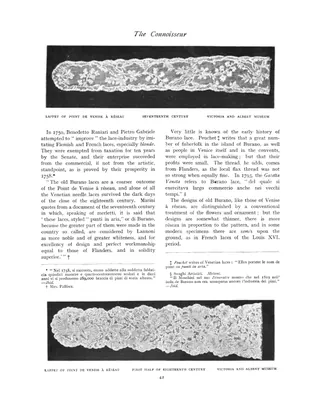
A short illustrated article on Point de Venise à réseau, a Venetian needle lace with a square-mesh ground, and on old Burano point, its coarser descendant. It describes the design and workmanship of the laces, compares them with Brussels and Alençon lace, and outlines their history from about 1650 to the extinction of the industry in 1866. It also gives a description of how Burano point was worked on a pillow. Photographs of lappets in the Victoria and Albert Museum illustrate it, and footnotes quote Italian and French sources.
Studies in Peruvian Textiles: Double-Cloth Weaves
Article · 4 pages
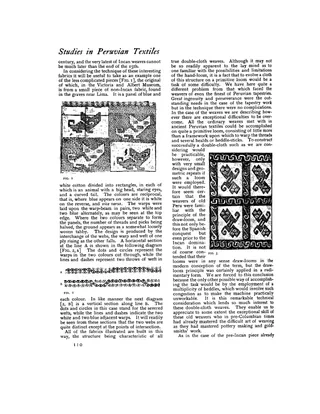
Article by Cyril G. E. Bunt in the series Studies in Peruvian Textiles, examining double-cloth (two-ply) weaving in ancient Peru. Bunt questions the claim by Squier and others that the Peruvians wove true "three-ply" cloth, and doubts Uhle's drafts of such pieces from Pachacamac. He explains double-cloth structure with sectional diagrams of a blue and white cotton panel in the Victoria and Albert Museum, and argues that the weaving implies a rudimentary draw-loom principle. He also discusses and dates several pieces from graves near Lima and from Nasca, and comments on the animal and stepped motifs.
12 documents found