Textile Documents › Authors › Author: Mrs. F. Nevill Jackson
8 documents found
Sort: 
Cravats
Article · 7 pages
An article from The Connoisseur on the history of the lace cravat in the later seventeenth and early eighteenth centuries. It covers the origin of the fashion in France and its spread to England, the Steinkerque style, the costs of royal cravats, and the use of Venetian point, point de France, Mechlin and point tresse. It describes surviving examples, including cravat ends in bobbin and needle lace. Illustrated with portraits and photographs of Venetian point, bobbin lace and modern Irish needle-point cravats.
Ecclesiastical Lace Ancient and Modern: A Comparison
Article · 6 pages
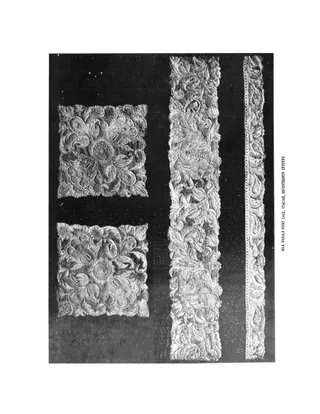
Part I of an article by Mrs. F. Nevill Jackson comparing seventeenth-century church lace with nineteenth-century work. It discusses what counts as ecclesiastical lace, lace made for church use versus lay lace later given to the church, and the role of convents in lace-making. It criticizes the weak design of modern lace, using the 1887 Youghal (Co. Cork) convent set made for Pope Leo XIII as its main example. Plates show Italian and Venetian needle-point lace, including an alb and a stole, and modern Irish needle-point.
Evolution of Alençon Lace
Article · 5 pages
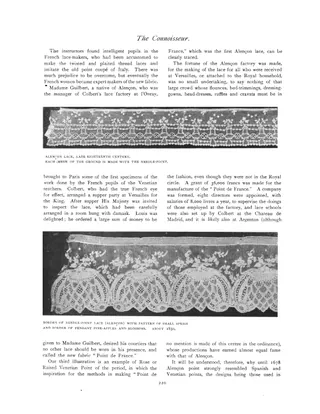
An illustrated article from The Connoisseur tracing the history of Alençon needle-point lace from its founding under Colbert in the 1660s with Venetian instructors, through its Venetian-influenced early phase and later changes in design, to its decline and revivals in the nineteenth century. It covers French sumptuary laws, the cordonnet padding, the ground (réseau), and Napoleonic commissions, and ends with modern production at Bayeux and Burano. Illustrations show Alençon lace borders from the eighteenth to nineteenth centuries and a piece of raised Venetian rose point.
A History of Hand-Made Lace
Book · 270 pages
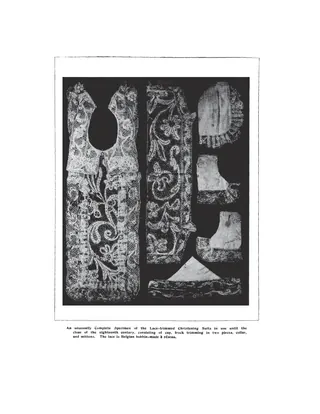
A comprehensive history of hand-made lace by Mrs. F. Nevill Jackson with E. Jesurum, covering lace from its early evolution through the nineteenth century. Chapters treat medieval, seventeenth-, eighteenth- and nineteenth-century lace, ecclesiastical lace, lace fans, peasant laces, transport and care of lace, restoration, and the literature of lace. A long alphabetical Dictionary of Lace describes named laces and centres (Alençon, Brussels, Honiton, Valenciennes, Venetian and others), followed by a glossary of terms and an index. It is illustrated with many photographic plates of lace specimens, portraits showing lace, and a song score, 'Nenia', written for lace-makers.
Human Figures in Lace
Article · 5 pages
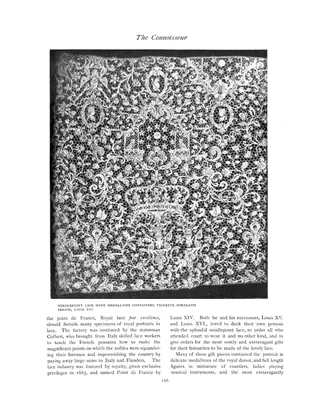
Article from The Connoisseur on the depiction of human figures in antique lace, written for collectors who want to specialise. It surveys figures in early openwork and lacis (darned netting), religious and royal portrait subjects, and figures in point de France, Alençon, Argentan, Venetian and Valenciennes laces, including the pseudo-Indian and Oriental figures of the late 17th and early 18th centuries. It also explains why figures declined in lace design and illustrates the points with plates and photographs of cravat ends, borders and medallion panels.
Lace of the Vandyke Period
Article · 10 pages
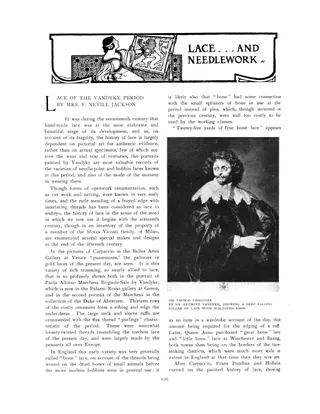
An illustrated article from The Connoisseur on the lace seen in the portraits of Sir Anthony Vandyke and worn in the seventeenth century. It discusses Genoese guipure and tape lace, flax thread and bobbin laces (a piombini), gold and silver laces, falling collars, Medici collars and ruffs, and the sumptuary laws that favored flax thread. Halftone plates of Vandyke portraits (Henrietta Maria, Helena Forman, Ernest of Mansfeld, Sir Thomas Chaloner, the Children of Charles I) show lace collars and cuffs, and one plate shows a specimen of Italian bobbin lace with a Vandyke edge.
A Remarkable Piece of Lace
Article · 2 pages
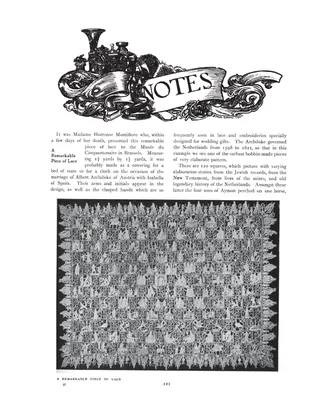
A short note from The Connoisseur describing a large bobbin-made lace panel given to the Musée du Cinquantenaire in Brussels. The piece measures about 1¾ by 1½ yards and is made up of 120 pictorial squares showing biblical, saintly and legendary Netherlandish scenes. It bears the arms and initials of Archduke Albert and Isabella of Spain and is thought to date from their rule of the Netherlands (1598-1621). The note also describes the figured, scalloped border. A photograph of the whole panel is included.
Ruffs
Article · 8 pages
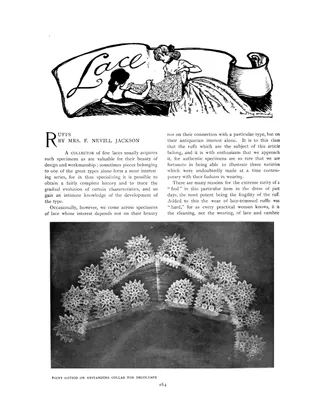
An article from The Connoisseur on the history of the lace-trimmed and lace-composed ruff. It covers the ruff's origins in France and England, the introduction of starch and the poking sticks and wire supertasses used to set and support ruffs, and the cambric, cut work, bone lace and pearl trimmings. It also covers the decline of men's ruffs and the later use of the outstanding collar by women. Illustrated with photographs of three surviving ruffs and portraits by Rubens and Van Dyck.
8 documents found