Textile Documents › Publications › Publication: The Connoisseur
58 documents found
Sort: 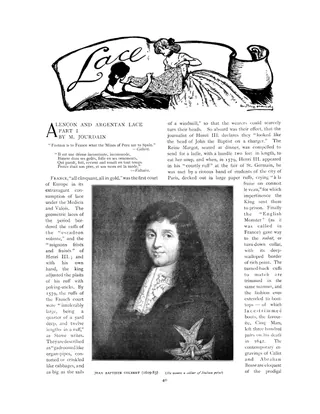
Alençon and Argentan Lace: Part I
Article · 4 pages
First part of an article on the history of Alençon and Argentan needle lace in France. It surveys the French court's extravagant use of lace under the Valois and Louis XIII and XIV, the sumptuary edicts against it, and Colbert's founding of the Point de France industry at Alençon with Venetian workers in the 1660s. It covers the royal privilege of 1665 and local resistance from the lace workers. Illustrated with a portrait of Colbert and photographs of eighteenth-century Point d'Alençon and Point d'Argentan lace.
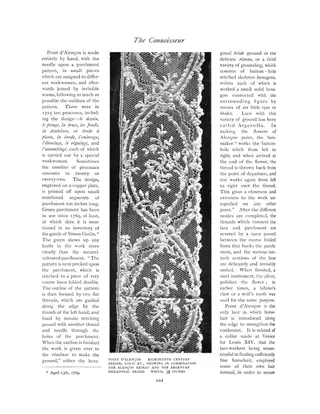
Alençon and Argentan Lace: Part II
Article · 5 pages
Second part of M. Jourdain's article on the history of Alençon and Argentan needle lace in The Connoisseur. It covers French protectionism under Colbert, the Venetian origins of the grounds, the stages of making Point d'Alençon (parchment pattern, réseau and bride grounds, horsehair cordonnet), and changes in design from Louis XIV to Louis XVI. It also traces the history of the Argentan manufacture, including the Guyard and La Leu rivalries and its decline in 1810. Illustrated with photographs of eighteenth-century lace panels and borders.
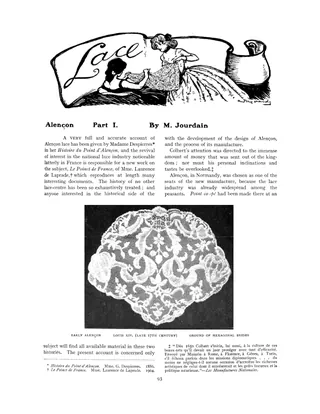
Alençon, Part I
Article · 5 pages
First part of a two-part article by M. Jourdain on Alençon needlepoint lace, focusing on how its design developed and how it was made rather than on its administrative history. It covers the founding of the Points de France manufacture under Colbert in the 1660s, the earlier point coupé industry in Alençon, the imitation of Venetian points, protectionist measures, and the protection of royal lace patterns and designers. Illustrated with photographs of 17th and 18th century Alençon lace from the Victoria and Albert Museum and the Brussels Musée des Arts Décoratifs, including hexagonal brides grounds and a sleeve trimming.
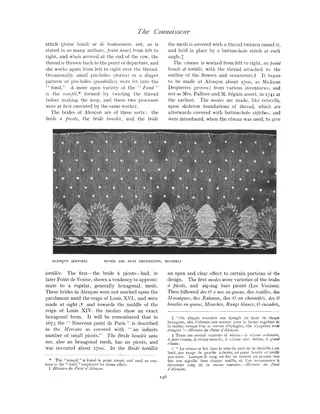
Alençon, Part II
Article · 4 pages
Part II of M. Jourdain's article on Alençon needle lace in The Connoisseur, covering how Point d'Alençon was made: pricking the parchment pattern, the trace, the fond or entoilage, the brides, the réseau ground, the modes (filling stitches), the brode, assembly and finishing. It also covers the horsehair cordonnet, the 1836 attempt to imitate the lace on bobbin net, shading introduced in 1855, the thread supply, and the relation of Alençon to Argentan and Argentella. Illustrated with photographs of Alençon lace (Louis XVI and Empire periods) from the Musée des Arts Décoratifs, Brussels, and the Victoria and Albert Museum. Footnotes cite the Histoire du Point d'Alençon, Mrs. Palliser and others.
Argentan Lace
Article · 6 pages
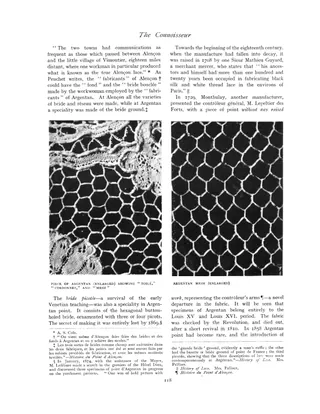
An article from The Connoisseur by M. Jourdain on the history and design of Argentan needlepoint lace, a Point de France lace made at Argentan and Alençon. It covers the characteristic hexagonal bride ground, the relation to Alençon lace, and its decline after the Revolution and with the adoption of cotton thread around 1830. It traces changing design styles from Louis XIV through Louis XV, Louis XVI and the Empire, relating lace motifs to contemporary textiles, brocades and fashion. Illustrated with photographs of Argentan pieces including a flounce, a lappet and enlarged views of the mesh.
Brussels Lace
Article · 7 pages
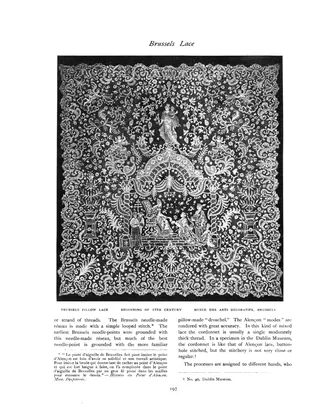
An illustrated article by M. Jourdain on the history and technique of Brussels lace, drawing on Mrs. Calderwood, Mrs. Palliser and Peuchet. It covers the division of labour among lace workers, the pillow-made and needle-made réseau grounds, the fine flax thread, the toilé, and the bride versus réseau grounds. It also traces design influences (French court, Chinese style, later Louis XVI and 19th-century styles) and the Point d'Angleterre name. Plates show 18th-century pillow-made Brussels lace in museum and private collections.
Buckinghamshire Lace
The Connoisseur, 1906
Article · 2 pages
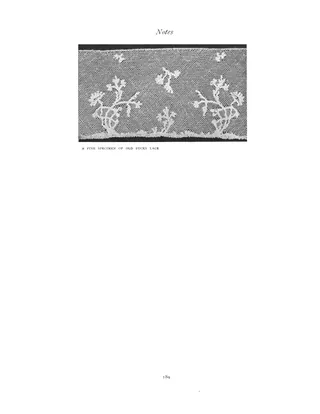
A short note on Buckinghamshire (Bucks) pillow lace, describing its sixteenth-century introduction by Flemish refugees and how it compares with Lille lace, which has a single twist in the net where Bucks has two or three. It mentions the North Bucks Lace Association's revival efforts, the heavier Bedford lace, and the old workers' reliance on traditional parchments and patterns. It also gives the legend linking Katherine of Aragon to the craft. A halftone photograph shows an old specimen about 120 years old, said to need roughly 200 bobbins.
Bucks. Lace
The Connoisseur, 1914
Article · 1 page
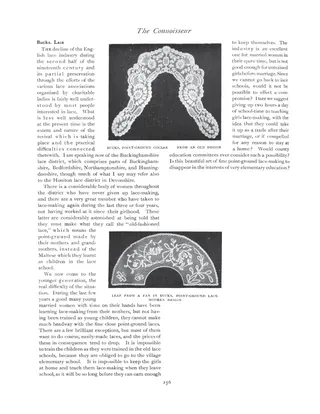
A one-page article from The Connoisseur on the state of the Buckinghamshire pillow lace industry in the early 1900s. It discusses the revival of lace-making among women in the Bucks, Bedfordshire, Northamptonshire and Huntingdonshire district, the preference for older point-ground lace versus Maltese lace, and the difficulty of training younger women now that lace schools have ended. The author floats the idea of teaching lace-making for part of the school day. Two photographs show a point-ground collar from an old design and a fan leaf in a modern design.
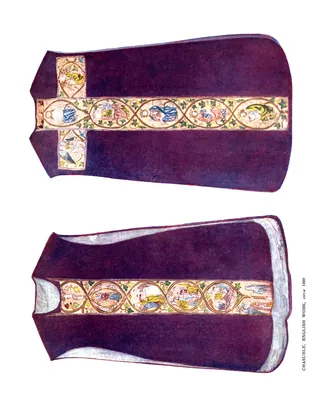
Collection of Monsieur G. Seligman
Article · 9 pages
A 1912 Connoisseur article by Ronald Clowes describing the Paris collection of Monsieur G. Seligman, focusing on medieval needlework and Venetian lace. It discusses an English chasuble of about 1300 with a Jesse Tree design, other English embroideries of the 14th and 17th centuries, a German 14th-century fragment with lacis and cross-stitch that may come from a sampler, and Venetian rose-point and gold-thread lace collars and strips. Illustrated with halftone plates of the pieces, including a bag of English work from about 1700.
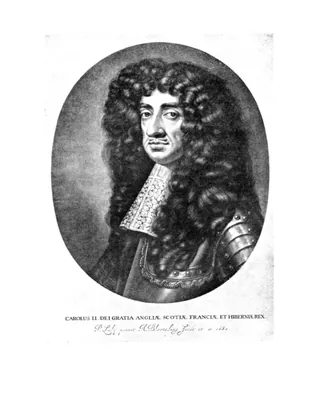
Cravats
Article · 7 pages
An article from The Connoisseur on the history of the lace cravat in the later seventeenth and early eighteenth centuries. It covers the origin of the fashion in France and its spread to England, the Steinkerque style, the costs of royal cravats, and the use of Venetian point, point de France, Mechlin and point tresse. It describes surviving examples, including cravat ends in bobbin and needle lace. Illustrated with portraits and photographs of Venetian point, bobbin lace and modern Irish needle-point cravats.
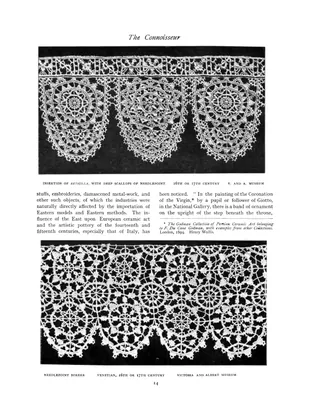
Cutwork (Reticilla) and Punto in Aria, Part I
Article · 5 pages
First part of M. Jourdain's article in The Connoisseur on cutwork (reticilla) and punto in aria, early Italian geometric needle laces. It traces Venice's role and the influence of Eastern (Arab and Persian) geometric design, then describes how cutwork and reticilla were made by cutting or drawing threads from linen and covering them with buttonhole stitch, and how punto in aria developed from reticilla. Pattern books by Vinciolo, Vecellio and Parasole are cited. Illustrated with photographs of reticilla, needlepoint borders and a linen collar from the Victoria and Albert Museum and a private collection. The article ends with "To be continued."
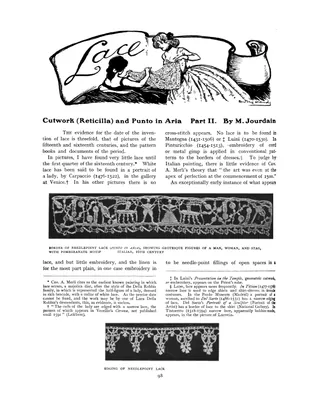
Cutwork (Reticilla) and Punto in Aria, Part II
Article · 4 pages
Part II of Margaret Jourdain's article in The Connoisseur on the early history of cutwork (reticella) and punto in aria needlepoint lace. It weighs the dating of lace's invention from three kinds of evidence: Italian paintings of the 15th and 16th centuries, early documents such as the 1493 Sforza inventory, and printed pattern books from 1527 onward (Vavassore, Pagannino, Taglienti, Vinciolo, Parasole, Vecellio). Illustrations show 16th and 17th century needlepoint borders, reticella insertions, a Spanish copy of Italian needlepoint, and pattern-book pages.
Drawn Thread Work and Lacis
Article · 3 pages
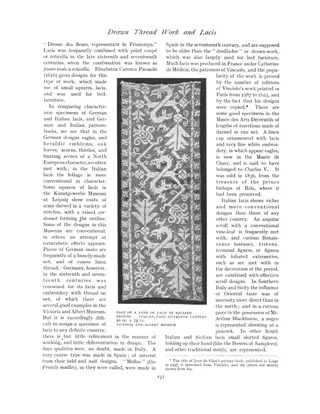
An article from The Connoisseur by M. Jourdain on the origins and history of lacis, the darned-net lace descended from drawn-thread work. It traces early references (Skelton, the Exeter Inventory, Quentell's 1527 pattern book) and discusses the pattern books of Vinciolo, Vavassore and Parasole. It also compares German, Italian, Spanish and French lacis and cites examples in the Victoria and Albert Museum, the Musée de Cluny and elsewhere. Illustrated with two Italian sixteenth-century pieces.
Eighteenth Century Spinning Wheel
The Connoisseur, 1916
Illustration · 1 page
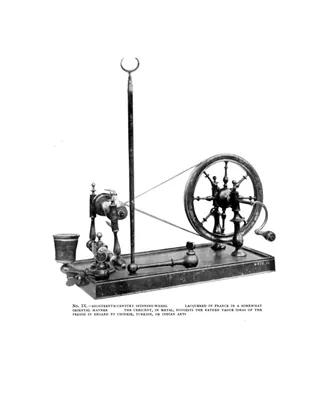
A single page with a black-and-white photograph of an eighteenth-century spinning wheel, lacquered in France in a somewhat oriental style. The caption notes that the metal crescent finial reflects the period's vague ideas about Chinese, Turkish, or Indian arts. It appears to be one plate from a numbered series in The Connoisseur.
English Lace: I. Needlepoint
Article · 4 pages
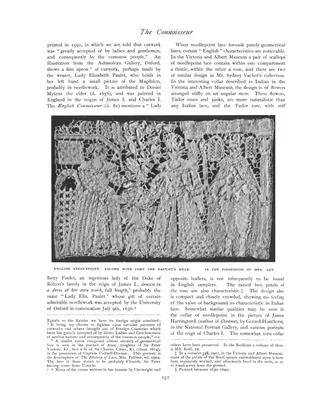
An illustrated article by M. Jourdain on English needlepoint lace of the seventeenth century, arguing that its designs and techniques were largely borrowed from Italian and Flemish work and that the flax was imported. It discusses cutwork, Elizabethan wardrobe accounts, the Vinciolo pattern book, and portraits showing lace and cutwork, and notes characteristic English features such as Tudor roses, compact designs and raised petals. It also covers biblical scenes in lace with beads and pearls, the 1635 proclamation protecting home lace, cutwork on samplers, and hollie point. Plates show pieces from the V&A, the Musée des Arts Décoratifs in Brussels and private collections.
English Pillow Lace, Part 1
Article · 5 pages
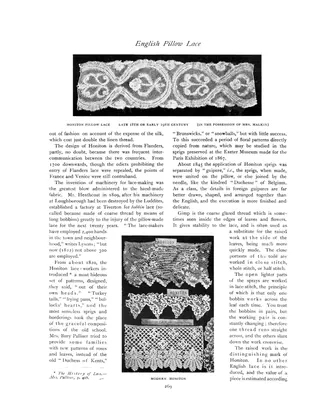
First part of M. Jourdain's series on English pillow lace in The Connoisseur, dealing with Honiton and Devonshire trolly lace. It traces the history of the Honiton industry from Flemish refugees in the 16th century through the 19th-century effects of machine net and appliqué work. It also describes raised work, gimp and stitches, the Honiton pillow and bobbins, and trolly lace made near Exmouth. Illustrated with plates of 18th- and early 19th-century pieces from the Victoria and Albert Museum, the Exeter Museum and private collections.
English Pillow Lace, Part 2
Article · 6 pages
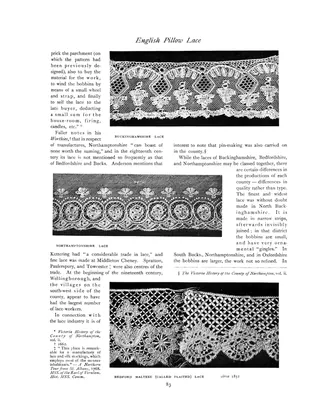
Part II of M. Jourdain's survey of English pillow lace in The Connoisseur, covering regional lace-making in Buckinghamshire, Bedfordshire, Northamptonshire, Wiltshire, Dorset, the Isle of Wight, Suffolk and elsewhere. It discusses the history of the industry, Flemish and French influences (especially Lille and Mechlin), grounds such as point ground, trolly and French ground, Maltese plaited laces, bobbins, pillows and lace schools. Illustrated with photographs of specimens from several counties.
Evolution of Alençon Lace
Article · 5 pages
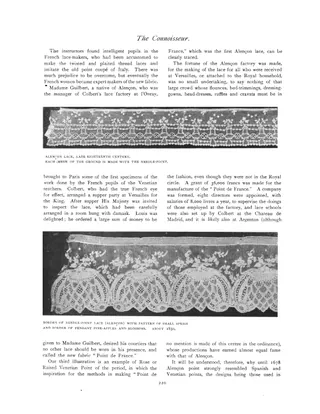
An illustrated article from The Connoisseur tracing the history of Alençon needle-point lace from its founding under Colbert in the 1660s with Venetian instructors, through its Venetian-influenced early phase and later changes in design, to its decline and revivals in the nineteenth century. It covers French sumptuary laws, the cordonnet padding, the ground (réseau), and Napoleonic commissions, and ends with modern production at Bayeux and Burano. Illustrations show Alençon lace borders from the eighteenth to nineteenth centuries and a piece of raised Venetian rose point.
Exhibition of Abruzzese Art at Chieti
Article · 5 pages
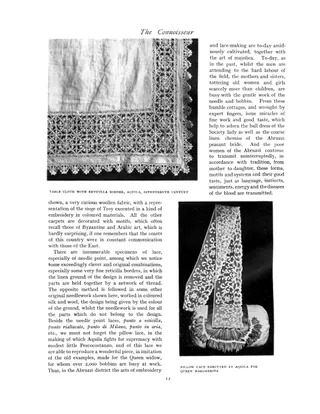
A 1906 Connoisseur article by Ettore Modigliani reviewing the exhibition of Abruzzese art held at Chieti. It covers sculpture, painting, goldsmiths' work (especially Nicola da Guardiagrele), majolica from Castelli and elsewhere, and in more detail the carpet, embroidery and lace section, centred on Pescocostanzo and Aquila. Illustrations include a woollen carpet showing the siege of Troy, silk and wool embroideries, a tucked surplice with pillow lace trim, a reticilla-bordered table cloth, and pillow lace made at Aquila for Queen Margherita.
Gold and Silver Lace, Part I
Article · 4 pages
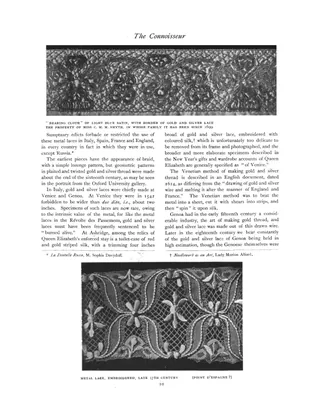
First part of an article on the history of gold and silver lace, published in The Connoisseur. It covers the fashion of 'parfilage' (unravelling gold lace for the metal), early metal-thread trimmings, sumptuary laws, and production centres in Venice, Genoa, Milan, Spain (including Point d'Espagne), Germany and Holland. Illustrations show a portrait with a gold lace ruff, a satin bearing cloth with a metal lace border, and 18th-century gold laces with réseau grounds and embroidery.
Gold and Silver Lace, Part II
Article · 5 pages
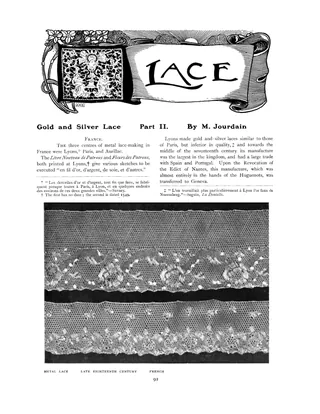
Part II of M. Jourdain's article on gold and silver (metal) lace in The Connoisseur, surveying its history in France (Lyons, Paris, Aurillac), Sicily, Switzerland, Russia and England. It draws on museum specimens, inventories, sumptuary laws, patents, and petitions, especially for English gold thread monopolies, fraud, and import prohibitions from the 13th to the 18th century. Illustrated with photographs of 18th-century French, Italian, and Russian metal lace.
Honiton Lace
The Connoisseur, 1906
Article · 1 page
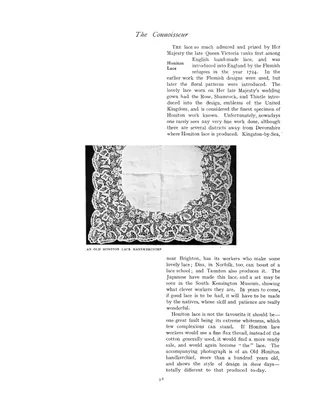
A short one-page note from The Connoisseur on Honiton lace, the English bobbin lace prized by Queen Victoria. It gives a brief history of its introduction by Flemish refugees and the shift from Flemish designs to floral patterns. It also names other places where it is made and argues that fine flax thread would suit it better than white cotton. A photograph shows an old Honiton lace handkerchief over a century old.
Human Figures in Lace
Article · 5 pages
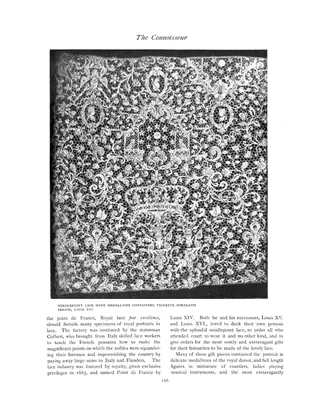
Article from The Connoisseur on the depiction of human figures in antique lace, written for collectors who want to specialise. It surveys figures in early openwork and lacis (darned netting), religious and royal portrait subjects, and figures in point de France, Alençon, Argentan, Venetian and Valenciennes laces, including the pseudo-Indian and Oriental figures of the late 17th and early 18th centuries. It also explains why figures declined in lace design and illustrates the points with plates and photographs of cravat ends, borders and medallion panels.
Italian Pillow Lace
Article · 5 pages
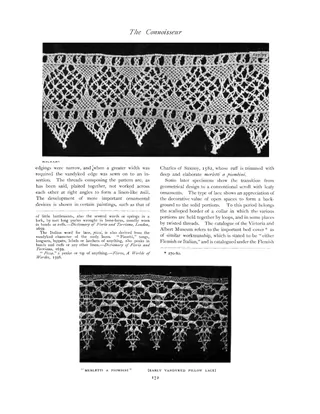
Article by M. Jourdain in The Connoisseur on the early history of Italian pillow lace. It covers punto a groppo (knotted lace) as a forerunner of pillow lace, early plaited and vandyked merletti a piombini, and Genoese pillow lace including point de Gênes frisé with its wheat-grain ornament. It draws on pattern books, portraits, dictionaries and Victoria and Albert Museum specimens, and is illustrated with photographs of laces, a coverlet, and a portrait of the Duc de Montmorency.
Lace Book -- Reviewed
The Connoisseur, 1905
Article · 3 pages
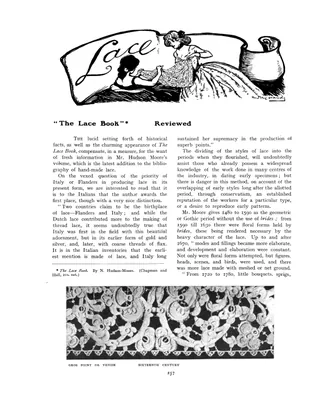
A three-page review from The Connoisseur of N. Hudson-Moore's book The Lace Book (Chapman and Hall). It summarizes the author's views on the Italian versus Flemish origins of lace, his division of lace styles into periods, and his accounts of Points de France, Alençon, Argentan, Venetian, and English and Spanish bobbin laces. It also reports auction prices, such as those from the 1902 Sir William Drake sale, and is illustrated with photographs of seventeenth-century needle-lace specimens.
Lace Dress
The Connoisseur, 1903
Article · 1 page
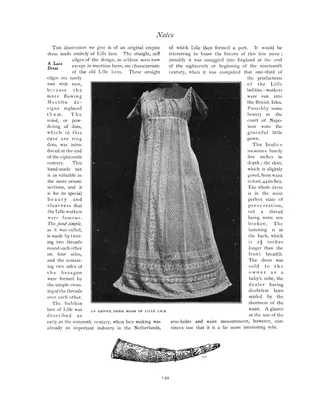
A short note from The Connoisseur on an original empire-style dress made entirely of Lille bobbin lace, illustrated with a photograph. It describes the straight-edged Lille designs, the ring-dot semé, and the hexagonal fond simple ground made by twisting and crossing threads. It also gives the dress's measurements and condition, notes that it was sold as a baby's robe, and mentions the smuggling of Lille lace into Britain.
Lace Maker
Illustration · 1 page
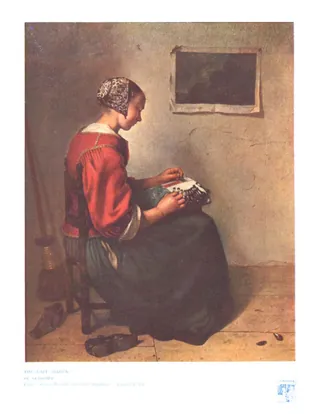
A single-page color reproduction of a painting titled The Lace Maker, showing a young woman in a red bodice and patterned white cap seated at a table working lace bobbins. A dark landscape painting hangs on the wall behind her. The caption credits the picture to M. Vischer and to the series "Great Pictures by Great Painters" (Gresch & Co.).
Lace Making in Spain and Portugal, Part I
Article · 4 pages
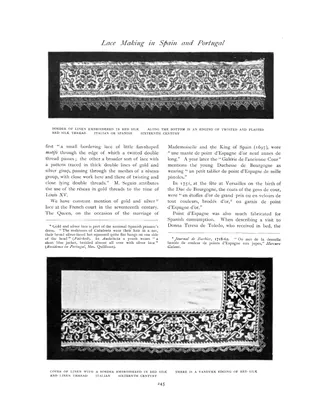
The first part of an article on the history of lace in Spain and Portugal, with most of the discussion on gold and silver lace known as point d'Espagne. It draws on literary, court and travel references, sumptuary laws and portraits to show how widely Spanish dress used gold and silver lace. It also argues that Spain relied on imported Flemish and Italian lace. Illustrations show a pillow-lace-edged napkin, Italian or Spanish red silk embroidered linen borders and a Point de Venise ('Spanish Point') sample.
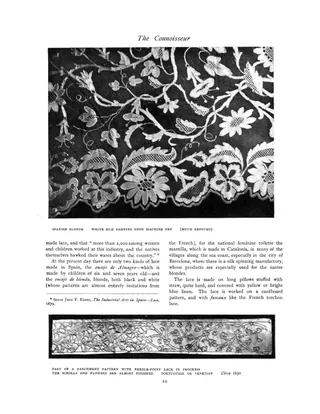
Lace Making in Spain and Portugal, Part II
Article · 4 pages
Second part of an article on the history of lace making in Spain and Portugal, from The Connoisseur. It covers sumptuary laws and lace imports, Spanish pillow guipure, blonde and gold and silver lace, and the centres of production in Catalonia, La Mancha and elsewhere. The Portuguese section covers court use of lace, a 1590 lace panel of Judith and Holofernes, and modern pillow lace schools at Peniche and other towns. Illustrated with plates of a Spanish blonde, seventeenth-century needle-point lace on parchment patterns, and modern Peniche lace.
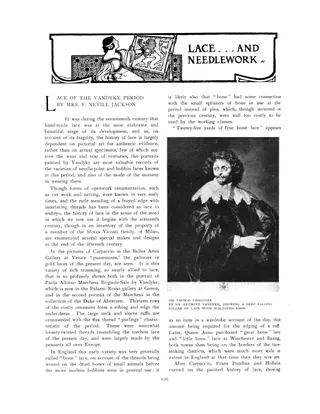
Lace of the Vandyke Period
Article · 10 pages
An illustrated article from The Connoisseur on the lace seen in the portraits of Sir Anthony Vandyke and worn in the seventeenth century. It discusses Genoese guipure and tape lace, flax thread and bobbin laces (a piombini), gold and silver laces, falling collars, Medici collars and ruffs, and the sumptuary laws that favored flax thread. Halftone plates of Vandyke portraits (Henrietta Maria, Helena Forman, Ernest of Mansfeld, Sir Thomas Chaloner, the Children of Charles I) show lace collars and cuffs, and one plate shows a specimen of Italian bobbin lace with a Vandyke edge.
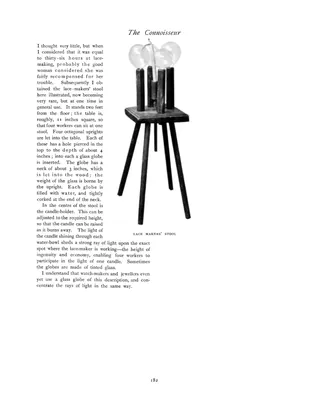
Lace-Makers' Stool
The Connoisseur, 1912
Article · 2 pages
A short note from The Connoisseur describing a lace-makers' stool used by pillow-lace workers. The author recounts meeting lace-makers at Lavendon near Bedford, who earned about a halfpenny per hour. He then describes the stool, which seats four workers, with water-filled glass globes on uprights that focus the light of a single central candle onto each worker's lace. A line drawing of the stool is included.
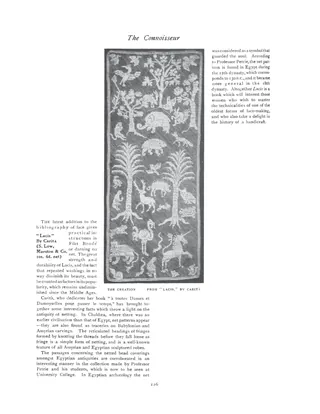
Lacis By Carita
The Connoisseur, 1909
Article · 1 page
A short book notice from The Connoisseur reviewing "Lacis" by Carita, a practical guide to filet brodé (darning on net). It summarizes the book's historical remarks on the antiquity of netting in Chaldaea, Assyria and Egypt, citing Professor Petrie's collection at University College. A full-page illustration shows a lacis panel titled "The Creation" with trees and animals in registers within a netted border.
A Linen Lace Industry
The Connoisseur, 1905
Article · 2 pages
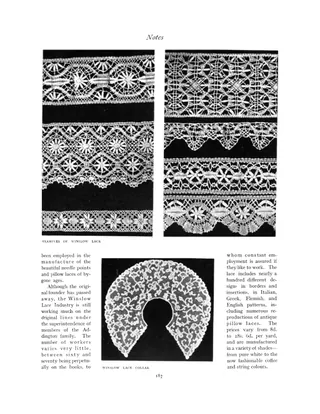
A short illustrated article from The Connoisseur (1905) on the Winslow (Buckinghamshire) Lace Industry, a pillow lace enterprise founded by Lucy Hubbard, daughter of Lord Addington. It describes how she had old Italian, Flemish, Brussels, Mechlin and Russian laces pricked for the local lacemakers to copy, and why only pure flax thread was used. It notes the workforce of sixty to seventy, the nearly hundred designs, and the price range. Illustrations show examples of Winslow lace borders and a lace collar.
Marquess of Bristol's Collection at Ickworth, Part III
Article · 3 pages
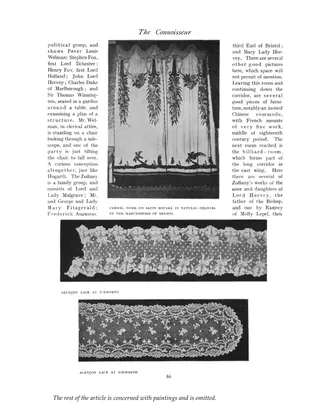
Part III of Leonard Willoughby's illustrated series on the Marquess of Bristol's collection at Ickworth, published in The Connoisseur in 1906. The text covers the Capo di Monte porcelain and its marks, then a walk through the smoking-room and billiard-room with their paintings by Hogarth and Zoffany and some furniture. The plates show a flounce of Point d'Angleterre lace, three fans, Alençon lace pieces, and a crewel-work panel on satin bourré by the Marchioness of Bristol.
Mechlin and Antwerp Lace
Article · 6 pages
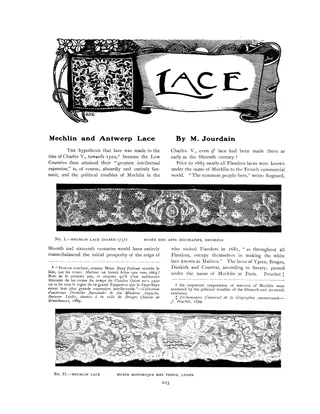
An illustrated article from The Connoisseur by M. Jourdain on the history and characteristics of Mechlin lace and Antwerp lace (Potten Kant). It covers the trade names and English fashion for Mechlin, its development from straight-edged laces, its réseau ground, fancy fillings, cordonnet, and Alençon and French influence in design. A short section on Antwerp peasant lace describes the flower-pot motif and its Annunciation symbolism. Twelve numbered photographs show examples from museums in Brussels, Lyons and London.
Milanese Lace
Article · 6 pages
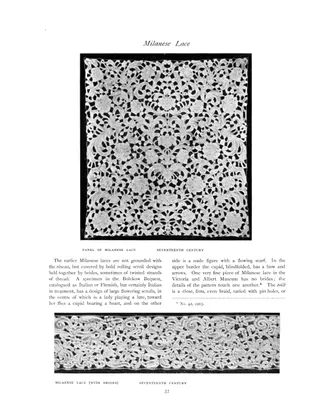
A 1906 Connoisseur article by M. Jourdain on the history and characteristics of Milanese pillow lace. It covers Milan's early embroidery guilds, the Sforza inventory references to trina and bobbins, and the 17th-century scroll designs joined by brides. It also discusses the réseau ground (introduced by 1664), the animal and heraldic motifs, a dated 1733 piece in Brussels, and the later "Genoese tape" and peasant laces. Illustrated with photographs of museum and private-collection specimens.
Needlework Pictures
Article · 5 pages
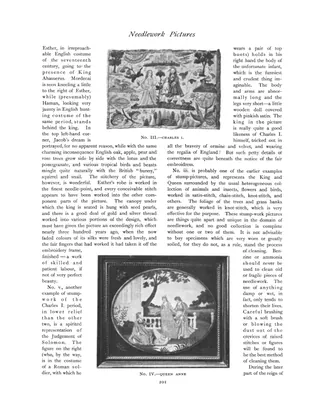
An article from The Connoisseur surveying English needlework pictures from the Stuart period to the early nineteenth century, written for collectors. It traces the development from flat tent-stitch pictures of Charles I's reign through raised stump-work, bead-work, Queen Anne sentimental pictures, and copies of engravings, then the decline after 1800. It describes the stitches used (tent, long-and-short, satin, knot, plush, lace-stitch, purl) and discusses six illustrated examples. The article ends with advice on buying, framing, cleaning and storing old needlework pictures.
Note on Lace Bobbins
Article · 3 pages
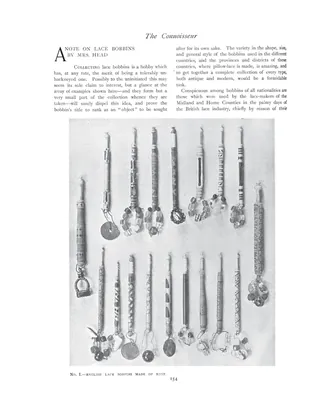
A short illustrated article by Mrs. Head on collecting pillow-lace bobbins. It describes English bobbins of bone and wood from the Midlands, Home Counties, Devon, Oxfordshire and Yarmouth, covering their inlays, wire and bead decoration, inscriptions, and the beaded "jingles". It ends with foreign bobbins from Portugal, Brussels, Russia (Vologda), Normandy, Spain, Italy and Malta, including bobbins with movable sheaths. Three plates show the bobbins discussed.
A Piece of Old Warwickshire Tapestry
The Connoisseur, 1903
Article · 2 pages
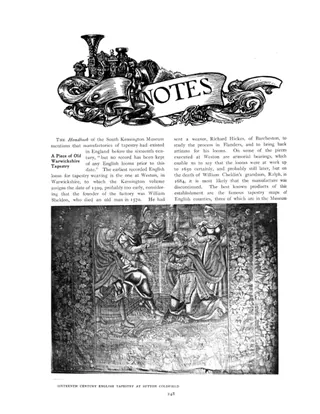
A short note from The Connoisseur on a sixteenth-century English tapestry at Sutton Coldfield, attributed to the Sheldon looms at Weston/Barcheston in Warwickshire. It reviews the history of the Sheldon manufactory founded by William Sheldon and Richard Hickes, then describes the piece, about 8 feet square, showing Queen Esther before King Ahasuerus. It traces the tapestry's provenance from Castle Bromwich to Sutton Coldfield and notes its cut borders and damp damage.
Point Compté, Lace Netting
Article · 3 pages
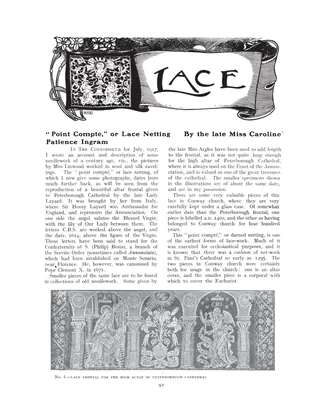
A short illustrated article on "point compté," or darned netting lace, one of the earliest forms of lace-work. It describes a 1614 Italian altar frontal of the Annunciation given to Peterborough Cathedral, pieces at Conway church, and historical references to netting at St. Paul's (1295) and Exeter (1327). It also mentions a piece attributed to Mary Queen of Scots, and ends with an obituary note on the author, a church embroiderer. Five photographs show the frontal and smaller examples.
Puntas and Passementerie
Article · 7 pages
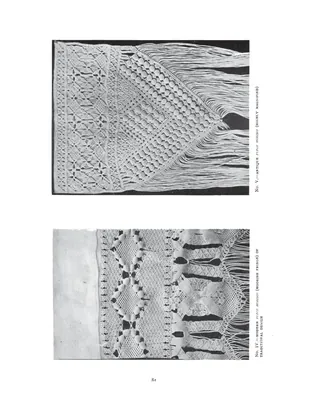
An article from The Connoisseur (1902) arguing that Spanish puntas were not point lace but a distinct Moorish-derived trimming: drawn-thread work and fleco morisco, a hand-knotted form akin to macramé. It traces them through Spanish sumptuary edicts from 1212 to 1723, medieval monuments, paintings and museum pieces, and links pasamanos (passementerie) and trenzas to Arabic origins. It also discusses the Moriscos' role in Seville's textile and silk industries, possible links to the pillow lace of Le Puy, and surviving Andalusian practice. Illustrated with ten figures of lace samples, paintings, a miniature of Charles I and a royal seal.
Punto de Aguja and Point d'Espagne. Part I
Article · 5 pages
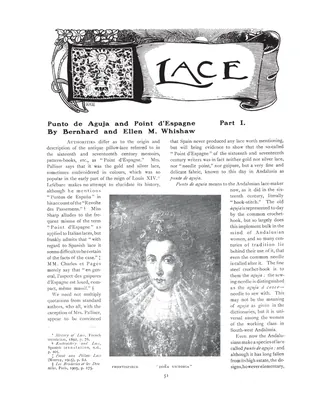
Part I of an article from The Connoisseur arguing that the 'Point d'Espagne' of sixteenth and seventeenth century writers was the fine Andalusian lace called punto de aguja (hook-stitch, worked with a crochet-like aguja on a horquilla fork), not gold lace, needle point or guipure. The authors cite Spanish edicts from 1534 to 1623, Moorish influence and pattern-books. They present evidence from two portraits of Andalusian ladies ('Doña Victoria') whose ruffs show the lace, including Arabic-letter motifs, and discuss later Philippine and Sevillian examples. Illustrated with photographs of portraits and lace details.
Punto de Aguja and Point d'Espagne. Part II
Article · 5 pages
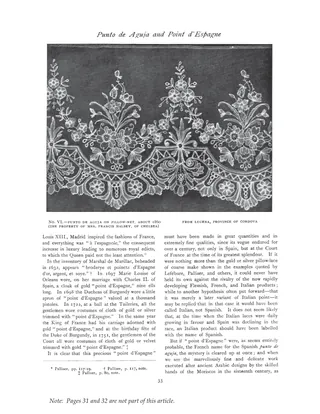
Second part of an article in The Connoisseur arguing that Spanish punto de aguja is the origin of the French 'point d'Espagne'. The authors examine a Lucena lace flounce on pillow-net, other Andalusian specimens and historical references (Gustavus Adolphus's collar, French court inventories, a South Kensington bed-cover). They then propose that the Spanish terms punto and punta (stitch and point) were mistranslated into French, Italian and English lace terminology. Illustrated with five numbered specimens, including a reconstructed net ground (réseau) and Morisco fringe.
Real Lace -- A Hint to Collectors
The Connoisseur, 1905
Article · 1 page
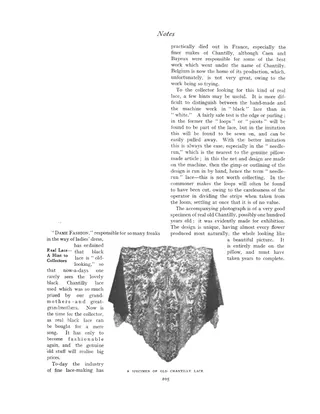
A short note from The Connoisseur advising collectors on buying real black lace, especially Chantilly. It explains how to tell hand-made pillow lace from machine imitation by examining the edge loops or picots, and warns against "needle-run" lace, in which the net and design are machine-made and the outline is added by hand. It also describes a photographed specimen of old Chantilly, possibly a century old and made for exhibition, and comments on the fashion and low prices of black lace in 1905.
Real Lace a Good Investment
The Connoisseur, 1905
Article · 1 page
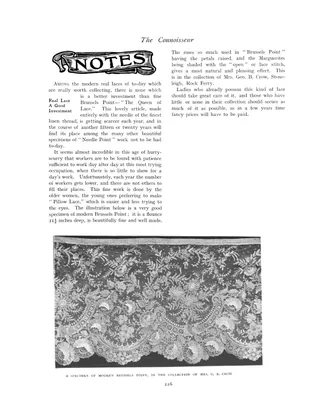
A short note from The Connoisseur arguing that fine modern Brussels Point needle lace is a good investment for collectors because it is growing scarce. It says the work is done by older women while younger workers prefer pillow lace, and it describes an illustrated flounce with raised roses and shaded marguerites from a private collection. It ends with advice to care for and acquire such lace.
A Remarkable Piece of Lace
Article · 2 pages
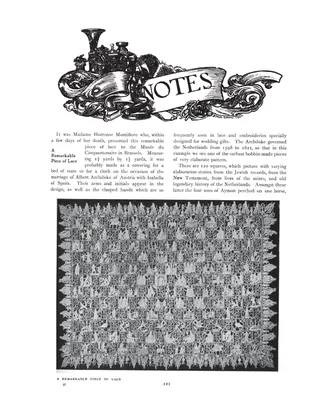
A short note from The Connoisseur describing a large bobbin-made lace panel given to the Musée du Cinquantenaire in Brussels. The piece measures about 1¾ by 1½ yards and is made up of 120 pictorial squares showing biblical, saintly and legendary Netherlandish scenes. It bears the arms and initials of Archduke Albert and Isabella of Spain and is thought to date from their rule of the Netherlands (1598-1621). The note also describes the figured, scalloped border. A photograph of the whole panel is included.
Ruffs
Article · 8 pages
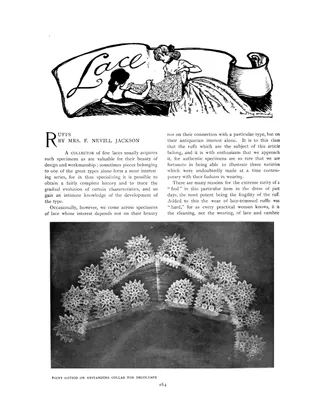
An article from The Connoisseur on the history of the lace-trimmed and lace-composed ruff. It covers the ruff's origins in France and England, the introduction of starch and the poking sticks and wire supertasses used to set and support ruffs, and the cambric, cut work, bone lace and pearl trimmings. It also covers the decline of men's ruffs and the later use of the outstanding collar by women. Illustrated with photographs of three surviving ruffs and portraits by Rubens and Van Dyck.
Some Old Lace Bobbins
The Connoisseur, 1919
Article · 3 pages
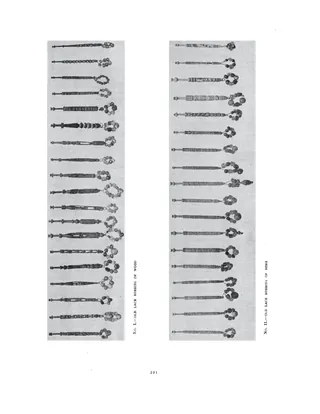
A short illustrated article from The Connoisseur on English pillow-lace (bobbin lace) bobbins. It sketches the history of the lace industry in England and its decline with machine-made lace, and describes bobbins of wood and bone, regional differences in decoration, inscribed love-token bobbins, movable rings, gimp bobbins, tallies and bead 'jingles'. Two pages of illustrations show old wooden and bone bobbins.
Spanish Lace
The Connoisseur, 1906
Article · 1 page
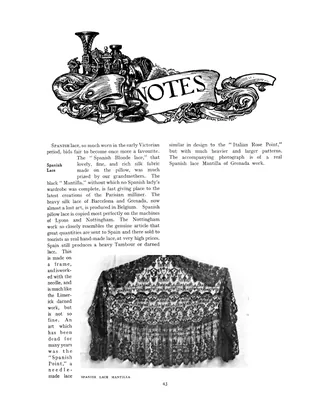
A short note from The Connoisseur on Spanish lace and its decline in the early twentieth century. It covers Spanish blonde silk pillow lace, the black mantilla, Barcelona and Granada silk lace now made in Belgium, machine copies from Lyons and Nottingham sold to tourists as hand-made, and Spanish tambour (darned) lace and the extinct Spanish Point needle lace. It includes a photograph of a Granada-work lace mantilla.
Spinning Wheel
The Connoisseur, 1905
Illustration · 1 page
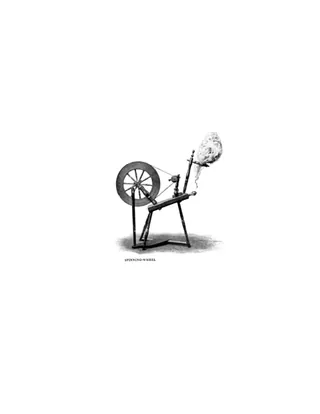
A single-page illustration of a treadle spinning wheel, reproduced from The Connoisseur, vol. 11 (1905). The line drawing shows a large spoked wheel on an upright support, a drive cord running to the spindle assembly, a bobbin and flyer arm, and a distaff holding fiber. The only text is the caption 'Spinning Wheel'.
58 documents found