Textile Documents › Authors › Author: Bernhard Whishaw
3 documents found
Sort: 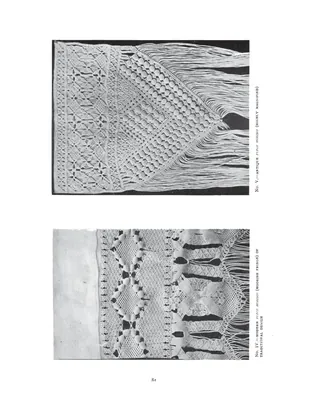
Puntas and Passementerie
Article · 7 pages
An article from The Connoisseur (1902) arguing that Spanish puntas were not point lace but a distinct Moorish-derived trimming: drawn-thread work and fleco morisco, a hand-knotted form akin to macramé. It traces them through Spanish sumptuary edicts from 1212 to 1723, medieval monuments, paintings and museum pieces, and links pasamanos (passementerie) and trenzas to Arabic origins. It also discusses the Moriscos' role in Seville's textile and silk industries, possible links to the pillow lace of Le Puy, and surviving Andalusian practice. Illustrated with ten figures of lace samples, paintings, a miniature of Charles I and a royal seal.
Punto de Aguja and Point d'Espagne. Part I
Article · 5 pages
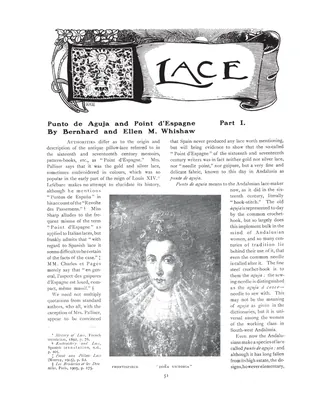
Part I of an article from The Connoisseur arguing that the 'Point d'Espagne' of sixteenth and seventeenth century writers was the fine Andalusian lace called punto de aguja (hook-stitch, worked with a crochet-like aguja on a horquilla fork), not gold lace, needle point or guipure. The authors cite Spanish edicts from 1534 to 1623, Moorish influence and pattern-books. They present evidence from two portraits of Andalusian ladies ('Doña Victoria') whose ruffs show the lace, including Arabic-letter motifs, and discuss later Philippine and Sevillian examples. Illustrated with photographs of portraits and lace details.
Punto de Aguja and Point d'Espagne. Part II
Article · 5 pages
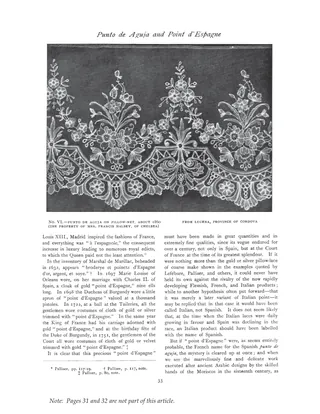
Second part of an article in The Connoisseur arguing that Spanish punto de aguja is the origin of the French 'point d'Espagne'. The authors examine a Lucena lace flounce on pillow-net, other Andalusian specimens and historical references (Gustavus Adolphus's collar, French court inventories, a South Kensington bed-cover). They then propose that the Spanish terms punto and punta (stitch and point) were mistranslated into French, Italian and English lace terminology. Illustrated with five numbered specimens, including a reconstructed net ground (réseau) and Morisco fringe.