Textile Documents › Authors › Author: Margaret Jourdain
31 documents found
Sort: 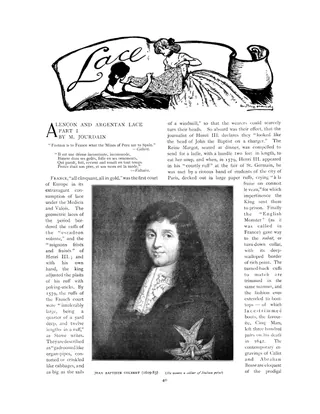
Alençon and Argentan Lace: Part I
Article · 4 pages
First part of an article on the history of Alençon and Argentan needle lace in France. It surveys the French court's extravagant use of lace under the Valois and Louis XIII and XIV, the sumptuary edicts against it, and Colbert's founding of the Point de France industry at Alençon with Venetian workers in the 1660s. It covers the royal privilege of 1665 and local resistance from the lace workers. Illustrated with a portrait of Colbert and photographs of eighteenth-century Point d'Alençon and Point d'Argentan lace.
Alençon and Argentan Lace: Part II
Article · 5 pages
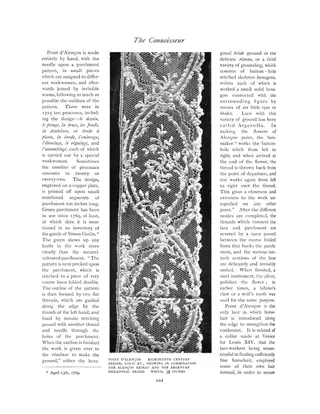
Second part of M. Jourdain's article on the history of Alençon and Argentan needle lace in The Connoisseur. It covers French protectionism under Colbert, the Venetian origins of the grounds, the stages of making Point d'Alençon (parchment pattern, réseau and bride grounds, horsehair cordonnet), and changes in design from Louis XIV to Louis XVI. It also traces the history of the Argentan manufacture, including the Guyard and La Leu rivalries and its decline in 1810. Illustrated with photographs of eighteenth-century lace panels and borders.
Alençon, Part I
Article · 5 pages
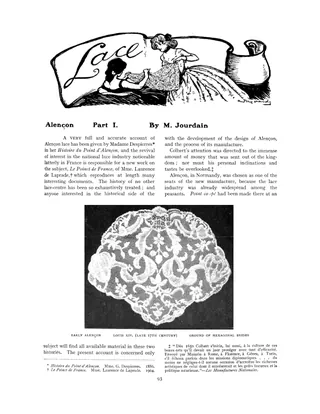
First part of a two-part article by M. Jourdain on Alençon needlepoint lace, focusing on how its design developed and how it was made rather than on its administrative history. It covers the founding of the Points de France manufacture under Colbert in the 1660s, the earlier point coupé industry in Alençon, the imitation of Venetian points, protectionist measures, and the protection of royal lace patterns and designers. Illustrated with photographs of 17th and 18th century Alençon lace from the Victoria and Albert Museum and the Brussels Musée des Arts Décoratifs, including hexagonal brides grounds and a sleeve trimming.
Alençon, Part II
Article · 4 pages
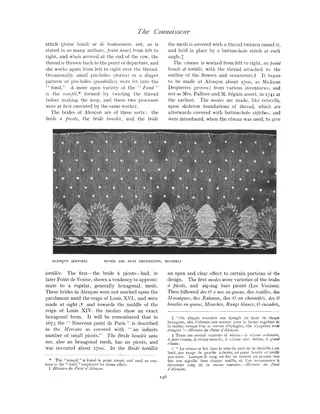
Part II of M. Jourdain's article on Alençon needle lace in The Connoisseur, covering how Point d'Alençon was made: pricking the parchment pattern, the trace, the fond or entoilage, the brides, the réseau ground, the modes (filling stitches), the brode, assembly and finishing. It also covers the horsehair cordonnet, the 1836 attempt to imitate the lace on bobbin net, shading introduced in 1855, the thread supply, and the relation of Alençon to Argentan and Argentella. Illustrated with photographs of Alençon lace (Louis XVI and Empire periods) from the Musée des Arts Décoratifs, Brussels, and the Victoria and Albert Museum. Footnotes cite the Histoire du Point d'Alençon, Mrs. Palliser and others.
Argentan Lace
Article · 6 pages
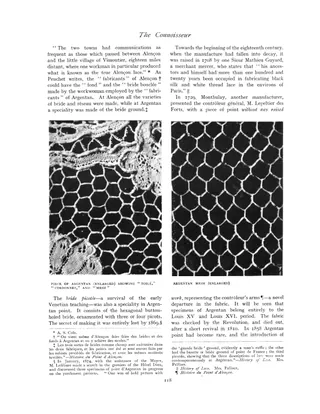
An article from The Connoisseur by M. Jourdain on the history and design of Argentan needlepoint lace, a Point de France lace made at Argentan and Alençon. It covers the characteristic hexagonal bride ground, the relation to Alençon lace, and its decline after the Revolution and with the adoption of cotton thread around 1830. It traces changing design styles from Louis XIV through Louis XV, Louis XVI and the Empire, relating lace motifs to contemporary textiles, brocades and fashion. Illustrated with photographs of Argentan pieces including a flounce, a lappet and enlarged views of the mesh.
Brussels Lace
Article · 7 pages
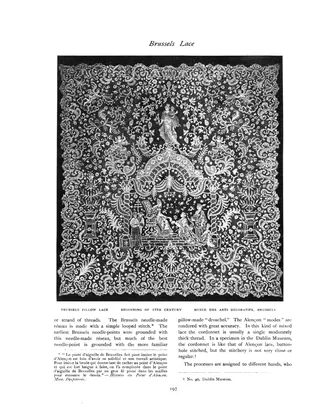
An illustrated article by M. Jourdain on the history and technique of Brussels lace, drawing on Mrs. Calderwood, Mrs. Palliser and Peuchet. It covers the division of labour among lace workers, the pillow-made and needle-made réseau grounds, the fine flax thread, the toilé, and the bride versus réseau grounds. It also traces design influences (French court, Chinese style, later Louis XVI and 19th-century styles) and the Point d'Angleterre name. Plates show 18th-century pillow-made Brussels lace in museum and private collections.
Cutwork (Reticilla) and Punto in Aria, Part I
Article · 5 pages
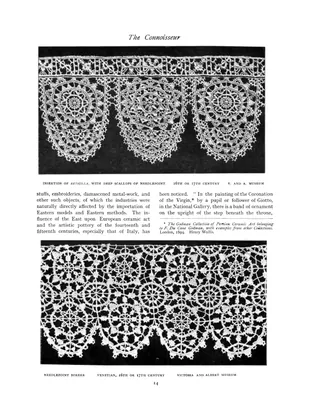
First part of M. Jourdain's article in The Connoisseur on cutwork (reticilla) and punto in aria, early Italian geometric needle laces. It traces Venice's role and the influence of Eastern (Arab and Persian) geometric design, then describes how cutwork and reticilla were made by cutting or drawing threads from linen and covering them with buttonhole stitch, and how punto in aria developed from reticilla. Pattern books by Vinciolo, Vecellio and Parasole are cited. Illustrated with photographs of reticilla, needlepoint borders and a linen collar from the Victoria and Albert Museum and a private collection. The article ends with "To be continued."
Cutwork (Reticilla) and Punto in Aria, Part II
Article · 4 pages
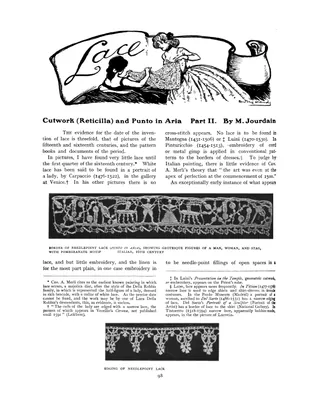
Part II of Margaret Jourdain's article in The Connoisseur on the early history of cutwork (reticella) and punto in aria needlepoint lace. It weighs the dating of lace's invention from three kinds of evidence: Italian paintings of the 15th and 16th centuries, early documents such as the 1493 Sforza inventory, and printed pattern books from 1527 onward (Vavassore, Pagannino, Taglienti, Vinciolo, Parasole, Vecellio). Illustrations show 16th and 17th century needlepoint borders, reticella insertions, a Spanish copy of Italian needlepoint, and pattern-book pages.
Drawn Thread Work and Lacis
Article · 3 pages
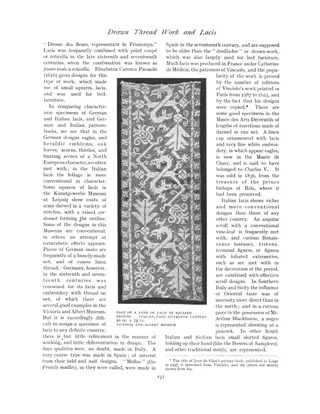
An article from The Connoisseur by M. Jourdain on the origins and history of lacis, the darned-net lace descended from drawn-thread work. It traces early references (Skelton, the Exeter Inventory, Quentell's 1527 pattern book) and discusses the pattern books of Vinciolo, Vavassore and Parasole. It also compares German, Italian, Spanish and French lacis and cites examples in the Victoria and Albert Museum, the Musée de Cluny and elsewhere. Illustrated with two Italian sixteenth-century pieces.
English Lace: I. Needlepoint
Article · 4 pages
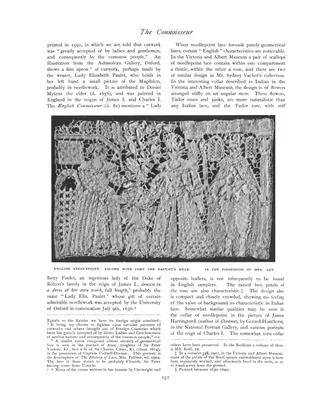
An illustrated article by M. Jourdain on English needlepoint lace of the seventeenth century, arguing that its designs and techniques were largely borrowed from Italian and Flemish work and that the flax was imported. It discusses cutwork, Elizabethan wardrobe accounts, the Vinciolo pattern book, and portraits showing lace and cutwork, and notes characteristic English features such as Tudor roses, compact designs and raised petals. It also covers biblical scenes in lace with beads and pearls, the 1635 proclamation protecting home lace, cutwork on samplers, and hollie point. Plates show pieces from the V&A, the Musée des Arts Décoratifs in Brussels and private collections.
English Pillow Lace, Part 1
Article · 5 pages
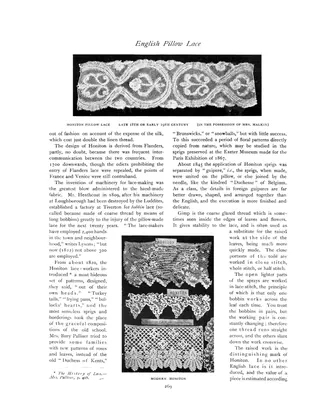
First part of M. Jourdain's series on English pillow lace in The Connoisseur, dealing with Honiton and Devonshire trolly lace. It traces the history of the Honiton industry from Flemish refugees in the 16th century through the 19th-century effects of machine net and appliqué work. It also describes raised work, gimp and stitches, the Honiton pillow and bobbins, and trolly lace made near Exmouth. Illustrated with plates of 18th- and early 19th-century pieces from the Victoria and Albert Museum, the Exeter Museum and private collections.
English Pillow Lace, Part 2
Article · 6 pages
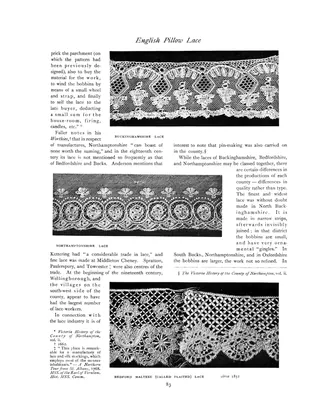
Part II of M. Jourdain's survey of English pillow lace in The Connoisseur, covering regional lace-making in Buckinghamshire, Bedfordshire, Northamptonshire, Wiltshire, Dorset, the Isle of Wight, Suffolk and elsewhere. It discusses the history of the industry, Flemish and French influences (especially Lille and Mechlin), grounds such as point ground, trolly and French ground, Maltese plaited laces, bobbins, pillows and lace schools. Illustrated with photographs of specimens from several counties.
Gold and Silver Lace, Part I
Article · 4 pages
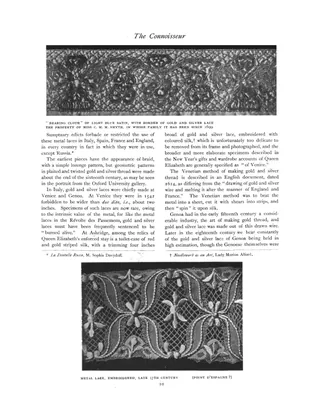
First part of an article on the history of gold and silver lace, published in The Connoisseur. It covers the fashion of 'parfilage' (unravelling gold lace for the metal), early metal-thread trimmings, sumptuary laws, and production centres in Venice, Genoa, Milan, Spain (including Point d'Espagne), Germany and Holland. Illustrations show a portrait with a gold lace ruff, a satin bearing cloth with a metal lace border, and 18th-century gold laces with réseau grounds and embroidery.
Gold and Silver Lace, Part II
Article · 5 pages
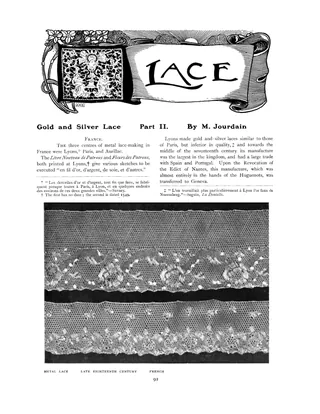
Part II of M. Jourdain's article on gold and silver (metal) lace in The Connoisseur, surveying its history in France (Lyons, Paris, Aurillac), Sicily, Switzerland, Russia and England. It draws on museum specimens, inventories, sumptuary laws, patents, and petitions, especially for English gold thread monopolies, fraud, and import prohibitions from the 13th to the 18th century. Illustrated with photographs of 18th-century French, Italian, and Russian metal lace.
Italian Pillow Lace
Article · 5 pages
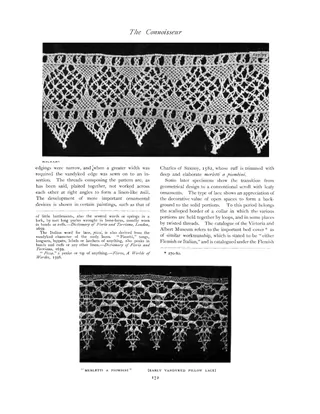
Article by M. Jourdain in The Connoisseur on the early history of Italian pillow lace. It covers punto a groppo (knotted lace) as a forerunner of pillow lace, early plaited and vandyked merletti a piombini, and Genoese pillow lace including point de Gênes frisé with its wheat-grain ornament. It draws on pattern books, portraits, dictionaries and Victoria and Albert Museum specimens, and is illustrated with photographs of laces, a coverlet, and a portrait of the Duc de Montmorency.
Lace as Worn in England Until the Accession of James I
Article · 5 pages
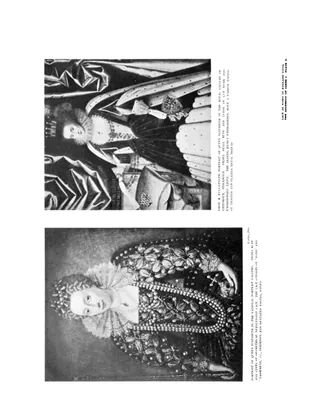
An article by M. Jourdain tracing the meaning of the word 'lace' and the kinds of lace worn in England from the late 15th century to the end of Elizabeth I's reign. It draws on royal wardrobe inventories, New Year's gift rolls and privy purse accounts to define passement, purle, bone-lace, billament, crown, cheyne, compas, parchment and byas laces, plus cut-work, drawn-work and Coventry blue bride laces. Two plates reproduce portraits of Elizabethan and Jacobean women, including Queen Elizabeth and the Countess of Pembroke, showing geometrical bobbin and needlepoint lace on ruffs, cuffs and caps.
Lace Collection of Mr. Arthur Blackborne: Part 1
Article · 9 pages
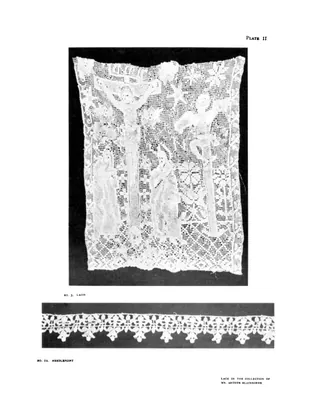
Part I of M. Jourdain's article describes the lace collection of Mr. Arthur Blackborne, some six hundred specimens begun in 1850. It discusses lacis (darned net), its terminology, pattern books such as Vinciolo and Parasole, and the symbolism of motifs like peacocks at a fountain. It then covers cutwork and punto in aria and gives numbered catalogue entries (Nos. 1-21) for lacis, cutwork, needlepoint, and Italian and English pillow laces. Four plate pages show photographs of selected specimens.
Lace Collection of Mr. Arthur Blackborne: Part 2 -- Later Punto in Aria
Article · 5 pages
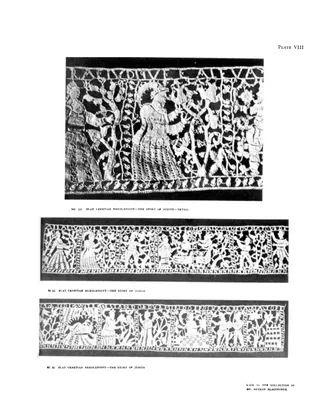
Second part of M. Jourdain's catalogue of Arthur Blackborne's lace collection, covering later punto in aria, the flat needlepoint that moved from geometric designs to scrolls, flowers and human figures. It describes specimens 22 to 30 by size and design, including a long Venetian panel with the story of Judith and Holofernes (with a Portuguese inscription), a figured strip with mediaeval costumed figures, and pieces with a Persian sun motif. The author discusses Persian influence on Venetian lace design. Two pages of photographic plates show the Judith panel and Nos. 25, 28 and 29.
Lace Collection of Mr. Arthur Blackborne: Part III-- Rose Point
Article · 9 pages
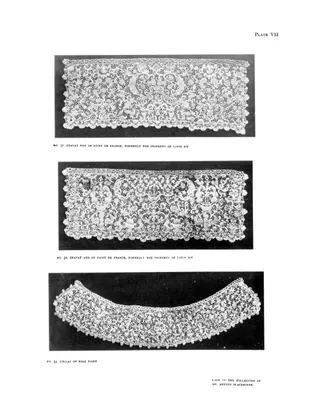
Part III of M. Jourdain's series on Arthur Blackborne's lace collection, devoted to rose point (raised Venetian needlepoint lace). The text first explains how rose point differs from later punto in aria in its conventional scroll design, raised relief, and elaborate brides (bar grounds). It then gives numbered catalogue entries (Nos. 31-47) for cravat ends once owned by Louis XIV, collars, cuffs, lappets, and borders, describing their designs, meshes, picots, and provenance. Four plates (VII-X) reproduce many of the pieces in black and white.
Lace Collection of Mr. Arthur Blackborne: Part IV -- Milanese Laces
Article · 7 pages
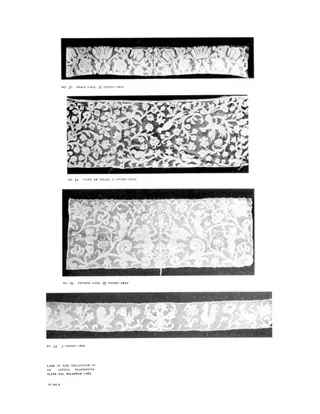
Concluding part of M. Jourdain's series on the lace collection of Mr. Arthur Blackborne, devoted to Milanese laces. It begins with a short history of Milanese passements and pillow lace, covering the flat toilé, réseau grounds and the hunting and heraldic designs. It then gives a numbered catalogue (Nos. 48-60) of specimens with dimensions and motif descriptions, including boar-hunt and animal scroll designs, armorial lace, braid lace, point de Milan and church laces. Four plates of halftone photographs illustrate the pieces.
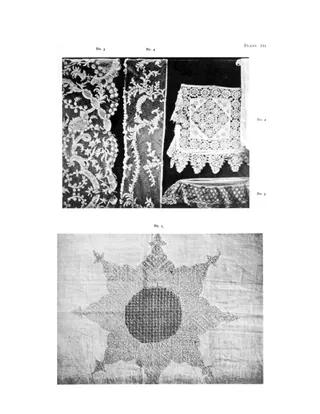
Lace in the Collection of Mrs. Alfred Morrison at Fonthill
Article · 6 pages
A 1903 Burlington Magazine article by M. Jourdain describing specimens of lace from Mrs. Alfred Morrison's collection at Fonthill House, illustrated on three photographic plates. Entries cover Venetian needle-point (gros point, rose point, point de Venise), Alen\u00e7on and Brussels lace, Honiton, Reticella and punto in aria, Turkish drawn-thread work, Russian lace, and modern Irish needle-point and crochet made to Mrs. Morrison's designs. Each specimen is given a short description of design, technique, and period.
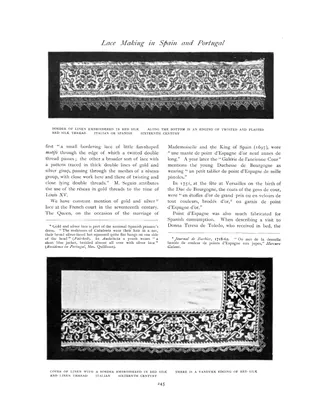
Lace Making in Spain and Portugal, Part I
Article · 4 pages
The first part of an article on the history of lace in Spain and Portugal, with most of the discussion on gold and silver lace known as point d'Espagne. It draws on literary, court and travel references, sumptuary laws and portraits to show how widely Spanish dress used gold and silver lace. It also argues that Spain relied on imported Flemish and Italian lace. Illustrations show a pillow-lace-edged napkin, Italian or Spanish red silk embroidered linen borders and a Point de Venise ('Spanish Point') sample.
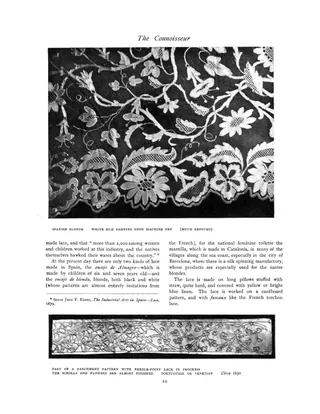
Lace Making in Spain and Portugal, Part II
Article · 4 pages
Second part of an article on the history of lace making in Spain and Portugal, from The Connoisseur. It covers sumptuary laws and lace imports, Spanish pillow guipure, blonde and gold and silver lace, and the centres of production in Catalonia, La Mancha and elsewhere. The Portuguese section covers court use of lace, a 1590 lace panel of Judith and Holofernes, and modern pillow lace schools at Peniche and other towns. Illustrated with plates of a Spanish blonde, seventeenth-century needle-point lace on parchment patterns, and modern Peniche lace.
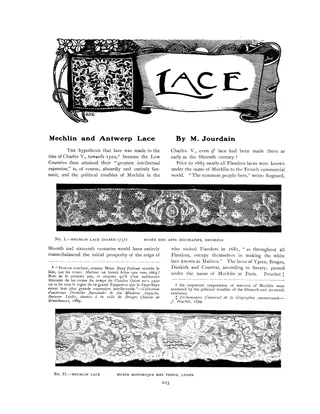
Mechlin and Antwerp Lace
Article · 6 pages
An illustrated article from The Connoisseur by M. Jourdain on the history and characteristics of Mechlin lace and Antwerp lace (Potten Kant). It covers the trade names and English fashion for Mechlin, its development from straight-edged laces, its réseau ground, fancy fillings, cordonnet, and Alençon and French influence in design. A short section on Antwerp peasant lace describes the flower-pot motif and its Annunciation symbolism. Twelve numbered photographs show examples from museums in Brussels, Lyons and London.
Milanese Lace
Article · 6 pages
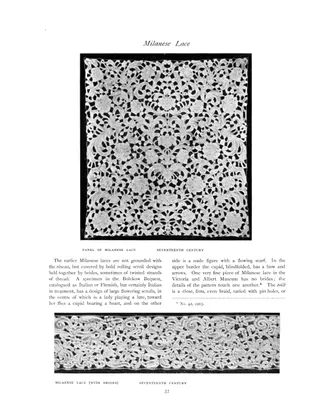
A 1906 Connoisseur article by M. Jourdain on the history and characteristics of Milanese pillow lace. It covers Milan's early embroidery guilds, the Sforza inventory references to trina and bobbins, and the 17th-century scroll designs joined by brides. It also discusses the réseau ground (introduced by 1664), the animal and heraldic motifs, a dated 1733 piece in Brussels, and the later "Genoese tape" and peasant laces. Illustrated with photographs of museum and private-collection specimens.
Old Lace: A Handbook for Collectors
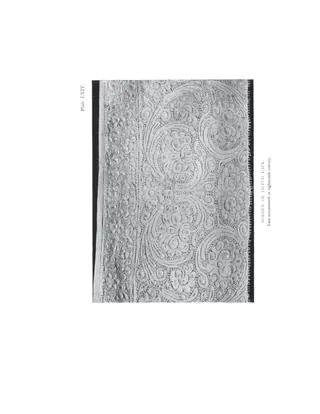
Book · 220 pages
A 1908 collector's handbook on hand-made lace, covering the history, characteristics and manufacture of the main lace styles. Chapters run from lacis, cutwork (reticella) and punto in aria through Italian bobbin and needlepoint laces (Venetian, Burano, Milanese) and the Flemish, Brussels, Mechlin, Valenciennes, Dutch, Alençon, Argentan, Lille, Arras and Chantilly laces. English needlepoint, Honiton, Midland bobbin lace, Irish laces and blondes follow. The book is illustrated with many photographic plates of lace borders, lappets, collars and cravat ends, and has an index.
Point de Venise à Réseau; Old Burano Point
Article · 4 pages
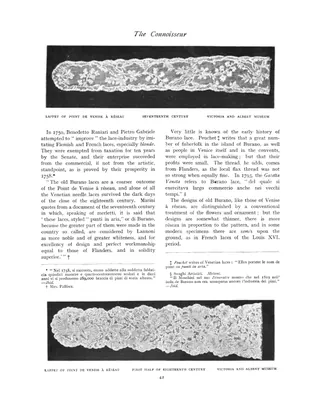
A short illustrated article on Point de Venise à réseau, a Venetian needle lace with a square-mesh ground, and on old Burano point, its coarser descendant. It describes the design and workmanship of the laces, compares them with Brussels and Alençon lace, and outlines their history from about 1650 to the extinction of the industry in 1866. It also gives a description of how Burano point was worked on a pillow. Photographs of lappets in the Victoria and Albert Museum illustrate it, and footnotes quote Italian and French sources.
Valenciennes, Part I
Article · 4 pages
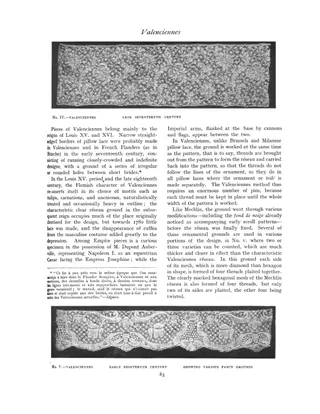
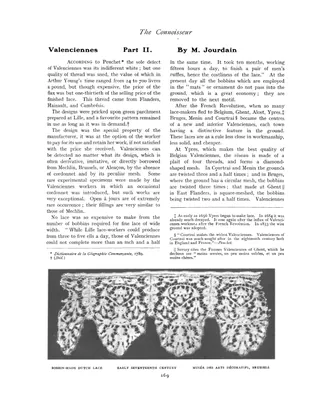
An article from The Connoisseur on the history of Valenciennes bobbin (pillow) lace. It traces the introduction of lace-making from Le Quesnoy and Antwerp, its peak between 1725 and 1780, and its decline after the Revolution. It also describes the characteristic ground (fond de neige and the clear réseau), how the ground is worked together with the pattern, and the true versus 'fausse' Valenciennes debate. Illustrated with six plates of Valenciennes lace specimens from the late 17th to the 18th century.
Valenciennes, Part II
Article · 2 pages
Second part of M. Jourdain's article on Valenciennes lace in The Connoisseur. It covers the thread, parchment patterns, and slow production of true Valenciennes, and the Belgian centres (Ypres, Courtrai, Menin, Bruges, Ghent) that made inferior versions after the French Revolution, with their different ground meshes. It also covers Fausses Valenciennes from northern France and Dieppe, then begins a section on Dutch bobbin lace of the seventeenth century and Haarlem thread. Illustrated with plates of Dutch bobbin lace.
Venetian Needlepoint, Part I
Article · 7 pages
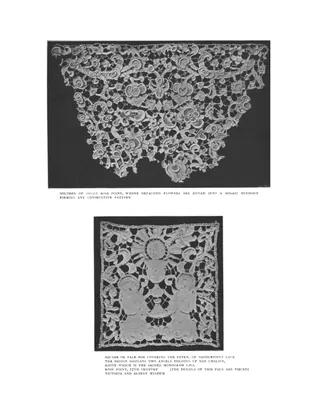
Part I of M. Jourdain's article on Venetian needlepoint lace in The Connoisseur. It covers lace-making as a private and convent enterprise in Venice, the shift from geometric cutwork to curved designs around 1600, the vague use of the term punto in aria, and the features of rose point: conventional pomegranate-scroll designs, raised relief over padded threads, button-hole stitch, and bride grounds. It also discusses pieced specimens with lost brides. Illustrated with plates of laces and embroideries, mostly from the Victoria and Albert Museum and private collections.
Venetian Needlepoint, Part II
Article · 7 pages
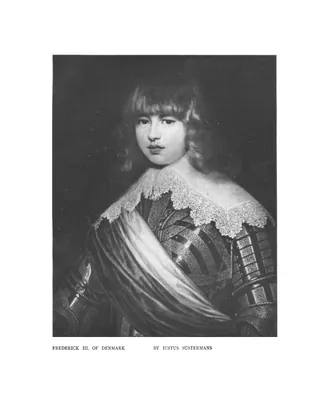
Second part of an article by M. Jourdain on Venetian needlepoint lace, in The Connoisseur. It discusses the brides (connecting bars) and their picot ornamentation in rose point and point de neige, and distinguishes gros point de Venise, point de neige, coraline point and point plat de Venise by design and date. It also covers uses of the lace (cravats, collars, flounces, ecclesiastical items) and the attribution of 'Spanish point'. Illustrated with specimens from the Musée des Arts Décoratifs in Brussels, a Siena fresco detail, and portraits by Sustermans showing lace collars.
31 documents found