Textile Documents › Authors › Author: Emmanuel Anthony Posselt
679 documents found
Sort: 
Analysis of Woolen and Worsted Cloths
Article · 3 pages
Three pages from Posselt's Textile Journal, January 1921, mainly on how to analyze a woolen or worsted cloth sample. It covers burning tests to tell animal from vegetable fibres, distinguishing cotton from linen and flax from jute, and removing rubber from waterproofed cloth. It then gives rules and worked examples for estimating loom width, finished length, ends and picks per inch, and the shrinkage and take-up allowances. The scan also includes a short note on Norwegian import prohibitions and the start of an article on bleaching silk by the sulphur process.
April, 1914
Article · 4 pages · weaving drafts
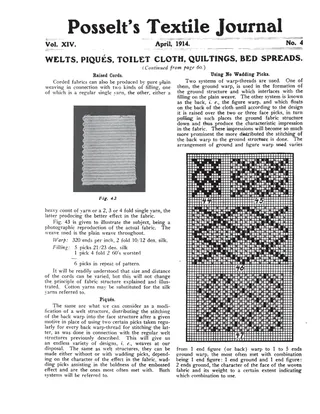
Four pages from the April 1914 issue of Posselt's Textile Journal (Vol. XIV, No. 4). The first part continues a series on welts, piqués, toilet cloth, quiltings and bed spreads, covering raised-cord fabrics and piqué weaves made with and without wadding picks. It gives weave and motive diagrams, warp and filling arrangements, fabric specifications, and rules for analyzing a sample to work out its weave. The final page begins an article on dressing woolen warps, covering spooling and warp calculations for a plain warp.
August, 1913
Article · 2 pages · weaving drafts
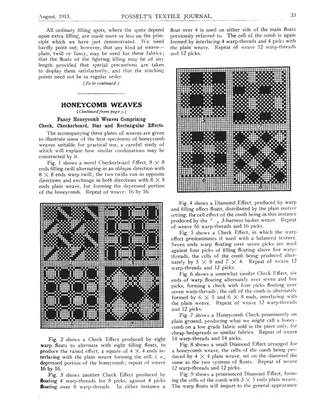
Two pages from the August 1913 issue of Posselt's Textile Journal (pp. 33-34). They continue the series on honeycomb weaves, describing Figs. 1-12 of fancy honeycomb designs with check, checkerboard, diamond and rectangular effects, with repeat sizes given for each. The pages also open a section on weaves and effects in ribbons, covering point paper and weave plans, and include a short note on testing foods and wines for aniline dyes.
August, 1913
Article · 3 pages · weaving drafts
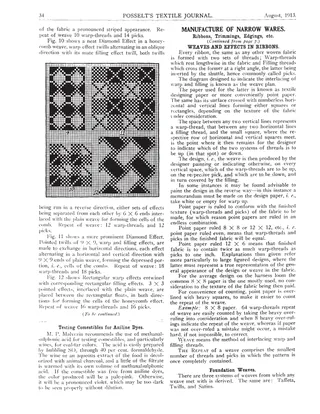
Three pages from the August 1913 issue of Posselt's Textile Journal (pp. 34-36). They continue a series on the manufacture of narrow wares, with a section on weaves and effects in ribbons. This part covers point paper, weave plans and repeats, then the foundation weaves (taffeta, twills, satins, double satins) and rib weaves, with numbered weave diagrams and drawing-in drafts for ribbon warps. The pages also include a short note on testing foods and wines for aniline dyes and a construction sheet for a woolen melton men's suiting (warp and filling arrangement, reed, finish).
August, 1913
Article · 1 page
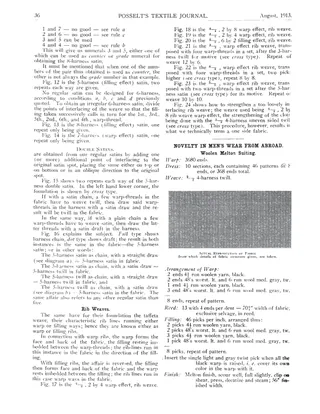
A single page from Posselt's Textile Journal, August 1913, continuing a series on fabric weave construction. It finishes the discussion of regular satins (8-, 5-, 6- and 7-harness), then covers double satins, satin drafting versus straight drafting, and rib weaves (warp and filling ribs, Figs. 17-24). It closes with the start of a mill-style fabric analysis of a woolen melton men's suiting on a 4-harness twill, giving warp and filling arrangement, reed, picks per inch, and finishing.
August, 1913
Article · 3 pages
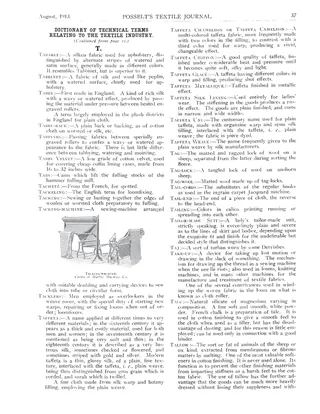
Three pages from the August 1913 issue of Posselt's Textile Journal (pp. 37-39). They continue the serialized Dictionary of Technical Terms Relating to the Textile Industry through the T entries, from Tabaret to Tartan and Teazeling-machine. They include a short article by James Blair on methods of testing waterproof fabrics and the start of a note on a patent for printing textile fabrics on paper sheets instead of grey back cloth. Engravings show a tacking-machine, a tape dresser (tape-sizing machine) and a teazeling-machine (gig).
August, 1913
Article · 2 pages · weaving drafts
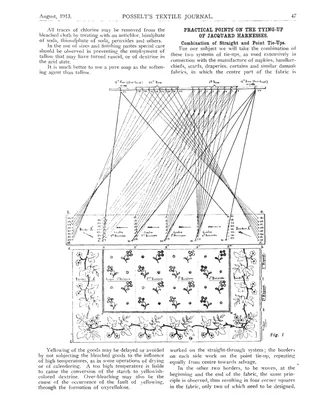
Two pages from the August 1913 issue of Posselt's Textile Journal (pp. 47-48) on tying up Jacquard harnesses. The article covers combining straight-through and point tie-ups for damask fabrics such as napkins, handkerchiefs and draperies, with worked needle and warp-end counts for 200 and 600 machines and diagrams of the tie-ups and fabric ground plans. A short note on waterproofing tulle with collodion, amyl acetate and gum-lac, and a few lines on removing chlorine and avoiding yellowing in bleached cloth, also appear.
Belgian Lace Making
Article · 1 page
A short item from Posselt's Textile Journal, July 1920, reporting on the state of the Belgian lace industry. It gives the decline in lace makers from 150,000 in 1875 to 45,000, the kinds of lace made (Malines, Paris, Lille, Binche, torchon), apprenticeship, hours, wages, and the crowded, unheated lace schools and middle-men that keep pay low. The page also carries a second short article on American Bureau of Standards research into the spectral transmissivities of dyes, and an aniline dye advertisement.
Bleaching, Dyeing and Finishing of Knit Goods
Article · 5 pages
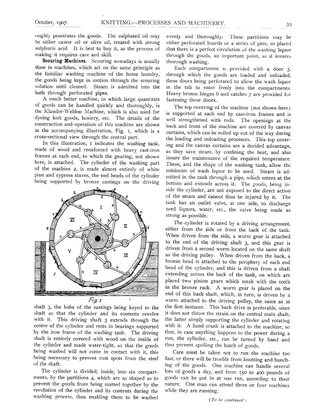
An installment from Posselt's Textile Journal (October 1907) on preparing knitted goods such as hosiery and underwear for market. It discusses design and finishing details, trimmings, seams, sorting, folding and packing, then turns to washing, scouring and bleaching cotton knit goods, including caustic soda and soda carbonate boiling procedures and sulphated oil pretreatment. It ends with a description of the Klauder-Weldon cylinder washing and dyeing machine, illustrated by a cross-section figure, and is marked to be continued.
Broken Steep Twills
Article · 3 pages · weaving drafts
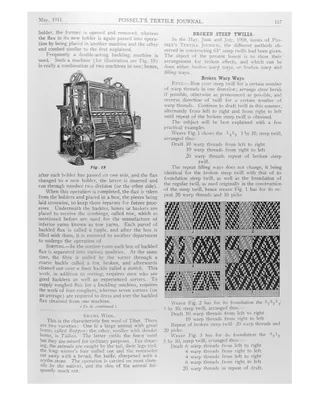
A May 1911 Posselt's Textile Journal lesson on constructing broken steep twills from 63-degree steep twill foundations. It gives the rule for reversing the twill direction at set thread counts, first broken warp ways and then broken warp and filling ways, with worked examples (Figs. 1-9) giving drafting sequences and repeat sizes. It also explains how dot and circle marks can soften the cut line across the filling. The pages also include the end of an installment on flax hackling and sorting, a short note on Tibetan shawl wool, and part of an article on the influence of yarn twist on fabrics.
Broken Twills
Article · 1 page · weaving drafts
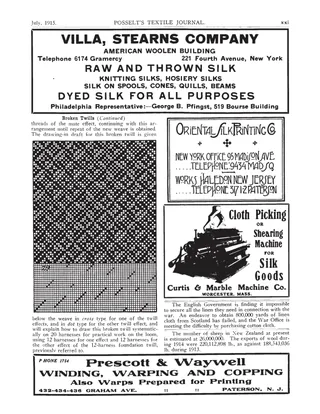
A single continued page of E. A. Posselt's "Broken Twills" from Posselt's Textile Journal, July 1915. It finishes explaining a broken twill built on a 12-harness foundation twill, with a large drawdown and a drawing-in draft marked in cross and dot type for the two twill effects, for working on 20 harnesses. The page is shared with advertisements and short news items on linen and cotton cloth for the English war effort and New Zealand wool exports.
Broken Twills
Article · 1 page · weaving drafts
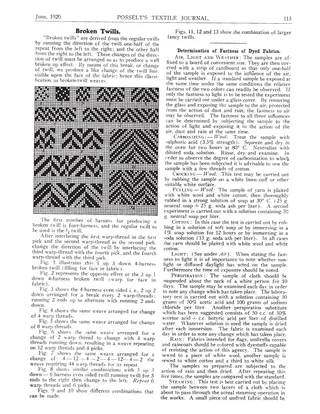
A one-page article from Posselt's Textile Journal explaining broken twills, which are derived from regular twills by reversing the twill direction partway through the repeat so the twill line breaks up. It starts with the 4-harness 1/3 broken twill and works through Figs. 1-13, including 2/2 and 3/3 even-sided twills with breaks every 2, 4 or 8 threads, and larger fancy combinations, illustrated with a drawdown grid. The page also begins a separate piece on testing the fastness of dyed fabrics to air, light, weather, carbonizing, crocking, fulling, perspiration, rain and steaming.
A Chinese Professor's Contribution to Scientific Sericulture
Article · 2 pages
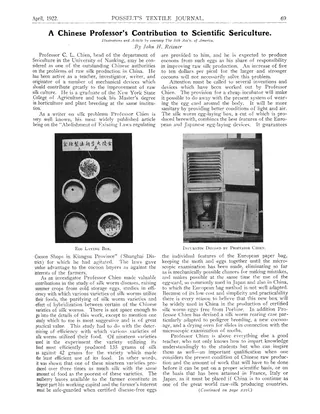
A 1922 article by John H. Reisner profiling Professor C. L. Chien, head of the sericulture department at the University of Nanking, and his work on raw silk production in China. It covers his research on silkworm diseases, feeding efficiency of nineteen silkworm varieties, and breeding, and describes his inventions: a cheap incubator, an egg-laying box for disease-free eggs, a rearing case, a cocoonage and a slide-drying oven. Two photographs show the egg-laying box and incubator; the article concludes on the second page with remarks on extension work among Chinese farmers.
Chronological Events in the Textile Industry
Article · 2 pages
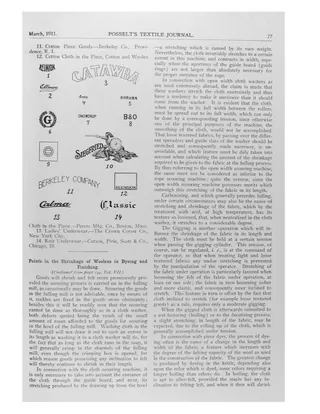
Two pages from the March 1911 issue of Posselt's Textile Journal. The first carries the continuation of a chronology of textile history (entries for 1606 to 1638, covering carpets, silk culture, the stocking frame, tapestry at Mortlake, cotton in Virginia, and the first fulling mill in Massachusetts), preceded by the end of an article on antiseptics in sizing. The second page has the end of a list of trademarks and labels and a continuation of an article on how woolens shrink and stretch during scouring, carbonizing, gigging and dyeing.
Chronological Events in the Textile Industry
Article · 2 pages
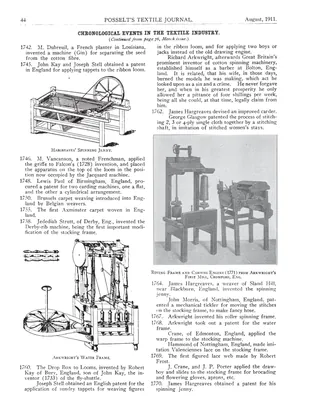
Installment of a chronological list of textile industry inventions and events from 1742 to 1783, published in Posselt's Textile Journal, August 1911, and continued from the March issue. Entries cover cotton gins, ribbon looms, carding machines, the spinning jenny, Arkwright's water frame, Crompton's mule, Almond's hand loom, power loom attempts, stocking frames, lace machines, and early American mills. Illustrations show Hargreaves' jenny, Arkwright's water frame, a roving frame and carding engine, Almond's loom, and Crompton's mule. A short unrelated note on removing nap from cotton yarns with konnyaku before mercerising ends the second page.
Chronological Events in the Textile Industry
Article · 2 pages
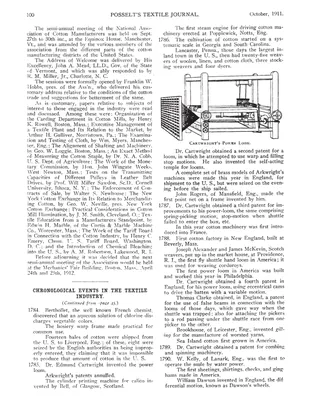
Two pages from Posselt's Textile Journal, October 1911. The main item is an installment of a chronology of textile industry events for 1784-1792, covering inventions such as Cartwright's power loom patents, Arkwright's patents, early cotton mills and looms in America, and cylinder printing. The pages also contain a description of the Globe Machine & Foundry Co. spindle-driven beam warper for silk, and a short note on a German patent for printing a pattern on both sides of a fabric. The page opens with a report on the National Association of Cotton Manufacturers meeting.
Chronological Events in the Textile Industry
Article · 3 pages
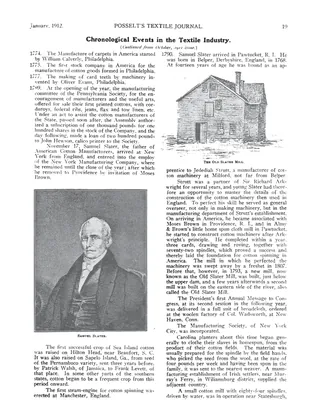
Installment of a serialized chronology of the textile industry, covering events from 1774 to the mid-1790s, mostly in the United States and England. It treats early American carpet, cotton, woolen and calico-printing enterprises, Samuel Slater's introduction of Arkwright-type cotton spinning at Pawtucket, Eli Whitney's cotton gin, and early cotton thread and stocking frames. Illustrated with portraits of Slater and Whitney, the Old Slater Mill, a model of the gin and a carding and spinning engraving. The last page carries a directory of textile trade marks registered in December 1911.
Chronological Events in the Textile Industry
Article · 2 pages
Two pages from the March 1911 issue of Posselt's Textile Journal. They carry the end of an article on sizing, covering antiseptics for size such as zinc chloride, formaldehyde and carbolic acid, followed by an installment of a chronology of textile industry events from 1606 to 1740. The chronology covers inventions like the stocking frame, fly shuttle and roller spinning, plus the start of carpet, lace, silk and calico industries. The pages end with a directory of textile trade marks registered in February 1911.
Chronological Textile Events
Article · 2 pages
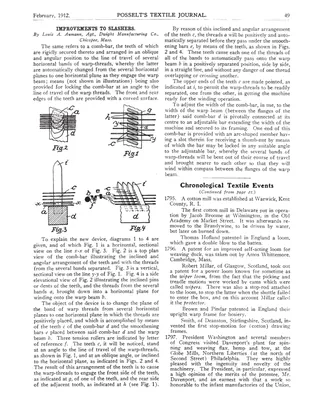
Two pages from the February 1912 issue of Posselt's Textile Journal. The main item is an installment of a chronology of textile history covering 1795 to 1801, with entries on cotton mills in the United States and Europe, power looms and other patents, Samuel Slater's mills, Merino sheep imports and early carding machinery. The pages also include a short article by Louis A. Aumann on a slasher comb-bar that spreads several bands of warp threads into one plane for winding on the warp beam, illustrated with four diagrams, and a brief note on waterproofing fabrics with copper sulphate and soap.
Chronological Textile Events
Article · 2 pages
A two-page excerpt from the February 1911 issue of Posselt's Textile Journal. It opens with short trade news items on Chinese and Japanese cotton competition, the Russian and Egyptian cotton crops, and British fire tests for flannelette. It then begins a chronology of textile history from 5000 B.C. to 1605 A.D. (to be continued), covering silk, wool, cotton, linen, lace, knitting and weaving guilds. The second page also starts a technical article on cotton carding and fly frame management, covering spindle speeds, creel bobbins and machine cleaning.
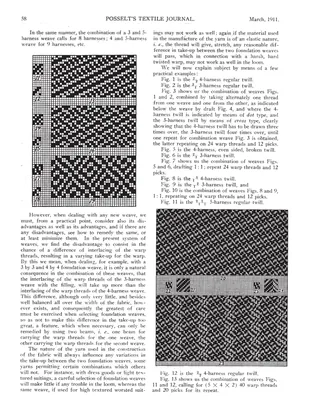
Chronological Textile Events
Article · 3 pages · weaving drafts
Three pages from Posselt's Textile Journal, March 1911, covering two textile-design instruction pieces. The first explains how to combine two foundation weaves of different repeats, drafting warp threads alternately, to produce large-repeat effect weaves that need few harnesses, with worked calculations of repeat size and harness count and Figs. 1-25 combining twills, broken twills and corkscrews. The second, a continuation of the Fabric Analysis series, covers picking out samples with one warp system and two filling systems (face and back picks) and begins on double cloth.
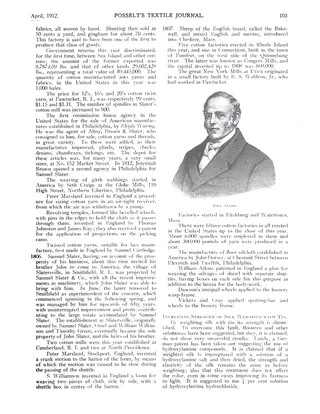
Chronological Textile Events
Article · 2 pages
Two pages from the April 1912 issue of Posselt's Textile Journal (pp. 102-103). They open with the end of a piece on cotton root galls and root rot (Ozonium), then continue the serial chronology of textile events with entries for 1803 to 1807 on early American cotton and woolen mills, Samuel and John Slater, carding and spinning machinery, and English loom and hosiery inventions. A short item on increasing the strength of tin-weighted silk follows.
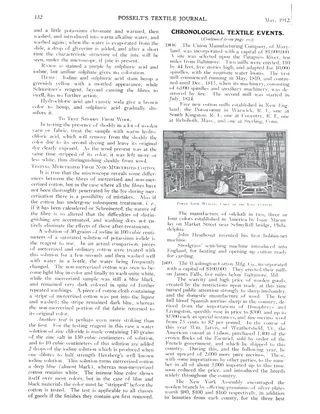
Chronological Textile Events
Article · 2 pages
Two pages from Posselt's Textile Journal, May 1912, with the installment of "Chronological Textile Events" covering 1808-1809. It lists the founding of American cotton and woolen mills, merino sheep imports, early power loom and calico printing developments, patents, and British lace-machine inventions by Heathcoat and Kirkland. The pages also hold the end of an article on chemical tests for fibers (jute, ramie, hemp, shoddy, mercerized cotton) and a warp-calculation example from Posselt's "Textile Calculations".
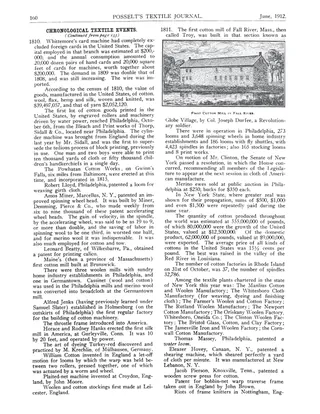
Chronological Textile Events
Article · 2 pages
Two pages from Posselt's Textile Journal, June 1912, continuing a chronology of textile events with entries for 1810 and 1811, mostly about the United States and England. Entries cover mills, patents, cotton printing, merino sheep, production statistics and Samuel Slater's expansion. The pages also include a directory of textile trade marks registered in May 1912 and the start of F. Polleyn's article on treating cotton fabrics with alkaline lye and dilute sulphuric acid.
Chronological Textile Events
Article · 2 pages
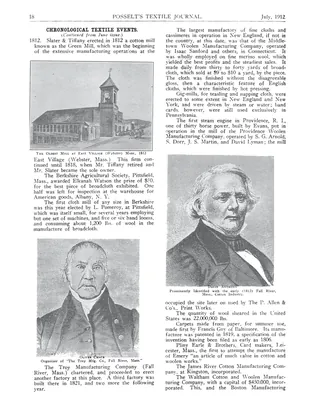
A two-page installment of a serial chronology of textile history from Posselt's Textile Journal, July 1912, covering events of 1812. It records American mill foundings and incorporations in Massachusetts, Rhode Island, Connecticut and New York, loom patents (Thorp, Shepherd, Sizer, Webb, Lee), wool production figures, and British developments such as Crompton's grant and the Nottingham riots. Illustrated with portraits and engravings of early mills and John Thorp's hand and power loom. A short note defining crochet cotton follows.
Chronological Textile Events
Article · 3 pages
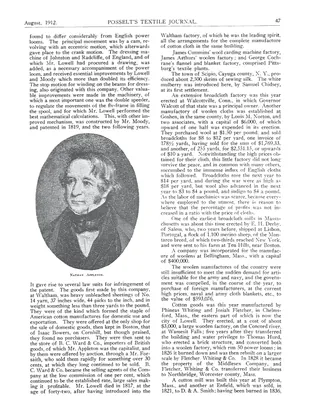
Three pages from the August 1912 issue of Posselt's Textile Journal. The main piece is an installment of a chronological history of textile events, covering 1813 in the United States: the Boston Manufacturing Company and its Waltham cotton mill with the power loom (Francis C. Lowell, Nathan Appleton, Patrick Tracy Jackson, Paul Moody), plus woolen, cotton, silk and carding enterprises and patents of that year. The pages also carry the end of an article on roller cloth and roller leather for spinning machinery, and the start of a 'Ring Frame' notes section on spindle power consumption and band tension.
Chronological Textile Events
Article · 1 page
A single page from Posselt's Textile Journal (September 1912) continuing a chronology of textile industry events, here covering 1814 in the United States. It records mills founded or chartered (silk at Gurleyville, Conn.; cotton at Fishkill, N.Y.; woolen at Lexington, Ky.; several in Massachusetts), William Gillmour's introduction of power loom patterns and the Bramah hydrostatic press, cotton yarn prices, and a calico color patent. A second item gives a table of Chemnitz textile exports to the United States for April-June 1911 and 1912, covering gloves, hosiery, trimmings, machinery and other goods.
Chronological Textile Events
Article · 2 pages
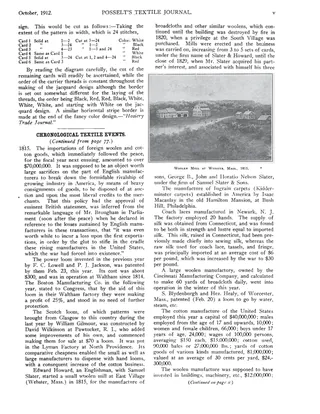
Two pages from the October 1912 issue of Posselt's Textile Journal. They carry the 1815 installment of a serialized chronology of textile events, covering American cotton and woolen manufacture, the power loom patented by Lowell and Jackson, the Scotch loom, tariff petitions and mill statistics. The first page opens with the end of a jacquard card-cutting note for a hosiery pattern, with a table of card cuts and colors. Advertisements for a Globe spindle driven ball warper and F. G. Lentz & Co. card stamping and harness building appear as well.
Chronological Textile Events
Article · 3 pages
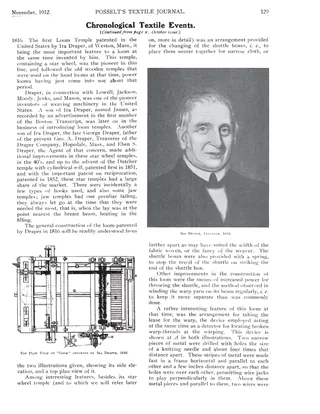
Installment of Posselt's "Chronological Textile Events" from the November 1912 issue, covering 1816. It describes in detail Ira Draper's 1816 loom and his patented star wheel temple, including the warp lease and broken-thread detector, the sizing rollers, the brush and the shuttle box arrangements. It then lists other 1816 textile events, such as power loom and loom reed patents, British lace and knitting inventions, and Jefferson's statement on domestic manufactures. Illustrated with a portrait of Draper and engravings of the loom and temple.
Chronological Textile Events
Article · 1 page
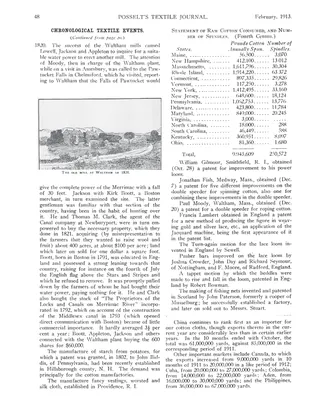
One page from the serialized 'Chronological Textile Events' column in Posselt's Textile Journal, covering the year 1820. It describes the founding of the Lowell mill site at Pawtucket Falls on the Merrimac by Jackson, Appleton, Moody and Kirk Boott, and includes an engraving of the old mill at Waltham. It also has a table of raw cotton consumed and spindles by state from the Fourth Census, a list of textile patents (power loom, double speeder, Jacquard lace figuring, lace loom improvements, tappet motion, fishing nets), and notes on 1912 US cotton cloth exports.
Chronological Textile Events
Article · 1 page
A single page from Posselt's Textile Journal, April 1913, continuing a chronology of textile events with entries for 1820 and 1821, mostly American. It covers mill foundings (Merrimac Manufacturing Co. at Lowell, Great Falls Manufacturing Co., Wolcott Woolen Manufactory), machinery patents (Paul Moody, John Brown, Ross Winans, Stephen Wilson's Jacquard card-punching apparatus), and cotton crop and price figures. A short news item reports Charles Cheney's election as president of the Silk Association of America.
Chronological Textile events
Article · 2 pages
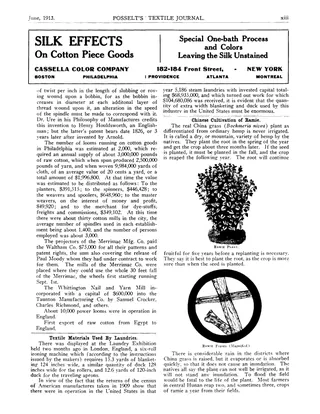
Two pages from Posselt's Textile Journal continuing a 'Chronological Textile Events' column, covering 1822 and 1823. Entries record American and British cotton mills, early power looms, sail cloth, lace, stocking machines, jute spinning, and Aza Arnold's differential motion patent. Two short items follow: textile materials used by laundries (blanketing and duck for ironing machines) and Chinese cultivation of ramie, with illustrations of a ramie plant and magnified fibres.
Clay Twills
Article · 2 pages · weaving drafts
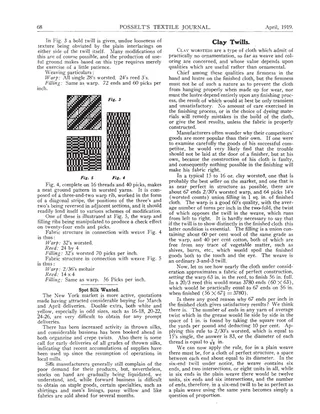
Two pages from Posselt's Textile Journal, April 1919, on the construction of clay worsted twill cloth. The article works out how many ends and picks per inch give a well-built 3-and-3 six-end twill, using yarn diameters, a proportion rule for twill versus plain weave, and a 60° warp bend angle to account for lustre. The first page also gives weave diagrams (Figs. 3-5) with fabric particulars for a bold twill and two 3-and-2 warp rib patterns. Two short silk market news items (spot silk, broad silk orders) share the pages.
Color Effects
Article · 1 page · weaving drafts
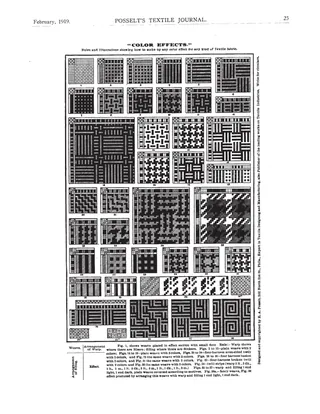
A single-page installment of Posselt's "Color Effects" series from Posselt's Textile Journal, February 1919, giving rules and 38 numbered illustrations of how color arrangements in warp and filling combine with weave to produce color effects. Examples cover plain weave in 2 and 3 colors, four-harness even-sided twill, four-harness basket, broken twill, a twill stripe, and a fancy weave. The rule given is that warp color shows where there are risers and filling color where there are sinkers.
Color Effects
Article · 1 page · weaving drafts
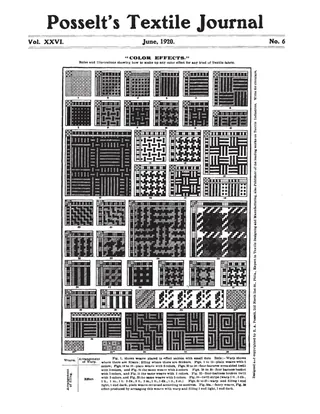
A one-page plate from Posselt's Textile Journal giving rules and illustrations for working out color-and-weave effects in textile fabrics. Figures 1 to 38a show how warp and filling color arrangements combine with plain weave, four-harness even-sided twill, basket weave, broken twill and a twill stripe, using two or three colors. The text explains that warp color shows where there are risers and filling color where there are sinkers.
Combining Two Systems of Filling with One Kind of Warp for Increasing the Bulk of the Fabric
Article · 3 pages · weaving drafts
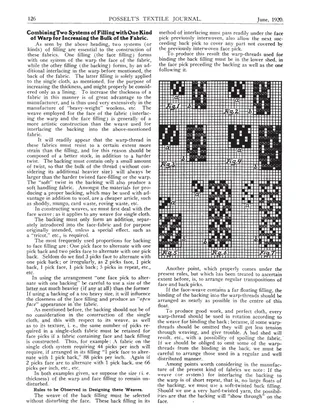
An instructional article from Posselt's Textile Journal (June 1920) on designing single-cloth fabrics that combine a face filling and a backing filling with one warp to add thickness, mainly for heavy woolens. It covers picking ratios (1 face:1 back, 2:1, 3:1), yarn twist and size for the backing, rules for binding the back picks, and the effect on texture and finishing. Thirteen figures show weave drawdowns for twill and satin faces with their back weaves, with repeat sizes given, and the later figures show double-cloth type structures with stitching. The scan also includes short trade news items on silk, cotton and hosiery.
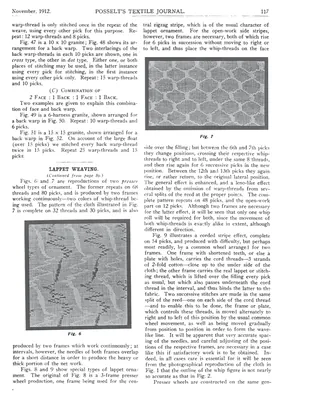
Combining Two Systems of Warp with One System of Filling
Article · 2 pages
Two journal pages from the November 1912 issue of Posselt's Textile Journal. The first finishes a discussion of combining face and back warps on granite weaves (6-harness and 10 x 10 and 15 x 15 granites, with repeats given). It then continues a series on lappet weaving, describing presser-wheel ornaments with whip threads, multi-frame effects, a corded stripe, and how presser wheels are constructed. The second page ends with an excerpt on defective shedding by Thomas Roberts, covering how troughing the shed affects cover and twill appearance.
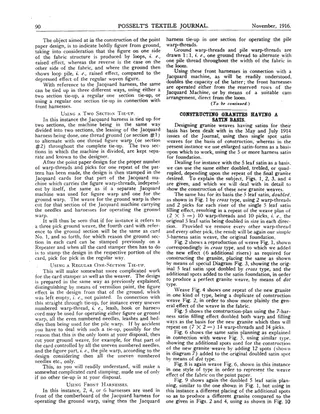
Constructing Granite Having a Satin Basis
Article · 2 pages · weaving drafts
A 1916 article from Posselt's Textile Journal on designing granite weaves built on enlarged satin foundations (5- and 7-harness satins doubled or tripled), with point-paper construction diagrams (Figs. 1-17) showing how extra risers are added to the satin spots. The scan opens with the end of a piece on Jacquard tie-ups (two-section, one-section, front harnesses) for pile fabrics, and page 2 also carries a short note on a new peroxide bleaching process and the start of a series on dyeing cotton and silk with logwood.
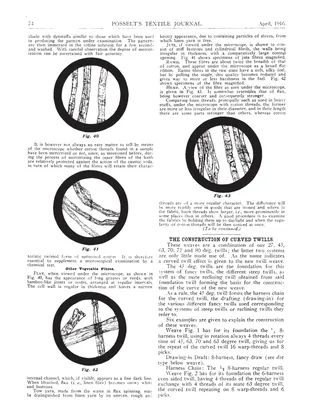
The Construction of Curved Twills
Article · 2 pages · weaving drafts
A two-page article from Posselt's Textile Journal (April 1916) explaining how curved twills are constructed by combining 27, 45, 63, 70 and 75 degree twills over a 45 degree foundation twill. Six examples (Figs. 1-6) give fancy drawing-in drafts, harness chains and repeat sizes on 5-, 6-, 8- and 10-harness twills, including broken curved twills, with a drawdown for Fig. 6. The first page also carries the end of a preceding article on microscopic identification of flax, jute, ramie and hemp fibres and the detection of mercerized cotton. A design for a grass rug from the Waite Grass Carpet Co. of Oshkosh, Wisconsin, appears at the end.
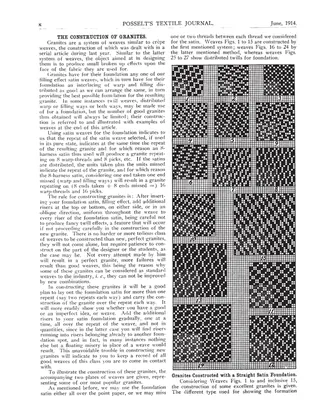
The Construction of Granites
Article · 2 pages · weaving drafts
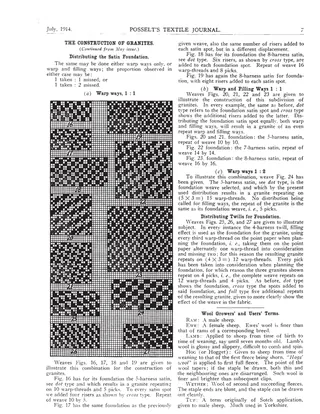
Part of a serial article by E. A. Posselt explaining how granite weaves (small broken-up effects similar to crepe weaves) are constructed from filling-effect satin foundations. It gives the rule of adding risers to each foundation satin point, advice on avoiding twill effects, and describes a plate of weaves, Figs. 1 to 15, built on 8- to 16-harness satins. The scan also includes two unrelated short pieces on finishing and sizing cotton and linen cleaning and dusting cloths and on New Jersey's woolen and worsted industry statistics for 1913.
The Construction of Granites
Article · 1 page · weaving drafts
A single page from Posselt's Textile Journal, continuing a series on constructing granite weaves. It explains how to build granites by distributing a satin foundation warp-ways or warp-and-filling-ways (1:1 and 1:2 proportions) and by distributing twills as a foundation, with weave draft Figs. 16-27 showing foundation spots (dot type) and added risers (cross type). The page also includes a short glossary of wool growers' and users' terms (ram, ewe, lamb, hog, wether, tup).
Construction of Skip Twills
Article · 1 page
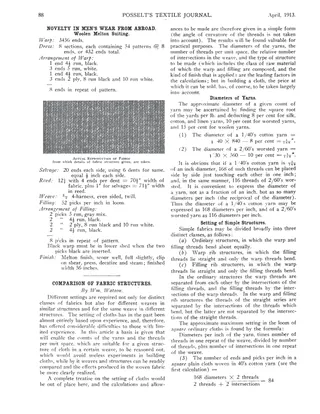
A single page from Posselt's Textile Journal (April 1913) with two items. The first is a fabric specification for a woolen melton men's suiting: warp and filling arrangement, reed, 4-harness even-sided twill weave, picks per inch, and finishing. The second is the start of Wm. Watson's article on comparing fabric structures, covering yarn diameters and the setting of simple cloths (ordinary, warp rib and filling rib structures). It includes a photograph of the fabric sample but no weaving drafts.
Construction of Skip Twills
Article · 2 pages · weaving drafts
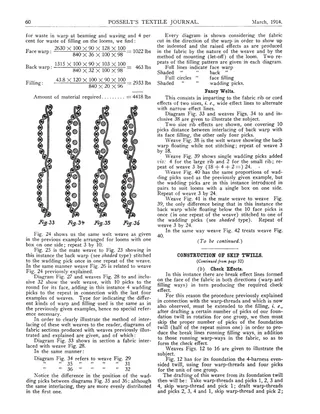
Two pages from a continuing series in Posselt's Textile Journal on the construction of skip twills. The check-effects section explains how to draft skip twills from 4-, 6- and 10-harness even-sided foundation twills, skipping ends and picks to make break lines in both warp and filling directions (Figs. 12-16). Fig. 16 is worked out as a broken-effect skip twill of 78 ends, with its construction draft. The first page also ends an installment on welt weaves, with wadding picks, fancy welts and fabric-section diagrams (Figs. 24-42) and a material-quantity calculation. The second page closes with a short note on cotton spinning in Japan.
Construction of Skip Twills
Article · 2 pages · weaving drafts
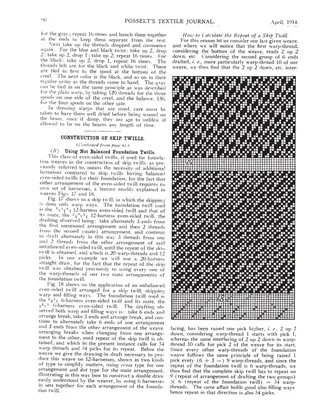
Continuation of E. A. Posselt's article on constructing skip twills, covering skip twills built on unbalanced (not balanced) even-sided foundation twills. It explains Figs. 17 and 18, with 12-harness and 6-harness foundation twills, the drafting alternating groups of ends, and the double-draw drawing-in draft on 12 harnesses. A section explains how to calculate the repeat of a skip twill, with a worked example giving 54 warp threads and 54 picks. The second page has short items on improvements to shuttles and loom pickers and a note on a new Egyptian cotton variety.
Construction of Skip twills
Article · 2 pages · weaving drafts
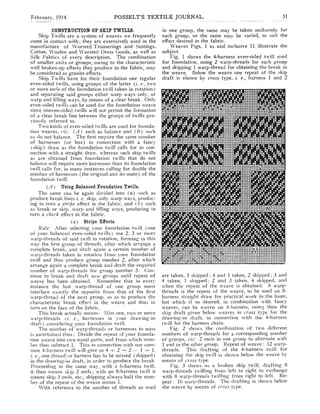
Part of a serial article from Posselt's Textile Journal explaining how skip twills are constructed from even-sided foundation twills. It gives the rule for choosing groups of warp threads and for working out how many harnesses to skip, and describes Figs. 1-11 (4-, 6- and 10-harness foundations, with stripe effects, alternating group sizes and broken skip twills). The second page also begins a separate article on Jacquard point-paper designing, with a diagram of the straight-through tie-up of a 400 Jacquard machine.
Construction of Weaves for Novelties
Article · 1 page · weaving drafts
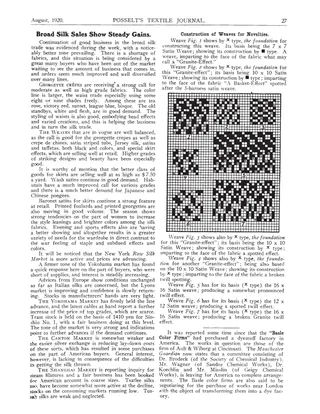
A one-page article from Posselt's Textile Journal, August 1920, describing seven weave constructions for novelty fabrics. Each is built on a satin base (7x7, 10x10, 12x12 or 16x16) to give granite, basket, spotted or broken twill effects, with a drawdown for Fig. 2. The page also carries a trade report on broad silk sales and raw silk markets, plus a short note on Basle dye firms buying a U.S. dyestuff factory.
A Convenient Color Table
Article · 2 pages
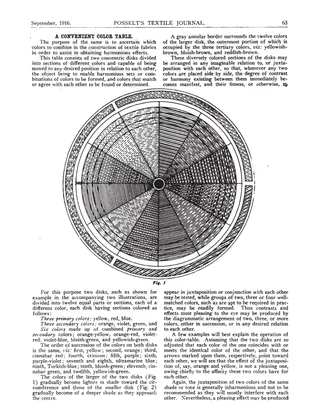
A short article from Posselt's Textile Journal, September 1916, describing a color table made of two concentric rotating disks divided into twelve colored sections. It explains how to turn the disks to find harmonious combinations of two, three, or more colors for textile fabrics, and how shades of one color can be paired. Two disk diagrams (Figs. 1 and 2) accompany the text.
Corkscrew Twills
Article · 2 pages · weaving drafts
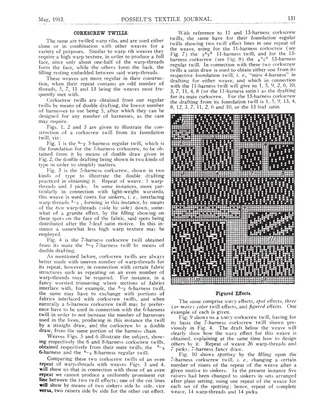
An article from Posselt's Textile Journal explaining corkscrew twills, which are twilled warp ribs made from regular twills by double drafting. It covers 5, 6, 7, 8, 11 and 13-harness examples and their drafting orders, then shows wavy, spot, three-color and figured corkscrew effects (Figs. 9-12) with a page of weave diagrams. The scan also includes the start of an unrelated article on faults in dyeing and how to correct them, including stripping and re-dyeing of vegetable fibres, wool and silk.
Cotton Manufacturing, Part 1
Book · 227 pages
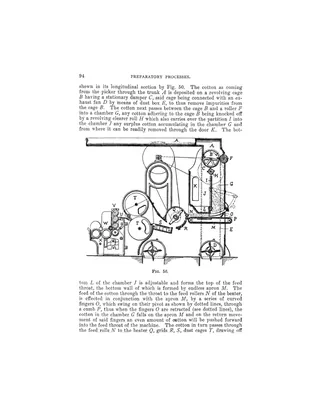
Part 1 of E. A. Posselt's multi-volume treatise on cotton manufacturing, covering the cotton fibre and its manufacture into yarn up to and including carding. It covers cotton botany, origin and history, diseases and pests, ginning and baling, and the preparatory processes: bale breaking, mixing, pickers, cleaning trunks and scutchers. The final section covers carding, including the revolving flat card, clothing, grinding and stripping, drives, and production calculations. It has many engraved machine diagrams, American and English machinery, and period advertisements for textile machinery makers at front and back.
Cotton Manufacturing, Part 2
Book · 337 pages
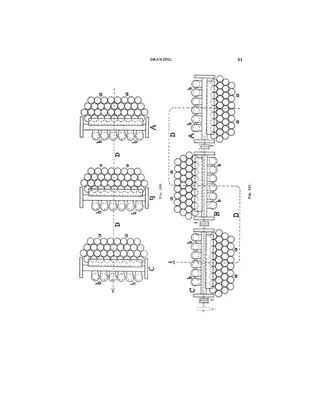
Part 2 of E. A. Posselt's technical treatise on cotton manufacturing, covering the machines that follow carding: combing, drawing, roller covering and fly frames (slubbers, intermediate and roving frames). It describes the sliver lap and ribbon lap machines, Heilmann, Nasmith and Duplex combers, drawing frames from several makers, and the construction and weighting of drawing rolls. It also covers leather roller covering, differential and builder motions, and gearing. Worked calculations for draft, production, twist and gear changes are included, with many line diagrams of machine mechanisms. The volume opens and closes with advertisements from textile machinery makers.
679 documents found