Textile Documents › Topic: Simple looms: backstrap, frame, and rigid heddle
248 documents found
Sort: 
Frame Loominations - Texture
Article · 1 page
A one-page column by Mary Temple in the 'Frame Loominations' series that considers what the word 'texture' means in weaving. She quotes Webster's definition and then lists words and phrases offered by weavers in her texturing workshops, such as tactile, nubby, lumpy, and 'regular irregularity', and invites readers to add their own. The page also carries the Minnesota Weaver staff list.
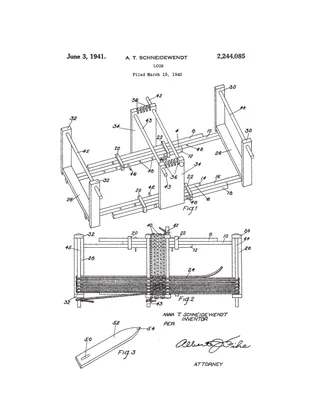
Loom, US Patent No. 2244085
Patent · 3 pages
US Patent 2,244,085, granted June 3, 1941 to Anna T. Schneidewendt of Chicago, for a hand-operated frame loom whose warp length can be adjusted by sliding strips bolted together. The woof is looped through slots in upright supports and the warp is carried around pins at the ends with a needle. The patent text describes the construction, the weaving procedure and two claims, and the loom is intended for schools and for weaving mops. The first page has the patent drawings (Figs. 1-3, including the needle).
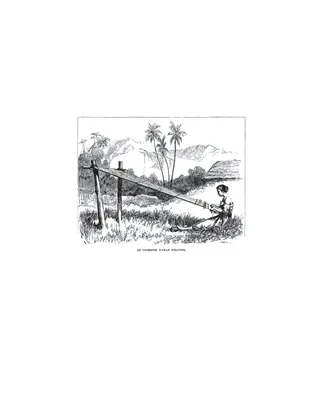
Ygorrote Woman Weaving
Illustration · 1 page
A single engraved illustration captioned "An Ygorrote Woman Weaving," showing a seated woman at a backstrap-style loom stretched between two upright posts. The setting includes palm trees, a thatched hut, and mountains. It was published in Harper's New Monthly in 1876 and documents Philippine (Igorot) weaving practice as seen by a 19th-century Western audience.
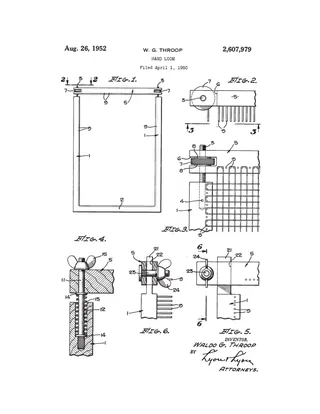
Hand Loom, US Patent No. 2607979
Patent · 3 pages
US Patent 2,607,979, granted to Waldo G. Throop of Pasadena, California, for a hand loom of the square or rectangular pin-frame type. The loom has an adjustable top rail that compensates for the shortening of the yarn strands as weaving progresses, so the frame can be much larger than the traditional six to eight inch pin looms. Three variants are described: screw collar adjustment, spring-loaded automatic adjustment, and a tongue-and-slot clamp. The patent includes six drawings, a description, six claims, and a list of references cited.
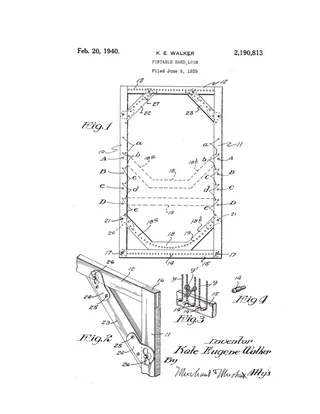
Portable Hand Loom, US Patent No. 2190813
Patent · 4 pages
US Patent No. 2,190,813, granted 20 February 1940 to Kate Eugene Walker of Oklahoma City, for a portable peg loom for hobby weaving of rugs. A wooden rectangular frame carries rows of pegs on its upper and lower bars. The lower bar can be moved to change the rug length, and removable angular and corner peg-carrying members allow oval or round rugs. The text covers the specification, the four figures described in the text, and five claims; the rugs are made by tying knots between adjacent strands wound on the pegs.
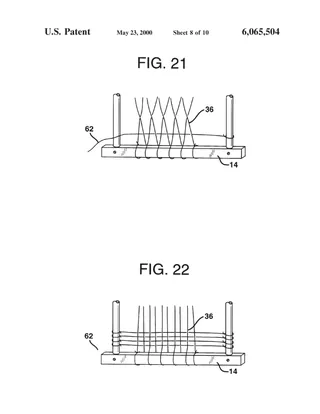
Portable Looms, US Patent No. 6065504
Patent · 16 pages
US Patent 6,065,504, granted May 23, 2000 to Micala Sidore of Northampton, Massachusetts, for a portable loom. The loom has a header, a bottom frame member and removable hollow side supports with threaded rods and abutment nuts for adjusting warp tension. Dowels fitted in the frame let the weaver make string heddles on site. The scan includes the USPTO web text of the patent, the title page, ten sheets of drawings (Figs. 1-26) and the printed specification and three claims. The drawings show assembly, heddle making, securing the pendant heddle bar and warp spacing, and rolling up a partly woven tapestry for transport.
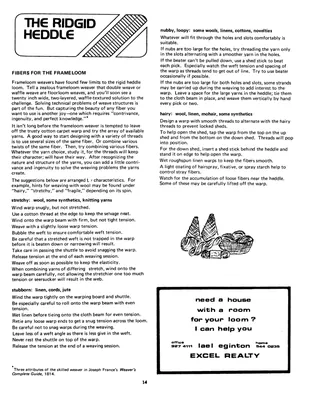
The Rigid Heddle - Fibers for the Frameloom
Article · 2 pages
A two-page column from the Minnesota Weaver's "Rigid Heddle" series by Gloria Rither on choosing and handling different yarns on rigid heddle (frame) looms. Yarns are grouped by character (stretchy, stubborn, nubby or loopy, hairy, fragile, thin, heavy or lumpy, wiry), with practical tips on warp tension, sleying, beating, and winding on. The pages include local advertisements and no weaving drafts.
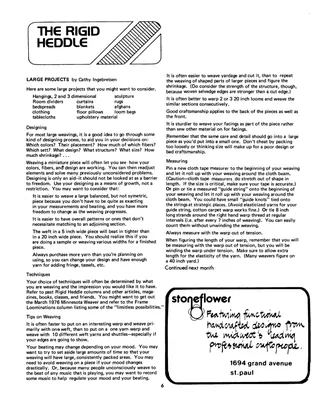
The Rigid Heddle - Large Projects
Article · 1 page
A one-page column from the Rigid Heddle series in Minnesota Weaver offering advice on planning and weaving large projects on a rigid heddle loom. It lists project ideas such as hangings, rugs, blankets and clothing, and gives guidance on designing with small samples, choosing techniques, weaving tips, and measuring progress and warp length. The article ends with "Continued next month".
Adjustable Loom, US Patent No. 3996969
Patent · 10 pages
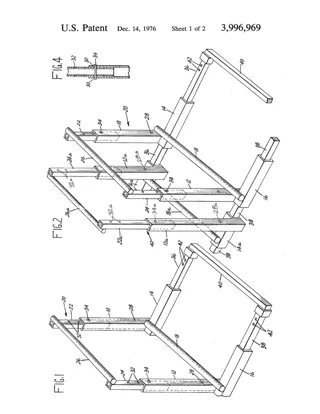
US Patent 3,996,969 for an adjustable frame loom intended for Navajo-type weaving, granted to George W. McCullough, Henrietta Tragitt McCullough and Timothy E. Doyle of Indiana. The loom has hollow uprights and legs, a telescoping upper frame held by pins at selectable heights, and a stabilizing frame that slides into the legs and can be removed for use as a warping frame. A second upright frame can be added for two-layer weaving. The scan includes the USPTO database printout (abstract, claims, description), the patent's front page, drawing sheets (FIGS. 1-6) and the printed patent text.
Frame Loominations-Rigid Heddle Loom
Article · 1 page
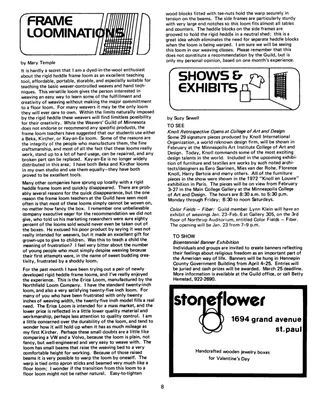
Mary Temple's column from the Minnesota Weaver argues for the rigid heddle frame loom as an affordable, portable teaching loom. She names the brands the Weavers' Guild of Minnesota frame loom teachers suggest (Beka, Kircher, Kay-an-Ee) and criticizes poorly made looms sold as gifts for children. She then gives a personal review of the new Erica Loom from the Northfield Loom Company, in 20-inch and 25-inch widths. The page also carries a separate Shows & Exhibits column by Suzy Sewell.
Garments- Another Jacket for Frame Loom Weavers
Article · 1 page
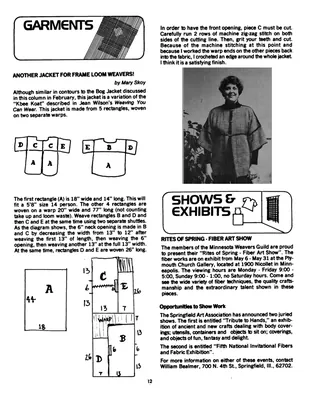
A short Minnesota Weaver column by Mary Skoy describing a jacket for frame loom weavers, a variation of the "Kbee Koat" from Jean Wilson's Weaving You Can Wear. The jacket is made from five woven rectangles on two warps, with dimensions, a neck opening, and a cut front opening finished with machine stitching and a crocheted edge. Line diagrams show the pieces and cutting layout. The page also carries notices for a Minnesota Weavers Guild fiber art show and two juried exhibition calls.
Loom, US Patent No. 3867965
Patent · 6 pages
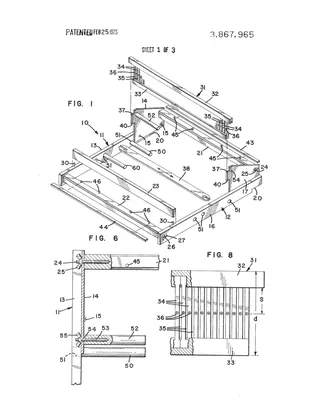
US Patent 3,867,965, granted Feb. 25, 1975 to James E. Hanson of Anoka, Minnesota, assigned to Trend Development Corporation. It describes a small hobby loom for table or lap use that can be set up for tabby weaving with a rigid heddle or for inkle weaving with string heddles. The side assemblies hold the rigid heddle in both up-shed and down-shed positions, leaving both hands free for the shuttle. The patent includes the abstract, three sheets of drawings, a description of warping and use, and four claims.
The Rigid Heddle - Pickup Weaves
Article · 2 pages
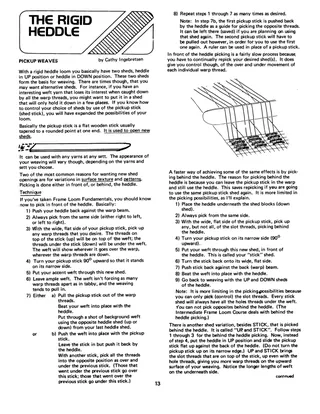
A two-page newsletter article explaining how to use a pickup stick (shed stick) on a rigid heddle loom to create extra sheds. It gives step-by-step instructions for picking in front of the heddle and behind the heddle, including the "stick" and "up and stick" sheds. It also covers surface texture, designing pickup patterns on graph paper, uses such as borders and sampling, and a short reference list of books.
Scenes et Types. – Femme tissant au Bali [Scenes and Types. – Woman Weaving in Bali]
Ephemera · 1 page · French
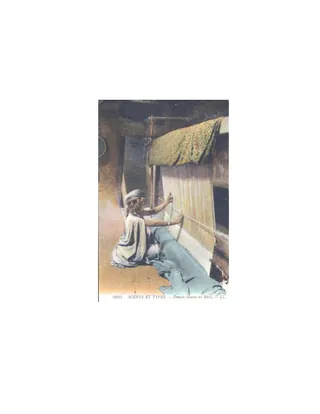
A hand-colored photographic postcard showing a woman seated at a vertical loom, weaving a patterned textile. Warp threads hang from the beam and finished cloth is draped over the top bar. The printed caption is in French, in the series "Scenes et Types", and the card is numbered 8083.
Studies in Primitive Looms
Article · 44 pages · weaving drafts
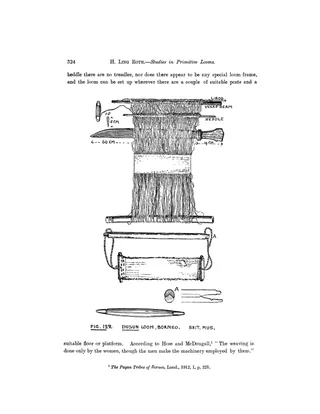
Part III of H. Ling Roth's comparative study of primitive looms, covering Indonesian looms (Dusun, Iban/Sea Dyak, Ilanun, Igorot, Bugis, Malay, Javanese, Cambodian) and the related Bhotiya, Korean, Santa Cruz and Caroline Islands looms. It describes loom parts such as warp beams, laze rods, heddles, sword beaters-in, temples, spools and reeds, with museum specimen dimensions, thread counts and comparison tables. Roth traces the evolution of the reed from a pegged warp spacer, discusses the migration of the Santa Cruz loom across the Pacific, and notes ritual practices tied to weaving. Numerous line drawings and a migration map accompany the text.
Tobeka Road: Local Loom Manufacturer
Article · 2 pages
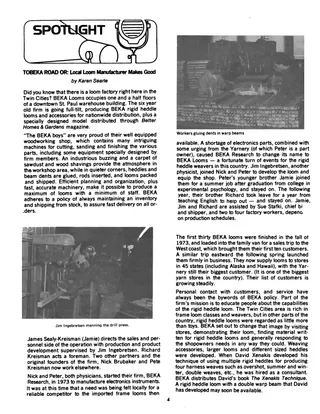
A profile of BEKA Looms, a St. Paul, Minnesota firm that manufactures rigid heddle looms and accessories for nationwide distribution. It covers the company's origins in 1973 as BEKA Research, its partners, its shop and production methods, and its customer education efforts, including a travelling workshop van and a planned Rigid Heddle Weaving Conference. It also mentions the Better Homes & Gardens loom, David Xenakis's multiple-heddle technique, and plans for a floor loom.
Camp Girls Response to Card Weaving
Article · 5 pages
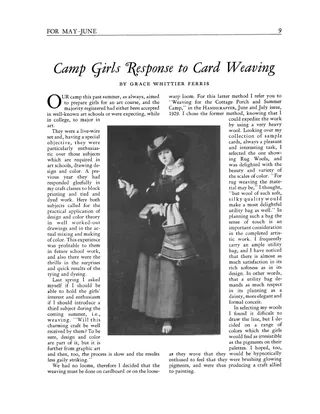
Grace Whittier Ferris describes teaching card weaving to girls at an art-preparatory summer camp, where weaving was done on cardboard cards without looms. She gives practical instructions for making the card loom (cutting, scoring, and punching the board, warping with handspun wool over cords, folding and tying) and for weaving a utility bag in tapestry technique with rug wool. She also covers design, color choice, the slit tapestry method, finishing, lining, and cords, with photographs of finished bags.
Frame Loominations
Article · 1 page
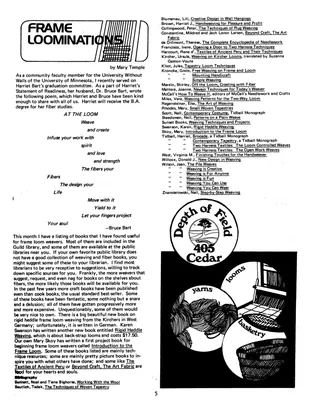
A column from the Minnesota Weaver by Mary Temple on frame loom weaving. It opens with a poem, "At the Loom," by Bruce Bart, written for his wife Harriet Bart's University of Minnesota fiber studies degree. Temple then comments on weaving books available through the Guild library and public libraries, mentioning new titles on rigid heddle and frame loom weaving. The column ends with a bibliography of about 40 titles on frame loom weaving, tapestry, rugs, two-harness weaving and fiber art.
Handweaving News (February 1944): Weaving on the Hearthside Loom
Periodical · 2 pages
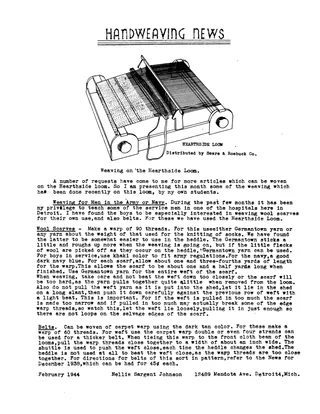
A two-page February 1944 issue of Handweaving News by Nellie Sargent Johnson, devoted to projects for the Hearthside loom, a small heddle-based loom sold through Sears & Roebuck. It gives instructions for wool scarves and belts for servicemen, notes the switch from a plastic to a metal heddle, and explains how to beat the weft close. It also includes a warping order for a striped rug woven with looped stockings and directions for a draw string bag.
Handweaving News (June 1944): Primitive or Picture Frame Loom
Periodical · 3 pages
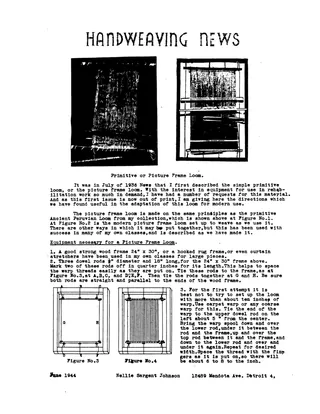
A 1944 Handweaving News article by Nellie Sargent Johnson giving step-by-step directions for building and warping a primitive (picture frame) loom, adapted for modern use and rehabilitation work. It covers the frame and dowel rods, winding and spacing the warp, setting up shed sticks and a heddle rod with looped cord heddles, and weaving plain weave (tabby). It closes with advice on keeping edges straight and a note on the loom's possibilities, including tapestry, knot techniques, brocading, gauze weave and twills. Illustrated with photographs and numbered line diagrams.
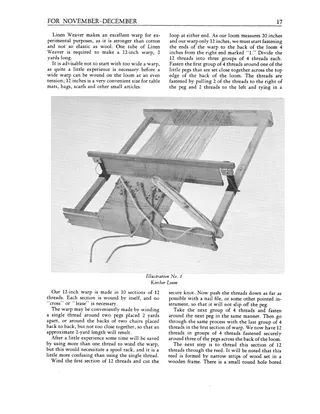
Handweaving on Loom Frames, The Kircher Loom
Article · 6 pages
Part Two of Cecelia Cleveland Willard's four-part series on handweaving on loom frames, devoted to the Kircher loom, a small German-made hardwood frame loom with a reed that raises both sheds and serves as a beater. It gives directions for assembling the loom, making and winding a 12-inch linen warp, threading the reed, and weaving plain (tabby) weave. It also covers a striped and patterned border on a luncheon mat in two colors, advancing the warp, and fixing common errors such as threading mistakes and doubled weft. A short note at the end describes a traveling exhibit of bag weaving assembled by Mrs. Nellie S. Johnson of Detroit.
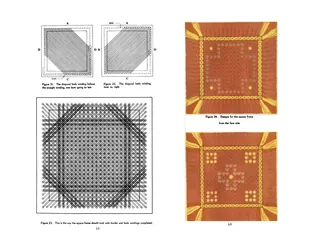
Honeycomb Weaving
Chicago Parks District, 1936
Monograph · 11 pages
Instruction manual from the Chicago Park District's Modern Recreation Series (1936) on honeycomb weaving, a recreational craft in which mercerized cotton thread is wound around nails on a wooden frame, tied at the intersections, and worked with spider-web rosette designs to make mats, pillow covers and centerpieces. It covers winding and tying on hexagonal frames, then on square and oblong frames, and how to remove the finished work. It ends with bills of materials and construction drawings for making the frames.
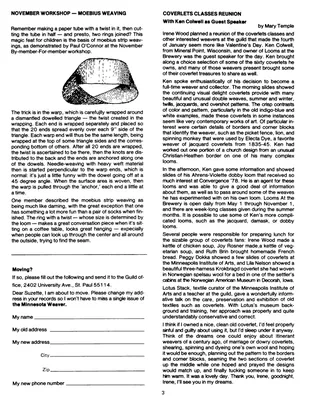
Moebius Weaving
Minnesota Weaver, February 1979
Article · 1 page
A single page from the Minnesota Weaver (February 1979) with two items. The first reports on a November guild workshop where Paul O'Connor demonstrated moebius strip weaving: a twisted warp wrapped around a dowelled triangular frame, then needle-woven with heavy weft. The second, by Mary Temple, reports on a coverlet classes reunion with guest speaker Ken Colwell, who showed slides of coverlets and his dobby loom, plus a talk on the care and preservation of old textiles.
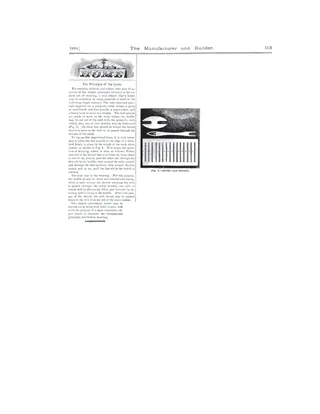
The Principle of the Loom
Manufacturer and Builder, 1890
Article · 1 page
A short 1890 article giving instructions for building a simple model loom from household materials to teach children the basic principles of weaving. It uses two pencils as warp beams, a cardboard heddle with slits, and card shuttles, with a book as a weight. It explains warping, raising and lowering the heddle to open the shed, passing the weft, and beating it with a paper-cutter.
The Ridgid Heddle- Finishing
Article · 2 pages
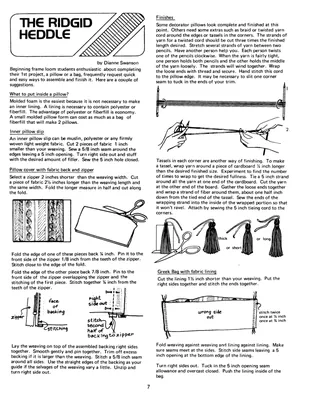
A short article from the Minnesota Weaver on assembling and finishing projects woven on a rigid heddle or frame loom. It covers pillow fillings, an inner pillow slip, a zippered fabric-backed pillow cover, twisted cord and tassel trims, and a lined Greek bag with a cord or braid handle. It closes with two book recommendations. The scan's second page also carries unrelated Weavers Guild newsletter items: a Guild and Science Museum of Minnesota class program, an educational coordinator's statistical report for 1975-76, and a report on a color and design workshop.
The Rigid Heddle - Large Projects Part 2
Minnesota Weaver, April 1977
Article · 1 page
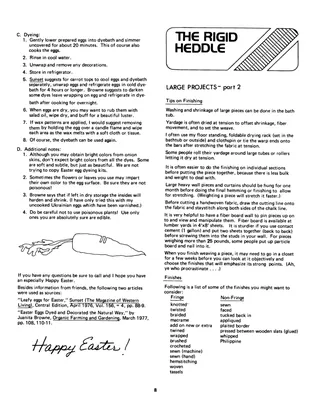
A single page from the Minnesota Weaver (April 1977) with the second part of a rigid heddle series on large projects, focused on finishing. It gives tips on washing, drying at tension, hanging heavy pieces, staystitching before cutting, and using a fiber board wall, then lists fringe and non-fringe finishes. The top of the page carries the end of an unrelated article on dyeing Easter eggs with natural materials such as onion skins and carrot tops.
The Rigid Heddle - Warp Variations on the Frame Loom
Article · 1 page
A one-page article on varying warp arrangement for rigid heddle weaving on the frame loom to add texture, pattern, and visual depth. It covers sampling with paper strips and wrapped cardboard, color choices, suitable yarns, and warp spacing and added threads for lacy, ribbed, or windowpane effects. It ends with a short list of reference books.
Weaving Block Patterns on the Daga and Kircher Looms
Article · 6 pages
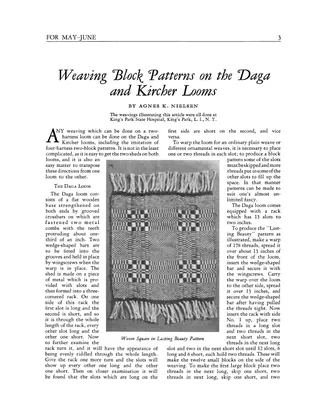
A 1932 Handicrafter article by Agnes K. Nielsen explaining how to weave two-block patterns on two small frame looms, the Daga (slotted metal rack) and the Kircher (wooden reed with pegged warp boards). It gives written warping and weaving instructions for patterns including Lasting Beauty, Four O'Clock, Pattern No. 1 and No. 2, Queen's Patch, Sugar Loaf (Window Sash) and Monk's Belt, using two shuttles in a dark and light alternation. Photographs show the finished squares and runners, which were woven at King's Park State Hospital, and the materials used are noted (carpet warp, perle cotton, novelty yarn, rayon).
Card Loom Weaving
Monograph · 16 pages
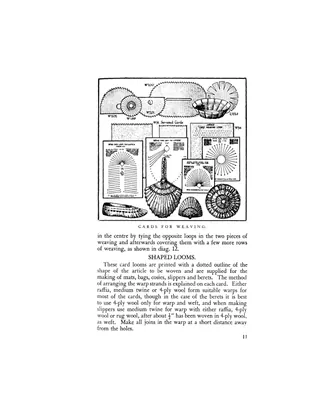
Dryad Leaflet No. 100 gives instructions for weaving on cardboard card looms, aimed at teachers and children in infant and junior classes. It covers basketry foundations, straight serrated cards, and shaped cards for mats, tea cosies, bags, berets and slippers. It explains warping methods, tapestry versus tabby weave, joining threads, removing work from the card, and finishing with felt linings, handles and sewing uppers to soles. Diagrams and photographs show the loom preparation and finished articles.
Frame Loominations
Article · 1 page
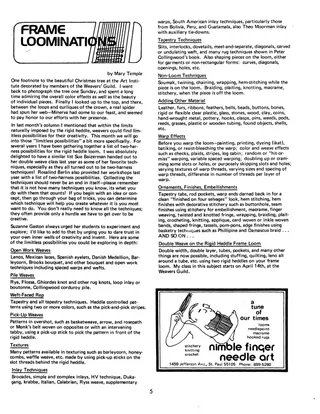
A column from the Minnesota Weaver on creative possibilities for the two-harness rigid heddle frame loom. Mary Temple lists categories of techniques, including open work weaves, pile weaves, weft-faced rep, pick-up weaves, texture patterns, inlay, tapestry, non-loom techniques, added materials, warp effects, and finishes. She closes with double weave using two rigid heddles and announces her class on the subject at the Weavers Guild. A small advertisement for a St. Paul needle art shop appears on the page.
Hand-Weaving on Two-Way Looms
Monograph · 16 pages
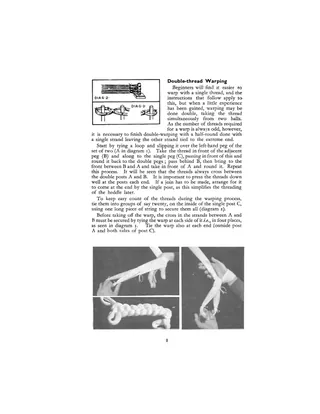
A Dryad Handicrafts leaflet introducing hand-weaving on two-way looms, where a heddle makes two sheds. It explains plain (tabby) weave, colour and texture variations, picked-out patterns and suitable yarns. It gives instructions for using a simple braid loom, warping with posts, chaining and mounting a warp on roller looms, and describes several Dryad models (W36, W38, W213, W204) and the Scottish inkle loom (W224).
How to Learn to Weave on a Lezur Loom
Cromaine Crafts, 1939
Other · 8 pages · weaving drafts
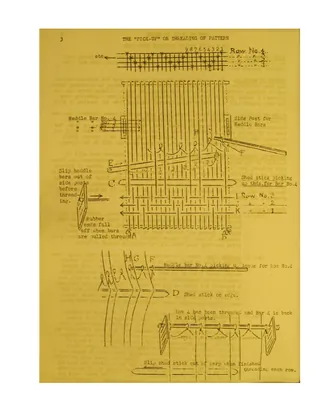
An instruction booklet from Cromaine Crafts of Hartland, Michigan, for the Lezur patent portable hand loom, a small frame loom with four heddle bars. It names the loom parts, then covers warp calculation, winding and tightening the warp, and picking up the threads onto heddle bars from a cross-notation pattern. It also explains weaving plain weave, pattern weave and the two combined, with the Rose-Path pattern as the worked example. The last page is a price list of threads and loom accessories sold by the company.
How to Weave on the Inkle Loom
Monograph · 12 pages · weaving drafts
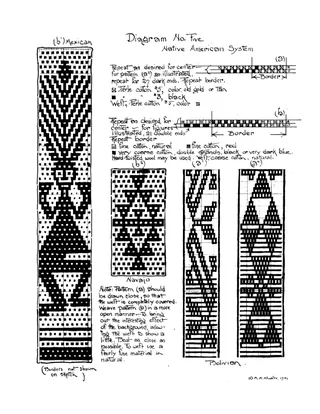
A 1941 instruction pamphlet by Mary Meigs Atwater of the Shuttle-Craft Guild on weaving narrow bands on the inkle loom. It describes the Old English and the table-model New American looms, how to warp them, and how to open the two sheds. It then covers plain-weave warp-faced patterns, pick-up patterns by the Scandinavian/European threading, and the native American system (Navajo, Mexican, Bolivian, Philippine). Six numbered diagrams give color-order drafts, threadings and pattern figures, with photographs of sample bands.
How to Weave Useful Novelties
Monograph · 32 pages
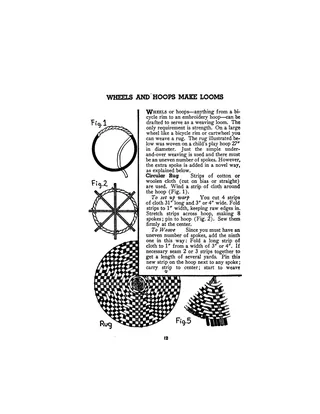
A 1938 booklet of step-by-step instructions for amateur weavers making useful novelties on simple and improvised looms. Projects include cardboard circles and rectangles, pin looms, hoops and wheels, the Weave-It square loom, an adjustable hand loom, a frame loom for rag rugs, and a small heddle loom for shuttle weaving a scarf. A final section covers novelty weaving on breadboards, dishcloths, cardboard forms and a lampshade frame, using materials such as cellophane, crepe paper raffia, passe-partout and ribbon. Includes a glossary of weaving terms, a materials guide and illustrated diagrams.
Instructions for the Use of the "Hearthside" Loom
Monograph · 7 pages
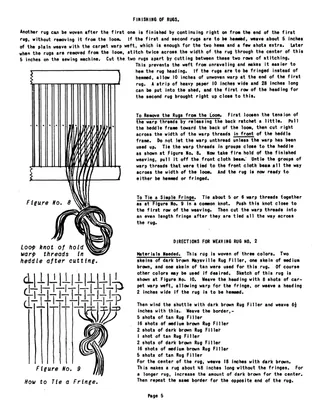
An instruction leaflet by Nellie Sargent Johnson for the "Hearthside" loom, a small portable frame loom about 27 inches wide with a heddle frame that serves as harness and beater. It names the loom's parts, covers choosing yarns and preparing rag or stocking weft, and explains tensioning the warp, winding a shuttle, weaving plain weave, adding new weft and rolling up the cloth. It gives step-by-step directions for three rugs (a blue border rug, a brown and tan rug, and a blue and white arrow-head rug with twisted wefts), plus finishing by hemming or fringing and suggestions for other items to weave.
Loom from Iquitos
Article · 3 pages
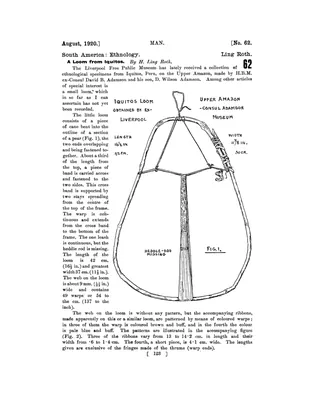
A short note in Man (August 1920, no. 62) describing a small pear-shaped cane loom from Iquitos, Peru, collected by ex-Consul David B. Adamson for the Liverpool Free Public Museum. Roth gives its dimensions, warp count and construction (cross band, two stays, continuous leash, missing heddle rod), and describes four accompanying warp-patterned ribbons or wrist-bands and four pot-whorl spindles. Adamson's notes on local weaving and ornament are included, with a comparison to similar looms in British Guiana and in Farabee's Central Arawaks. Figures show the loom, the ribbons and the spindle whorls.
Primitive and Antique Looms
Article · 3 pages
Extracts from a 1918 club lecture comparing primitive and antique looms from many cultures. It describes South Sea Islander, Alaskan, ancient Greek, Egyptian, Navajo, Zuni and Hopi, Indian hill tribe, Peruvian, tapestry (Gobelin and Beauvais), Chinese, and Colonial/Swedish looms. It emphasizes how the basic warp and weft principle carries through to complex heddle and pedal looms.
Studies in Primitive Looms
Article · 26 pages · weaving drafts
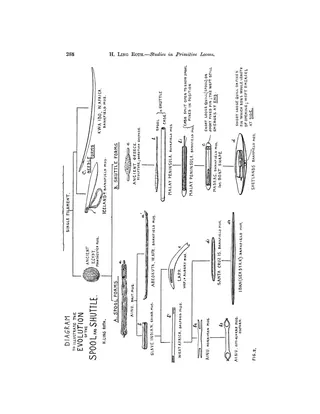
H. Ling Roth's 1916 anthropological article on primitive looms, from the Journal of the Royal Anthropological Institute. It defines loom terms (warp, weft, shed, heddle, lease rods, warp spacer, reed) and traces the evolution of the spool and shuttle. It then describes the Ainu backstrap loom in detail from museum specimens, and surveys looms from North and South America (Slave Indian quill belt loom, Hopi, Kachiquel, Uitoto, Peruvian, Apache, and a Mazatec gauze loom). The article is illustrated with many line drawings of loom parts, tools and warp layouts, and includes a plate of the Mazatec loom.
Studies in Primitive Looms
Article · 39 pages · weaving drafts
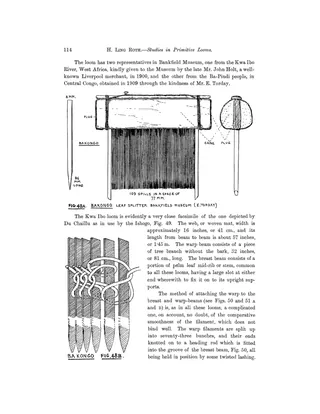
Part II of H. Ling Roth's series on primitive looms, covering African looms. He identifies seven forms: vertical mat loom, horizontal fixed heddle loom, vertical cotton loom, horizontal narrow band treadle loom, pit treadle loom, Mediterranean or Asiatic treadle loom, and the "carton" loom. The text describes museum specimens (Bankfield, Liverpool, Glasgow, Edinburgh, Brighton, British Museum) from Kwa Ibo, Ba-Pindi, Old Calabar, Madagascar, Nyasaland, Abeokuta and Opobo, with dimensions, warp attachments, heddles, selvedges, needles, spools, reeds and shuttles. It has many line drawings and diagrams, including pattern-heddle and herring-bone rod threading diagrams for the vertical cotton loom. It ends with a tentative distribution map of loom types in Africa and discussion of their origins.
Weaving on the Inkle Loom
Article · 6 pages · weaving drafts
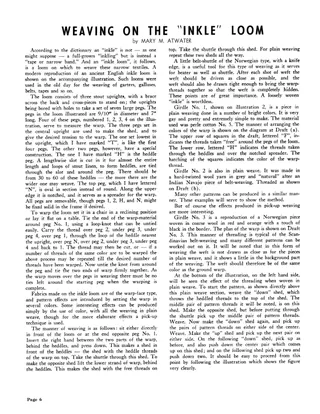
Mary Atwater describes the construction and use of the inkle loom, a peg loom for weaving narrow warp-faced bands such as belts and girdles. She explains how to warp the loom, make the sheds with heddle and free threads, and weave plain-weave color-striped bands. She also covers pick-up patterns in Scandinavian, South American, Navajo and Mexican styles. Nine sample girdles are described with their materials and colors, and warp threading drafts (a)-(e) are given. Photographs of the finished bands are included, and the article ends with finishing methods and other uses for the bands.
Looming Arts, Vol. 4, No. 6 (November-December 1969)
Looming Arts, November-December 1969
Periodical · 10 pages · weaving drafts
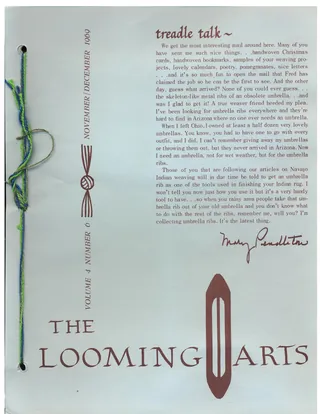
Issue of a small handweaving newsletter edited by Mary Pendleton of Sedona, Arizona. It includes a draft and directions for a tripled three-thread herringbone drapery fabric, an 8-harness rosepath project for weaving hearts and flowers, and part 3 of a series on setting up a Navajo rug loom, mounting the warp on dowels and attaching it to the frame. Other items cover pin weaving a collar, a guest article on weaving in occupational therapy, tips for tying fringe knots, and a report on the 1969 Handweavers International Festival in Las Vegas. Also included are studio news, a student project week, a calendar and advertisements.
Simplified Weaving with the Peacock 6-Inch Loom
Other · 4 pages
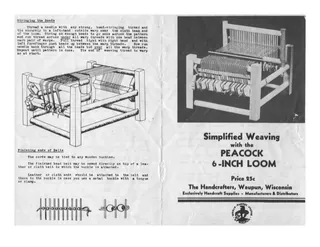
A four-page instruction leaflet for the Peacock 6-inch two-shed loom, sold by The Handcrafters of Waupun, Wisconsin. It covers loom parts, warp length and count, winding and tying the warp, threading the heddle-beater, and basic weaving with finishing and troubleshooting. It also gives sections on bead weaving (stringing beads and finishing belts), card weaving with a dozen punched cards, pattern ideas such as stripes, plaids and Navajo-style color changes, and suggested small projects.
Weave-It Book Number 7
Donas Products Corp, 1939
Monograph · 32 pages · weaving drafts
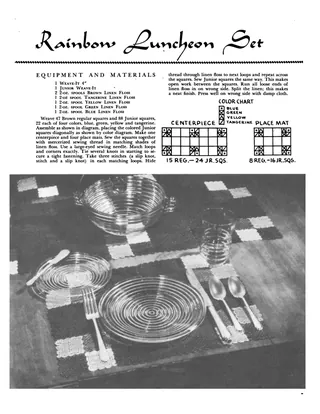
A 1939 pattern booklet from Donas Products Corp. with instructions for garments, afghans and household items made from small woven squares on the Weave-It pin loom. Each pattern lists equipment and yarn, the number of squares to weave, assembly diagrams with square counts, and sewing and finishing directions. Projects include dresses, sweaters, a cape, coats, a bed jacket, afghans, luncheon sets, a hand bag and a living room doily set. Brief square-weaving directions (diagonal stripe, fancy, fancy stripe, triple rib) are given for some patterns.
Weaving on the Hearthside Loom
Monograph · 17 pages · weaving drafts
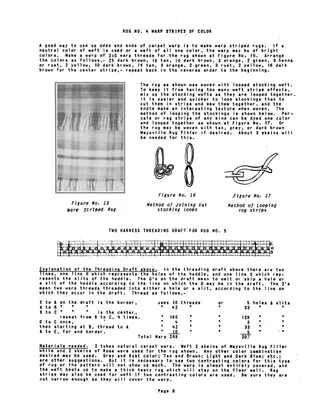
A 1942 instruction booklet by Nellie Sargent Johnson for owners of the "Hearthside" loom, a small plain-weave loom sold already warped by Sears & Roebuck. It explains how to make a new warp on chairs or a warping frame, thread the heddle, wind on, and weave. Projects include weft-striped and warp-striped rugs, a two-harness pattern rug, brocaded rug borders from Guatemalan textile patterns, a striped bag, open warp glass curtains, corn shuck place mats, and two-color warp place mats. Diagrams and photographs illustrate each step and project.
The Madmar-Bush Lap Loom
Other · 12 pages
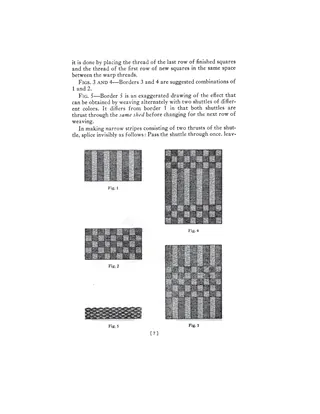
Instruction booklet for the Madmar-Bush Lap Loom, a small frame loom with a slotted heddle-beater, issued by Madmar Quality Co. of Utica, New York. It explains weaving terms, materials, assembling and stringing the loom, weaving technique, selvages, shaping, and removing work from the loom. Further sections cover color and simple striped and checked border designs, dyeing, weaving with silk stockings, cotton rag rugs woven as squares, preparing old yarn, and a project for a pleated zipper purse.
Studies in Primitive Looms
Article · 42 pages
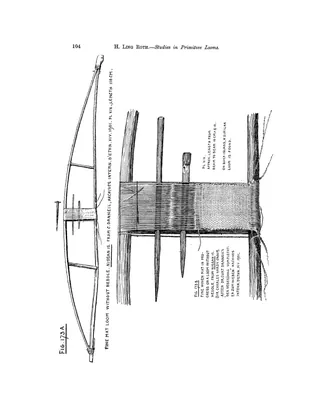
Concluding part (Part IV) of H. Ling Roth's series on primitive looms, from the Journal of the Royal Anthropological Institute, 1918. It describes and compares the Solomon Island (Nissan/Buka) frame loom, a Lapp braid loom with bone heddle, Norwegian and English rigid-heddle looms, Oriental vertical mat looms (Ceylon, Hong Kong, Ainu), upright and warp-weighted looms from classical sources (the Vatican Virgil, Braunius) and Egypto-Greek models, and Indian and Turkish rug looms. It also examines toothed beaters-in and bone combs from Mortlake, Kent's Cavern and Glastonbury, disputing their interpretation as weaving tools, and closes with a discussion of the origin and distribution of looms, arguing for independent invention in some cases. Illustrated with many line drawings of looms and tools.
Weaving with Small Appliances, Book I: The Weaving Board
Book · 93 pages · weaving drafts
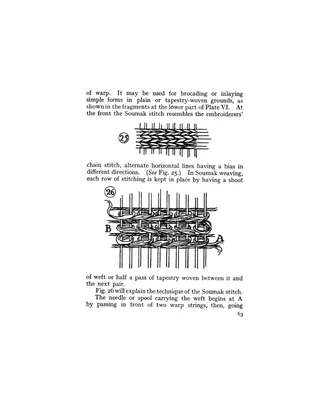
A 1922 instruction book by Luther Hooper on weaving with a simple board loom, intended for students and class teaching. It covers building and warping the loom, winding appliances, making leashes (heddles), plain tabby weaving, ornamental bands, brocading or inlay, tapestry weaving, Egyptian and Coptic mixed weaving, and Kelim, Soumak and knotted pile carpet effects. It ends with an upright tapestry table loom. It is illustrated with line figures, colored plates of woven samples, and design charts, and includes an index and publisher's advertisements.
Weben: Einführung in die Techniken des Handwebens [Weaving: Introduction to the Techniques of Hand Weaving]
Book · 79 pages · German · weaving drafts
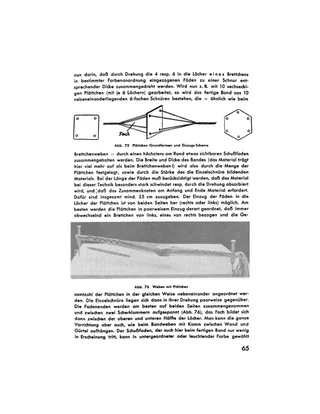
A German-language handbook introducing hand weaving to beginners, published by Otto Maier Verlag, Ravensburg. It covers basic weaving terms and a short account of weave structures (plain weave, rib, cannelé, twill, panama), then the available looms and frames (comb, heddle and shaft devices, table looms), materials, and warp calculation, warping and dressing the loom. Technique chapters treat rib, kelim, gobelin, Swedish technique, Smyrna knotting, noppen, plain weave, twill and rag weaving, followed by band weaving with comb and tablets, round weaving, tundeln and bead weaving. It also includes design guidelines, a short history of hand weaving, a table of things to weave, and advertisements for loom makers; the accompanying pattern sheets contain warping and weft plans.
Handbook of South American Indians, The Araucanians
Illustration · 3 pages
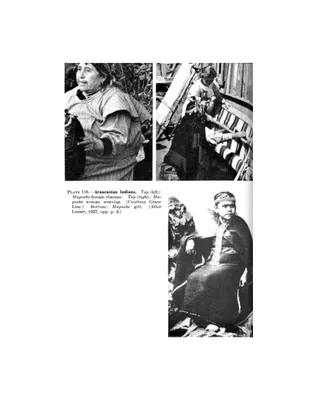
Extract of three pages from Handbook of South American Indians, Volume 2 (Bulletin 143, Bureau of American Ethnology, 1946), containing the volume title page, the heading of John M. Cooper's chapter on the Araucanians, and Plate 156. The plate shows black-and-white photographs of Mapuche (Araucanian) people, including a female shaman, a woman weaving, and a girl. Only the illustration is included, not the chapter text.
Handbook of South American Indians, Tribes of the Sierra Nevada de Santa Marta, Colombia
Illustration · 3 pages
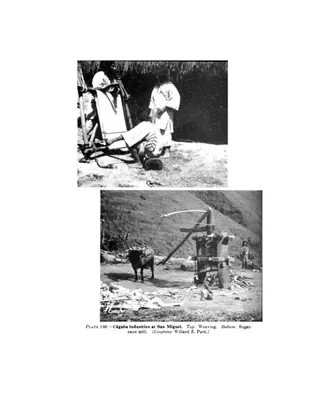
Excerpt of three pages from the Handbook of South American Indians (Bureau of American Ethnology Bulletin 143, Volume 2, The Andean Civilizations, 1946), containing the volume title page, the chapter heading for Willard Z. Park's 'Tribes of the Sierra Nevada de Santa Marta, Colombia', and Plate 180. The plate shows Cágaba (Kogi) industries at San Miguel: a woman weaving at a ground or backstrap loom, and a sugar-cane mill.
248 documents found