Textile Documents › Publications › Publication: Smithsonian Institution
14 documents found
Sort: 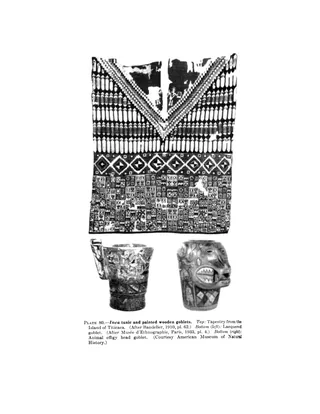
Handbook of South American Indians, Inca Culture at the Time of the Spanish Conquest
Illustration · 3 pages
Excerpt of three pages from John Howland Rowe's chapter 'Inca Culture at the Time of the Spanish Conquest' in the Handbook of South American Indians, Volume 2 (Bureau of American Ethnology Bulletin 143, 1946). It includes the volume title page, the chapter title page, and Plate 80, which shows an Inca tapestry tunic from the Island of Titicaca with bands of stylized figures and stepped and diamond motifs, along with painted wooden goblets.
Handbook of South American Indians, The Andean Highlands
Illustration · 4 pages
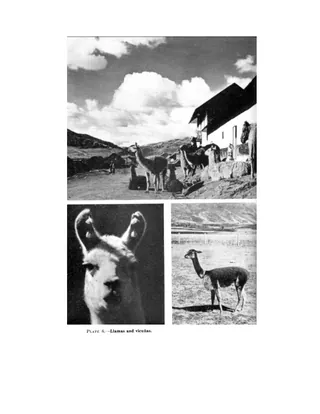
Four-page excerpt from Bureau of American Ethnology Bulletin 143, Handbook of South American Indians, Volume 2 (The Andean Civilizations), edited by Julian H. Steward. It includes the title page, the opening page of Wendell C. Bennett's introduction to the Andean Highlands, and two plates of photographs showing alpacas on the Bolivian puna and llamas and vicuñas. The excerpt is limited to the illustrations relevant to camelid fiber animals.
Handbook of South American Indians, The Araucanians
Illustration · 3 pages
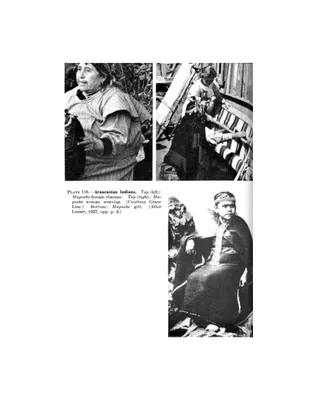
Extract of three pages from Handbook of South American Indians, Volume 2 (Bulletin 143, Bureau of American Ethnology, 1946), containing the volume title page, the heading of John M. Cooper's chapter on the Araucanians, and Plate 156. The plate shows black-and-white photographs of Mapuche (Araucanian) people, including a female shaman, a woman weaving, and a girl. Only the illustration is included, not the chapter text.
Handbook of South American Indians, The Archeology of the Central Andes
Illustration · 6 pages
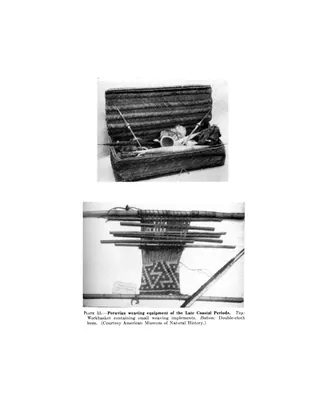
Extract of selected plates from Wendell C. Bennett's chapter on the archeology of the Central Andes in the Handbook of South American Indians, Volume 2 (Bulletin 143, Bureau of American Ethnology, 1946). It consists of a title page, a chapter heading page and four pages of textile photographs: Paracas Necropolis embroidered shawl and shirt, Coast Tiahuanaco embroidered fragment and velvet-technique hat, a double cloth detail and Middle Ica shirt, and Late Coastal Peruvian weaving equipment including a workbasket and a double-cloth loom.
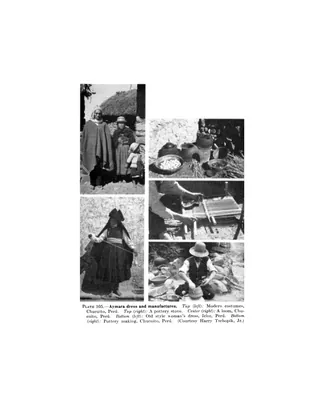
Handbook of South American Indians, The Aymara
Illustration · 3 pages
Excerpt from Bureau of American Ethnology Bulletin 143, Handbook of South American Indians, Volume 2 (The Andean Civilizations), edited by Julian H. Steward. It includes the volume title page, the opening page of Harry Tschopik Jr.'s chapter on the Aymara, and Plate 105 with five photographs of Aymara dress and manufactures. The plate shows modern and old-style costumes, a pottery stove, pottery making, and a loom, all from Chucuito and Ichu, Peru.
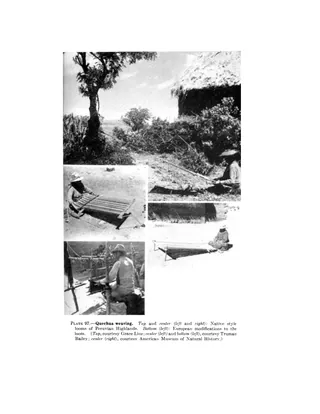
Handbook of South American Indians, The Contemporary Quechua
Illustration · 3 pages
Excerpt from Volume 2 (The Andean Civilizations) of the Handbook of South American Indians, Smithsonian Bureau of American Ethnology Bulletin 143, 1946. It contains the volume title page, the chapter heading for Bernard Mishkin's 'The Contemporary Quechua', and Plate 97 showing Quechua weaving. The plate shows native-style looms of the Peruvian Highlands and European modifications to the loom.
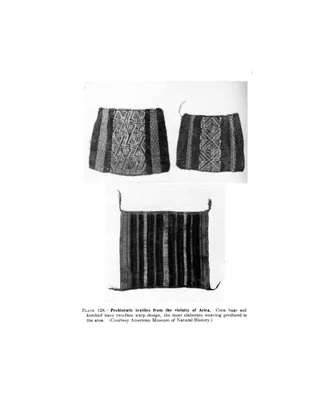
Handbook of South American Indians, The Cultural Sequence of the North Chilean Coast
Illustration · 4 pages
Excerpt from Bulletin 143 of the Smithsonian Bureau of American Ethnology, Handbook of South American Indians, Volume 2 (The Andean Civilizations), containing the title page and the opening of Junius B. Bird's chapter on the cultural sequence of the North Chilean coast. Only two plates of textiles are included: Plate 126 shows textiles from a child burial at Playa Miller, Arica, including a kerchief, meal bag, matting fragment and coca bag, and Plate 128 shows prehistoric coca bags and a kerchief from the Arica area with two-face warp designs.
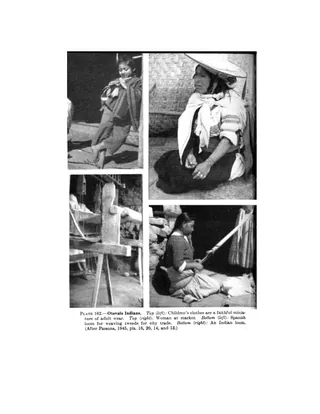
Handbook of South American Indians, The Highland Tribes of Souther Columbia
Illustration · 4 pages
Excerpt of four pages from Smithsonian Bureau of American Ethnology Bulletin 143, Handbook of South American Indians, Volume 2 (The Andean Civilizations), edited by Julian H. Steward. It includes the title page, the opening page of John Murra's chapter 'The Historic Tribes of Ecuador', and two plates of photographs of Otovalo Indians. The plates show children's clothing, a market woman, a Spanish treadle loom used for tweeds, an indigenous loom, and Cholo girls weaving rugs and blankets on an outdoor loom at Riobamba, Ecuador.
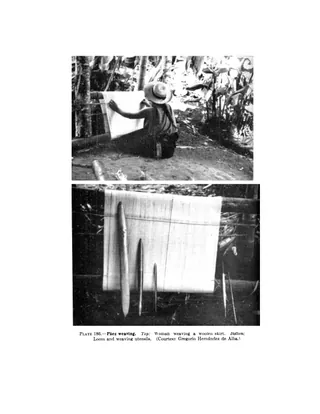
Handbook of South American Indians, The Historic Tribes of Ecuador
Illustration · 4 pages
A four-page excerpt of illustrations from Handbook of South American Indians, Volume 2 (The Andean Civilizations), Bureau of American Ethnology Bulletin 143, edited by Julian H. Steward. It includes the title page, the opening heading of Gregorio Hernández de Alba's chapter on the highland tribes of southern Colombia, and two plates showing Páez weaving and spinning. The plates show a woman weaving a woolen skirt on a backstrap-style loom, loom and weaving utensils, a woman spinning wool while walking in Tierradentro, and men weaving straw hats.
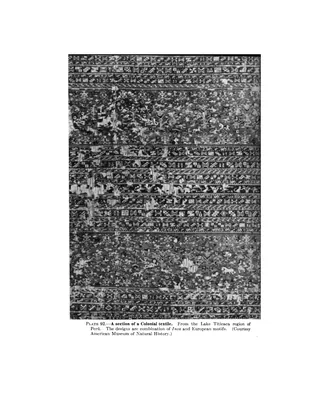
Handbook of South American Indians, The Quechua in the Colonial World
Illustration · 4 pages
A four-page extract from the Handbook of South American Indians, Volume 2 (Bulletin 143, Bureau of American Ethnology, 1946), containing the title page, the section heading for George Kubler's chapter on the Quechua in the colonial world, and two plates. Plate 91 shows a Colonial poncho from the Lake Titicaca region alongside a Cuzco School painting; Plate 92 shows a section of a Colonial textile from the same region combining Inca and European motifs. Useful for researchers of colonial Andean textile design.
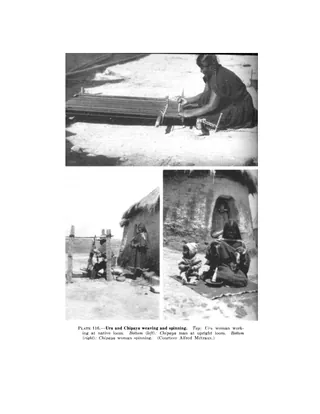
Handbook of South American Indians, The Uru-Chipaya
Illustration · 3 pages
Excerpt from the Smithsonian's Handbook of South American Indians, Volume 2 (Bureau of American Ethnology Bulletin 143, 1946), consisting of the volume title page, the heading of Weston La Barre's chapter on the Uru-Chipaya, and Plate 116. The plate shows photographs of an Uru woman at a native loom, a Chipaya man at an upright loom, and a Chipaya woman spinning. Only these illustrative pages are included, not the chapter text.
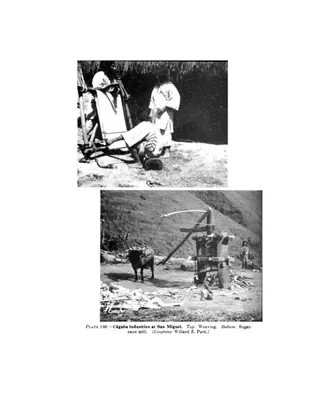
Handbook of South American Indians, Tribes of the Sierra Nevada de Santa Marta, Colombia
Illustration · 3 pages
Excerpt of three pages from the Handbook of South American Indians (Bureau of American Ethnology Bulletin 143, Volume 2, The Andean Civilizations, 1946), containing the volume title page, the chapter heading for Willard Z. Park's 'Tribes of the Sierra Nevada de Santa Marta, Colombia', and Plate 180. The plate shows Cágaba (Kogi) industries at San Miguel: a woman weaving at a ground or backstrap loom, and a sugar-cane mill.
The Loom and Spindle: Past, Present, and Future
Monograph · 61 pages · weaving drafts
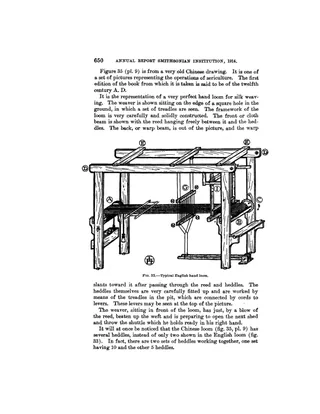
Reprint of Luther Hooper's three Canton Lectures on the history and mechanics of the spindle and the loom, given to the Royal Society of Arts in 1912 and reprinted in the Smithsonian Annual Report for 1914. It covers prehistoric, ancient and primitive looms and spindles (Swiss lake dwellers, Greek, Egyptian, African, Indian, Chinese), the development of spinning wheels and spinning machinery, and the loom's shedding motions, heddles and treadles. The later lectures treat the draw loom, the drawboy, the Jacquard machine, the fly shuttle and power looms. It has 11 plates and many line drawings, with a few simple drawdown and tie-up diagrams.
A Primitive Frame for Weaving Narrow Fabrics
Monograph · 35 pages
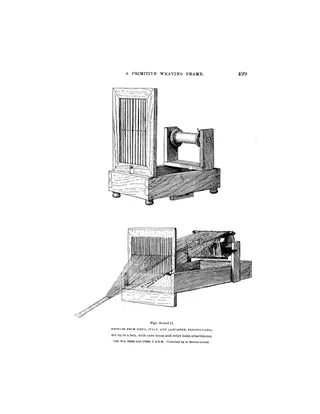
Otis T. Mason's 1901 Smithsonian monograph (reprinted from the Report of the U.S. National Museum) surveys the heddle frame, a hand-held or stationary device that forms the sheds when weaving narrow belts, garters and tapes. It describes specimens in the museum collection from the Chippewa, Masquakie and Pueblo/Zuni peoples, Finland, Germany, Italy, and New England and Pennsylvania. It also covers a patented hand-weaving apparatus and Pueblo battens. Each type is described with dimensions, materials, catalog numbers and method of use, and illustrated with line drawings and nine plates. It argues that the Native American frames derived from European settlers' folk craft.
14 documents found