Textile Documents › Authors › Author: Junius B. Bird
3 documents found
Sort: 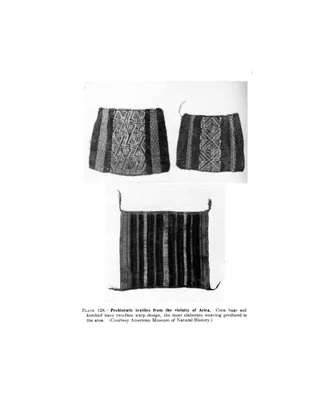
Handbook of South American Indians, The Cultural Sequence of the North Chilean Coast
Illustration · 4 pages
Excerpt from Bulletin 143 of the Smithsonian Bureau of American Ethnology, Handbook of South American Indians, Volume 2 (The Andean Civilizations), containing the title page and the opening of Junius B. Bird's chapter on the cultural sequence of the North Chilean coast. Only two plates of textiles are included: Plate 126 shows textiles from a child burial at Playa Miller, Arica, including a kerchief, meal bag, matting fragment and coca bag, and Plate 128 shows prehistoric coca bags and a kerchief from the Arica area with two-face warp designs.
Pre-Spanish Peruvian Ikat
Article · 6 pages
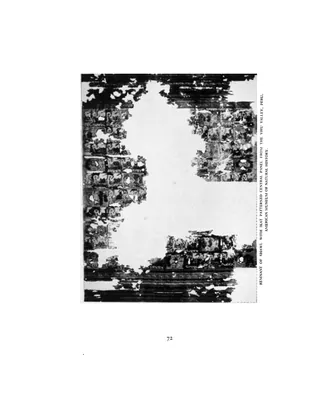
Junius Bird describes a single pre-Spanish Peruvian ikat textile from the Huaca de la Cruz in the Viru Valley, held by the American Museum of Natural History. He covers its size, construction in five sewn strips, cotton yarn and paired warps, and the warp-ikat pattern of human and bird figures. He analyzes the weaver's miscalculations in the warp counts and the later painted dye, and concludes that ikat was probably not a traditional technique in northern Peru. The article ends with a list of published references to ancient Peruvian ikats, and includes a photograph, pattern-row details and a diagram of the dyed figures.
Two Guatemalan Wedding Huipils
Article · 11 pages
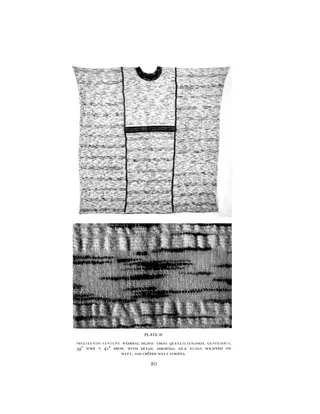
Junius Bird examines two 19th-century wedding huipils from Quetzaltenango, Guatemala, from the Elsie McDougall collection, shown at the American Museum of Natural History for the Needle and Bobbin Club. The first is a sheer cotton plain-weave huipil with creped weft stripes, silk floss wrapped on the weft, Purpura shellfish-dyed purple cable-twist yarn, and twill stripes. The second is a brocaded cotton huipil with white and purple brocading. Bird compares these techniques (creped stripes, wrapped fibers, twill, brocading) with Peruvian and Maya evidence, including Cupisnique and Paracas textiles. Illustrated with plates; no weaving drafts.