Textile Documents › Authors › Author: Otis Tufton Mason
9 documents found
Sort: 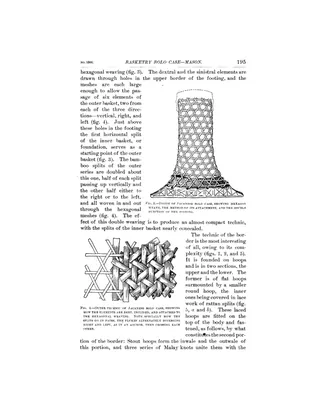
Basketry Bolo Case from Basilan Island
Article · 4 pages
Otis T. Mason describes a basketry bolo (toilet or knife) case of the Jacanes (Yacanes) of Basilan Island in the Philippines, held in the U.S. National Museum. He covers its structural parts: a carved wooden footing and bottom, a body of bamboo splits woven in four directions over a hexagonal foundation, a complex hooped border with rattan lace work and Malay knots, and rattan carrying strips. He also describes the Malay knot and the decoration by carving, staining and smoking. Illustrated with photographs and line drawings of the case, its weave and its border.
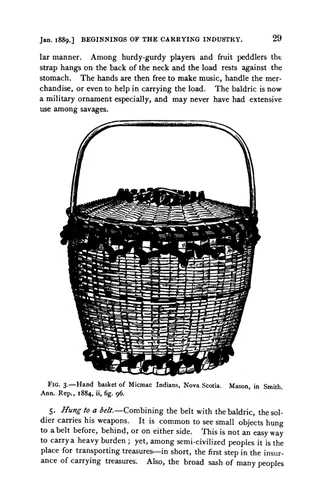
Beginnings of the Carrying Industry
Article · 26 pages
Otis T. Mason's 1889 essay in American Anthropologist surveys the origins of human burden-carrying as the starting point of transport and commerce, using the railway as a modern analogy. It catalogs the methods of bearing loads on the human body (hand, arm, shoulder, back, head, forehead, pockets) and goes on to combined effort, hauling, tossing, caravans, trails, couriers and professional carriers, drawing on ethnographic examples. Basketry and carrying devices appear in the illustrations (Hupa cradle, Ute seed basket, Micmac hand basket, Aleutian twined wallet, Zuni head pad, Gallinomero burden basket). The scan ends with two short unrelated notes.
Hudson Collection of Basketry
Article · 8 pages
Otis T. Mason describes the Hudson collection of Pomo basketry from the Russian River region of California, acquired by the U.S. National Museum in 1899. He tabulates the plants, minerals and animal materials used, with scientific and Pomo names, and explains their preparation, colors and trade values in shell and magnetite money. He then classifies the baskets into twined and coiled types, giving Pomo names and technical descriptions of each. He closes with notes on ornamentation, including feather-work and the symbolic meaning of patterns.
Hudson Collection of Basketry
Article · 8 pages
Otis T. Mason describes the Hudson collection of Pomo basketry from the Russian River region of California, acquired by the U.S. National Museum in 1899 from Dr. J. W. Hudson. The article lists the plants, minerals, and animal materials used, with Pomo names and the parts used. It then classifies the baskets into twined and coiled weaving types, with Pomo terms for each. It closes with notes on ornamentation, feather and shell decoration, and the meanings of patterns.
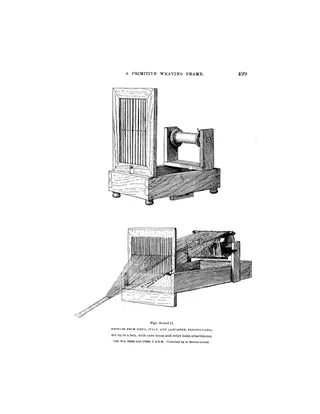
A Primitive Frame for Weaving Narrow Fabrics
Monograph · 35 pages
Otis T. Mason's 1901 Smithsonian monograph (reprinted from the Report of the U.S. National Museum) surveys the heddle frame, a hand-held or stationary device that forms the sheds when weaving narrow belts, garters and tapes. It describes specimens in the museum collection from the Chippewa, Masquakie and Pueblo/Zuni peoples, Finland, Germany, Italy, and New England and Pennsylvania. It also covers a patented hand-weaving apparatus and Pueblo battens. Each type is described with dimensions, materials, catalog numbers and method of use, and illustrated with line drawings and nine plates. It argues that the Native American frames derived from European settlers' folk craft.
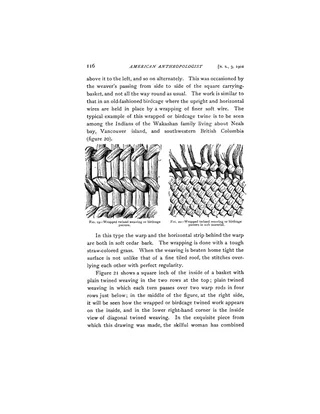
Technic of Aboriginal American Basketry
Article · 20 pages
Otis T. Mason's 1901 article classifies the technical methods of Native American basketry into woven (plicated) and coiled types. Woven types covered are checkerwork, diagonal or twilled work, wickerwork, and twined work, the last with plain, diagonal, wrapped (birdcage), lattice (tee), and three-ply varieties. Coiled types are classed by foundation: single-rod, two-rod, rod and welt, three-rod, splint (including the imbricated Klikitat style), and grass or shred. Forty numbered figures illustrate the structures, with examples from the Pomo, Hopi, Tlingit, Aleut, Nez Percé, Thompson River and other peoples. Decoration is explicitly left for a later paper.
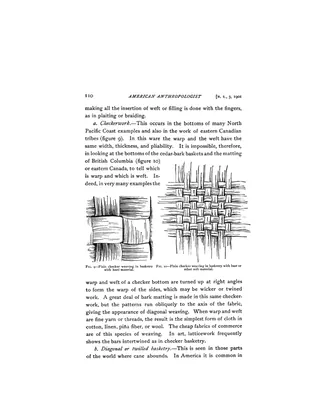
Technic of Aboriginal American Basketry
Article · 20 pages
Otis T. Mason's 1901 article classifies Native American basketry by technique. It covers woven basketry (checkerwork, diagonal or twilled, wickerwork, and several forms of twined weaving, including plain, diagonal, wrapped, lattice or tee, and three-ply) and coiled basketry (single-rod, two-rod, rod and welt, three-rod, splint, and grass or shred foundations, plus the imbricated Klikitat technique). Forty line drawings and photographic figures illustrate the structures, with examples from the Pomo, Hopi, Tlingit, Aleut, Nez Percé, Thompson River, and other peoples. Ornamentation and geographic distribution are deferred to a later paper.
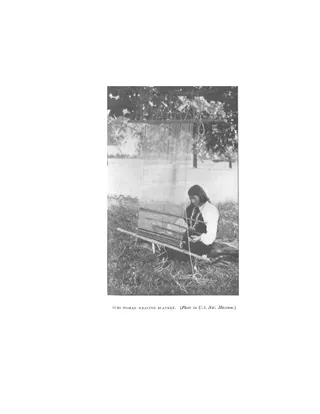
"The Textile Industry" in The Origins of Invention: A Study of Industry Among Primitive Peoples
Monograph · 36 pages
Chapter VII of Otis T. Mason's The Origins of Invention (pp. 224-257 of the London/New York 1901 edition) surveys textile arts among so-called primitive peoples. It covers bark cloth and tapa, woven, twined and coiled basketry, matting, spinning and cordage, simple looms and heddles, netting, loopwork, sewing, feather work, embroidery, decoration and dyeing. Examples are drawn from Polynesia, Africa, the Americas and Asia, with illustrations of basketry weaves and a Zuni woman weaving a blanket.
"The Weaver" in Woman's Share in Primitive Culture
Monograph · 31 pages
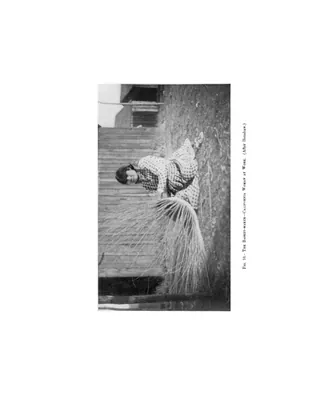
Chapter III of Otis T. Mason's Woman's Share in Primitive Culture (pp. 41-69), surveying textile arts practiced by women in non-industrial societies. It covers basketry types (plaited, wicker, twined, coiled), hand weaving without a frame, bark cloth, spinning and twisting fibers, simple looms and heddles, feather work, natural dyes and mordants, and netting and knots. Examples come from Native North America (Navajo, Hupa, Ute, Moki, Panamint), Polynesia, Africa, and South America, with illustrations of baskets, a Mohave cradle, a Navajo loom, and pottery impressions of twined weaving.
9 documents found